Retention Is Recruitment: Every Foster Carer You Lose Creates Another Recruitment Target - Some New Solutions?
Foster carer recruitment and foster carer retention are often treated as two separate areas of responsibility.
Recruitment teams are expected to generate enquiries, arrange initial visits, secure applications and help create a pipeline of new foster carers.
Operational teams are responsible for supporting approved carers, maintaining placements and managing the day-to-day realities of fostering.
The reporting structures may be different.
The budgets may be different.
The meetings may be different.
But the outcome is inseparable.
Every experienced foster carer who leaves the service creates another household that recruitment must replace.
And replacing an experienced foster carer is not the same as simply approving one new household.
A new approval does not automatically replace what has been lost
A foster carer who has been with a service for several years may have developed considerable experience.
They may be able to care for:
- sibling groups;
- older children;
- children with complex needs;
- emergency placements;
- parent and child placements;
- or children who have experienced several previous disruptions.
They understand the realities of fostering.
They have completed training.
They know the organisation.
They may have built strong relationships with social workers, schools, health professionals and other foster carers.
A newly approved household may have significant potential, but it will still require time, support and experience before it can provide the same level of placement capacity.
This means that losing one established fostering household may require more than one new approval to replace what the service has actually lost.
Yet retention is frequently discussed separately from recruitment performance.
Recruitment may report that ten new households have been approved.
That sounds positive.
But if eight experienced households have resigned during the same period, what has the service genuinely gained?
The headline recruitment figure may be encouraging while the overall capacity of the service remains largely unchanged—or becomes weaker.
The real measure is net growth
Senior fostering leaders need to look beyond the number of new approvals.
The more important measure is:
How many fostering households did the service gain after losses are taken into account?
If a service begins the year with 100 fostering households, approves 12 new households and loses 10 existing ones, it has not grown by 12.
It has grown by two.
Even that figure may not show the full picture.
What types of placements could the carers who left provide?
What approvals do the new carers have?
How many available beds have genuinely been gained?
Are the newly approved households able to meet the needs of the children currently waiting?
Were the carers who resigned active, experienced and highly utilised?
The numerical difference between recruitment and resignation matters, but so does the difference in capability.
A service can increase its number of approved households while reducing the breadth of placements it can realistically offer.
Retention failures increase recruitment pressure
When carers leave, the usual organisational response is often to increase the recruitment target.
More enquiries are required.
More advertising is commissioned.
More events are arranged.
More pressure is placed on recruitment staff to generate applications.
But if the reasons carers are leaving are not addressed, the service is effectively trying to refill a container that continues to leak.
Recruitment works harder to replace capacity that should not necessarily have been lost.
This is expensive.
It is also demoralising.
Recruitment teams may be told that they are not delivering enough growth, even though a significant proportion of their work is replacing carers who have resigned elsewhere in the service.
Approved carers may also notice the contradiction.
They see considerable effort being invested in attracting new people while existing carers feel that their own concerns are not being heard.
That can create a damaging message:
New foster carers are being pursued while experienced foster carers are being taken for granted.
Why do foster carers leave?
Some departures are inevitable.
Carers retire.
Their health changes.
They move out of the area.
Their family circumstances alter.
They may decide that fostering is no longer right for them.
No retention strategy will prevent every resignation, nor should it attempt to.
But many carers leave after a period of growing dissatisfaction rather than because of one isolated event.
The final resignation may appear sudden to the service.
For the foster carer, it may be the end of a much longer process.
They may have experienced:
- inconsistent support;
- frequent changes of supervising social worker;
- poor communication;
- insufficient respite;
- uncertainty about payments and allowances;
- a lack of recognition;
- repeated placement pressure;
- delays in resolving practical issues;
- inadequate support during allegations or complaints;
- difficult placement endings;
- or the feeling that decisions are being made about them rather than with them.
Individually, each incident may appear manageable.
Together, they can gradually damage the carer’s trust in the organisation.
By the time the resignation is received, the opportunity to retain them may already have passed.
Carers do not usually leave only because of money
Fees and allowances matter.
Foster carers need financial security, particularly where fostering limits their ability to undertake other employment.
Payments should be clear, fair and reliable.
But retention cannot be reduced to money alone.
A service may increase its fees and still lose carers if they feel unsupported, disrespected or unheard.
Carers often remain with an organisation because of relationships.
They stay because they trust their supervising social worker.
They feel understood by the duty team.
They believe managers will respond when something goes wrong.
They have confidence that the service will stand alongside them through difficult periods.
They feel connected to other carers.
They believe their experience is valued.
A competitive financial package may attract attention.
The quality of the relationship often determines whether carers remain.
What happens when a supervising social worker leaves?
For many foster carers, the supervising social worker is the organisation.
They are the person who understands the household, the children, the family dynamics and the pressures of each placement.
A strong supervising social worker can build years of trust.
When that worker leaves, the service may view the issue primarily as a staffing vacancy.
For the foster carer, it can feel like the loss of their main professional relationship.
They may have to explain their history again.
They may receive temporary support from several different people.
Reviews, training discussions and practical requests may be delayed.
The replacement worker may bring a different style, different expectations and a different interpretation of policies.
If the transition is not managed carefully, the carer can begin to feel disconnected from the service.
In some cases, experienced workers move to another fostering provider and carers consider following them.
It would be easy to frame that as disloyalty.
A better leadership question is:
What was the carer losing when that member of staff left, and what did we do to preserve the relationship with the organisation?
Staff retention and foster carer retention are closely connected.
A service cannot consistently provide stable support to foster carers while experiencing continual instability within its own workforce.
Placement endings are critical retention moments
The period after a placement ends can determine whether a carer continues fostering.
Some endings are positive and planned.
Others may be sudden, distressing or emotionally complex.
A child may return home, move to another placement, enter residential care or transition to independence.
The foster carer may be dealing with grief, relief, guilt, exhaustion or concern about what happens next.
Yet the organisational focus can quickly move to the vacant bed.
The carer may receive an immediate call about another child before they have had time to process the previous placement.
From a placement perspective, this may appear efficient.
From the carer’s perspective, it can feel as though the child who has just left—and the work they have invested—has already been forgotten.
A good retention approach recognises placement endings as significant events.
It asks:
How is the carer feeling?
What went well?
What was difficult?
What support do they need?
Do they require a period of rest?
Has the placement changed the type of fostering they feel able to offer?
What would need to be different next time?
These conversations are not simply welfare checks.
They are part of sustaining the future fostering capacity of the service.
Support during allegations can define the entire relationship
Allegations and complaints are an unavoidable possibility within fostering.
Children must be listened to and safeguarding concerns must be investigated properly.
That is not negotiable.
But the foster carer’s experience of the process can have a lasting effect on whether they remain.
Carers may understand the need for an investigation while still feeling frightened, isolated and uncertain.
They may worry about their reputation, income, family and future as foster carers.
Communication may become restricted or highly procedural.
The organisation that previously described them as a valued part of the team can suddenly feel distant.
How a service supports carers during these periods sends a powerful message—not only to the household involved, but to the wider carer community.
Other carers hear what happened.
They notice whether the family was supported.
They consider how they would be treated in the same circumstances.
A poorly handled allegation process can therefore become a wider retention issue.
A fair and supportive approach does not compromise safeguarding.
It demonstrates that the service can protect children while treating foster carers with dignity and procedural fairness.
Do carers feel able to say no?
Retention is also influenced by placement pressure.
Foster carers may feel encouraged to accept placements that do not match their approval, household circumstances or current capacity.
They may be told that the need is urgent.
They may understand the pressure on children’s services and genuinely want to help.
But repeated requests can make it difficult to decline.
If a carer feels that saying no will affect how they are viewed, how often they are contacted or whether they are considered committed, they may accept a placement that is not sustainable.
A poor match can then lead to stress, disruption and ultimately resignation.
A service that respects a considered “no” may retain the carer for a more appropriate placement later.
A service that applies too much pressure may fill one urgent vacancy while losing the household completely.
Retention requires carers to feel that professional matching decisions are respected—even when the immediate answer is not the one the service hoped to receive.
Are foster carers heard before they resign?
Many organisations conduct exit interviews.
These can provide useful information.
But by the time the exit interview takes place, the carer has already decided to leave.
The more valuable question is whether the service has structured opportunities to understand dissatisfaction earlier.
Annual reviews alone may not be enough.
Carers may be reluctant to raise concerns formally, particularly if they believe doing so could affect placements or working relationships.
They may describe themselves as “fine” while gradually becoming disengaged.
Warning signs may include:
- reduced willingness to accept placements;
- declining training participation;
- repeated concerns about communication;
- frustration about unresolved issues;
- withdrawal from support groups;
- increased interest in transfer arrangements;
- or comments suggesting they no longer feel valued.
These signs should not automatically be interpreted as a lack of commitment.
They may indicate that the relationship requires attention.
Senior leaders need mechanisms that allow carers to speak honestly before frustration becomes resignation.
Retention should not begin when somebody threatens to leave
Some services become highly responsive when a resignation is submitted.
Senior managers make contact.
Meetings are arranged.
Outstanding issues are reviewed.
Promises are made.
The carer may reasonably ask why this level of attention was unavailable earlier.
Last-minute retention efforts can feel reactive and transactional.
They may also reinforce the belief that concerns only become important when the organisation faces losing capacity.
Effective retention is built into the ordinary experience of fostering.
It is present in communication, support, supervision, recognition, matching, respite and leadership visibility.
It does not begin with the resignation letter.
Existing carers are also recruiters
Foster carers talk to other people.
They speak to friends, relatives, colleagues, neighbours and members of their local communities.
Their lived experience shapes how others perceive fostering.
A well-supported carer can become one of the most credible advocates a service has.
They can explain the realities honestly while still communicating that the organisation provides meaningful support.
They may encourage someone else to make an enquiry.
They may participate in events.
They may share recruitment content.
They may reassure prospective carers who have concerns.
But a dissatisfied carer can have the opposite effect.
They do not need to make a public complaint.
A quiet conversation with a friend may be enough:
“I love fostering, but I would not recommend doing it with my provider.”
That single sentence can undo the impact of an expensive recruitment campaign.
Retention therefore influences recruitment in two ways.
It preserves existing capacity.
It also affects whether current carers become advocates or warnings.
Retention is part of the recruitment proposition
Recruitment campaigns frequently describe the support available to foster carers.
Prospective applicants are told that they will not be alone.
They are promised supervision, training, advice, peer support and help when challenges arise.
Those promises are part of the recruitment proposition.
Retention reveals whether they are being delivered.
If current carers do not recognise the support described in recruitment materials, the proposition lacks credibility.
Senior leaders should therefore test recruitment messages against operational reality.
Can the service consistently deliver what it promises?
Do existing carers describe the organisation in the same way as the recruitment campaign?
Would they recommend the service?
Do they believe new carers receive an accurate picture of the support and pressures involved?
Recruitment and retention should not be communicating different versions of the organisation.
Retention requires leadership data
Senior leaders should be able to see more than the annual number of resignations.
They need to understand:
How many carers are leaving?
At what stage of their fostering career are they leaving?
What types of approval and experience are being lost?
How many placements and available beds does that represent?
What reasons are recorded?
Are the same issues recurring?
Are particular teams, locations or management changes associated with higher losses?
How many carers transfer rather than leave fostering completely?
What happened in the six or twelve months before resignation?
And, critically:
Which departures might have been preventable?
Without this analysis, resignation becomes an accepted annual total rather than a source of organisational learning.
Recruitment targets should include retention assumptions
A recruitment plan that ignores expected losses is incomplete.
If a service wants to increase its fostering capacity by ten households but expects eight carers to resign or retire, the real approval requirement may be 18—not ten.
Even then, the calculation should reflect the type of capacity being lost and recruited.
This does not mean accepting attrition as unavoidable.
It means planning honestly while working to reduce preventable departures.
Recruitment and retention targets should be considered together.
Otherwise, leaders may celebrate gross approvals while missing the fact that net capacity is barely moving.
The leadership challenge
Foster carer recruitment will always be important.
Services need new households, different skills and greater placement choice.
But recruitment cannot compensate indefinitely for an organisation that struggles to retain the carers it already has.
The answer to every capacity problem cannot simply be:
Recruit more carers.
Sometimes the right response is:
Support existing carers more effectively.
Retain experienced staff.
Improve respite.
Review placement matching.
Respond to concerns earlier.
Manage allegations fairly.
Recognise the emotional impact of placement endings.
Treat carers as long-term partners rather than an available resource.
Every foster carer retained protects capacity that recruitment does not then have to replace.
Every positive carer experience strengthens the reputation from which future recruitment grows.
Every experienced household that remains gives children greater choice, stability and support.
Retention is not a separate issue sitting alongside foster carer recruitment.
Retention is recruitment.
And the most important recruitment target may sometimes be the foster carers you already have.
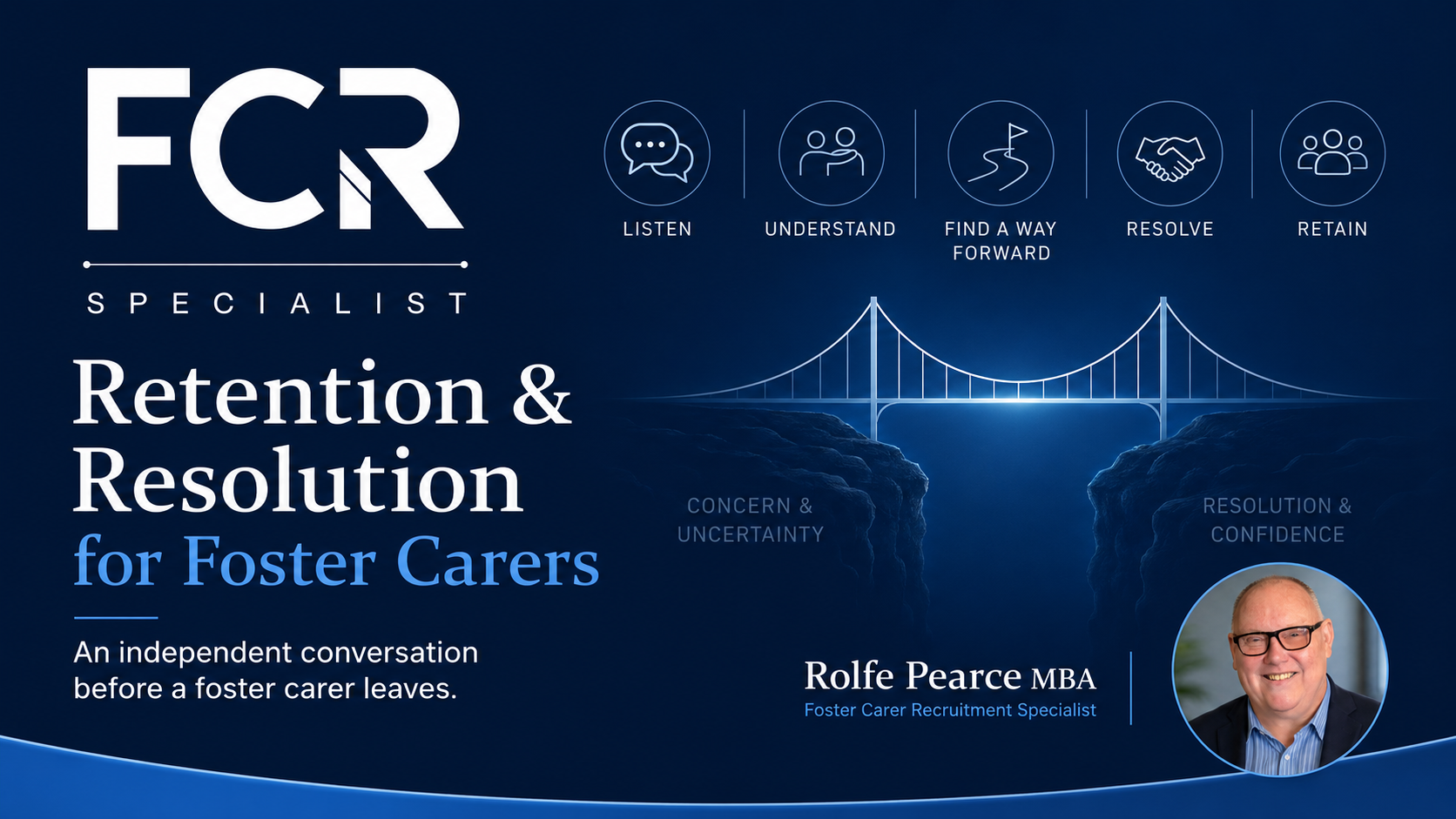
Would an independent conversation help before the carer leaves?
When a foster carer indicates that they may resign, the next conversation is often conducted by someone within the same service.
That manager may be experienced, supportive and genuinely committed to resolving the situation.
But they are still part of the organisation the foster carer is considering leaving.
The carer may worry about speaking completely openly.
They may believe that previous concerns were minimised.
They may feel that the service has already formed a view about them.
They may not want to damage relationships with staff who continue to support their household or the children in placement.
In some situations, an independent external conversation could help.
An Independent Foster Carer Retention and Resolution Service would give the foster carer an opportunity to explain:
- what has happened;
- how long the concerns have been developing;
- what attempts have already been made to resolve them;
- what would need to change for them to remain;
- and whether trust in the relationship can realistically be rebuilt.
The purpose should not be to pressure someone into staying.
A foster carer who has made a considered decision to retire or leave should have that decision respected.
The purpose is to identify whether a potentially preventable resignation is being driven by issues that could still be resolved.
The immediate trigger may be a disagreement about one placement, one payment or one member of staff.
But an independent conversation may reveal a longer pattern involving communication, support, respite, matching, recognition or unresolved concerns.
Unless that wider history is understood, the provider may attempt to solve the final incident while missing the reason the relationship has broken down.
From listening to resolution
Where the foster carer gives permission, the independent service could help both parties clarify the issues and identify possible actions.
That might include:
- facilitating a structured discussion between the carer and the provider;
- separating immediate concerns from longer-term relationship issues;
- agreeing which matters require a practical remedy;
- clarifying misunderstandings or conflicting expectations;
- developing a written retention plan;
- identifying additional support, respite or management involvement;
- agreeing communication arrangements;
- and reviewing progress after 30, 60 or 90 days.
The external person would not replace safeguarding procedures, formal complaints processes, legal representation or the provider’s management responsibilities.
Their role would be to create a neutral space in which concerns can be heard properly and realistic solutions explored before the relationship becomes irretrievable.
There will be occasions when the issues cannot be resolved.
The foster carer may still decide to leave.
But even then, the service can help ensure that the departure is handled respectfully and that the organisation learns from it.
Independent exit interviews should form part of the service
Exit interviews are frequently conducted internally.
That can limit what departing foster carers are prepared to say.
Some may soften their feedback because they still have relationships within the service.
Some may believe that being completely honest will make no difference.
Others may have lost confidence in the organisation’s willingness to listen.
An independently conducted exit interview may produce a clearer account of:
- why the foster carer began considering resignation;
- what the service knew and when;
- whether opportunities to intervene were missed;
- which problems were isolated and which were systemic;
- whether the carer is leaving fostering entirely or transferring elsewhere;
- what could have been done differently;
- and whether the experience may affect what they say about the provider to others.
The provider should receive an anonymised thematic report identifying recurring issues, organisational risks and practical recommendations.
Individual information should only be shared according to the confidentiality and consent arrangements agreed with the foster carer.
This would allow the organisation to move beyond recording:
“Carer resigned.”
It could begin to understand:
“What caused the relationship to deteriorate, could the resignation have been prevented, and what must we change to avoid repeating it?”
Independence must be credible
For an external retention and resolution service to work, foster carers must believe that the person listening to them is not simply representing the provider.
The service would therefore need clear principles:
The foster carer must be able to speak confidentially.
Information should only be shared with informed consent, except where safeguarding or legal duties require otherwise.
The external adviser should not be paid according to how many carers are persuaded to remain.
The provider should not control the conclusions of an independent exit review.
The adviser should be able to identify failings by the provider as well as misunderstandings or relationship difficulties.
The foster carer must remain free to leave.
The measure of success should not simply be the number of resignations stopped.
Success may also include a better-managed departure, an issue resolved before it affects other carers, improved organisational practice or a foster carer leaving with their dignity and contribution properly recognised.
A practical retention intervention
Providers invest significant resources in finding, assessing and approving foster carers.
Yet when an experienced carer begins to disengage, there is rarely an equivalent independent intervention designed to understand whether the relationship can be repaired.
An Independent Foster Carer Retention and Resolution Service could provide that intervention.
Not as a last-minute attempt to talk someone out of resigning.
But as a credible opportunity to listen, identify the real issues, negotiate practical change where possible and help both sides reach an informed outcome.
Sometimes the carer will still leave.
Sometimes the relationship may be recoverable.
But without an honest and independent conversation, the service may never know whether an experienced foster carer was genuinely ready to stop—or simply needed the organisation to listen and respond differently.