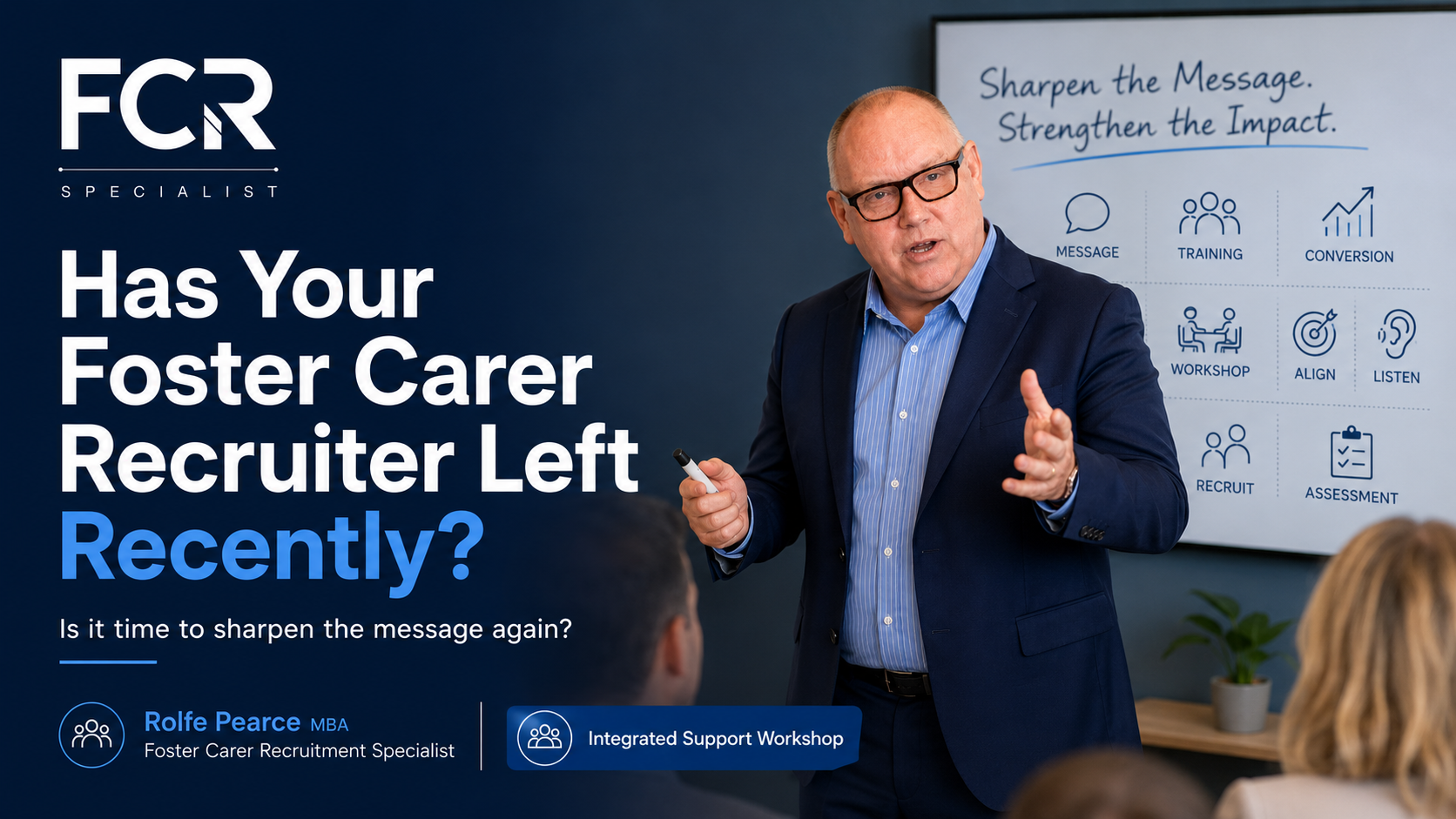
Has Your Foster Carer Recruiter Left Recently? What Happened to the Recruitment Message They Left Behind?
When an experienced foster carer recruiter leaves a service, the immediate concern is usually operational.
Who will respond to the enquiries?
Who will run the information events?
Who will complete the initial visits?
Who will update the database and keep applicants moving?
The vacancy is filled, responsibilities are redistributed and recruitment activity continues.
But a more important question can be missed:
Who has trained the person now delivering your foster carer recruitment?
Not simply how to use the system.
Not merely which form needs completing.
Not only where the information packs are stored or how an enquiry is recorded.
Who has trained them to have the right conversation with a prospective foster carer?
Who has explained the organisation’s recruitment proposition?
Who has shown them what the service wants prospective carers to understand, feel and do after each interaction?
And who is checking that the agreed message is still being delivered?
When knowledge leaves with the recruiter
In many fostering services, a large amount of recruitment knowledge sits with one or two experienced people.
They know how to speak to nervous enquirers.
They understand which questions need careful handling.
They know how to explain finances, assessment, working while fostering and the impact on the wider household.
They recognise when someone needs reassurance rather than another form.
They understand the local competition and can explain why a prospective carer should choose their service.
But much of that knowledge may never have been properly documented.
When the recruiter leaves, the organisation does not only lose a member of staff.
It can lose:
- the established tone of the initial conversation;
- knowledge of common applicant concerns;
- the reasoning behind the enquiry process;
- local recruitment intelligence;
- relationships with community contacts;
- understanding of previous campaigns;
- and the practical experience of converting interest into progression.
The replacement recruiter may inherit the tasks without inheriting the recruitment strategy.
How is the new recruiter trained?
Too often, training is informal.
A colleague explains what normally happens.
The new recruiter listens to a few calls.
They are shown the form.
They are given the current information pack.
They may sit in on an information event or initial visit.
Then they begin handling enquiries themselves.
This is where the hearsay mentality can develop.
The process is explained through phrases such as:
“This is how we normally do it.”
“I was told we need to ask this.”
“We have always sent that form.”
“Assessment prefers us to deal with it this way.”
“Marketing usually puts something out on Facebook.”
Over time, the original reason for the process can disappear.
One employee teaches the next employee.
Custom and practice gradually replace the intended recruitment model.
The service remains busy, but nobody is certain whether the activity still reflects the agreed strategy.
What is your recruitment message?
This sounds like a simple question.
In practice, many services would struggle to provide one clear answer.
Is the message:
We provide outstanding support?
We are local and understand your community?
We specialise in therapeutic fostering?
We offer better financial support?
We welcome working applicants?
We need carers for older children and sibling groups?
We offer a more personal experience than larger providers?
All of these may be valid.
But has the message been clearly defined?
Does the recruitment team understand it?
Does marketing communicate it?
Does the website support it?
Does the person answering the telephone reinforce it?
Does the information event bring it to life?
Does the initial visit reflect it?
And does the applicant continue to experience it when they move into assessment?
A recruitment proposition cannot exist only in a strategy document or on a presentation slide.
It has to be heard and felt throughout the applicant journey.
Message drift weakens recruitment
Even when a clear message was originally agreed, it can weaken over time.
A new recruiter introduces their own way of explaining fostering.
A marketing agency creates campaign wording without fully understanding the operational offer.
Assessment staff provide a different interpretation of suitability or timescales.
Managers add new priorities.
Information packs remain unchanged while the service itself evolves.
Eventually, prospective foster carers receive several slightly different versions of the organisation.
The advertisement says one thing.
The website says another.
The person on the telephone emphasises something else.
The information event focuses heavily on process.
The initial visit introduces concerns that were not previously mentioned.
Assessment then changes the tone again.
The applicant experiences inconsistency.
The organisation may call this different teams doing different jobs.
The prospective foster carer may simply conclude that the service does not appear joined up.
Is form completion replacing recruitment?
When recruiters are under pressure, the enquiry process can become increasingly administrative.
The focus moves toward:
- completing mandatory fields;
- recording household information;
- checking bedrooms;
- confirming employment;
- issuing information packs;
- booking events;
- and updating the system.
These tasks matter.
But they are not the same as recruiting.
A completed form does not tell you whether the person felt listened to.
It does not tell you whether their concerns were addressed.
It does not show whether they understood why your service might be right for them.
It does not measure whether the conversation increased or reduced their confidence.
A recruiter can complete every administrative step correctly while the prospective foster carer quietly decides not to continue.
The report then shows that the enquiry was processed.
The pipeline shows another person who did not progress.
The organisation may decide that the enquiry was poor quality.
But was the recruitment conversation of sufficient quality?
Lots of activity, poor conversion
This is where senior leaders can receive a misleading picture.
The recruitment team appears extremely busy.
Calls are being made.
Information events are taking place.
Social media content is being published.
Community events are attended.
Information packs are distributed.
Initial visits are arranged.
The monthly report contains plenty of activity.
But the number of applications remains disappointing.
The number entering assessment is lower than expected.
Approvals do not justify the volume of enquiries generated.
The response is often to increase the activity.
Run more campaigns.
Attend more events.
Generate more leads.
Spend more on advertising.
But greater activity will not solve a weakened recruitment message or an inconsistent applicant experience.
It may simply place more people into a process that is not converting effectively.
Before increasing activity, leaders should ask:
Are we saying the right things?
Are we saying them consistently?
Do staff understand the purpose of each stage?
Are we listening to prospective carers or processing them?
Do recruitment, marketing and assessment share the same expectations?
Does the team understand why people withdraw?
Are staff confident enough to handle difficult questions?
Is our recruitment proposition genuinely distinctive?
Recruitment training should go beyond induction
A recruiter may have worked in fostering for years without receiving specialist recruitment development.
They may have been trained thoroughly in safeguarding, data protection, eligibility and internal procedures.
But have they been trained in:
- consultative questioning;
- active listening;
- explaining complex information clearly;
- handling hesitation without becoming pushy;
- identifying the real reason behind an objection;
- building trust during the first conversation;
- differentiating the provider without criticising competitors;
- maintaining contact with the “not yet” audience;
- and agreeing a clear next step?
These are recruitment skills.
They should not be assumed simply because someone is experienced in fostering, social care, marketing or administration.
Equally, commercial recruitment techniques cannot simply be imposed without understanding the sensitivity and safeguarding responsibilities involved in fostering.
The role requires a specific blend of human, operational and recruitment capability.
The team may need alignment, not criticism
When conversion is weak, it is easy to assume that somebody is underperforming.
That may not be the case.
Staff may be working extremely hard within a process they inherited.
They may have received conflicting instructions.
They may be trying to meet activity targets while responding to large volumes of enquiries.
They may not have been given the opportunity to step back and examine the complete applicant journey.
A supportive review should not begin by asking:
“Who is getting this wrong?”
It should ask:
“What are we trying to achieve, what message should applicants receive, and what support does the team need to deliver it consistently?”
That creates a very different conversation.
An integrated Foster Carer Recruitment Workshop
This is where a focused, external workshop could make a practical difference.
Not a generic training day.
Not a presentation about the national shortage of foster carers.
Not an audit conducted at the team from a distance.
A structured working session involving the people who influence the applicant experience.
That could include:
- foster carer recruitment staff;
- marketing and communications colleagues;
- assessment representatives;
- operational managers;
- and, where appropriate, experienced foster carers.
The purpose would be to examine the real recruitment journey and sharpen the service’s message together.
What should the workshop explore?
The session should begin with the organisation’s recruitment proposition.
Why should someone foster with this service?
What can the provider genuinely offer?
Which applicants is it trying to reach?
Which children and placement types are creating the greatest need?
What does the service want a prospective carer to understand after the first conversation?
The team could then review each stage:
The advertisement
Does it attract the right people and set realistic expectations?
The website
Does it answer real questions, or rely on generic fostering language?
The initial response
Is it timely, welcoming and conversational—or dominated by form completion?
The information event
Does it build confidence, or overwhelm people with process and warnings?
The initial visit
Does it continue the recruitment relationship while beginning a realistic exploration of suitability?
The handover to assessment
Is the message preserved, or does the applicant experience an abrupt change?
The “not yet” response
Are people nurtured for the future, or dismissed because they are not ready immediately?
Withdrawals
Are the reasons properly understood and used to improve the process?
The output should be practical
A good workshop should not end with a collection of interesting ideas that disappear once everyone returns to their normal workload.
It should produce usable outcomes, such as:
- a clear recruitment proposition;
- agreed core messages;
- a structured initial conversation guide;
- plain-English explanations of common fostering questions;
- agreed language around assessment and timescales;
- a clearer handover between recruitment and assessment;
- a response plan for “not yet” enquirers;
- defined applicant journey standards;
- improved withdrawal categories;
- and a small number of conversion measures that leaders can monitor.
The objective is not to script every conversation.
It is to ensure that staff understand the message well enough to communicate it naturally and consistently.
Sharpening the message can improve the conversion
A provider may not need another complete recruitment strategy.
It may already have the right foundations.
The team may simply need time and external support to reconnect with the purpose of the process.
To remove the custom and practice that no longer helps.
To identify where mixed messages have developed.
To build confidence in the people having the conversations.
To align recruitment, marketing and assessment.
And to ensure that all the activity being delivered has a clearer route toward progression and approval.
The leadership question is therefore not only:
“Has our foster carer recruiter left?”
It is:
“What knowledge, message and recruitment discipline left with them—and have we properly rebuilt it?”
Because when a service is generating plenty of activity but achieving poor conversion, the answer may not be another advertising campaign.
It may be time to bring the team together, sharpen the message and rebuild a consistent approach to foster carer recruitment.