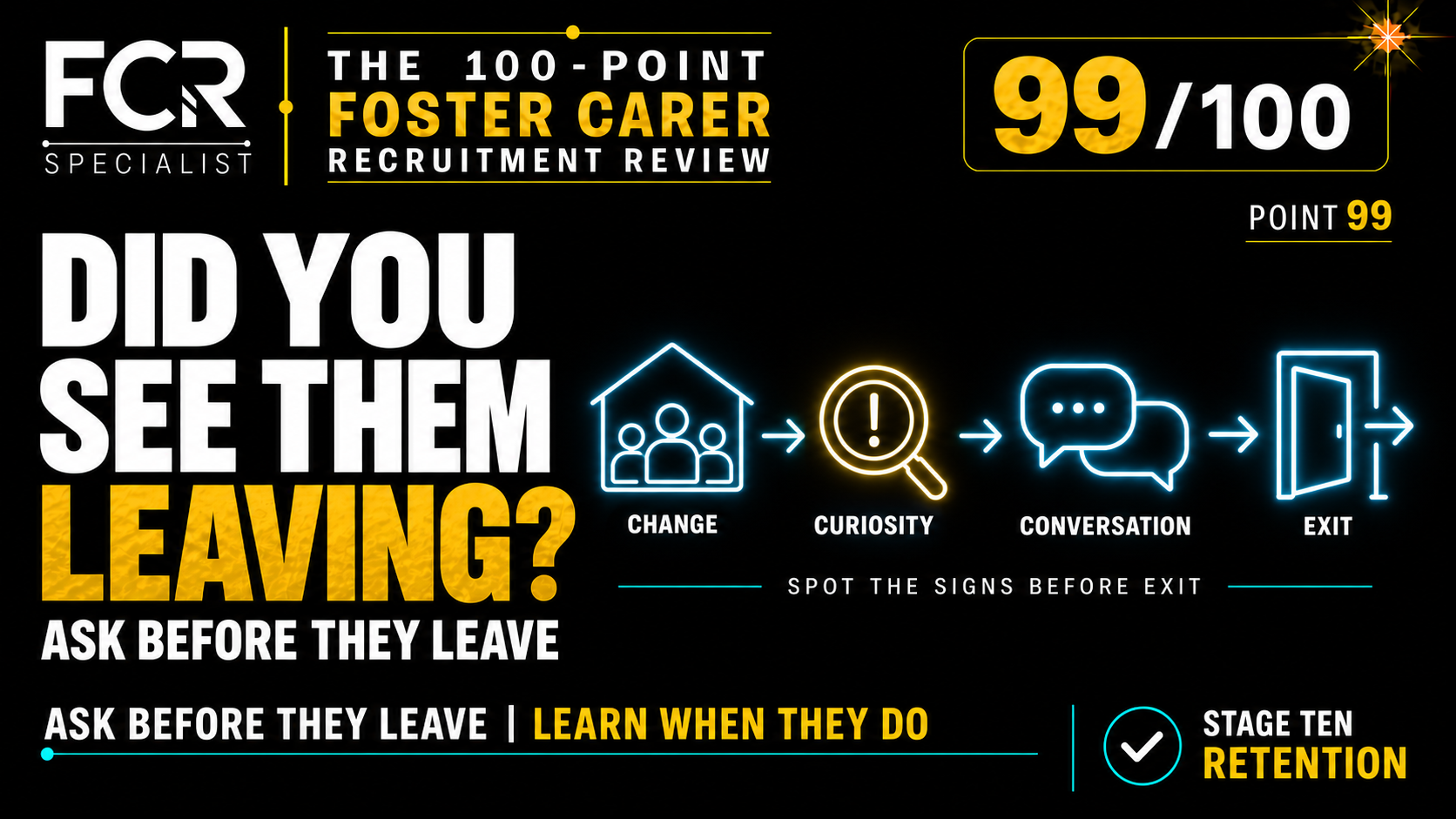
POINT 99/100 — DON’T WAIT FOR THE EXIT INTERVIEW: DID YOU SEE THEM LEAVING?
POINT 99/100 — DON’T WAIT FOR THE EXIT INTERVIEW: DID YOU SEE THEM LEAVING?
There is something slightly strange about the way organisations often approach retention.
A Foster Carer resigns.
Then everybody becomes interested in why.
A manager asks:
“What happened?”
An exit interview is arranged.
The deregistration reason is recorded.
A report goes to senior leadership.
Lessons may be identified.
All of that has value.
But by then:
THE FOSTER CARER HAS ALREADY DECIDED TO GO.
Which raises a much more useful retention question:
WHAT DID WE KNOW BEFORE THE RESIGNATION ARRIVED?
Because resignation is rarely the first sign that something has changed.
It is usually the clearest sign.
That is why Stage Ten has repeatedly returned to this principle:
RESIGNATION IS A LAGGING INDICATOR.
Point 99 asks whether fostering services are collecting enough leading retention intelligence before departure becomes inevitable.
Three in five had already thought about leaving
The Fostering Network’s State of the Nations’ Foster Care 2024 found that three in five Foster Carers surveyed had considered, or were considering, resigning from fostering.
The most commonly identified reasons included:
lack of support from their fostering service;
lack of respect from other professionals;
and burnout or poor wellbeing associated with fostering.
That is highly relevant to Point 99.
Because a Foster Carer does not necessarily move instantly from:
happy
to:
resigned.
There may be a long middle period.
They are still registered.
Still fostering.
Still attending meetings.
Still appearing on the dashboard as:
ACTIVE.
But their willingness to remain may already be deteriorating.
What might leaving look like before somebody actually leaves?
There is no validated Foster Carer “resignation prediction score”.
Nor should we invent one.
A Foster Carer who declines placements is not automatically unhappy.
Someone who stops attending a support group may simply be busy.
A complaint does not mean somebody intends to resign.
A change in communication style may have nothing to do with fostering.
So none of the following should be turned into:
“retention risk flags”
that label Foster Carers.
Instead, treat them as:
REASONS TO BECOME CURIOUS.
Possible signals might include:
reduced willingness to accept placements;
repeated unresolved concerns;
increasing frustration;
withdrawal from support groups;
repeated SSW changes;
difficulty accessing practical support;
a prolonged vacancy after previously being active;
narrowing availability;
declining engagement with training;
repeated complaints;
greater household strain;
or comments such as:
“There’s no point asking.”
Perhaps the most obvious one is:
“I don’t know how much longer we can do this.”
If somebody says that, believe that the sentence matters.
Do not wait for it to become a resignation letter.
The problem with annual snapshots
Many services already have formal mechanisms that can reveal some of this.
Supervision.
Annual reviews.
Support groups.
Training feedback.
Complaints.
Carer forums.
Surveys.
Management meetings.
The problem is not necessarily lack of contact.
It may be that information is fragmented.
One team knows the Foster Carer has complained.
Another knows they have declined three referrals.
Finance knows there have been repeated payment problems.
The SSW knows the household is tired.
Training knows attendance has fallen.
Recruitment knows they have stopped recommending friends.
Individually, none may seem particularly significant.
Together, they may tell a very different story.
THE FOSTER CARER EXPERIENCES THE WHOLE ORGANISATION.
THE ORGANISATION MAY EXPERIENCE THE FOSTER CARER IN DEPARTMENTS.
That is a management issue.
We already know recommendation is weakening
The 2024 State of the Nations survey found that less than half of Foster Carers said they would recommend fostering, down from just over half in 2021.
Point 100 will examine recommendation properly.
But for Point 99, recommendation can be useful as a retention signal.
If someone who once enthusiastically told friends:
“You should foster.”
now says:
“I wouldn’t recommend it,”
that should interest the service.
Not because every Foster Carer must become a recruitment ambassador.
They do not.
But because a change in willingness to recommend may tell us something about lived experience.
Ask:
WHAT CHANGED?
Stay conversations before exit interviews
This brings us back to Point 96.
I suggested stay conversations.
Point 99 makes them part of the retention intelligence system.
A stay conversation is not statutory guidance.
I am not presenting it as a validated fostering intervention.
It is simply a management proposition based on a straightforward idea:
ASK WHY PEOPLE STAY WHILE THEY ARE STILL STAYING.
Not:
“Are you going to resign?”
That may produce little useful information.
Instead ask:
What keeps you fostering?
What is getting harder?
What frustrates you most?
Is there anything you have stopped asking us for because you no longer expect it to happen?
What could realistically make you stop?
What could we change now?
Has your experience improved or worsened during the last year?
And perhaps:
“IF YOU WERE DECIDING WHETHER TO START FOSTERING WITH US TODAY, WOULD YOU STILL CHOOSE US?”
That last question may be uncomfortable.
Good.
It may also be very informative.
The Fostering Network already advocates exit interviews
Exit interviews themselves should not be dismissed.
The Fostering Network now explicitly recommends that fostering services offer all resigning Foster Carers an exit interview to inform service development and recruitment and retention strategies.
It has also developed a dedicated Foster Carer Exit Interview Toolkit.
The toolkit includes:
a guide for fostering services;
an exit interview discussion guide;
information for departing Foster Carers;
and a data collection tool intended to help services turn exit information into improvements in practice and retention.
That is exactly the right principle.
DON’T JUST COLLECT THE EXIT.
LEARN FROM IT.
But I would take it one stage further.
Do not rely on exit interviews as your first serious retention conversation.
Who conducts the exit interview matters
Suppose the Foster Carer says they are leaving because of:
their relationship with their SSW.
And then the SSW is asked:
“Why did they leave?”
Or suppose the problem involved a manager.
And the manager summarises the departure for senior leadership.
That doesn't mean the professional's account is inaccurate.
But it cannot be the only account.
This connects directly with Point 93.
When professional relationships deteriorate:
ONE VERSION SHOULD NOT BECOME ORGANISATIONAL FACT WITHOUT BEING TESTED.
So where the departure involves a relationship with:
the SSW;
a team manager;
or another professional,
consider whether the Foster Carer should be offered the opportunity to speak to someone sufficiently outside that immediate chain.
Perhaps:
another manager;
a senior manager;
an independent interviewer;
or a suitably separate person within the organisation.
The exact mechanism will depend on service size and structure.
The principle is more important than the model:
THE PERSON INVOLVED IN THE PROBLEM SHOULD NOT BE THE ONLY PERSON EXPLAINING THE PROBLEM.
Don’t let the organisation write the Foster Carer’s exit story without them
This gives us one of the strongest principles in Point 99:
DON’T LET THE ORGANISATION WRITE THE FOSTER CARER’S EXIT STORY WITHOUT THEM.
The Foster Carer may decline an exit interview.
That is their choice.
They may not want further contact.
They may prefer to move on.
But they should have a meaningful opportunity to provide their account.
Because otherwise the organisational record may become:
“Personal reasons.”
while the Foster Carer believes they left because:
support repeatedly failed;
payments were constantly wrong;
professional relationships broke down;
an allegation destroyed trust;
placements were repeatedly inappropriate;
they could not obtain breaks;
or they felt they were no longer valued.
Those distinctions matter.
“Personal reasons” can become a data graveyard
Ofsted itself has recently made deregistration coding more specific.
For the 2024–25 collection, the previous broad category “initiated by Foster Carer” was replaced with more specific codes including:
carer retirement;
personal carer circumstances;
and:
carer ceased fostering.
That is an improvement in national data structure.
But provider-level retention intelligence can go further.
Because:
personal circumstances
may genuinely mean:
health;
bereavement;
moving;
family change;
or retirement planning.
But it can also become a convenient catch-all.
The more useful question is:
WHAT WAS THE PRIMARY DRIVER?
And sometimes:
WHAT WERE THE CONTRIBUTING DRIVERS?
Because Foster Carer departure may have more than one cause.
One reason is often too simplistic
Take this example.
A Foster Carer resigns after a difficult placement ends.
The service codes:
placement breakdown.
But suppose the fuller sequence was:
three SSW changes;
no proper break;
an unresolved payment issue;
a complaint;
a partner becoming increasingly unhappy;
and then a difficult placement ending.
Which was the reason?
The placement ending may have been the final trigger.
But:
THE FINAL STRAW IS NOT NECESSARILY THE FIRST CAUSE.
So exit intelligence needs room for:
PRIMARY REASON
What most directly triggered the decision?
and:
CONTRIBUTING REASONS
What had been building?
That creates better data.
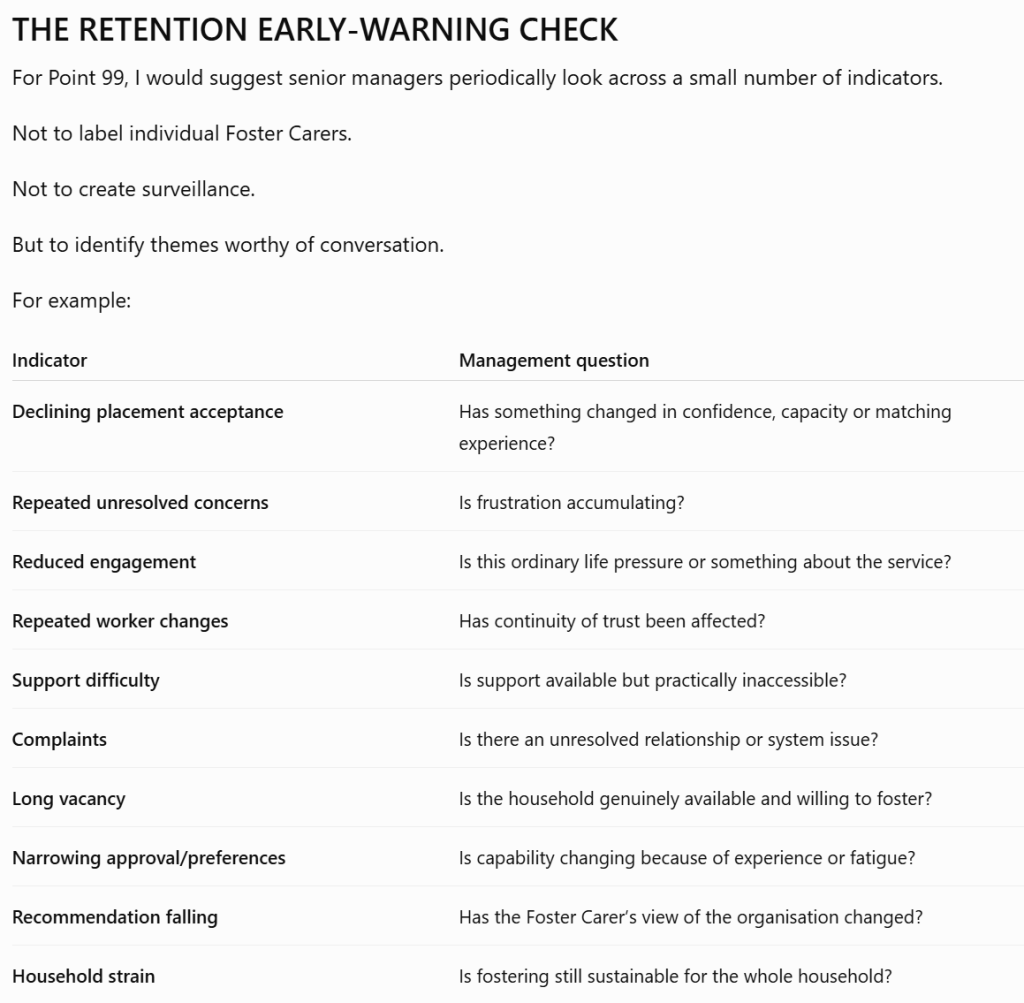
None predicts departure.
Together they tell managers:
ASK.
Then build the Stay → Exit intelligence pathway
A good retention system might therefore look like:
STAY CONVERSATION
while somebody is still actively fostering.
↓
EARLY INTERVENTION
where something manageable can be improved.
↓
RESIGNATION
if the Foster Carer ultimately decides to leave.
↓
EXIT INTERVIEW
giving the Foster Carer a genuine opportunity to explain.
↓
ROOT-CAUSE CODING
not just generic reasons.
↓
CAPABILITY LOSS
what exactly left with the household?
↓
ORGANISATIONAL LEARNING
what should change?
This makes retention intelligence useful rather than retrospective.
Capability needs to be part of every exit record
Point 98 asked:
Where did they go?
Point 99 adds:
WHAT DID WE LOSE?
Do not end an exit report with:
one household deregistered.
Record:
years of fostering;
approval range;
number of available places;
sibling capacity;
teenage capacity;
complex-needs experience;
local geography;
specialist knowledge;
short-break capability;
peer mentoring;
and whether they previously recommended the service to others.
Because a departure of:
one
may represent radically different sufficiency consequences.
What should senior leaders receive?
Imagine a quarterly report saying:
8 Foster Carers deregistered.
Useful?
A little.
Now compare it with:
8 deregistrations
3 planned retirements
1 health-related departure
2 transfers to other providers
2 ceased fostering following unresolved support/household issues
Then:
capability lost:
2 sibling households;
3 teenage placements;
47 cumulative years of fostering experience;
1 specialist parent-and-child household;
2 peer mentors.
And:
common avoidable themes:
support delays;
SSW continuity;
financial administration.
That is a retention report.
The first number is merely a count.
Learn without becoming defensive
Exit interviews will sometimes contain criticism that managers disagree with.
A Foster Carer may interpret events differently.
They may have been dissatisfied with a completely legitimate professional decision.
Their version is not automatically fact.
But that does not make it useless.
The question is:
WHAT DOES THEIR EXPERIENCE TELL US?
Perhaps management concludes:
“We would make the same decision again.”
Fine.
But could communication have been better?
Could expectations have been clearer?
Could support have been stronger?
Could the relationship have been repaired?
Could another Foster Carer experience the same thing?
Learning does not require agreeing with every criticism.
It requires curiosity.
Do not turn exit interviews into retention negotiations
By the time somebody reaches an exit interview, they may have decided firmly.
The interview should not become:
“How can we persuade you to stay?”
There may sometimes be a genuine opportunity to resolve something.
But an exit interview primarily needs to be safe enough for honest information.
If Foster Carers believe everything they say will immediately trigger:
argument;
defence;
or pressure,
the organisation may receive polite answers rather than useful ones.
Sometimes the most valuable outcome is simply:
“Thank you. We have heard you.”
Then act on the themes.
Close the feedback loop
Perhaps the biggest failure with exit interviews is not failing to conduct them.
It is conducting them and doing nothing visible with the results.
If five Foster Carers leave citing:
payment administration;
and nothing changes,
the sixth interview is not a learning system.
It is paperwork.
Senior leaders should periodically ask:
What are our top recurring exit themes?
Which are avoidable?
What have we changed because of them?
Did the change work?
Then share appropriate learning with Foster Carers.
Not confidential individual information.
But something like:
“You told us out-of-hours support was not working well enough. We changed X.”
That demonstrates:
YOUR EXPERIENCE CHANGED SOMETHING.
That can strengthen trust among the people who remain.
Current reform context
At 9 September 2026, the Department for Education consultation on revised fostering standards and guidance remains open and closes on 16 September 2026. The proposed revisions are not yet final current standards.
Whatever the final framework looks like, the retention principle in Point 99 remains relevant.
Better recruitment cannot compensate indefinitely for avoidable loss.
Services need to understand:
why people stay;
what changes before they leave;
why they finally leave;
and what capability disappears with them.
The management test for Point 99
Look at the last ten Foster Carers who left your service.
Ask:
When did we first know they were unhappy?
Did we know at all?
What signals existed before resignation?
Did anyone have a stay conversation?
Were their concerns resolved?
Who recorded why they left?
Did the Foster Carer get to provide their own version?
Was the exit reason specific enough to learn from?
What capability did we lose?
What changed afterwards?
And then perhaps the hardest question:
COULD WE HAVE SEEN THEM LEAVING?
Not every departure is preventable.
It never will be.
But if the first moment the organisation becomes seriously curious is the exit interview: