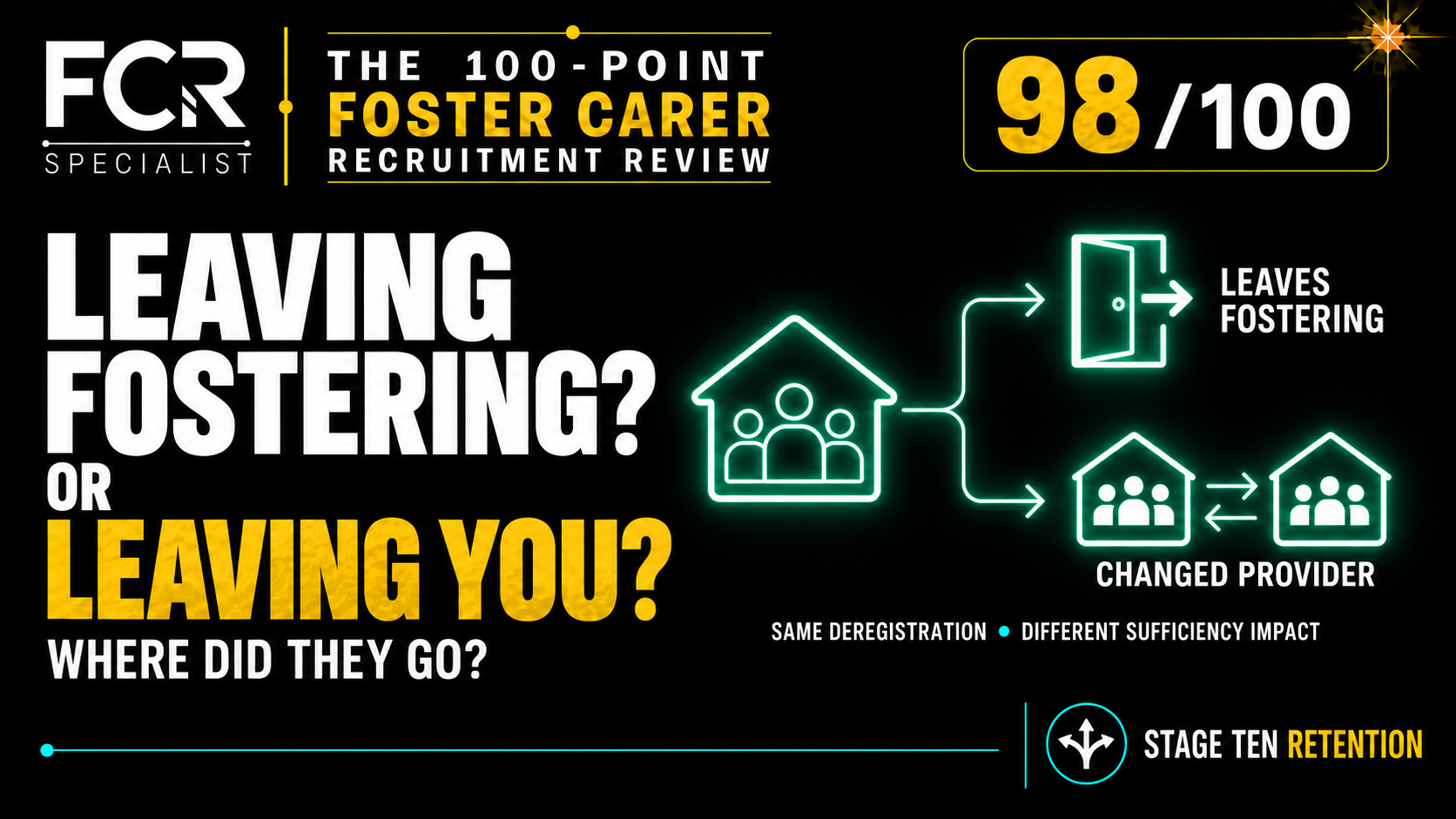
POINT 98/100 — ARE THEY LEAVING FOSTERING — OR LEAVING YOU?
POINT 98/100 — ARE THEY LEAVING FOSTERING — OR LEAVING YOU?
There is a number that appears in fostering dashboards everywhere:
DEREGISTRATIONS.
Perhaps:
12 this year.
The number rises.
Management asks:
“Why are Foster Carers leaving?”
But before asking why, I think we need to ask something even more basic:
WHERE DID THEY GO?
Because a Foster Carer who retires after 20 years and a Foster Carer who transfers to the organisation down the road are both technically:
deregistered.
But strategically they represent completely different events.
One may be an unavoidable departure from fostering.
The other may still be fostering children next month.
Just not with you.
That gives us the central question for Point 98:
ARE WE LOSING FOSTER CARERS FROM FOSTERING — OR LOSING THEM FROM OUR ORGANISATION?
The national statistics contain an important warning
Ofsted's latest statistics for England recorded 4,690 mainstream fostering household deregistrations during 2024–25.
That represented 12% of households that held approved status at some point during the year.
But Ofsted immediately adds an important qualification:
some of these households may have deregistered and subsequently re-registered, changing agency or sector.
That sentence matters enormously.
Because it tells us that:
A DEREGISTRATION FIGURE IS NOT THE SAME AS A FOSTER-CARER-EXIT FIGURE.
If we conflate the two, we misunderstand retention.
There are several different kinds of departure
A Foster Carer may deregister because they:
retire;
experience health changes;
experience family changes;
move home;
leave the country;
decide fostering is no longer right for them;
transfer from one IFA to another;
move from an IFA to a local authority;
move from a local authority to an IFA;
move between local authorities;
or leave because their relationship with their current organisation has deteriorated.
Those outcomes need different management responses.
A retirement does not require the same response as a transfer.
A relocation does not require the same response as a breakdown of trust.
A health-related departure may be largely unavoidable.
A transfer triggered by poor support may be substantially more preventable.
If management reports all of them as:
“leavers”
it loses the intelligence.
Transfer is a legitimate part of fostering
Foster Carers are not owned by providers.
That point should be obvious.
But competitive recruitment pressures can make transfer emotionally difficult for organisations.
The Fostering Network's transfer guidance states clearly that Foster Carers have the right to freedom of movement between fostering services.
Transfer planning should be child-centred and protect continuity for children where relevant.
The protocol also guards against inappropriate behaviour by providers.
Services should neither coerce nor entice Foster Carers to move simply to preserve a child's placement.
That balance is important.
FREEDOM TO MOVE DOES NOT MEAN TRANSFER SHOULD BECOME A RECRUITMENT FREE-FOR-ALL.
Children's welfare remains central.
Why do Foster Carers transfer?
There is no contemporary national dataset that neatly ranks every reason Foster Carers transfer between providers.
We should not pretend there is.
But The Fostering Network specifically acknowledges that Foster Carers may consider another provider because they do not believe their current:
support;
training;
or:
remuneration
gives them what they need to care for children or makes them feel valued.
That fits closely with the broader retention evidence.
The 2024 State of the Nations' Foster Care survey found three in five Foster Carers surveyed had considered or were considering resignation, with lack of support, lack of professional respect, and burnout or poor wellbeing among the most commonly identified reasons.
Again, resignation consideration and transfer are not identical.
But they tell us something about the conditions Foster Carers value.
Don't automatically call transfer disloyalty
This is important.
Suppose a Foster Carer says:
“Another provider has offered me better support.”
The defensive response is:
“After everything we've done for you?”
The useful response is:
“WHAT ARE THEY OFFERING THAT YOU VALUE?”
Perhaps it is:
more reliable out-of-hours support;
better access to respite;
higher or clearer fees;
advanced training;
recognition of experience;
better communication;
stronger peer support;
a different professional culture;
more local placements;
better matching;
or simply a relationship that feels more respectful.
None of those automatically means the original provider has behaved badly.
Different services suit different people.
But if several experienced Foster Carers move for the same reason:
THAT IS NOT DISLOYALTY DATA.
IT IS MARKET INTELLIGENCE.
There is an interesting competition issue here
The Competition and Markets Authority looked at Foster Carer transfer during its children's social care market study.
It found that transfers between agencies appeared relatively infrequent and did not regard transfer itself as a major barrier to recruitment.
But it made an important observation:
difficulties transferring may negatively affect overall Foster Carer retention where someone wants to leave a particular agency but remain fostering.
That is exactly the distinction Point 98 is making.
The sector should not force someone into the choice:
stay with an organisation you no longer want to foster with
or:
leave fostering altogether.
Transfer can preserve experience inside fostering.
System sufficiency versus provider sufficiency
This is where the sufficiency argument becomes interesting.
Suppose an experienced Foster Carer transfers from:
Provider A
to:
Provider B.
Nationally, the sector may still have that household.
The children they can potentially foster still have access to that capability.
So:
SYSTEM SUFFICIENCY MAY BE PRESERVED.
But Provider A has lost:
that household;
that geography;
their approval range;
their relationships;
their experience;
their referral capacity;
perhaps their sibling capacity;
perhaps their teenage capability;
perhaps their specialist skills;
and possibly an advocate who once recommended the organisation to others.
So:
PROVIDER SUFFICIENCY HAS FALLEN.
Those are different management problems.
And sector movement can matter too
Ofsted's latest statistics show that between 2024 and 2025 the number of mainstream local-authority households fell by around 2%, while IFA household numbers increased slightly.
Since 2021, local-authority mainstream fostering households have fallen by 14%.
We should be very cautious about interpreting that.
Those figures do not prove Foster Carers are transferring from local authorities to IFAs.
New approvals, retirement, deregistration and other movements all affect the totals.
But they reinforce why local and regional leaders need to understand actual movement rather than infer it from headline numbers.
If your Foster Carers are transferring:
KNOW WHERE THEY ARE GOING.
If a Foster Carer moves to another provider, what can you learn?
There is a useful distinction between:
competitive anxiety
and:
competitive intelligence.
Competitive anxiety says:
“How do we stop them going?”
Competitive intelligence asks:
“Why was another proposition more attractive?”
That is a healthier question.
You may discover something genuinely fixable.
Perhaps your fees are competitive but support isn't.
Perhaps the training offer looks impressive but experienced Foster Carers cannot access advanced development.
Perhaps your out-of-hours arrangements are weak.
Perhaps carers feel less professionally respected.
Perhaps transfer has nothing to do with any of those things.
But you need the information before reaching the conclusion.
Don't assume the highest-paying provider always wins
Financial differences matter.
We have already examined that in Point 95.
But I would resist reducing transfer to money.
The Fostering Network's transfer guidance itself refers to:
support;
training;
remuneration;
and whether the Foster Carer feels valued.
And its broader retention evidence repeatedly highlights relationships, professional respect and support.
A Foster Carer may accept a lower headline payment in exchange for:
better matching;
reliable professional support;
local placements;
peer networks;
or greater confidence in the provider.
Equally, financial viability may be decisive for another household.
The point is:
ASK.
Don't assume.
The originating organisation should remain professional
Transfer can expose organisational culture.
Does the existing provider become:
defensive?
slow?
obstructive?
hostile?
Or does it say:
“We are disappointed to lose you, but we will make sure the transfer is handled professionally and safely.”
The Fostering Network's protocols exist precisely because children and Foster Carers need movement to be managed properly.
How the original provider behaves during transfer may be remembered for years.
And that matters for reputation.
The Foster Carer may continue talking to:
other Foster Carers;
prospective Foster Carers;
professionals;
support groups;
and local communities.
You may lose the household.
You do not necessarily lose their influence.
THE DESTINATION CHECK
For Point 98 I would introduce a simple management classification.
Every Foster Carer deregistration should answer:
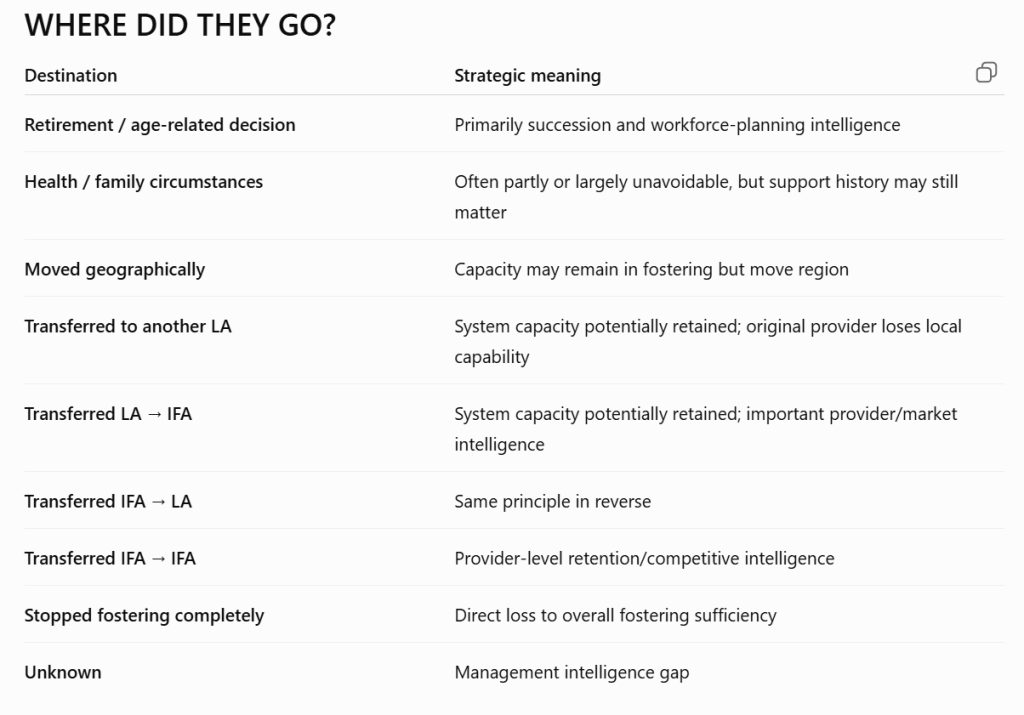
This is not a statutory classification.
It is a management tool.
And I would add one more column:
WHAT CAPABILITY WENT WITH THEM?
For example:
10 years' experience
teenagers
siblings
parent-and-child
short breaks
therapeutic skills
local postcode
peer mentor
referral advocate
Then the data becomes far more meaningful.
The number “one” can hide very different losses
Consider three deregistrations.
HOUSEHOLD A
20 years fostering.
Retired at 70.
HOUSEHOLD B
Eight years fostering.
Transferred to another provider after repeated support concerns.
HOUSEHOLD C
Three years fostering.
Moved to Scotland because of partner's employment.
Dashboard:
3 DEREGISTRATIONS.
Management reality:
three completely different stories.
The intervention required in each is completely different.
If we aggregate them into one turnover percentage, we lose almost everything useful.
What if the Foster Carer transfers but the child stays with them?
This can be particularly significant.
Transfer protocols are built around protecting children's interests where a child is already placed.
The service changes.
The Foster Carer's professional relationship changes.
But the child's home may potentially remain stable.
That illustrates something important:
THE ORGANISATION IS NOT THE PLACEMENT.
The Foster Carer household provides the child's day-to-day home.
The provider supplies the professional, regulatory and support framework around that household.
That distinction should encourage humility when somebody decides another framework suits them better.
There is also a recruitment lesson
If experienced Foster Carers are transferring into your service:
don't simply celebrate the additional capacity.
Ask:
WHY DID THEY CHOOSE YOU?
That may reveal what your recruitment proposition genuinely does well.
Likewise, if experienced Foster Carers transfer out:
ask:
WHAT DID SOMEBODY ELSE OFFER THAT WE DIDN'T?
That turns transfer into market intelligence in both directions.
A service could track:
TRANSFER IN — reason for choosing us
and:
TRANSFER OUT — reason for choosing elsewhere
Then compare the themes.
That might tell you more about your real Foster Carer proposition than a branding workshop ever could.
Be careful with financial incentives around transfer recruitment
There can be competitive pressures in fostering.
Providers need Foster Carers.
Experienced Foster Carers can be particularly attractive because they bring existing skills.
But transfer recruitment should not become:
aggressive targeting;
financial inducement detached from suitability;
or behaviour that destabilises placements.
The Fostering Network's guiding principles specifically say fostering services should not coerce or entice Foster Carers to transfer simply to secure continuation of an existing child's placement.
Healthy competition may improve the Foster Carer proposition.
Unhealthy competition risks turning Foster Carers into assets being traded between organisations.
That would be a serious mistake.
Current national reform context
At 9 September 2026, the Department for Education's consultation on revised fostering standards and guidance remains open and closes on 16 September 2026.
The proposed revisions are therefore not yet the current final standards.
Transfer itself remains governed by the existing regulatory framework and supported in practice by the England transfer protocol.
Point 98 is not proposing a regulatory change.
It is proposing better retention intelligence.
The management test for Point 98
Go back through every deregistration from the last three years.
Then classify it.
Did they:
leave fostering?
retire?
move geographically?
transfer?
And if they transferred:
WHERE DID THEY GO?
Then ask:
What attracted them?
What had become less attractive about us?
Was the cause potentially preventable?
What capability did we lose?
Did national capacity disappear — or only our capacity?
Because:
“FOSTER CARER LEFT” IS NOT ENOUGH INFORMATION.
And:
“DEREGISTERED” IS NOT A RETENTION DIAGNOSIS.
If the person is still fostering successfully elsewhere, perhaps the most useful question is not:
“Why did they leave fostering?”
It is:
“WHY DID THEY LEAVE US?”
That distinction may change your entire retention strategy.