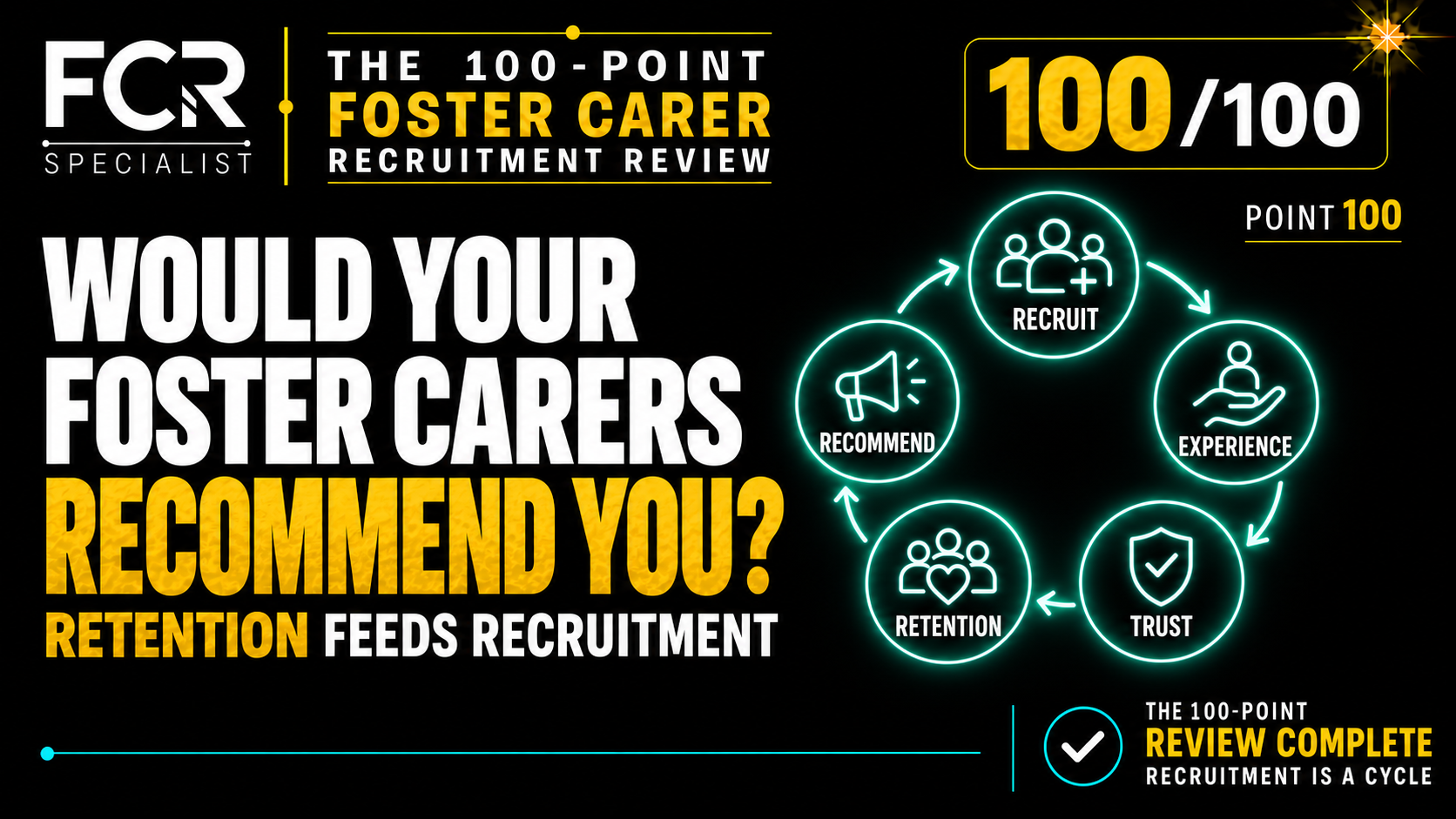
POINT 100/100 — WOULD YOUR FOSTER CARERS RECOMMEND YOU?
POINT 100/100 — WOULD YOUR FOSTER CARERS RECOMMEND YOU?
The final Point — and the question that takes us straight back to recruitment
We have reached:
100/100.
One hundred Points examining Foster Carer Recruitment from beginning to end.
Although, after completing this Review, I am increasingly convinced there isn't really an:
“end.”
Because Foster Carer Recruitment is not a straight line.
It does not begin with an advert and finish when somebody is approved.
It is a cycle.
And that means the final question in this entire Review should bring us straight back to the beginning:
WOULD YOUR EXISTING FOSTER CARERS RECOMMEND FOSTERING WITH YOU TO SOMEBODY THEY CARE ABOUT?
Not:
Would they appear in one of your videos?
Not:
Would they accept a referral payment?
Not:
Would they attend your recruitment event?
The more fundamental question is:
WOULD THEY PUT THEIR OWN REPUTATION BEHIND RECOMMENDING YOU?
Because that may tell us more about the health of Foster Carer Recruitment than almost any advertising metric.
We began with strategy
Point 1 asked:
IS FOSTER CARER RECRUITMENT REALLY A STRATEGIC PRIORITY?
One hundred Points later, perhaps we now have a better test.
If it really is strategic, then recruitment cannot sit solely with:
marketing;
a recruitment officer;
a call centre;
or whoever answers initial enquiries.
Because everything that happens to a Foster Carer afterwards can influence the next person's decision to foster.
That means:
matching affects recruitment.
Support affects recruitment.
Training affects recruitment.
Fees affect recruitment.
Professional relationships affect recruitment.
Allegations affect recruitment.
How disagreement is handled affects recruitment.
How experienced Foster Carers are treated affects recruitment.
And ultimately:
RETENTION AFFECTS RECRUITMENT.
That is why the final Point cannot simply be another retention checklist.
It has to close the circle.
Only 48% would recommend fostering
The latest State of the Nations' Foster Care 2024 provides a sobering benchmark.
Across the UK:
48% of Foster Carers said they would recommend fostering to someone considering it;
35% answered maybe;
and:
17% said they would not recommend it.
The proportion saying yes had fallen from 54% in 2021.
In England specifically, the recommendation figure was also 48%.
That means more than half were not a definite yes.
We should be careful interpreting this.
The survey question asks whether Foster Carers would recommend fostering.
It does not tell us whether they would recommend their particular fostering service.
That distinction gives us one of the most useful management opportunities in Point 100.
Ask two questions, not one
I would suggest every fostering service asks Foster Carers:
QUESTION ONE
WOULD YOU RECOMMEND FOSTERING TO SOMEBODY YOU CARE ABOUT?
Then:
QUESTION TWO
WOULD YOU RECOMMEND FOSTERING WITH US?
Those are different questions.
And the difference between the answers is potentially very revealing.
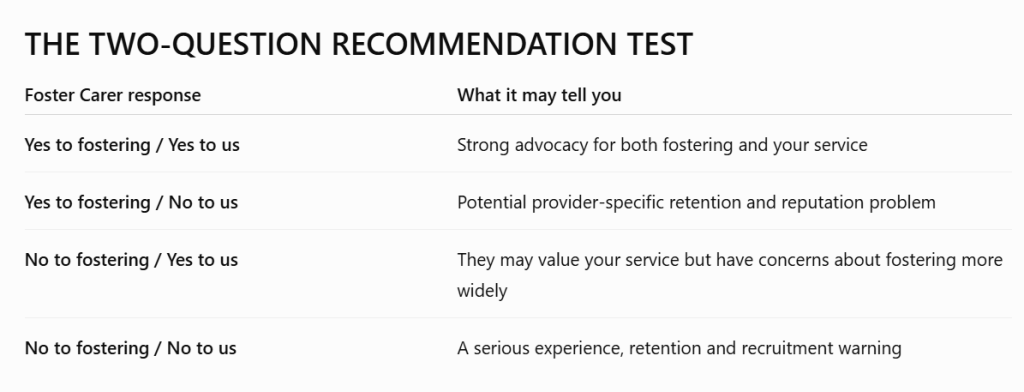
Real life will obviously be more nuanced than four boxes.
Many Foster Carers will say:
maybe.
Others will say:
“Yes, but…”
Those qualifications may be the most valuable information of all.
So add:
Why did you answer that way?
What would make your answer stronger?
And perhaps my favourite question:
WHAT WOULD YOU TELL A PROSPECTIVE FOSTER CARER THAT OUR RECRUITMENT MATERIAL DOESN'T TELL THEM?
That could be an extraordinarily useful conversation.
Recommendation is where your recruitment promise meets lived experience
Think about what prospective Foster Carers hear during recruitment:
We will support you.
You will be part of the team.
Training will help you develop.
You won't be alone.
We value our Foster Carers.
Point 100 asks:
DID THAT PROMISE SURVIVE CONTACT WITH REALITY?
Because existing Foster Carers know.
They have experienced:
the first referral;
the first difficult night;
the first SSW relationship;
the first review;
the first disagreement;
the first request for help;
perhaps the first complaint;
possibly an allegation;
training;
payments;
matching;
breaks;
and the everyday reality of working with the wider professional system.
They know whether:
“We'll support you”
turned into:
“They supported us.”
And prospective Foster Carers know something else.
Existing Foster Carers have no marketing department between them and reality.
That gives their recommendation enormous credibility.
The evidence on word-of-mouth is particularly important
Department for Education-commissioned qualitative research into Foster Carer recruitment and conversion examined five local authorities and five IFAs.
Services described word-of-mouth as a particularly strong recruitment route.
Participants reported that people approaching fostering after speaking with an existing Foster Carer could arrive:
better informed;
with more realistic expectations;
and sometimes with an existing support network.
The research also recommended making greater use of existing Foster Carers within recruitment and, critically, said recruitment work should always include a focus on retention, because improving the experience of existing Foster Carers should reduce pressure on recruitment.
That may be the single most important evidence connection for Point 100.
RETENTION REDUCES RECRUITMENT PRESSURE.
But it can do more than that.
Good retention can also create recruitment.
A retained Foster Carer contributes to sufficiency twice
This is the final sufficiency principle of the Review.
An experienced Foster Carer contributes once because:
THEY CONTINUE FOSTERING.
Their household remains available.
Their experience remains in the system.
Their local knowledge remains.
Their ability to foster:
siblings;
teenagers;
children with more complex needs;
or whatever particular capability they hold
remains available.
But they can potentially contribute a second time.
They can say to:
a friend;
a colleague;
a neighbour;
someone at school;
someone in their community;
or somebody who asks what fostering is really like:
“You should think about it.”
That conversation might generate the next enquiry.
Government research suggests those word-of-mouth enquiries can be particularly valuable precisely because the person has already heard something real about fostering.
So:
RETENTION CAN CREATE RECRUITMENT.
But recommendation cannot be manufactured
This is where referral schemes need careful thinking.
I support existing Foster Carer referral schemes.
There is nothing inherently wrong with recognising and rewarding someone who introduces another suitable person to fostering.
But:
A REFERRAL PAYMENT IS A MECHANISM.
IT IS NOT THE REASON SOMEBODY RECOMMENDS YOU.
If the Foster Carer's lived experience is:
poor support;
incorrect payments;
broken promises;
difficult professional relationships;
inaccessible training;
weak matching;
or feeling undervalued,
increasing the referral reward may not solve the fundamental problem.
You cannot simply pay somebody enough to make an inauthentic recommendation to someone they care about.
The experience has to support the message.
Stage Ten was really about protecting recruitment
Look back across Points 91–99.
POINT 91 — RETENTION IS SUFFICIENCY
Losing an experienced Foster Carer is not merely losing one name from the register.
You may lose years of capability.
POINT 92 — EQUAL PARTNER UNTIL YOU DISAGREE?
Partnership is easy while everyone agrees.
The real test is what happens during professional disagreement.
POINT 93 — WHEN DISAGREEMENT BECOMES A LABEL
Organisations need curiosity before conclusion.
One version of a deteriorating relationship should not automatically become organisational fact.
POINT 94 — ALLEGATIONS
Child protection remains paramount.
But how an allegation is experienced can have consequences long after the process closes.
POINT 95 — DEVELOPMENT AND PROGRESSION
If progression depends on development, organisations need to provide a realistic route to that development.
POINT 96 — WHEN COMMITMENT BECOMES EXHAUSTION
The final straw may not be the first cause.
Talk to experienced Foster Carers before exhaustion becomes resignation.
POINT 97 — WOULD WE APPROVE THEM TODAY?
Life circumstances change.
Experienced Foster Carers may need review, adjustment and support — not automatic assumptions that changing circumstances erase accumulated capability.
POINT 98 — LEAVING FOSTERING OR LEAVING YOU?
Provider sufficiency and system sufficiency are not always the same thing.
Understand where people go.
POINT 99 — DID YOU SEE THEM LEAVING?
Exit interviews matter.
Stay conversations need to happen earlier.
And now:
POINT 100 — WOULD THEY RECOMMEND YOU?
Because every one of the previous nine Points can ultimately influence the answer.
The whole 100-Point Review is a circle
Now step back beyond Stage Ten.
The journey looks something like this:
STRATEGY
Do we know what Foster Carers and placement capability we actually need?
↓
MARKETING
Can the right people find us and understand the opportunity?
↓
ENQUIRY
What happens when interest becomes human contact?
↓
INITIAL VISIT
Are we building understanding, not simply pushing people forward?
↓
ASSESSMENT
Can statutory rigour coexist with a positive applicant experience?
↓
APPROVAL
Does somebody move from applicant to Foster Carer with clarity and confidence?
↓
EXPERIENCE
Does the reality resemble what recruitment promised?
↓
TRUST
Does their confidence in the organisation grow or decline?
↓
RETENTION
Do the conditions exist in which capable Foster Carers want to continue?
↓
RECOMMENDATION
Would they put their own credibility behind encouraging somebody else to foster with you?
↓
RECRUITMENT
And the cycle starts again.
The data demonstrate why the circle matters
Ofsted's latest statistics make the point rather starkly.
During 2024–25:
4,430 mainstream fostering households joined the sector, including 3,050 households new to fostering.
But:
4,690 households deregistered.
Overall mainstream household numbers continued to fall.
Some deregistered households may have re-registered elsewhere, so we should not describe all 4,690 as permanent losses from fostering.
But at system level the message remains clear:
RECRUITMENT ACTIVITY ALONE DOES NOT GUARANTEE GROWTH.
If households leave as quickly as others enter, recruitment teams are running simply to stand still.
That is why:
YOU CANNOT RECRUIT YOUR WAY OUT OF A RETENTION PROBLEM.
And the Foster Carer evidence tells us what matters
When The Fostering Network asked Foster Carers what currently works well, the most frequently identified themes included:
positive relationships with Social Workers;
the fostering community;
and the positive impact of fostering on children and young people.
When Foster Carers were asked what they most wanted changed, the leading themes included:
finances;
status and respect within the team around the child;
and support for Foster Carers and children.
Those findings should sound familiar.
They run throughout this Review.
Recruitment cannot be separated from them.
Because those are the realities prospective Foster Carers eventually inherit.
THE RECOMMENDATION CONVERSATION
So Point 100 needs one final practical management tool.
Not another huge dashboard.
Just a conversation.
Ask a representative range of Foster Carers:
1. WOULD YOU RECOMMEND FOSTERING?
Yes?
Maybe?
No?
2. WOULD YOU RECOMMEND FOSTERING WITH US?
Do not combine the two questions.
3. WHY?
Allow the answer to be qualitative.
4. WHAT WOULD YOU TELL SOMEBODY THINKING ABOUT FOSTERING WITH US?
This tests recruitment messaging against reality.
5. WHAT WOULD YOU WARN THEM ABOUT?
Do not become defensive.
The answer may identify what needs fixing.
6. WHAT WOULD YOU TELL THEM WE DO PARTICULARLY WELL?
Protect your strengths too.
7. WHAT WOULD NEED TO CHANGE FOR YOU TO RECOMMEND US MORE CONFIDENTLY?
That becomes management intelligence.
And then:
DO SOMETHING WITH THE ANSWERS.
Recommendation should not become another target imposed on Foster Carers
One warning.
Do not turn Point 100 into:
“Every Foster Carer must recruit somebody.”
That misses the entire argument.
Foster Carers are not unpaid recruitment officers.
Some will never want to:
attend events;
appear on social media;
make videos;
or refer friends.
That is completely legitimate.
Recommendation needs to remain voluntary and authentic.
The management objective is not to extract advocacy.
It is to create an experience worth advocating.
There is an enormous difference.
Measure experience, not just advocacy
If someone says:
“I would never tell a friend to foster with you,”
that is not primarily a marketing problem.
It is an experience problem.
Similarly:
“I would recommend fostering, but I wouldn't recommend this provider”
should immediately interest senior leadership.
And:
“I think you are a good provider, but I cannot currently recommend fostering because the wider system is too difficult”
tells you something different again.
This is why the two-question approach matters.
It separates:
THE FOSTERING PROPOSITION
from:
YOUR PROVIDER PROPOSITION.
The strongest marketing department may already be fostering for you
Fostering services spend:
on Facebook;
Google;
events;
creative agencies;
websites;
video;
radio;
print;
recruitment hubs;
and campaigns.
Some of that is necessary.
But perhaps the most credible recruitment message still begins with an ordinary conversation:
“I foster.”
“What's it really like?”
Everything that follows depends on what the Foster Carer says next.
That is the connection between Point 1 and Point 100.
One hundred Points were never about generating more enquiries
That was never enough.
The purpose was to improve the whole Foster Carer journey so more of the right people:
FIND FOSTERING.
UNDERSTAND FOSTERING.
PROGRESS.
BECOME APPROVED.
FEEL SUPPORTED.
DEVELOP.
STAY.
and eventually:
HELP SOMEBODY ELSE BELIEVE THEY COULD FOSTER TOO.
That is Foster Carer Recruitment.
Not advertising alone.
Not conversion alone.
Not assessment alone.
Not approval alone.
The whole experience.
The final management test
So after 100 Points, I would ask senior managers just five questions.
1. Would your Foster Carers recommend fostering?
2. Would they recommend fostering with you?
3. If the answers are different, do you understand why?
4. What would your Foster Carers tell a prospective applicant that your marketing does not?
And finally:
5. IS THE EXPERIENCE YOU ARE ADVERTISING ACTUALLY THE EXPERIENCE YOU DELIVER?
Because the answer to that question affects:
trust;
retention;
reputation;
word-of-mouth;
recruitment;
and ultimately:
SUFFICIENCY.
Point 100 does not really finish the Review.
It takes us back to the beginning.
Because:
RECRUITMENT IS NOT A FUNNEL.
IT IS A CYCLE.
And after one hundred Points, the conclusion I keep coming back to is still the simplest: