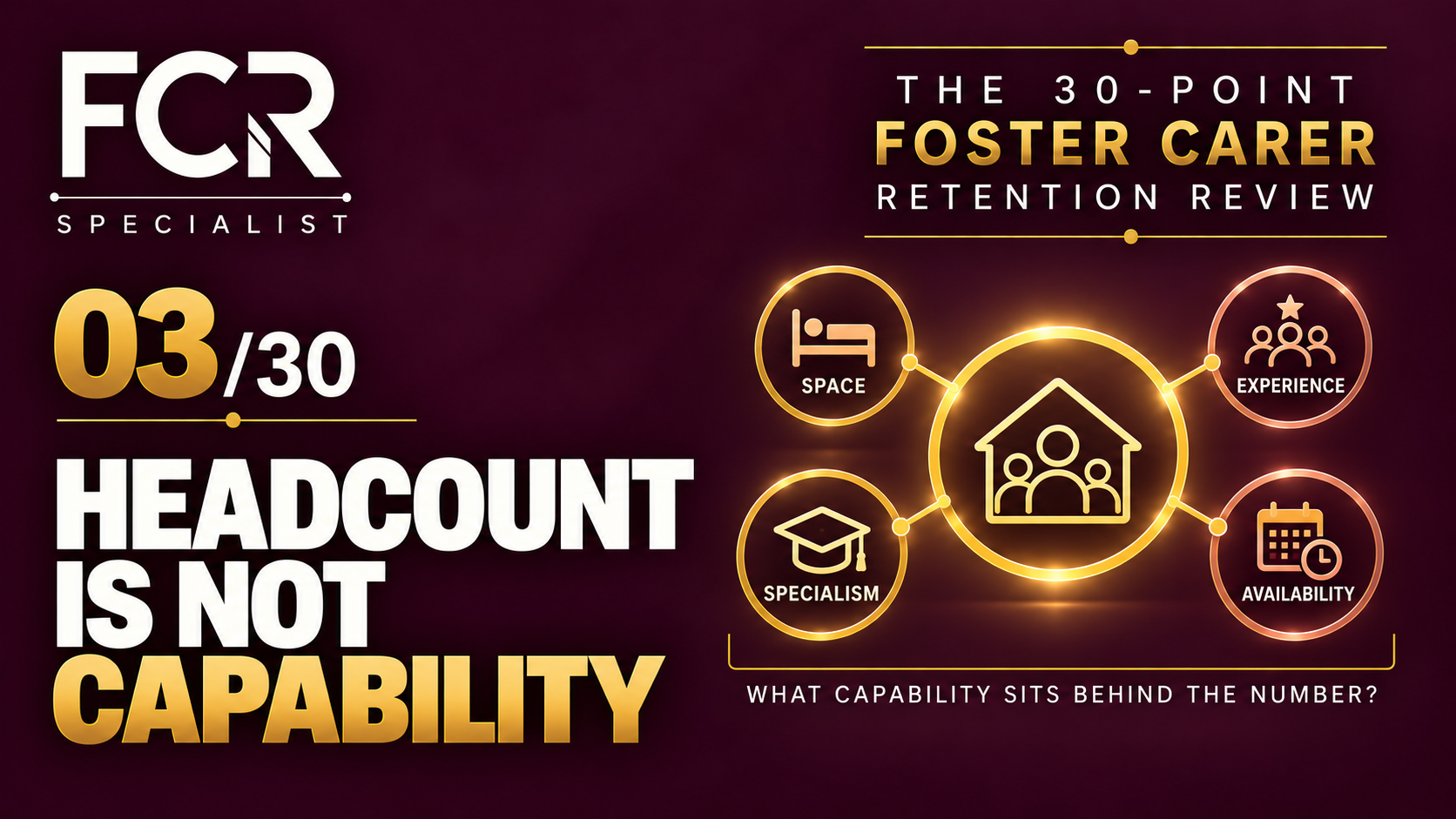
Point 03/30 — Foster Carer Headcount Is Not Capability
Point 03/30 — Headcount Is Not Capability
One Foster Carer is not simply one Foster Carer
In Point 2 I argued that Foster Carer retention is a sufficiency issue.
But there is another problem with the numbers.
Even if we know how many households we have gained and lost, we still do not necessarily know what happened to our ability to meet children's needs.
Because:
HEADCOUNT IS NOT CAPABILITY.
Imagine two fostering services.
Both report:
100 approved Foster Carer households.
On paper they look similar.
But Service A may have:
experienced teenage Foster Carers;
sibling capacity;
several households able to offer two or three places;
Foster Carers experienced in disability;
emergency availability;
language and cultural knowledge;
parent-and-child experience;
short-break capacity;
strong geographical coverage;
experienced mentors;
and households comfortable with more complex needs.
Service B may also have 100 households — but a very different combination of availability, approval, experience and practical capacity.
The same headcount.
A completely different sufficiency position.
THE OFFICIAL DATA ALREADY SHOW WHY COUNTING ALONE IS DANGEROUS
At 31 March 2025, Ofsted recorded 69,825 approved mainstream fostering places in England.
Of those:
42,015 were filled.
12,080 were vacant.
14,335 were recorded as not available. GOV.UK
That does not mean 14,335 places represented a service failure.
There are legitimate reasons why an approved place may not currently be available.
Nor does a vacant place automatically mean it would be suitable for whichever child needs a placement next.
That is precisely the point.
A PLACE ON PAPER IS NOT NECESSARILY A USABLE MATCH.
And a Foster Carer on a register is not simply interchangeable with another Foster Carer on a register.
SUFFICIENCY IS ABOUT MEETING NEED
The current legal framework already points us in this direction.
Section 22G of the Children Act 1989 requires local authorities, so far as reasonably practicable, to secure sufficient accommodation within their area that meets the needs of looked-after children. In doing so, authorities must have regard not only to the number of providers but to having a range of accommodation capable of meeting different needs. Legislation.gov.uk
That is an important distinction.
The duty is not simply:
Have enough beds.
It is about having sufficient accommodation capable of meeting different children's needs.
The Department for Education's 2026 sufficiency research makes the same point in contemporary language.
It concludes that sufficiency is shaped by multiple factors and cannot be understood through volume of provision alone. Availability, suitability, location, workforce and children's needs all interact. GOV.UK
In other words:
NUMERICAL CAPACITY AND USEFUL CAPACITY ARE DIFFERENT THINGS.
WHAT ACTUALLY SITS BEHIND ONE HOUSEHOLD?
This is where senior-management reporting can become too simplistic.
A line reading:
Foster Carer households: 163
tells me remarkably little about what those 163 households enable the service to do.
Behind each household may sit several different forms of capability.
BEDROOM CAPABILITY
How many placements can the household realistically offer?
One?
Two?
Three?
Could they care for siblings together?
Are some rooms currently unavailable?
Could existing space potentially be adapted?
This is already recognised in current government policy.
The 2026 Renewing Fostering plan notes that around 28% of fostering households are approved for only one child and has committed up to £25 million over two years to help experienced local-authority Foster Carers adapt or expand homes where appropriate, with sibling placements explicitly identified as one potential benefit. GOV.UK
That policy is revealing.
Government is effectively saying:
some additional sufficiency may already exist within experienced households if practical barriers can be addressed.
AGE-RANGE CAPABILITY
A household approved to foster does not automatically provide equal capacity across every age range.
There can be an enormous operational difference between having:
a Foster Carer comfortable with very young children;
a Foster Carer experienced with primary-age children;
and:
a Foster Carer who genuinely wants, understands and has experience of fostering teenagers.
Historical and contemporary sufficiency work repeatedly identifies difficulty finding appropriate family placements for some older children. Current government policy also notes that children now enter care at an older age on average and that the needs profile of children in care has changed. GOV.UK
So losing an experienced teenage Foster Carer may create a very different sufficiency impact from the simple subtraction:
163 households → 162 households.
SIBLING CAPABILITY
Some households have the space, experience, confidence and household circumstances to foster brothers and sisters together.
Others quite reasonably do not.
That means losing a household able to foster a sibling group can remove several things simultaneously:
bedrooms;
experience;
matching options;
and the possibility of keeping brothers and sisters together.
The Government's current fostering plan specifically identifies creating additional space in experienced Foster Carer homes as a way of improving matching options, including for siblings. GOV.UK
So again:
ONE HOUSEHOLD LOST MAY REPRESENT MORE THAN ONE PLACEMENT LOST.
SPECIALIST CAPABILITY
Some Foster Carers develop substantial knowledge and confidence over many years.
For example:
disability;
complex health needs;
therapeutic approaches;
trauma;
parent-and-child fostering;
remand fostering;
emergency care;
short breaks;
children stepping down from residential care;
or other locally required specialisms.
These capabilities are not instantly replaceable.
Indeed, the Government's 2026 strategy specifically recognises the need to expand specialist fostering provision in areas such as remand fostering and to develop innovative arrangements for cohorts including unaccompanied asylum-seeking children. GOV.UK
So a service should know:
Where does specialist capability currently sit?
And:
How vulnerable is it?
CULTURAL, COMMUNITY AND LANGUAGE CAPABILITY
Capability can also include:
language;
cultural knowledge;
faith understanding;
community connections;
and experience supporting children's identity.
This needs careful handling.
It should never become simplistic matching based solely on ethnicity or protected characteristics.
Nor should we assume that a person's identity automatically equates to a particular fostering capability.
The management issue is more practical:
What relevant knowledge, experience, language and community connections exist within the Foster Carer population that may help children maintain identity, relationships and belonging?
And:
where are the gaps?
GEOGRAPHY IS A CAPABILITY
Where the Foster Carer lives matters.
A suitable household 60 miles away does not provide exactly the same option as a suitable household near:
the child's school;
family time;
health provision;
siblings;
friends;
or community.
The Department for Education's 2026 sufficiency research emphasises that availability and suitability must be considered alongside location and accessibility, with pressures sometimes contributing to children being placed further from home. GOV.UK
So a service can have a healthy Foster Carer headcount overall while having serious geographical insufficiency.
That is another reason a service-wide total can conceal the problem.
AVAILABILITY IS CAPABILITY
Approval and availability are not the same.
A Foster Carer may be approved for two children but currently able to offer only one place.
They may need a break.
They may have another child already placed.
The household may have changed.
A birth child may have returned home.
They may temporarily not be accepting placements.
They may have decided not to consider a particular type of referral.
There may be entirely appropriate reasons.
The management issue is not to pressure them into accepting placements.
It is to understand:
WHAT CAPABILITY IS ACTUALLY AVAILABLE TODAY?
Ofsted's figures showing 14,335 approved places recorded as unavailable at March 2025 demonstrate why that distinction matters nationally. GOV.UK
EXPERIENCE IS CAPABILITY
Years of fostering can create knowledge that is difficult to represent on a spreadsheet.
An experienced Foster Carer may know:
how local services work;
who to contact;
how meetings operate;
how to advocate constructively;
how to recognise early placement strain;
how to manage difficult transitions;
how to work with birth families;
how to support a new Foster Carer;
and when something that feels overwhelming is actually a familiar part of fostering.
That does not mean every long-serving Foster Carer is automatically more capable than every newer Foster Carer.
Nor does longevity remove the importance of continuing learning.
It means experience itself can be an organisational asset.
Ofsted's latest data show that households deregistering in 2024–25 had, on average, been registered for just over 7.5 years in local authorities and just over 5.5 years in IFAs. GOV.UK
That should make senior managers pause.
A departure can represent years of accumulated practical experience walking out of the service.
PEER CAPABILITY CAN DISAPPEAR TOO
Some Foster Carers contribute far beyond the placement in their own home.
They may:
buddy new Foster Carers;
speak at information events;
support recruitment;
contribute to training;
chair or support groups;
provide informal advice;
offer respite;
help newer households normalise difficult experiences;
or become trusted leaders within the local Foster Carer community.
If one of those Foster Carers leaves, the official household count records one departure.
The actual organisational loss may reach several other households.
That is why capability needs a broader definition.
OFSTED'S DATA SHOW THAT HOUSEHOLDS ALREADY DIFFER SIGNIFICANTLY
At March 2025, 64% of mainstream households offered multiple types of foster care.
The proportion was considerably different by sector:
86% of IFA households offered multiple types compared with 47% of local-authority households.
Ofsted also recorded that 39% of IFA households were approved for three or more children, compared with 29% of local-authority households. GOV.UK
These figures should not be used to conclude that one sector has "better" Foster Carers.
They illustrate something else:
HOUSEHOLDS ARE NOT HOMOGENEOUS UNITS.
Their approval, offer and potential capacity differ.
Any meaningful understanding of sufficiency needs to recognise that.
MY PROPOSED MANAGEMENT APPROACH: THE CAPABILITY LOSS MATRIX
Despite the name, I do not recommend creating a huge spreadsheet full of subjective scores.
Nor should this become a system for ranking individual Foster Carers.
The purpose is management intelligence.
The Capability Loss Matrix asks a service to understand its Foster Carer population through four questions:
WHAT CAPABILITY EXISTS?
WHAT CAPABILITY ARE WE DEVELOPING?
WHAT CAPABILITY IS VULNERABLE?
WHAT CAPABILITY HAVE WE LOST?
That can then be considered across several domains.
1. PLACEMENT CAPABILITY
Ask:
What age ranges can we realistically support?
Where do we have sibling capacity?
Where do we have multiple-placement capacity?
Where is emergency capacity?
Where is short-break capacity?
Where are permanent or long-term options?
Where are locally important specialist offers?
2. NEEDS-BASED CAPABILITY
Ask:
Where is experience of disability?
Complex health needs?
Therapeutic care?
UASC?
Parent-and-child?
Complex trauma?
Children stepping down from residential care?
Other needs identified by local sufficiency analysis?
The precise categories should be locally determined.
A service should not create a generic national list and assume it reflects its own children.
3. PRACTICAL CAPABILITY
Ask:
Where are the bedrooms?
Where are households geographically?
What capacity is currently available?
Which households can realistically respond urgently?
Where are transport or employment patterns relevant?
Where can children remain close to school, family and community?
4. EXPERIENCE CAPABILITY
Ask:
Where do we have long-standing fostering experience?
Where is strong local system knowledge?
Who can support newer Foster Carers?
Where are our mentors and buddies?
Which Foster Carers contribute to training, recruitment or service development?
5. IDENTITY AND CONNECTION CAPABILITY
Ask appropriately:
What languages are available?
What relevant cultural and faith knowledge exists?
What community connections can support children's identity?
What capability is missing?
Again, this should never become crude demographic matching.
It should remain child-centred and evidence-based.
THEN ADD THE RETENTION LENS
Once the service understands what capability exists, ask:
IS IT SECURE?
Not every Foster Carer needs to be individually labelled:
safe
at risk
or:
likely to leave.
That would quickly turn a useful management tool into intrusive surveillance.
Instead, look for service-level vulnerabilities.
For example:
We have only three households confident with this type of work.
Two have recently reduced availability.
Or:
Most of our sibling capacity depends on a small number of long-serving households.
Or:
Our emergency capability is concentrated geographically in one part of the authority.
Or:
Several of our experienced peer mentors are approaching a point where their fostering contribution may change.
That is strategic intelligence.
THE REDUNDANCY QUESTION
There is a principle from many other forms of operational planning that applies here.
If an essential capability depends upon one person, it is fragile.
So services should ask:
WHERE DO WE HAVE SINGLE-POINT DEPENDENCY?
Suppose only one household can currently offer a particular specialist placement locally.
That household may be excellent.
But from a sufficiency perspective, the system is vulnerable.
The answer is not to place additional pressure on that Foster Carer.
It is to:
protect them;
support them;
and develop additional capability elsewhere.
That creates resilience.
RETENTION AND DEVELOPMENT MEET HERE
Point 3 begins to expose why recruitment cannot solve every capability problem.
Sometimes the capability does not currently exist.
Then recruitment may be required.
But sometimes the capability could exist within the existing Foster Carer population if services provide:
training;
experience;
support;
mentoring;
progression;
or practical investment.
That is an important distinction which Point 19 will develop much further.
The strategic principle is:
RECRUIT WHERE CAPABILITY DOESN'T EXIST.
DEVELOP WHERE CAPABILITY COULD EXIST.
RETAIN THE EXPERIENCE YOU HAVE ALREADY CREATED.
DON'T TURN FOSTER CARERS INTO INVENTORY
There is an important warning here.
A Capability Loss Matrix could become very managerial very quickly.
A Foster Carer is not:
two bedrooms + teenager + UASC + emergency.
They are a person and usually part of a household whose circumstances, confidence, preferences and capacity change.
Capability mapping should therefore never become a mechanism for:
pressuring placements;
ignoring a Foster Carer's judgement;
treating an approval range as compulsory availability;
or deciding that a Foster Carer "owes" the organisation use of their bedrooms.
This is about understanding organisational capability.
Not owning it.
A Foster Carer can say:
No.
They can need a break.
Their household can change.
Their confidence can alter.
Later Points will examine those issues properly.
CAPABILITY CAN BE LOST WITHOUT ANYBODY RESIGNING
This may be the most important retention connection in Point 3.
Imagine an experienced Foster Carer remains approved.
But over time they:
withdraw one bedroom;
stop considering teenagers;
decline sibling placements;
give up emergency work;
stop mentoring;
or become unavailable for longer periods.
The headcount has not changed.
Your annual retention rate may initially look unchanged.
But capability has already gone.
That is why the Review repeatedly asks:
WHAT COULD WE HAVE SEEN SIX MONTHS EARLIER?
Deregistration is sometimes the final measurement event.
It may not be the point at which the real capacity loss began.
WHAT DOES THIS FEEL LIKE FROM THE FOSTER CARER SIDE?
There is a corresponding risk in the other direction.
A highly experienced Foster Carer may feel that their service sees them merely as:
one household
or:
one vacancy.
They may have built ten or fifteen years of knowledge.
They may have supported dozens of professionals.
They may have learned how to care for children with complex needs.
They may be the person newer Foster Carers telephone when they are struggling.
They may know their local community extraordinarily well.
And yet much of that value may remain invisible until they resign.
Recognition matters because:
PEOPLE ARE MORE THAN THE PLACEMENT CURRENTLY IN THEIR HOME.
Later Points will examine professional respect, recognition and progression.
Point 3 asks management to make the asset visible.
THE MANAGEMENT TEST
Take your current Foster Carer list.
Then hide the total number.
Ask instead:
What can these households actually enable us to provide?
Where is that capability located?
What is currently available?
Where do we rely heavily on only one or two households?
What capability are we developing?
What capability is becoming vulnerable?
What disappeared when our recent leavers left?
If you cannot answer those questions, you may know your Foster Carer headcount.
But you may not yet understand your sufficiency.
CONCLUSION
Counting matters.
We need to know how many:
Foster Carers;
households;
and places
exist.
But counting is the beginning of sufficiency intelligence.
Not the end.
An experienced Foster Carer can represent:
space;
skill;
confidence;
geography;
flexibility;
relationships;
specialism;
experience;
peer leadership;
and knowledge that took years to build.
So when somebody leaves, do not record only:
ONE HOUSEHOLD DEREGISTERED.
Ask:
WHAT CAPABILITY DID WE JUST LOSE?
And before they leave, ask:
WHAT CAPABILITY ARE WE AT RISK OF LOSING?
Because: