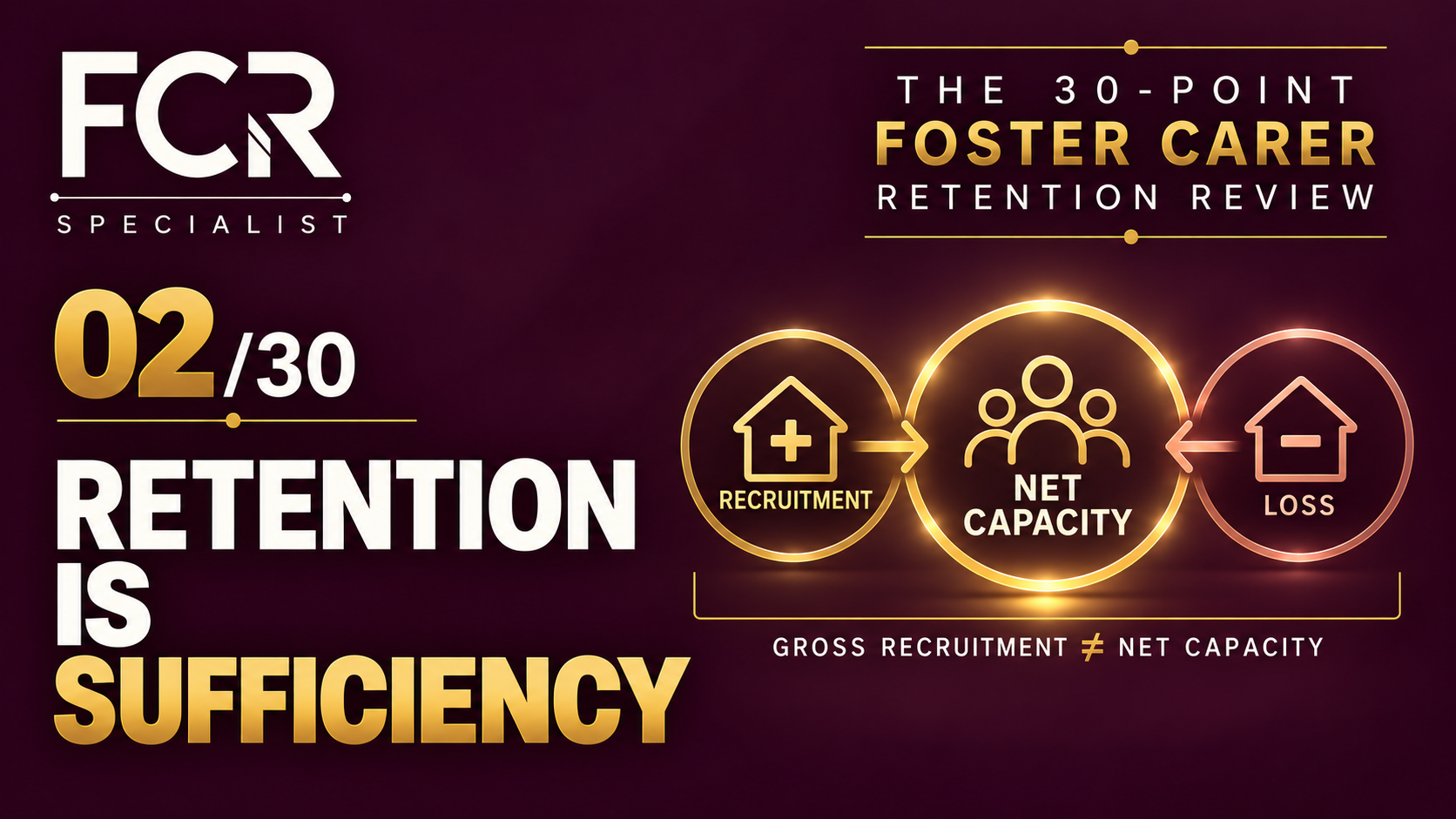
Point 02/30 — Foster Carer Retention Is Sufficiency
Point 02/30 — Foster Carer Retention Is Sufficiency
Recruitment tells you what came in. Foster Carer Retention helps tell you what you still have.
Foster Carer recruitment targets are highly visible.
How many enquiries?
How many Initial Visits?
How many applications?
How many approvals?
How many new households?
These are important questions.
But there is another number that matters just as much:
WHAT HAPPENED TO THE CAPACITY WE ALREADY HAD?
A fostering service can hit its recruitment target and still finish the year with less usable capacity than it started with.
That is why retention cannot sit on the edge of the sufficiency conversation.
RETENTION IS SUFFICIENCY.
THE ENGLAND NUMBERS MAKE THE POINT
The latest complete Ofsted fostering statistics for England cover the year ending 31 March 2025.
During that year:
4,430 mainstream fostering households joined the sector.
Of those, 3,050 were new to fostering.
At the same time:
4,690 mainstream fostering households deregistered.
Ofsted recorded the resulting in-year change as minus 255 households, allowing for rounding within the data. GOV.UK
Recruitment improved.
The net position was still negative.
That distinction is fundamental.
If management looks only at the 4,430 households joining, the story can sound encouraging.
If it looks at what happened after departures are included, the story changes.
GROSS RECRUITMENT IS NOT NET CAPACITY
I think fostering services need to become much more disciplined about these two concepts.
GROSS RECRUITMENT
This tells us what we added.
For example:
new approvals;
new households;
new Foster Carers;
or new places created.
Those figures matter.
They tell us whether recruitment activity is producing results.
But they do not tell us whether sufficiency improved.
NET FOSTERING CAPACITY
I use this as a proposed management concept, not as a statutory metric.
It asks a different question:
AFTER NEW CAPACITY, LOST CAPACITY AND CHANGED AVAILABILITY ARE CONSIDERED, ARE WE ACTUALLY BETTER OFF?
That is a much harder question.
But strategically it is the more important one.
A SIMPLE EXAMPLE
Imagine a fostering service celebrates:
20 new Foster Carer households approved this year.
That sounds like significant growth.
But during the same period:
18 households leave.
The service has not grown by 20 households.
The simple household movement is:
+20 gained
−18 lost
= +2
And even that may not tell the whole story.
What if another three experienced Foster Carers remain registered but reduce their availability?
What if two bedrooms are withdrawn?
What if somebody who previously fostered teenagers now only wishes to consider younger children?
What if a household takes a prolonged break?
None of those necessarily appears as a deregistration.
Yet sufficiency can still reduce.
This is why retention management cannot begin and end with counting resignations.
SOMEBODY DOES NOT HAVE TO LEAVE FOR YOU TO LOSE CAPACITY
This will become particularly important later in the Review.
A Foster Carer can remain approved and still:
reduce the number of children they will foster;
restrict age range;
stop offering emergency placements;
withdraw a bedroom;
decline more referrals;
take extended periods unavailable;
or stop offering a specialist type of care.
On paper:
RETAINED.
Operationally:
CAPACITY REDUCED.
That distinction matters.
Point 4 will look properly at how we define retention and active capability.
Point 2 establishes the strategic principle:
SUFFICIENCY CAN BEGIN TO DISAPPEAR BEFORE A FOSTER CARER DEREGISTERS.
THE GOVERNMENT HAS NOW MADE THE CONNECTION EXPLICIT
The February 2026 Government strategy, Renewing Fostering: homes for 10,000 more children, sets an ambition to create 10,000 more local authority and third-sector foster places by April 2029, backed initially by £88 million over two years. GOV.UK
Importantly, the strategy does not frame this solely as a recruitment exercise.
It states that fostering services will be expected to prioritise both recruitment and retention, and describes the two as closely linked. GOV.UK
The Government's choice of places as the target metric is also interesting.
Its explanation is that places provide a useful view of system capacity because they can include both new households and additional capacity created within existing households. GOV.UK
That reinforces an important strategic point.
Sufficiency is not created only by finding somebody new.
It can also be:
protected by retaining existing Foster Carers;
restored by helping a Foster Carer return to availability;
or:
expanded within existing households where that is appropriate and sustainable.
RECRUITMENT AND RETENTION ARE NOT COMPETING PRIORITIES
I do not think the answer is to shift attention or investment away from recruitment.
England plainly needs more Foster Carers.
The latest Ofsted figures show 56,345 approved mainstream Foster Carers at March 2025, down 12% from 2021. GOV.UK
The Government's current strategy recognises the need for major expansion.
But recruitment and retention should not compete for strategic attention.
They perform different functions.
RECRUITMENT ADDS CAPACITY.
RETENTION PROTECTS CAPACITY.
DEVELOPMENT CAN EXPAND CAPACITY.
A credible sufficiency strategy needs all three.
THE LEAKING BUCKET PROBLEM
There is a familiar analogy here.
Imagine pouring water into a bucket with a hole in the bottom.
You can respond by pouring faster.
That may temporarily increase the water level.
But unless somebody pays attention to the leak, increasingly large amounts of effort are required simply to stand still.
Fostering recruitment can operate in the same way.
Campaigns generate enquiries.
Recruiters convert them.
Assessors undertake substantial work.
Training is delivered.
Panels approve.
New households arrive.
Meanwhile experienced households leave.
The recruitment team can succeed while the overall system remains under pressure.
That is not a recruitment failure.
It is a whole-service sufficiency problem.
NOT EVERY DEPARTURE IS A FAILURE
This distinction is essential.
The objective of a retention strategy should not be zero turnover.
Foster Carers retire.
People develop health problems.
Households change.
People move.
Family responsibilities alter.
Some approvals should appropriately end.
And sometimes a Foster Carer transferring to another provider remains within the national fostering system.
So the strategic question is not:
HOW DO WE STOP ANYBODY LEAVING?
It is:
HOW MUCH OF THE CAPACITY WE ARE LOSING IS NATURAL, APPROPRIATE OR UNAVOIDABLE — AND HOW MUCH MIGHT HAVE BEEN PROTECTED?
That is a much more useful management question.
SYSTEM LOSS AND PROVIDER LOSS ARE DIFFERENT
Another distinction matters.
Suppose a Foster Carer transfers from:
an LA to an IFA;
an IFA to an LA;
one IFA to another;
or one LA to another.
For the original provider:
capacity has been lost.
For the national fostering system:
the household may still be fostering.
Those are two different sufficiency stories.
Both matter.
A provider needs to understand why households are choosing to leave it.
But national policy needs to know whether households are leaving providers or leaving fostering altogether.
Point 26 will examine that distinction properly.
For now, the key principle is:
KNOW WHICH SUFFICIENCY PROBLEM YOU ARE TRYING TO SOLVE.
THE GROSS-TO-NET SUFFICIENCY CHECK
I propose a simple management discipline.
This is not a statutory tool.
It is a way of forcing recruitment and retention into the same strategic conversation.
At each agreed reporting period, ask five questions.
1. WHAT DID WE ADD?
How many new households or usable fostering places genuinely entered the service?
Not simply enquiries.
Not applications.
Actual additional capacity.
2. WHAT DID WE LOSE?
How many households or places disappeared through:
deregistration;
transfer;
retirement;
or other forms of exit?
3. WHAT CAPACITY BECAME LESS AVAILABLE?
Without trying to create a complicated metric yet, ask:
Did existing Foster Carers reduce availability?
Did approved places become unavailable?
Did households reduce what they could offer?
Point 4 will develop measurement in much greater detail.
For Point 2, management simply needs to acknowledge that this loss exists.
4. WHAT CAPACITY DID WE PROTECT OR RESTORE?
Were Foster Carers supported through strain who might otherwise have left?
Did somebody return after a planned break?
Was availability restored?
Did an existing household appropriately create additional capacity?
Retention success should be visible too.
5. WHAT WAS THE REAL DIRECTION OF TRAVEL?
After everything that entered and everything that disappeared:
DID OUR USABLE FOSTERING CAPACITY GROW, STAND STILL OR SHRINK?
That should sit beside the recruitment headline.
A SIMPLE REPORTING CHANGE
Imagine a senior-management report that currently says:
ANNUAL FOSTER CARER RECRUITMENT TARGET: 20
APPROVED: 22
STATUS: TARGET EXCEEDED
Nothing there is necessarily wrong.
But I would add:
HOUSEHOLDS LOST DURING PERIOD: 19
OTHER SIGNIFICANT CAPACITY REDUCTIONS: REVIEWED
NET SUFFICIENCY POSITION: +3 HOUSEHOLDS BEFORE OTHER CAPACITY CHANGES
That immediately creates a different conversation.
It does not diminish the recruitment achievement.
It places it in context.
RETENTION IS ALSO ABOUT PROTECTING INVESTMENT
Consider what happens before a new Foster Carer becomes experienced.
Marketing.
Enquiry handling.
Recruitment.
Initial Visits.
Assessment.
Preparation.
Panel.
Training.
Supervision.
Matching experience.
Professional learning.
Relationships.
Years of practice.
When an experienced Foster Carer leaves, the organisation is not simply losing a name from a register.
It may be losing an investment built over many years.
I am deliberately not attaching a universal monetary figure to that loss because no credible national figure applies equally to every provider and every household.
But strategically the principle is obvious:
REPLACING AN EXPERIENCED FOSTER CARER IS NOT THE SAME AS REPLACING A NUMBER.
Point 3 will examine that much more closely.
SUFFICIENCY IS ABOUT SUITABLE CAPACITY, NOT SIMPLY VOLUME
Recent Department for Education analysis published in 2026 reinforces this point.
Its work on children's social care sufficiency concluded that sufficiency is shaped by availability, suitability and wider system pressures rather than simply the volume of provision. It also found an association between lack of available Foster Carers and more — including younger — children being placed in children's homes. GOV.UK
That gives retention an even stronger strategic significance.
The question is not merely:
How many Foster Carers do we have?
It is:
Do we have enough Foster Carers able and willing to offer the placements children actually need?
We will go much deeper into that in Point 3.
WHAT DOES THIS FEEL LIKE FROM THE FOSTER CARER SIDE?
There is another reason retention needs to sit inside sufficiency planning.
Foster Carers can sometimes feel that recruitment is highly visible while retention is largely assumed.
They see:
advertising;
campaigns;
events;
referral drives;
recruitment targets;
new initiatives.
Meanwhile existing Foster Carers may be experiencing pressures that make continuing harder.
That can create an uncomfortable message:
We appear to be working extremely hard to find your replacement while not working equally hard to understand what might help you remain.
That may not be management's intention.
But perception matters.
A mature sufficiency strategy visibly values both:
THE NEXT FOSTER CARER
and:
THE FOSTER CARER WHO IS ALREADY HERE.
THE CENTRAL MANAGEMENT QUESTION
At the end of every recruitment reporting period, do not stop at:
How many did we approve?
Add:
How many did we lose?
What availability changed?
What capacity did we protect?
What was our net direction of travel?
Then ask:
WHAT DOES LOSING ONE EXPERIENCED FOSTER CARER ACTUALLY COST OUR SUFFICIENCY?
Because recruitment success and sufficiency success are not automatically the same thing.