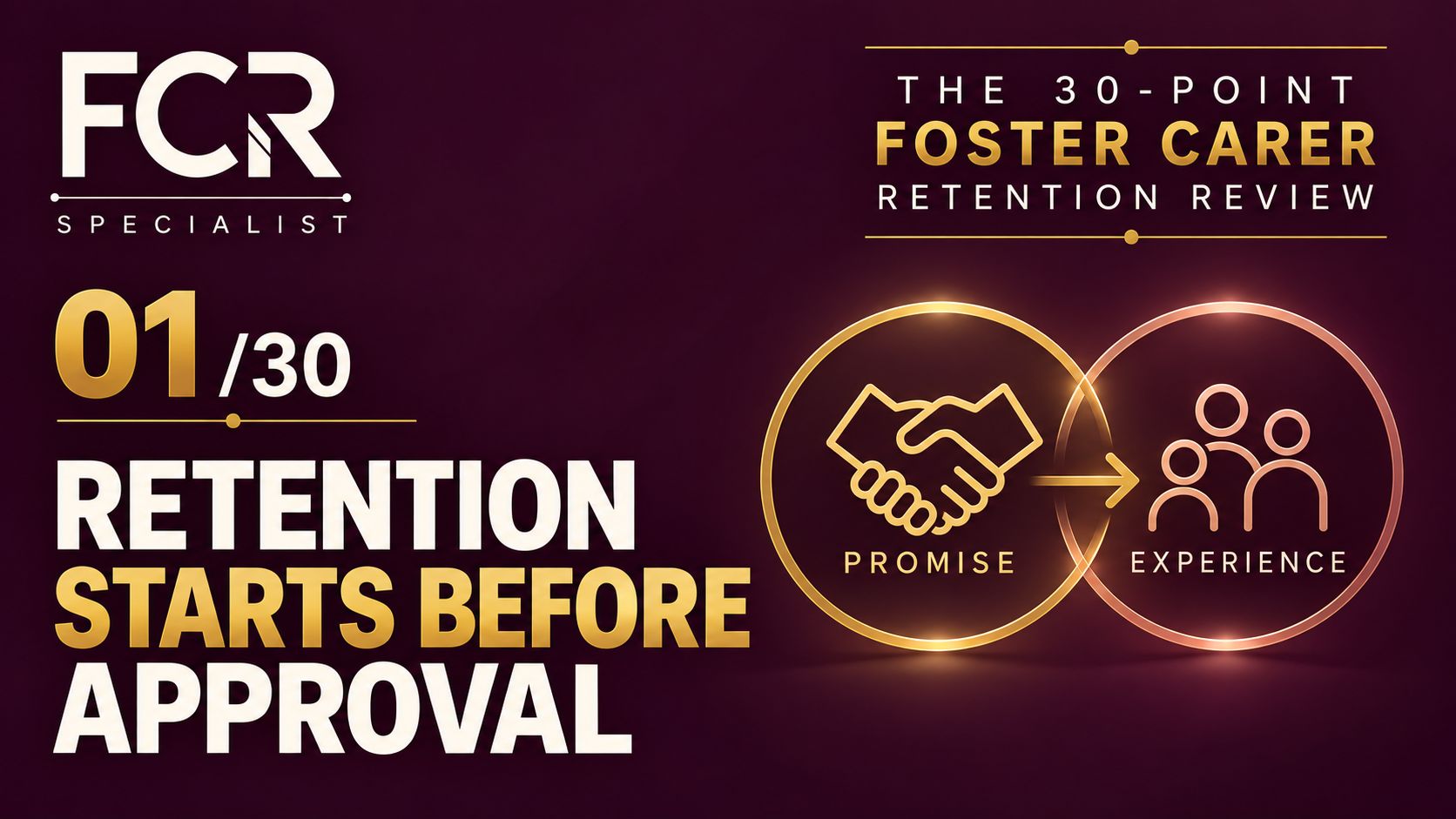
Point 01/30 — Retention Starts Before Approval
Point 01/30 — Retention Starts Before Approval
The recruitment promise becomes the retention benchmark
Foster Carer recruitment and Foster Carer retention are often managed as though they are two separate activities.
Recruitment finds and approves people.
Retention keeps them.
Operationally, that separation may make sense.
From the Foster Carer's perspective, it is much less clear.
Their experience is continuous.
They see an advert.
They visit a website.
They make an enquiry.
They speak to a recruiter.
They attend an information event.
They meet Foster Carers.
They begin assessment.
They learn about support, matching, payments, training and the professional role.
Eventually, if approved, they begin fostering.
There is no psychological reset button at approval.
Nobody thinks:
"Everything I was told before today no longer counts."
Quite the opposite.
Those earlier conversations may become the benchmark against which the real experience of fostering is judged.
That is why:
RETENTION STARTS BEFORE APPROVAL.
Expectations are not a soft issue
There is evidence behind this.
The 2023 Foster Carer Retention and Recruitment in England research, undertaken by the Centre for Evidence and Implementation for The Fostering Network, gathered almost 2,000 responses alongside interviews, focus groups and national-data analysis.
One finding is especially relevant here:
only about half of Foster Carers agreed that the reality of fostering had met their expectations, while around one third disagreed. CEI Global
The research also emphasised the importance of realistic expectations, transparency, lived experience within recruitment, financial information and supportive relationships. The Fostering Network
That does not prove that unmet expectations cause Foster Carers to leave.
Retention is far more complicated than that.
But it gives us a strong reason to ask whether the expectations created during recruitment become part of the conditions within which later retention succeeds or fails.
Ofsted is already seeing expectation mismatch before approval
The latest fully published fostering statistics for England cover 1 April 2024 to 31 March 2025.
Ofsted recorded 8,290 applications during the year. Of 5,370 applications completed in-year, 2,050 ended in approval, 3,290 in withdrawal and 30 in rejection.
Among applications that both started in-year and were withdrawn by applicants by year-end, 20% cited the fostering process not being as expected. GOV.UK
We need to interpret that carefully.
It does not mean all of those withdrawals were caused by bad recruitment.
Nor is applicant withdrawal automatically a failure.
The assessment process should help people understand whether fostering is right for them. Sometimes deciding not to proceed is entirely appropriate.
But the figure demonstrates something important:
EXPECTATION AND REALITY ARE ALREADY INTERACTING BEFORE APPROVAL.
That makes expectation-setting an operational issue, not simply a marketing issue.
RECRUITMENT DOES MORE THAN ATTRACT
A strong Foster Carer recruitment system needs to do at least three things.
ATTRACT
Reach potentially suitable people and create enough interest for them to enquire.
HELP PEOPLE UNDERSTAND
Give prospective Foster Carers progressively better information about what fostering involves.
HELP PEOPLE DECIDE
Enable the individual and the household to make an increasingly informed judgement about whether fostering fits their lives.
The danger comes when the first objective overwhelms the other two.
Recruitment becomes focused on:
How do we keep this person moving?
rather than:
How do we help this household understand what they are moving towards?
Those are not the same thing.
REALISM IS NOT NEGATIVITY
Being realistic about fostering does not mean making it sound miserable.
People should hear about:
the purpose;
the difference Foster Carers can make;
children's achievements;
relationships;
belonging;
growth;
family life;
and the extraordinary rewards Foster Carers can experience.
But they should also begin to understand that fostering can involve:
meetings;
recording;
training;
difficult emotions;
complex behaviour;
professional challenge;
family time;
uncertain matching;
changes to household routines;
periods without placements;
and working within a complicated children's social care system.
The right approach is not pessimism.
It is what I would call:
REALISTIC OPTIMISM.
This can be an extraordinary thing to do.
It can also be demanding.
We will help you understand both before you decide.
THE EXPECTATION–EXPERIENCE GAP
The retention risk is not simply that something difficult happens.
Fostering will inevitably contain difficult experiences.
The issue is the size of the gap between:
WHAT I THOUGHT I WAS JOINING
and:
WHAT I DISCOVERED I HAD JOINED.
Instead of using a table, I think services should examine that gap one promise at a time.
“YOU'LL BE FULLY SUPPORTED”
What might the prospective Foster Carer hear?
Someone will be available when I genuinely need help, including when things become difficult.
What might the later experience reveal?
Support exists, but its availability, timing, scope or usefulness is different from what they assumed.
The recruitment question
Have we explained what support actually means?
“WE MATCH CAREFULLY”
What might the prospective Foster Carer hear?
Placements will only be proposed when the service is confident the child and household are well matched.
What might the later experience reveal?
Matching takes place within real sufficiency pressures, variable information and sometimes urgent circumstances.
Ofsted's current IFA inspection framework explicitly states that careful matching contributes to placement stability and Foster Carer retention. GOV.UK
The recruitment question
Have we explained the principle of matching without creating a promise of certainty that the system cannot always provide?
“WE HAVE EXCELLENT TRAINING”
What might the prospective Foster Carer hear?
I will have access to development that helps me grow and become more capable.
What might the later experience reveal?
Training exists, but the timing, location, delivery method or eligibility criteria make some opportunities difficult to access.
Current government guidance states that mainstream Foster Carers in England need to complete the Training, Support and Development Standards workbook within 12 months of approval, with services supporting continued development. GOV.UK
The recruitment question
Is the development pathway we advertise one the Foster Carer can realistically access?
“THE FINANCIAL PACKAGE IS COMPETITIVE”
What might the prospective Foster Carer hear?
Fostering will be financially viable for my household.
What might the later experience reveal?
They had not fully understood the distinction between the child's allowance, any fee or skills payment, expenses, vacancies and periods without a placement.
The recruitment question
Could we have corrected that financial assumption before approval?
Money should not be treated as an embarrassing subject during recruitment.
A person considering reducing employment, changing hours or reorganising their household needs clear information.
Purpose and financial realism are not opposites.
“YOU'LL BE PART OF THE TEAM”
What might the prospective Foster Carer hear?
My experience and knowledge of the child will be respected within the professional system.
What might the later experience reveal?
The meaning of professional partnership is more complicated than they expected.
Ofsted's current IFA framework describes Foster Carers benefiting from professional and supportive relationships and being part of the team around the child, with their views valued. GOV.UK
The recruitment question
Are we explaining both the caring role and the professional role somebody is joining?
SUPPORT: WHAT EXACTLY ARE YOU PROMISING?
"Excellent support."
"Outstanding support."
"Support whenever you need us."
These are powerful recruitment phrases.
But what do they actually mean?
Does support mean:
a Supervising Social Worker?
regular supervision?
out-of-hours telephone advice?
someone with authority to make a decision?
respite?
peer support?
help following a difficult placement ending?
financial assistance?
therapeutic advice?
support during an allegation?
practical help in a crisis?
The prospective Foster Carer does not necessarily know.
So they fill the gap themselves.
That is where expectation can become dangerous.
The recruitment team may mean:
"We have a comprehensive support structure."
The applicant may hear:
"Someone will solve the problem when I need them."
Neither interpretation has necessarily been dishonest.
But they are not necessarily the same promise.
THE WHOLE HOUSEHOLD HEARS THE PROMISE
The prospective Foster Carer is not the only person forming expectations.
Their partner may be considering:
employment;
privacy;
holidays;
weekends;
family routines;
shared responsibilities.
Their own children may be thinking about:
bedrooms;
parental attention;
family activities;
privacy;
relationships;
and what having another child in the home will actually mean.
Other family members may eventually become part of the support network.
So recruitment should not ask only:
Does the applicant understand fostering?
It should also consider:
DOES THE HOUSEHOLD UNDERSTAND WHAT FOSTERING MAY ASK OF IT?
Point 9 will examine the whole household properly.
Here the narrower issue is expectation creation.
A household can enter fostering enthusiastically and still carry several different versions of what fostering is going to be like.
THE RECRUITMENT-TO-RETENTION PROMISE CHECK
I propose a simple management exercise.
This is not a statutory requirement.
It is a practical way of testing whether the promises made during recruitment remain aligned with operational reality.
Take the major themes within your recruitment proposition:
SUPPORT
MATCHING
TRAINING
FINANCE
PROFESSIONAL PARTNERSHIP
HOUSEHOLD IMPACT
DEVELOPMENT
Then ask the same five questions about each one.
1. WHAT ARE WE SAYING?
What exactly are our adverts, website, recruiters, information events, Initial Visits and preparation materials telling prospective Foster Carers?
Be specific.
Do not settle for:
"We say we offer good support."
Record the actual proposition.
2. WHAT MIGHT THEY HEAR?
What would a reasonable prospective Foster Carer understand those words to mean?
This question matters because:
what the organisation intends to communicate
is not necessarily identical to:
what the applicant reasonably understands.
3. CAN WE CURRENTLY DELIVER IT?
Does present operational practice genuinely support the promise?
Not:
Did we used to do this?
Not:
Is it in the policy?
Not:
Would we like to offer it?
But:
Can today's Foster Carer reasonably experience what today's applicant is being promised?
4. WHO OWNS THE PROMISE AFTER APPROVAL?
Recruitment may make the commitment.
Someone else usually has to deliver it.
That might be:
the SSW team;
placements;
training;
finance;
out-of-hours;
service management;
commissioning;
or another part of Children's Services.
Every meaningful recruitment promise should have an operational home.
5. HAVE WE EXPLAINED IMPORTANT LIMITATIONS?
Honesty does not weaken a proposition.
It strengthens credibility.
If something depends upon:
eligibility;
child need;
availability;
commissioning;
matching;
approval level;
specific circumstances;
or another organisation,
say so.
THEN ADD THE FOSTER CARER TEST
There is one further question I would strongly recommend.
Take your current recruitment proposition to a representative group of existing Foster Carers.
Ask:
“DOES THIS DESCRIBE THE SERVICE YOU EXPERIENCE?”
Do not ask whether they like the advertising.
Ask whether they recognise the service.
You may hear:
"Yes. That's fair."
Excellent.
You may hear:
"Mostly, but that bit isn't really how it works."
Useful.
Or:
"That's what we were told too. It hasn't been our experience."
That is valuable management intelligence.
The purpose is not to allow one negative experience to rewrite an entire recruitment strategy.
It is to identify repeated gaps between the:
ADVERTISED SERVICE
and the:
EXPERIENCED SERVICE.
RECRUITMENT AND OPERATIONS NEED THE SAME VERSION OF THE TRUTH
There is another important risk.
Recruitment teams may be describing a service accurately based upon the information they have.
Meanwhile operational practice has changed.
Training has changed.
Out-of-hours arrangements have changed.
Respite availability has changed.
Payment structures have changed.
Management has changed.
Matching pressure has changed.
The recruitment proposition has not.
This is not necessarily deliberate overselling.
It may simply be organisational drift.
So recruitment should regularly ask operations:
WHAT HAS CHANGED THAT WE NEED TO KNOW?
Operations should regularly ask recruitment:
WHAT ARE WE CURRENTLY PROMISING PEOPLE?
And Foster Carers can help answer:
DOES THAT PROMISE STILL FEEL TRUE?
WHY THIS MATTERS FOR RETENTION
Retention is rarely caused by one event.
Later Points will examine:
support;
trust;
professional relationships;
matching;
finances;
breaks;
training;
household sustainability;
allegations;
progression;
exhaustion;
and exit.
Point 1 has a different job.
It asks whether some of those later experiences begin with an expectation that was formed months or even years earlier.
A Foster Carer may cope perfectly well with a difficult experience they were realistically prepared for.
The same event can feel very different if their reaction is:
"Nobody ever told me this could happen."
Or:
"This isn't what I was told."
That gap matters.
QUESTIONS FOR MANAGEMENT
Before moving beyond Point 1, I would ask every fostering service:
Are we describing fostering realistically?
What does an applicant think “support” means when we use that word?
Have we explained matching without implying certainty?
Could somebody enter fostering with a major financial misunderstanding we should have corrected?
Can Foster Carers realistically access the training and development we advertise?
Do prospective Foster Carers understand the professional role as well as the caring role?
Do other members of the household have a realistic picture?
Do recruitment and operational teams describe the same service?
Who owns each significant recruitment promise after approval?
Would our existing Foster Carers recognise the service portrayed in our recruitment materials?
And finally:
ARE WE PROMISING AN EXPERIENCE WE CAN ACTUALLY DELIVER?
Because the recruitment promise does not disappear at approval.
It may become the benchmark against which everything that follows is judged.