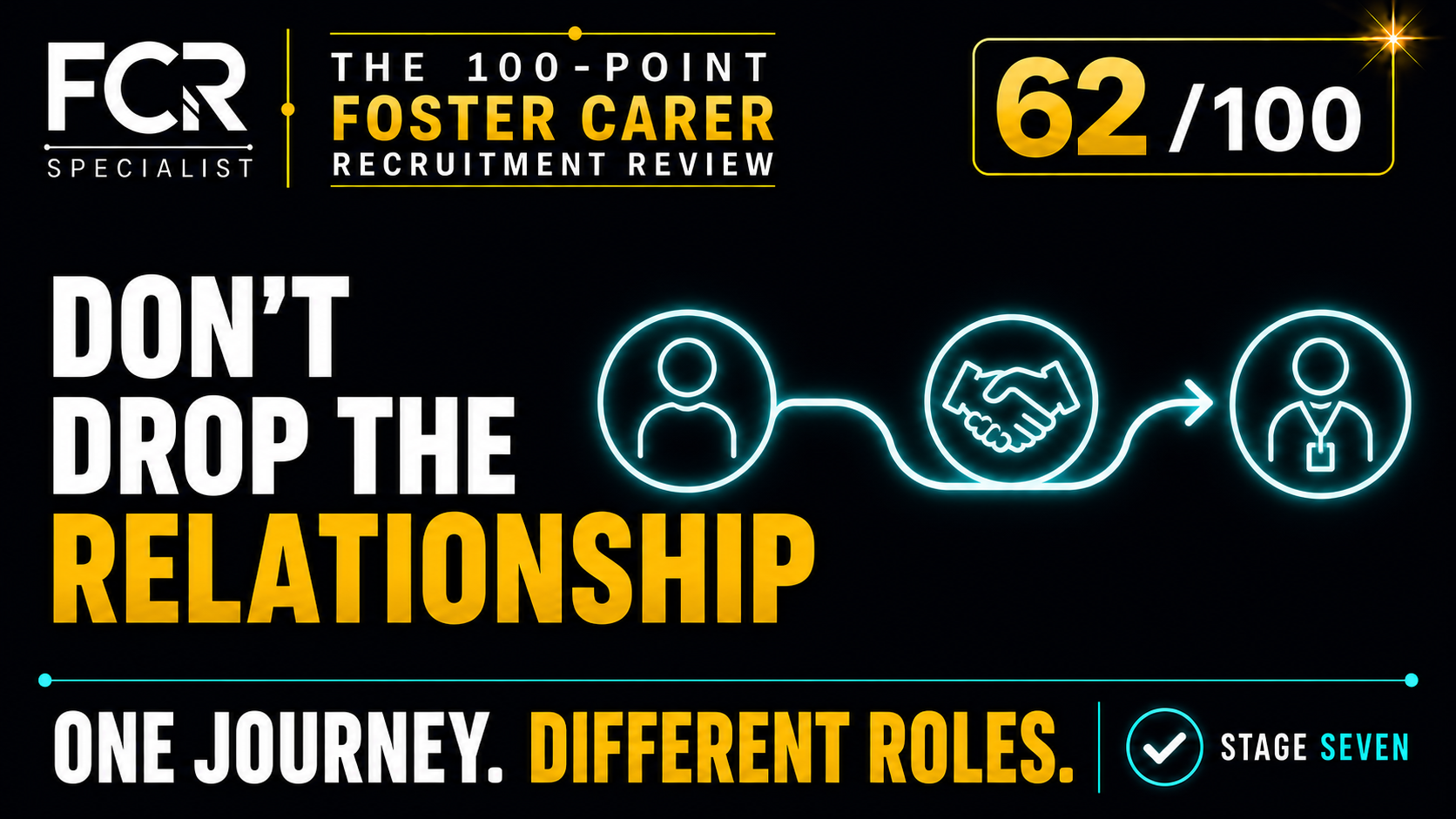
POINT 62/100 — DOES THE HANDOVER INTO ASSESSMENT PROTECT THE RECRUITMENT RELATIONSHIP?
POINT 62/100 — DOES THE HANDOVER INTO ASSESSMENT PROTECT THE RECRUITMENT RELATIONSHIP?
There is a potentially dangerous moment in Foster Carer Recruitment that can happen almost without anyone noticing.
The prospective Foster Carer has made an enquiry.
Someone has responded.
A relationship has developed.
There have been conversations.
An Initial Visit has taken place.
The household has increasingly understood what fostering involves.
Perhaps an experienced Foster Carer buddy has been introduced.
The prospective Foster Carer has decided:
Yes. I want to apply.
And then the organisation changes gear.
Recruitment finishes.
Assessment starts.
A different person appears.
Perhaps a different team.
Potentially a different administrative system.
Sometimes the applicant is effectively told:
“Your Assessing Social Worker will contact you.”
And the person who has guided them to this point quietly disappears.
From an organisational perspective, that might look like a perfectly ordinary transfer of responsibility.
From the applicant's perspective, it can feel very different.
HAVE I JUST BEEN HANDED OVER TO ANOTHER ORGANISATION?
That is the question behind Point 62.
THE HANDOVER IS NOT AN ADMINISTRATIVE EVENT
The move into assessment is a change of professional function.
That distinction matters.
The Assessing Social Worker now has a responsibility that the recruiter does not.
They must undertake a rigorous professional assessment of whether the applicant is suitable to Foster.
They may need to ask difficult questions.
They may need to revisit information.
They may have to explore matters that recruitment has only touched upon.
They must retain professional judgement.
Recruitment must never attempt to influence an ASW to reach a favourable recommendation because a household has been difficult or expensive to recruit.
But none of that means that the applicant relationship needs to be reset.
The assessment is new.
The relationship with the organisation should not be.
That gives us one of the central principles for Stage Seven:
ASSESSMENT OWNERSHIP ≠ RECRUITMENT ABANDONMENT.
THE EVIDENCE SUPPORTS CONTINUITY
The Department for Education's 2023 qualitative research into Foster Carer Recruitment and conversion rates found that consistency and interaction with the same person or people throughout the process was considered helpful.
Participants also described collaborative relationships with prospective Foster Carers as particularly useful during assessment, and highlighted streamlined processes in which applicants understand what will happen at each stage and who they will speak to.
That research was small-scale — ten case studies involving five local authorities and five independent fostering agencies — so it should not be presented as evidence that every service or every applicant has the same experience.
But the direction is remarkably consistent with current Government policy.
In Renewing Fostering: homes for 10,000 more children, published in February 2026, the Government identifies consistent and reliable points of contact that support trusted relationships as one of the features associated with applicants progressing through recruitment.
More significantly for this Point, the Government identifies a structural weakness in the existing regional fostering hub model.
It says that concentrating only on initial enquiry and application is not enough, and specifically identifies fragmentation where hubs operate as an entry point before applicants are passed into local authorities.
The proposed direction is an end-to-end model, including a “journey guide” providing responsive support from first enquiry through to decision.
That is almost exactly the recruitment–assessment interface this Stage of the Review is examining.
THE APPLICANT DOES NOT CARE ABOUT YOUR ORGANISATIONAL CHART
Imagine the applicant's experience.
They have built a relationship with Sarah in recruitment.
Sarah knows:
- why they first enquired;
- who lives in the household;
- what questions worried them;
- what their partner initially thought;
- what kind of fostering they are considering;
- what their working arrangements are;
- what was discussed at Initial Visit;
- what information has already been provided;
- what training has been discussed;
- what checks are about to begin;
- and what the applicant thinks happens next.
Then assessment starts.
The applicant meets David.
David may be an excellent Assessing Social Worker.
But if the organisational handover is weak, David may know surprisingly little about the journey that preceded him.
The applicant starts explaining everything again.
David may quite properly need to explore much of that information professionally.
But the applicant may not understand the difference between:
“I need to explore that in more depth as part of your assessment.”
and:
“Nobody appears to have told me anything about you.”
That distinction is crucial.
A WARM HANDOVER SHOULD REPLACE A COLD TRANSFER
This does not need to become complicated.
At the point an ASW is allocated, the organisation could create a simple warm handover.
For example:
The recruitment worker contacts the applicant.
“Your Assessing Social Worker is David. David has been briefed on the journey so far. I'd like to introduce you rather than simply give him your details.”
That introduction could happen by telephone, Teams, email or face-to-face depending on how the service operates.
It might take 10 or 15 minutes.
The purpose is not to discuss the substance of the assessment.
It is simply to join one part of the journey to the next.
The recruiter can say:
“David will now lead your formal assessment. My role changes from here, but you haven't been dropped by the recruitment service. You still know how to contact us if you need help with the journey itself.”
David can explain:
“Some of what you have already discussed will need to be revisited because my role is different and I need to explore it properly as part of your assessment. But I have received the information already gathered and we are not pretending the previous part of your journey didn't happen.”
That one conversation could remove enormous ambiguity.
WHAT SHOULD ACTUALLY BE HANDED OVER?
A handover should not simply consist of:
Name, address, telephone number, application received.
Nor should it become a lengthy recruitment assessment masquerading as a professional conclusion.
The useful handover is context, not judgement.
It could include:
What has already happened
Enquiry date.
Initial conversation.
Initial Visit.
Application/progression decision.
Information already provided.
Consents already completed.
Checks already initiated.
Preparation training already booked.
Buddy/mentor arrangements where used.
What the applicant has been told
Expected process.
Likely timescale.
What assessment involves.
Any commitments discussed.
What happens next.
Practical household context
Contact preferences.
Availability.
Working arrangements relevant to appointments.
Accessibility requirements.
Known diary constraints.
What remains outstanding
Documents.
Checks.
Medical activity.
References.
Training.
Administrative actions.
The immediate next action
Who contacts the applicant?
By when?
For what purpose?
There should never be ambiguity about this.
THE HANDOVER SHOULD NOT PRE-JUDGE THE ASSESSMENT
This requires an important professional safeguard.
Recruitment information should not contaminate independent professional assessment.
There is a difference between recording:
“Applicant works Monday to Thursday and has asked for evening appointments where possible.”
and:
“Applicant is difficult about appointments.”
There is a difference between:
“Applicant asked several questions about finance and wants clarification before leaving employment.”
and:
“Applicant appears very money motivated.”
One provides context.
The other potentially imports an interpretation into assessment before the ASW has formed their own professional view.
That is why the principle should be:
TRANSFER INFORMATION. DON'T TRANSFER LABELS.
Recruitment should help the ASW understand the journey.
It should not tell the ASW what conclusion to reach.
WHAT HAPPENS TO RECRUITMENT WHEN ASSESSMENT BEGINS?
This is where services need clarity.
The answer should not be:
Recruitment continues to interfere with the assessment.
But nor should it automatically be:
Recruitment has finished.
A better distinction is:
THE ASW OWNS THE ASSESSMENT.
THE ORGANISATION OWNS THE JOURNEY.
Recruitment may no longer be the applicant's primary professional contact.
But somebody should retain sight of whether the applicant experience is functioning.
For example:
Has the ASW made contact?
Has the first assessment meeting happened?
Does the applicant know what happens next?
Has preparation training been booked?
Are checks moving?
Has there been an unexplained four-week silence?
Has the applicant expressed uncertainty?
Has their Foster Carer buddy heard that they are beginning to feel overwhelmed?
None of those questions asks recruitment to judge suitability.
They ask whether the recruitment journey is still moving.
THIS IS PARTICULARLY IMPORTANT GIVEN APPLICATION ATTRITION
The national figures make this difficult to dismiss as a minor customer-service issue.
Of 5,370 fostering applications recorded by Ofsted as completed during 2024–25:
2,050 — 38% — were approved.
3,290 — 61% — were withdrawn.
30 — 1% — were rejected.
Of those withdrawals, 2,175 were applicant-led and 1,115 were service-led.
As throughout Stage Seven, those figures must be interpreted properly.
They are reporting-year flows, not a cohort of 5,370 applicants all beginning and finishing together.
And a withdrawal is not automatically a recruitment failure.
Some applicants should withdraw.
Some applicants discover that fostering is not right for them.
Some circumstances change.
Some services correctly conclude that progression is inappropriate.
But among applications started during the year and withdrawn by the applicant by the year-end, Ofsted reports that 20% recorded the fostering process not being what the applicant expected.
That does not prove poor handovers cause applicant withdrawal.
There is no evidence that allows us to make that claim.
But it does make this management question entirely legitimate:
WHAT HAPPENS BETWEEN “YES, I WANT TO APPLY” AND “I'M WITHDRAWING”?
The handover into assessment is one of the places we should look.
DON'T ASSUME THE ASW HAS BEEN TAUGHT THE RECRUITMENT JOURNEY
There is another management issue here.
Assessing Social Workers come into fostering with different professional backgrounds and different levels of fostering-specific experience.
That should not be turned into a criticism of individual workers.
Nor should we assume that somebody who is newer to fostering lacks professional assessment skills.
But senior managers should ask a different question:
WHAT DO WE INVEST IN WHEN SOMEONE BECOMES AN ASSESSING SOCIAL WORKER?
An ASW may quite properly receive:
- training in Foster Carer assessment;
- statutory guidance;
- Form F guidance;
- supervision;
- shadowing;
- quality assurance;
- support from experienced colleagues.
But are they also shown:
- how Foster Carers are recruited;
- what happens before application;
- what applicants have already experienced;
- the service's enquiry-to-application figures;
- its application withdrawal figures;
- why applicants withdraw;
- where delays commonly occur;
- what applicants say about their experience;
- and the importance of maintaining momentum?
If not, how would we expect them to know?
This is not about teaching Social Workers to sell fostering.
That would be the wrong objective.
The ASW must be able to reach an unfavourable conclusion where the evidence requires it.
The better concept is:
RECRUITMENT AWARENESS WITHOUT RECRUITMENT PRESSURE.
An ASW should understand the recruitment environment in which the assessment sits without ever being pressured to approve an unsuitable applicant.
BE CAREFUL OF THE PRACTICE ECHO CHAMBER
There is also a quality-assurance question for senior management.
Fostering-specific assessment practice will inevitably be learned partly through colleagues, supervision and observation.
That is normal professional development.
But where practice is transmitted largely through:
“This is how we do it here.”
there is a potential risk.
Local practice can reproduce itself.
Good practice can spread.
But so can unnecessary local habit.
That doesn't mean colleagues are teaching each other badly.
It means management should periodically ask whether established practice remains:
- professionally necessary;
- proportionate;
- applicant-aware;
- consistent;
- efficient;
- and aligned with the wider recruitment strategy.
Otherwise the organisation can inadvertently create its own echo chamber.
The question is not:
Who is doing this wrong?
It is:
WHO IS CHECKING WHETHER THE WAY WE DO IT STILL WORKS?
THE ASW SHOULD NOT RECEIVE AN APPLICANT WITH NO RECRUITMENT CONTEXT
Imagine joining a fostering assessment team and being allocated three new households.
You know their names.
You receive the case information.
You know your job is to assess them.
What you may not know unless someone tells you is that:
one household first enquired nine months ago;
one nearly withdrew following a previous delay;
one has already spoken to four different members of staff;
one is extremely anxious about the process;
one has a Foster Carer buddy;
one was told training would happen next month;
and one has already repeated their story several times.
That information does not determine suitability.
But it can fundamentally alter how well the organisation manages the next stage.
Senior managers therefore need to make applicant-journey awareness part of how the assessment function connects with recruitment.
ONE APPLICANT — TWO PROFESSIONAL FUNCTIONS — ONE JOURNEY
This is perhaps the simplest way to describe the model.
Recruitment and assessment are different professional functions.
They should remain different.
But they are serving the same household through the same organisational journey.
The applicant should not have to understand the internal boundary.
They should experience:
continuity of information;
continuity of expectation;
continuity of communication;
and, wherever practical,
continuity of relationship.
That is not the same as having one person perform every role.
Continuity does not mean sameness.
It means the next person knows what happened before them.
HERE IS THE TEST…
Take every applicant who has moved into assessment during the last six months.
Do not start by looking at assessment quality.
Look specifically at the handover.
Handover test What to examine
Named ASW How long between decision/application and the applicant knowing who their ASW is?
Warm introduction Were they actually introduced, or was the applicant simply told someone would contact them?
First contact gap How many days from progression to first meaningful ASW contact?
Information continuity Could the ASW see the relevant enquiry and Initial Visit information?
Applicant repetition What information did the applicant have to provide again without a clear professional reason?
Expectation continuity Did what recruitment told the applicant match what assessment then told them?
Training Had preparation training already been discussed or booked?
Checks Were checks already triggered where appropriate, and could the ASW see their status?
Buddy support If a buddy had been introduced, did that relationship continue?
Recruitment awareness Does the ASW know the service's recruitment and assessment attrition position?
Next action At handover, was there always a named person, action and date?
Withdrawal If the applicant subsequently withdrew, was the handover examined as a possible contributing factor?
Then look for variation.
Does one team allocate ASWs within two days while another routinely takes two weeks?
Do some recruiters provide comprehensive handovers while others provide almost nothing?
Do some ASWs make immediate introductory contact while others wait until they have time for the first full assessment visit?
Do applicants allocated to particular parts of the system experience longer unexplained gaps?
This is not about constructing a league table of Social Workers.
There may be legitimate workload, complexity and allocation explanations.
The purpose is to identify system variation that management should understand.
And finally ask the applicant.
A very simple question could provide information your dashboard cannot:
“Did the move from recruitment into assessment feel joined-up?”
If the answer is no, ask why.
THE GOVERNMENT IS ALREADY MOVING TOWARDS END-TO-END RECRUITMENT
This issue is particularly timely.
The Government's 2026 fostering plan says the existing hub model needs to develop beyond an initial recruitment front door into an end-to-end journey encompassing assessment, approval and ongoing support.
Its proposed principles include a single front door, a journey guide from enquiry to approval and data that follows applicants through the complete pipeline.
Whether a service is an IFA, an individual local authority or eventually part of a larger regional structure, the lesson is the same:
DO NOT BUILD A GREAT FRONT DOOR AND THEN LOSE THE PERSON IN THE CORRIDOR.
You can have excellent marketing.
Excellent enquiry handling.
An excellent Initial Visit.
An informed applicant.
And still damage the recruitment journey at the moment one team passes responsibility to another.
That is why Point 62 is not really asking whether you have a handover procedure.
It is asking something much more important:
DOES THE APPLICANT EXPERIENCE A HANDOVER AT ALL?
Or do they simply experience the next part of one coherent journey?
The principle is:
THE ASW ASSESSES. THE ORGANISATION STILL RECRUITS.
And:
ASSESSMENT OWNERSHIP ≠ RECRUITMENT ABANDONMENT.
Point 63 takes us directly into one of the most obvious tests of whether that handover really worked:
Why are we asking them the same questions again?