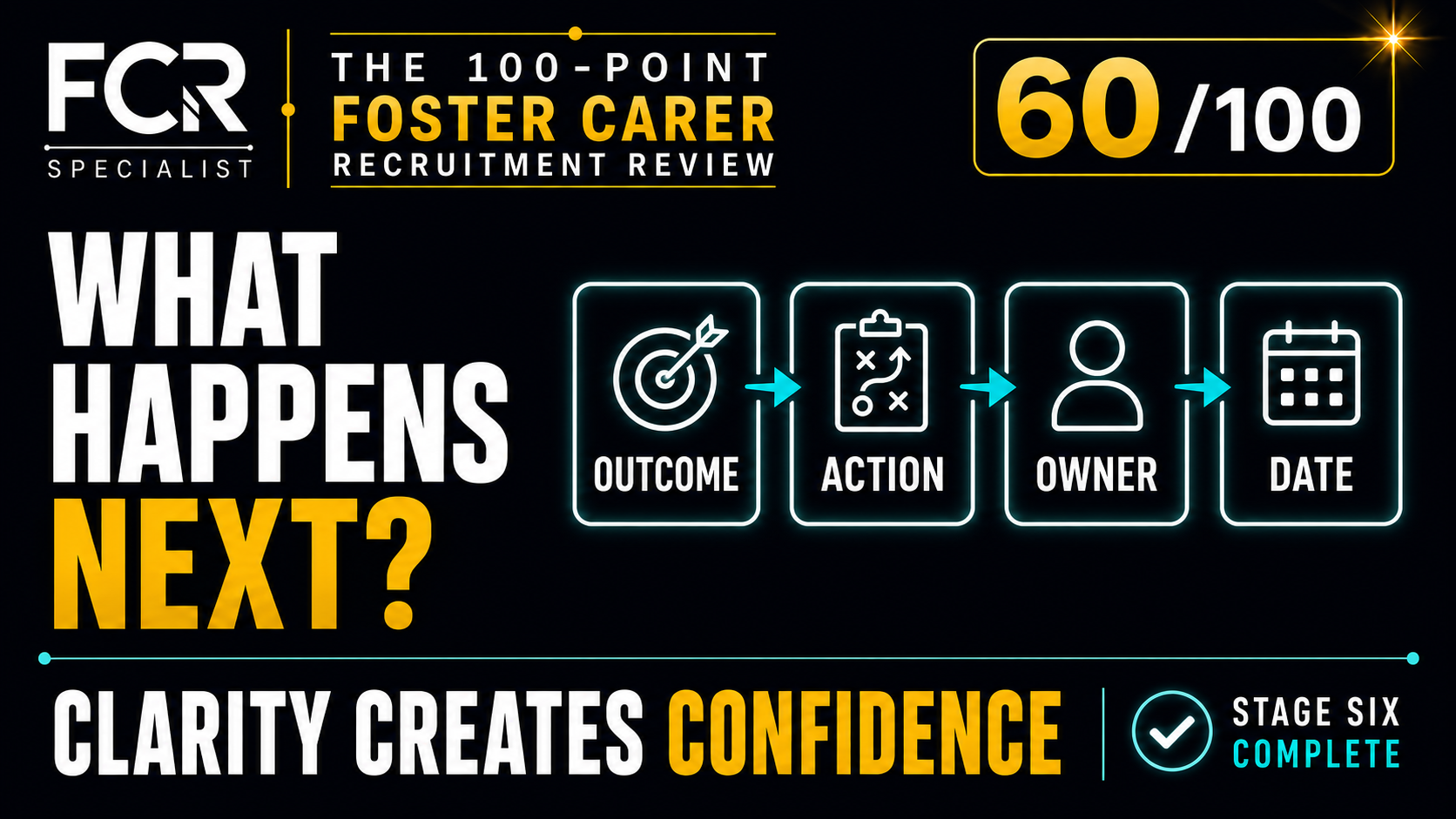
POINT 60/100 — DOES THE INITIAL VISIT END WITH CLARITY — OR ANOTHER WAIT?
POINT 60/100 — DOES THE INITIAL VISIT END WITH CLARITY — OR ANOTHER WAIT?
There is a moment during an Initial Visit that receives far less attention than it deserves.
The end.
The conversation is finished.
The coffee cups are empty.
The Social Worker gathers their things.
Everyone stands up.
And somebody says:
“Thanks very much. We'll take this back to the team and somebody will be in touch.”
The front door closes.
The professional gets into their car.
And the prospective Foster Carer is left in their home wondering:
What just happened?
Did we pass?
Were there concerns?
Did they like us?
Did I say something wrong?
Are we applying now?
Are they sending something?
Should I call them?
How long do we wait?
That is an extraordinary way to end one of the most important early interactions in Foster Carer Recruitment.
THE INITIAL VISIT SHOULD END WITH MORE CLARITY THAN IT STARTED WITH.
Not more uncertainty.
THE APPLICANT SHOULD NOT HAVE TO INTERPRET THE PROFESSIONAL
Social Workers understandably need time to reflect.
There may be information that needs checking.
They may need to speak with a manager.
Nobody should be expected to make a decision on the doorstep that requires professional consultation.
But that does not prevent clarity.
You can say:
“From what we've discussed today, I think there is a sensible basis for us to continue. I need to discuss two points with my manager before confirming the next stage. I will call you by Thursday afternoon.”
That is clear.
Or:
“There is one issue I need professional advice about before I can say whether progression is appropriate. I will explain exactly what that is, why it matters and when you should expect to hear from us.”
Also clear.
Or:
“Based on what we've discussed, we don't think fostering with our service is likely to be appropriate at the moment. I want to explain why rather than leave you waiting for another call.”
Difficult.
But clear.
The problem is not always lack of an immediate decision.
The problem is:
UNCERTAINTY WITHOUT A PLAN.
THIS IS THE CULMINATION OF POINTS 51–59
Stage Six began with Point 51:
Is the prospective Foster Carer ready for the Initial Visit?
Point 52 asked whether the visit fits their life, not merely the organisation's diary.
Point 53 asked who should be there.
Point 54 defined what the Initial Visit is actually for.
Point 55 looked at asking difficult questions at the right time and in the right way.
Point 56 widened the lens to the whole household.
Point 57 connected the household to potential Foster Carer capacity.
Point 58 argued for giving prospective Foster Carers the real picture.
Point 59 introduced:
PROGRESS + RESOLVE.
Point 60 now asks whether all of that thinking gets converted into an intelligible next step.
Because otherwise the Initial Visit can be excellent for 90 minutes and poor in the final two.
THERE SHOULD BE AN OUTCOME
This does not necessarily mean a final decision.
It means the applicant should know the current position.
I would use five broad outcomes.
1. PROGRESS
Nothing has emerged that currently prevents the next appropriate stage.
2. PROGRESS + RESOLVE
The household can continue while one or more clearly defined matters are addressed.
3. PAUSE + CLARIFY
Something potentially significant requires investigation before substantial progression.
4. NOT NOW
Fostering may remain realistic, but current circumstances make this the wrong time.
5. STOP
There is a clear reason progression is not appropriate.
Those outcomes do not replace professional procedures.
They describe the recruitment status in language people can actually understand.
THEN THERE SHOULD BE AN ACTION
What happens next?
Not:
“We'll progress you.”
What does progress actually mean?
Perhaps:
“Tomorrow I will send you the application information.”
Or:
“Our Assessing Social Worker will telephone you to arrange the next conversation.”
Or:
“I am booking you onto preparation training on 14 September.”
Or:
“I need to obtain advice from our medical adviser before we decide whether progressing is appropriate.”
An outcome without an action is still vague.
THEN GIVE THE ACTION AN OWNER
This is where many journeys disappear.
Suppose the Initial Visit concludes:
“We need some additional information about your employment.”
Who obtains it?
The applicant?
The Social Worker?
Recruitment?
HR?
A manager?
If nobody knows, nothing happens.
The same applies to:
- additional information;
- home improvements;
- partner conversations;
- references;
- specialist advice;
- application documents;
- training dates;
- manager decisions;
- and follow-up calls.
So every action should answer:
WHO OWNS THIS?
That may be the applicant.
That may be the fostering service.
Often it will be both.
AND THEN GIVE IT A DATE
This is perhaps the most important piece.
“I'll call you next week.”
When?
“Someone will contact you shortly.”
What does shortly mean?
“We'll discuss it at our meeting.”
When is the meeting?
A prospective Foster Carer should not be expected to understand internal organisational time.
Give a date.
Not necessarily:
“At precisely 10.42am.”
But:
“I will update you by Thursday.”
or:
“You will hear from us within three working days.”
or:
“Our training coordinator will contact you by the end of next week.”
And if something changes?
Contact them.
A MISSED DEADLINE WITH AN UPDATE IS MANAGEABLE.
A MISSED DEADLINE WITH SILENCE DAMAGES TRUST.
THE GOVERNMENT'S DIRECTION IS MOVING TOWARDS END-TO-END OWNERSHIP
This is particularly relevant to the Government's current fostering reform programme.
Renewing Fostering proposes an expanded regional hub model covering the whole journey from recruitment through assessment, approval and ongoing support.
One of its seven principles is a:
“journey guide” from enquiry to approval
providing responsive, dedicated support to prospective Foster Carers from first enquiry to decision. The model also envisages regular pipeline monitoring to identify delays and a regional system tracking applicants from enquiry through to approval.
That is significant.
Because a journey guide is the opposite of:
“Somebody will contact you.”
It implies:
- ownership;
- continuity;
- visibility;
- and responsibility for forward movement.
DON'T MAKE THE APPLICANT BECOME THE PROJECT MANAGER
This is a recurring flaw in recruitment processes generally.
The organisation has:
systems;
teams;
managers;
databases;
workflow;
calendars;
and professionals.
The prospective Foster Carer has none of those things.
Yet sometimes they are effectively expected to coordinate the journey.
“Have you heard from assessments yet?”
“Did recruitment send that?”
“Did somebody book your training?”
“Have you chased the medical?”
“Can you call us if nobody contacts you?”
No.
The applicant should not have to become the project manager of the organisation that is recruiting them.
THE SERVICE SHOULD MANAGE THE JOURNEY.
That does not mean removing applicant responsibility.
Applicants will have plenty to do.
It means the organisation remains accountable for the process it owns.
SEND A SHORT WRITTEN SUMMARY
This would be one of my strongest recommendations.
After the Initial Visit, send a brief written summary.
Not a complete professional assessment record.
Not confidential case analysis.
A simple applicant-facing confirmation.
For example:
Thank you for meeting us today.
Current position: Progress + Resolve.
Next step: Application / preparation stage.
Actions for you: Speak to employer about working flexibility.
Actions for us: Confirm training dates and provide information about teenage fostering.
Next contact: Rolfe will call you by Thursday 10 September.
That's enough.
The household now knows exactly where it stands.
THIS IS ALSO A DATA OPPORTUNITY
The 2023 DfE recruitment research repeatedly examined:
- follow-up;
- response times;
- who conducts follow-up;
- whether set timescales exist;
- how interactions are recorded;
- and where people leave the recruitment journey.
That suggests a clear management opportunity.
The CRM should not merely record:
Initial Visit Completed: Yes.
It should record:
INITIAL VISIT OUTCOME
NEXT ACTION
OWNER
DUE DATE
ACTUAL COMPLETION DATE
CURRENT STATUS
Now management can see something enormously useful:
WHERE IS THE PIPELINE STUCK?
This aligns directly with the 2026 reform model, which describes pipeline meetings used to track progress, identify delays and achieve faster approvals.
THE 48-HOUR QUESTION
I would not invent a universal national rule saying every service must complete every post-Initial-Visit action within 48 hours.
There isn't one.
But every organisation should establish its own reasonable operating standard.
For example:
How quickly should the written summary go out?
How quickly should the applicant receive the next appointment?
How quickly should a manager resolve an escalated question?
How quickly should someone be contacted after an unsuccessful or paused outcome?
Set standards.
Measure them.
Then improve them.
Without standards, words like:
soon
promptly
and:
shortly
cannot be managed.
THE PERSON SHOULD KNOW WHO THEIR CONTACT IS
Point 53 considered continuity and buddying.
Point 60 adds a simpler requirement.
At the end of the Initial Visit, the prospective Foster Carer should know:
WHO DO I CONTACT NOW?
Not a generic inbox if that can reasonably be avoided.
A person.
The Government's proposed journey guide model strongly reinforces this principle of dedicated support across the recruitment journey.
Perhaps the Initial Visit is conducted by somebody who will not remain involved.
That's fine.
Then explain the handover.
“From this point, Sarah becomes your main contact. I've already spoken with her and she will call you tomorrow.”
That is a handover.
Compare it with:
“Someone from assessments will probably contact you.”
One creates continuity.
The other creates a gap.
HANDOVERS ARE WHERE PEOPLE DISAPPEAR
Think of the recruitment journey:
MARKETING
↓
ENQUIRY
↓
RECRUITMENT
↓
INITIAL VISIT
↓
APPLICATION
↓
ASSESSMENT
↓
TRAINING
↓
PANEL
Every arrow is dangerous.
Because every arrow represents:
a different team;
a different person;
a different database;
a different email;
a different process;
or simply somebody assuming another person has taken responsibility.
That is why the principle developed earlier in the Review matters so much:
ONE HOUSEHOLD. ONE JOURNEY RECORD. MANY TOUCHPOINTS.
Every handover should transfer:
information
and:
ownership.
Not just information.
AND TELL THEM WHAT HAPPENS IF THEY DON'T HEAR FROM YOU
This is another small improvement.
At the end say:
“I expect you to hear from Sarah by Thursday. If for any reason you haven't heard by Friday, please contact me directly and I will sort it.”
Now there is a safety net.
That is very different from leaving someone wondering whether chasing will make them appear impatient.
Remember Point 55:
people can interpret organisational silence emotionally.
They may think:
We weren't good enough.
They don't want us.
We said something wrong.
Whereas the reality may be:
Sarah was off sick.
A manager forgot to approve something.
An email went into junk.
Simple operational failure can become applicant rejection in the person's mind.
NOT NOW NEEDS THE SAME CLARITY
Suppose the outcome is:
NOT NOW.
That should not mean:
“Come back sometime.”
Instead:
“We agree fostering still looks worth exploring, but because you are moving house in October it makes sense to pause. We will contact you during the first week of January. In the meantime we'll keep you updated with our information evenings if you'd like us to.”
Now:
Not Now
has become:
Not Now — and here is what happens next.
That protects future recruitment capacity.
STOP NEEDS CLARITY TOO
A service will occasionally conclude that progression is not appropriate.
Applicants deserve clarity there as well.
The response should be:
- respectful;
- accurate;
- proportionate;
- clear about the reason;
- and clear about any relevant formal process or options at the stage they have reached.
We should not use ambiguity to avoid an uncomfortable conversation.
“We'll discuss it and let you know”
should not become a way of slowly allowing somebody to realise the service is no longer interested.
That is poor recruitment practice.
THE INITIAL VISIT CLOSE
I would recommend the worker finishes every Initial Visit with five minutes deliberately reserved for this.
Perhaps:
1. REFLECT
“How are you feeling about fostering now compared with before we arrived?”
This checks the applicant's position.
2. SUMMARISE
“This is what I think we've established today.”
This checks mutual understanding.
3. OUTCOME
Progress / Progress + Resolve / Pause + Clarify / Not Now / Stop.
4. NEXT ACTION
What happens now?
5. OWNER + DATE
Who will do it and when?
Then ask:
“IS THERE ANYTHING YOU ARE LEAVING THIS CONVERSATION UNCLEAR ABOUT?”
That final question could prevent an enormous amount of misunderstanding.
HERE IS THE TEST…
Take your last 20 Initial Visits.
Do not look initially at whether they progressed.
Look only at what happened after the worker left the house.
For each one record:
- What was the outcome?
- Was the applicant told that outcome?
- Was it recorded?
- Was the next action explicit?
- Who owned it?
- Was there a due date?
- Did the applicant know when they would next hear from the service?
- Did they know from whom?
- Was a written summary sent?
- When?
- Did the promised action happen?
- Was it late?
- If it was late, did anyone proactively update the applicant?
- Did responsibility move between teams?
- Was there a documented handover?
- Did the applicant have to chase?
- How many times?
- Was anything repeated because information did not transfer?
- Were Progress + Resolve actions tracked?
- Were Pause + Clarify cases given review dates?
- Were Not Now cases placed into nurture?
- Were stopped cases given a clear explanation?
- Are there Initial Visits where nobody can now identify what should have happened next?
Then calculate something very simple:
INITIAL VISIT → NEXT MEANINGFUL ACTION
How long?
Not:
Initial Visit to CRM entry.
Not:
Initial Visit to internal meeting.
To the next meaningful thing the prospective Foster Carer experiences.
That is the applicant journey.
THE 100-ENQUIRY TEST RETURNS
Point 50 ended Stage Five by asking whether your enquiry system could account for all 100 enquiries.
Stage Six adds another layer.
Take those same 100 prospective Foster Carers.
How many reached Initial Visit?
And for every one who did, can you show:
WHEN IT HAPPENED
WHO ATTENDED
WHAT WAS LEARNED
WHAT THE OUTCOME WAS
WHAT ACTION WAS AGREED
WHO OWNED IT
WHEN IT SHOULD HAVE HAPPENED
WHEN IT ACTUALLY HAPPENED
WHAT HAPPENED NEXT
If you cannot reconstruct that journey, you cannot properly understand Initial Visit performance.
And you cannot distinguish:
applicant decision
from:
organisational delay.
STAGE SIX — THE INITIAL VISIT
So what have Points 51–60 established?
POINT 51
Enthusiasm ≠ readiness.
POINT 52
Accessibility does not stop when the enquiry form is submitted.
POINT 53
The right people — at the right part of the conversation.
POINT 54
The Initial Visit should inform the assessment — not become the assessment.
POINT 55
Context before conclusion.
POINT 56
You are recruiting into a household.
POINT 57
Don't recruit numbers. Develop capacity.
POINT 58
Don't sell fostering. Explain fostering.
POINT 59
A question mark is not always a stop sign.
And finally:
POINT 60
CLARITY CREATES CONFIDENCE. SILENCE CREATES DOUBT.
Together, they create a very different model of the Initial Visit.
Not:
a screening appointment.
Not:
a mini assessment.
Not:
a professional arriving to decide whether they like the applicant.
But:
A STRUCTURED, TWO-WAY, PROFESSIONAL RECRUITMENT CONVERSATION THAT ENDS WITH A CLEAR ROUTE FORWARD.
THE FINAL PRINCIPLE
At the end of every Initial Visit, both sides should know:
WHERE WE ARE.
WHAT HAPPENS NEXT.
WHO IS DOING IT.
WHEN IT WILL HAPPEN.
That is not complicated.
But it requires discipline.
And when fostering services are trying to recruit scarce Foster Carer capacity, it is extraordinary how much difference simple operational clarity can make.
DON'T MAKE THEM CHASE YOUR PROCESS.
MANAGE THE JOURNEY.
That closes Stage Six of The 100-Point Foster Carer Recruitment Review.
And it sets up the next stage perfectly.
Because once somebody has made the informed decision to progress, the recruitment relationship changes again.
They move towards application and formal assessment — where the risk of duplication, delay, unnecessary bureaucracy and losing good applicants remains very real.