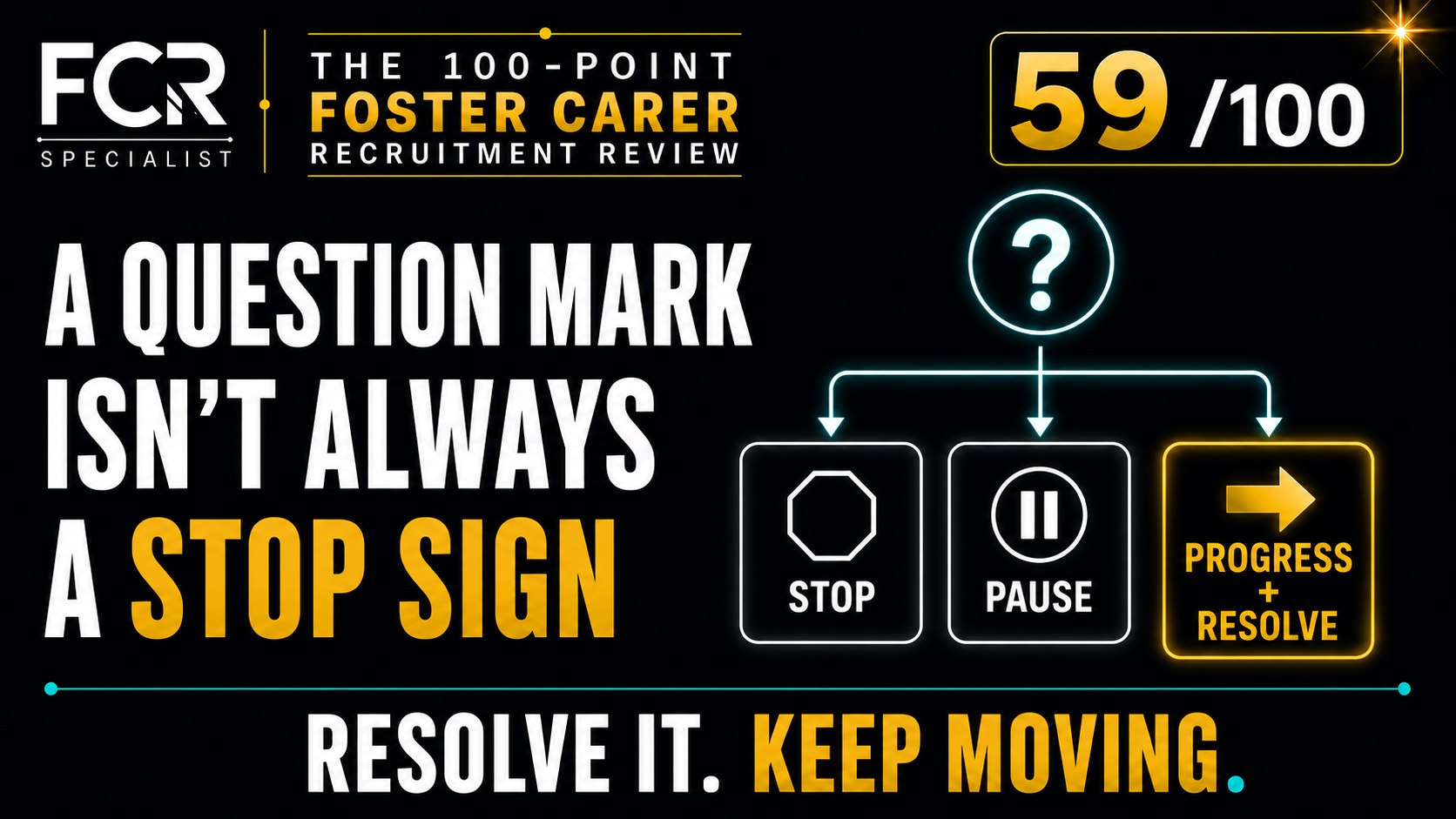
POINT 59/100 — PROGRESS + RESOLVE: MUST EVERYTHING BE FIXED BEFORE THEY MOVE FORWARD?
POINT 59/100 — PROGRESS + RESOLVE: MUST EVERYTHING BE FIXED BEFORE THEY MOVE FORWARD?
An Initial Visit has gone well.
The household appears promising.
They understand fostering better.
They want to continue.
But something isn't quite right.
Perhaps:
the proposed bedroom needs redecorating;
a fence needs repairing;
medication storage needs thinking about;
the applicant needs a clearer conversation with their employer;
a partner is supportive but still needs more understanding;
a pet requires further consideration;
the support network is weaker than originally thought;
a piece of information needs checking;
or a professional opinion is required before the service can reach a conclusion.
What happens?
In some recruitment systems:
EVERYTHING STOPS.
The applicant is told:
“Come back when that's sorted.”
And perhaps they do.
Perhaps they don't.
Three months later somebody looks at the enquiry record and says:
“They never came back.”
But was a complete stop actually necessary?
That is the question behind Point 59.
A QUESTION MARK IS NOT ALWAYS A STOP SIGN.
SOME THINGS ABSOLUTELY SHOULD STOP PROGRESSION
Before going further, this principle needs a substantial safeguard around it.
Progress + Resolve does not mean progress regardless.
There will be circumstances where the appropriate response is:
STOP.
Or:
PAUSE AND CLARIFY BEFORE GOING FURTHER.
For example, information may emerge that:
- raises a serious safeguarding concern;
- could mean the applicant is legally disqualified from ordinary fostering approval;
- fundamentally contradicts information already provided;
- raises serious concern about household safety;
- indicates significant unresolved disagreement within the household;
- or suggests the applicant may be unlikely to be suitable to foster.
Current statutory guidance provides mechanisms for ending assessment where information indicates that somebody is unsuitable, including the Stage 1 decision process and, once Stage 2 is involved, the brief-report procedure.
So this Point is not arguing that momentum is more important than safeguarding.
It isn't.
The question is:
DOES THIS ISSUE NEED TO STOP EVERYTHING — OR DOES IT SIMPLY NEED RESOLVING?
Those are different professional judgements.
THE REGULATORY FRAMEWORK ALREADY ALLOWS PARALLEL PROGRESS
There is an important fact here that I think is sometimes overlooked.
The statutory guidance on assessment and approval says:
- fostering assessment has two stages;
- they can be carried out concurrently;
- Stage 1 information should be sought as soon as possible;
- and the required Stage 1 decision must be made within 10 working days after all Stage 1 information has been received.
Stage 2 information can therefore be gathered while Stage 1 work continues.
The DfE's 2023 research found this was common practice precisely because services found it quicker and more efficient. Importantly, participants also said there were occasions where running the stages consecutively made sense — particularly when concerns required further investigation before committing to the full assessment.
That gives us a sensible professional model.
Not:
ALWAYS PROGRESS.
Not:
ALWAYS WAIT.
But:
TRIAGE THE ISSUE.
THREE POSSIBLE RESPONSES
I would simplify this into three categories.
1. STOP
There appears to be a clear reason why progression should not continue.
That needs proper professional decision-making and explanation.
2. PAUSE + CLARIFY
The issue could materially affect suitability, but there is insufficient information to know yet.
So investigate the issue before committing substantially more resource.
3. PROGRESS + RESOLVE
The issue matters, but there is no current reason why other appropriate parts of the journey cannot continue.
That distinction could prevent a significant amount of unnecessary delay.
WHAT MIGHT “PROGRESS + RESOLVE” LOOK LIKE?
Imagine the bedroom needs decorating.
Does the applicant need to spend two weekends redecorating it before they can attend preparation training?
Probably not.
The relevant requirement might simply be:
Bedroom completed to an appropriate standard before approval or placement.
So training can continue.
Conversations can continue.
Assessment can continue where appropriate.
The bedroom gets completed alongside them.
Another example:
The applicant works full-time and needs to discuss flexibility with their employer.
That is important.
But does the entire process necessarily need to halt until HR provides a letter?
Perhaps not.
The household can continue learning while the employment issue is clarified.
Another:
Their garden fence needs repairing.
Does that make them unsuitable to foster?
Not necessarily.
It may simply be:
repair required before the home can safely be used for a placement.
Another:
The applicant says:
“I'm not sure who would support us if we needed help.”
That is worth exploring.
Perhaps the assessment process itself helps them identify and strengthen their support network.
The existence of a development need is not automatically evidence of unsuitability.
ASSESSMENT SHOULD SOMETIMES DEVELOP READINESS — NOT MERELY TEST WHETHER READINESS ALREADY EXISTS.
DON'T DEMAND PLACEMENT-DAY READINESS AT INITIAL VISIT
This is particularly important.
At an Initial Visit, the household is not usually expecting a child to arrive tomorrow.
So why assess every practical detail as though they are?
Point 54 established:
THE INITIAL VISIT SHOULD INFORM THE ASSESSMENT — NOT BECOME THE ASSESSMENT.
Point 59 adds:
THE INITIAL VISIT SHOULD IDENTIFY WHAT NEEDS TO HAPPEN — NOT REQUIRE EVERYTHING TO HAVE ALREADY HAPPENED.
This is a major difference.
The first approach creates a plan.
The second creates unnecessary barriers.
THE WORD “BEFORE” MATTERS
Whenever someone identifies a requirement, ask:
BEFORE WHAT?
For example:
“The bedroom needs redecorating before…”
Before Initial Visit?
Before application?
Before assessment begins?
Before panel?
Before approval?
Before matching?
Before placement?
Those are completely different deadlines.
The phrase:
“That needs sorting before you can continue”
is often far too vague.
Professionals need to know the actual decision point.
Imagine the unnecessary delay created if something that needs completing before placement is treated as though it must be completed before assessment starts.
The requirement has not become safer.
It has simply moved earlier.
PUT EACH REQUIREMENT AT THE POINT WHERE IT ACTUALLY MATTERS.
THIS IS ALSO ABOUT APPLICANT MOTIVATION
Imagine being a prospective Foster Carer.
You have:
made an enquiry;
had several conversations;
invited somebody into your home;
talked honestly about your family;
and become increasingly interested.
Then you are told:
“Your garden fence needs attention. Give us another call once you've had it replaced.”
What message does that send?
Potentially:
“The relationship is now your responsibility.”
Compare that with:
“The fence will need resolving before we could safely place a child here. Let's record that as something to complete. In the meantime, there's no reason we can't continue with the next appropriate stage.”
Very different.
One closes the door.
The other creates a pathway.
BUT DON'T CREATE FALSE MOMENTUM
There is another side to this.
Suppose a substantial issue emerges.
Everyone knows it may fundamentally affect the application.
But because managers want conversion numbers looking healthy, the assessment continues anyway.
More visits.
More training.
More professional hours.
More emotional investment.
Then three months later the service concludes:
“Actually, the original concern means we cannot recommend approval.”
That isn't applicant-centred either.
Sometimes a deliberate pause is the fairest thing to do.
The DfE research recognised exactly this point: although concurrent assessment could make the journey more efficient, sequential work could be better where an application contained concerns requiring further investigation.
So:
PROGRESS WHEN PROGRESSION IS SENSIBLE.
PAUSE WHEN THE ANSWER MATTERS BEFORE ANYTHING ELSE DOES.
TURN ISSUES INTO ACTIONS
One of the simplest improvements would be to change the language used in records.
Instead of:
ISSUE: Garden unsuitable
write:
RESOLUTION: Fence repair required before home-safety requirement can be completed. Applicant obtaining quotation. Review by 15 October. Assessment can continue meanwhile.
Instead of:
ISSUE: Work
write:
RESOLUTION: Applicant exploring flexible working with employer. Review employment arrangements before final capacity/approval recommendation. Other assessment activity can continue.
Instead of:
ISSUE: Partner uncertain
write:
RESOLUTION: Separate discussion with partner required before decision to proceed to formal application. Do not progress until household commitment better understood.
Notice that the third example is different.
That may genuinely require a pause.
The point is not that everything becomes amber.
The point is:
SAY WHAT THE ISSUE MEANS OPERATIONALLY.
A SIMPLE PROGRESS + RESOLVE RECORD
For every unresolved issue, record five things:
ISSUE
What exactly needs attention?
WHY IT MATTERS
What decision, safety requirement or piece of evidence does it affect?
ACTION
What needs to happen?
OWNER + DATE
Who will do it, and when will it be reviewed?
STATUS
STOP
PAUSE + CLARIFY
or:
PROGRESS + RESOLVE
That's enough.
No new twelve-page form.
Just disciplined management.
WHO OWNS THE ACTION?
This matters enormously.
Sometimes a prospective Foster Carer is told:
“Sort X and come back to us.”
The organisation then does nothing.
That is not nurture.
That is abandonment with an action point.
For every unresolved matter, ownership should be explicit.
Some actions belong to the applicant.
Some belong to the fostering service.
Some belong to both.
For example:
Applicant: speak to employer.
Service: provide clear explanation of likely fostering time commitments.
Applicant: obtain information.
Service: seek professional advice.
Applicant: repair garden fence.
Service: confirm precisely what standard is required.
Both: review progress on agreed date.
PROGRESS + RESOLVE NEEDS A PLAN — NOT A VAGUE PROMISE TO COME BACK LATER.
DO NOT MAKE PEOPLE SPEND MONEY TOO EARLY
This deserves its own section.
Prospective Foster Carers may be asked to consider changes to their homes.
Some may be inexpensive.
Others may not be.
Before telling somebody to:
replace fencing;
convert a room;
buy equipment;
change a vehicle;
alter employment;
or make another significant financial commitment,
ask:
DO THEY ACTUALLY NEED TO DO THIS YET?
And:
ARE WE CONFIDENT THIS APPLICATION IS LIKELY TO PROGRESS FAR ENOUGH TO JUSTIFY IT?
It would be unreasonable to encourage substantial expenditure unnecessarily early.
Sometimes the correct resolution plan is:
Requirement identified now — action deferred until later decision point.
That is still progress.
WAITING FOR CHECKS DOES NOT ALWAYS MEAN WAITING TO LEARN
Formal assessment requires significant information and checks.
Stage 1 includes matters such as health information, household details, references and DBS information. GOV.UK confirms that Stage 1 and Stage 2 may be undertaken separately or together.
Some checks inevitably take time.
The statutory guidance specifically permits Stage 2 work to progress in parallel with Stage 1.
That means services should examine how much dead time exists in their processes.
If a DBS check is pending, what else can appropriately happen?
If a medical report is being obtained, what else can happen?
If references are progressing, can preparation activity continue?
The answer will depend on circumstances.
But:
“WE ARE WAITING FOR X” SHOULD NOT AUTOMATICALLY MEAN “NOTHING ELSE HAPPENS.”
That is how assessment journeys become unnecessarily long.
THERE IS AN IMPORTANT LEGAL QUALIFICATION
Parallel working does not remove decision requirements.
The statutory guidance sets specific rules around Stage 1 decisions, Stage 2, brief reports and termination of assessment. Once Stage 2 has commenced, services cannot simply treat later decisions as though they were still informal pre-assessment screening.
This matters operationally.
A service needs to understand:
what stage the applicant is actually at.
Not simply call everything:
“the recruitment process.”
The law and procedural rights can differ according to where the person is in the journey.
That strengthens the argument for clear process design.
A DEVELOPMENT NEED IS NOT THE SAME AS A DEFICIT
This also links back to the DfE research.
The 2023 report described relational and strengths-based recruitment as an enabler and noted concerns about deficit approaches, overly strict eligibility screening and judgemental practice.
That is relevant here.
Suppose someone lacks knowledge about trauma.
Why would they already know it?
That's partly what preparation training is for.
Suppose their support network has not yet thought seriously about fostering.
Perhaps they need time and information.
Suppose a child in the household has understandable concerns.
Perhaps those concerns need conversation and support.
We should distinguish:
A CAPABILITY THAT CAN DEVELOP
from:
A FUNDAMENTAL BARRIER TO FOSTERING.
Otherwise we risk recruiting only people who somehow arrive fully formed.
THE RED / AMBER / GREEN TEST
For management purposes, the simplest model may be:
RED — STOP
A clear barrier or serious concern makes continuation inappropriate.
AMBER — PAUSE + CLARIFY
The issue could materially affect suitability and needs resolving before significant further progression.
GREEN/AMBER — PROGRESS + RESOLVE
Something needs changing, confirming or developing, but appropriate parts of the journey can continue safely.
The terminology matters less than the discipline.
Every service should be able to explain:
Why did this case stop?
Why did this case pause?
Why did this case continue while something remained unresolved?
HERE IS THE TEST…
Take the last 20 prospective Foster Carers whose journeys were paused before or during assessment.
For each one ask:
WHAT EXACTLY CAUSED THE PAUSE?
Then ask:
- Was it a legal requirement?
- A safeguarding concern?
- A service policy?
- A professional judgement?
- An administrative dependency?
- A property issue?
- A household issue?
- A missing check?
- A development need?
- Or simply the way the process has always been sequenced?
Then examine the timing.
- What activity genuinely could not continue?
- What activity could have continued safely?
- How long did the pause last?
- Was a review date agreed?
- Who owned the next action?
- Did the applicant understand what needed resolving?
- Did the service explain why?
- Were they given a clear route back?
- Did somebody maintain contact during the pause?
- Did the applicant eventually return?
- If not, was the delay a contributing factor?
- Did someone have to repeat activity because the pause lasted too long?
- Did the organisation require home improvements unnecessarily early?
- Did people spend money before there was sufficient confidence they would progress?
- Were checks run sequentially simply through habit?
- Are Stage 1 and Stage 2 routinely run concurrently where appropriate?
- Where they are not, why not?
- Are recruiters able to distinguish a hard barrier from a resolvable condition?
- Are Social Workers?
- Are managers?
- Does the CRM distinguish stopped, paused and progressing with actions?
Then ask:
HOW MANY PEOPLE HAVE WE LOST BECAUSE WE TURNED A RESOLVABLE ISSUE INTO A DEAD END?
That is worth knowing.
MANAGERS SHOULD ALSO LOOK AT PAUSE LENGTH
A managed pause is not inherently a problem.
An unmanaged pause is.
A household might reasonably need:
three weeks;
three months;
or longer.
The relevant measure is not simply elapsed time.
It is whether there is:
a reason
a plan
an owner
and:
a review point.
Without those things, “pause” becomes storage.
People disappear into CRM categories such as:
ON HOLD
NOT NOW
PENDING
and nobody can explain what would cause them to move again.
That is not management.
“NOT NOW” STILL NEEDS NURTURE
There will also be circumstances where the issue genuinely cannot be resolved quickly.
Perhaps:
a house move;
a significant family event;
bereavement;
pregnancy;
a major employment change;
relationship change;
or another substantial life circumstance.
It may be sensible to pause the recruitment journey.
But:
PAUSE THE PROCESS — NOT THE RELATIONSHIP.
Agree when you will reconnect.
Provide information.
Invite them to appropriate events.
Keep them within a thoughtful nurture route where they consent to that.
The fact that somebody cannot progress today does not mean they will never become a Foster Carer.
DfE research itself notes that enquiries can take years to progress to application in some cases, making simplistic short-window conversion measures unreliable.
The door does not have to slam shut.
PROGRESS + RESOLVE CAN ALSO REDUCE ASSESSMENT TIME
There is an efficiency issue here too.
If every task is completed sequentially:
Task A
then:
Task B
then:
Task C
then:
Task D
the total journey becomes the sum of all four.
If appropriate activity can happen concurrently:
A + B + C
with D completed before its relevant decision point,
the overall time can reduce substantially without reducing scrutiny.
That is process engineering, not cutting corners.
The statutory model itself permits concurrency.
Good recruitment should exploit that intelligently.
THE CENTRAL MANAGEMENT QUESTION
Every time someone says:
“We can't move forward until…”
ask:
WHY NOT?
Not confrontationally.
Professionally.
What exactly is dependent upon the unresolved issue?
What risk would continuing create?
What regulation requires the sequence?
What decision cannot be taken?
Could some other work continue?
Sometimes the answer will confirm that the pause is absolutely right.
Excellent.
Sometimes the answer may be:
“Because that's how we've always done it.”
That deserves another look.
THE PRINCIPLE
We should not lower the bar for becoming a Foster Carer.
We should remove unnecessary waiting on the way to reaching it.
Those are completely compatible objectives.
So when a potentially good household has something to resolve:
do not ignore it;
do not minimise it;
do not automatically stop everything either.
Classify it.
Explain it.
Plan it.
Own it.
Review it.
And continue anything that can safely and appropriately continue.
PROGRESS + RESOLVE.
Because:
A QUESTION MARK IS NOT ALWAYS A STOP SIGN.
And:
SAFEGUARDING DEFINES THE STANDARD.
GOOD PROCESS DESIGN DEFINES HOW EFFICIENTLY WE REACH IT.
That takes us to the final Point in Stage Six.
Point 60 asks: