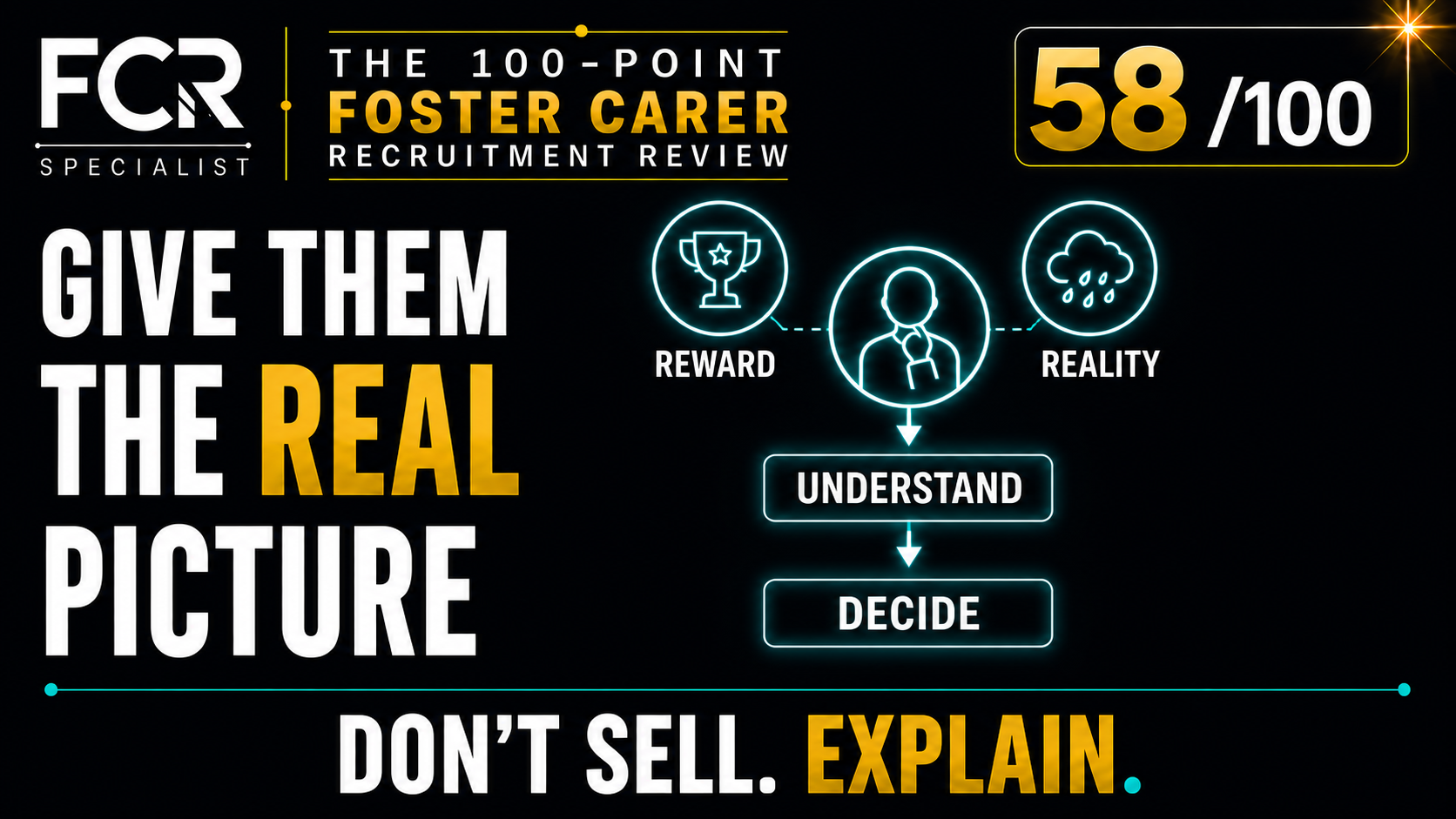
POINT 58/100 — ARE YOU GIVING THEM THE REAL PICTURE BEFORE THEY SAY YES?
POINT 58/100 — ARE YOU GIVING THEM THE REAL PICTURE BEFORE THEY SAY YES?
There is an understandable temptation in Foster Carer Recruitment.
You have somebody sitting in front of you who appears promising.
They like children.
They have space.
The household appears positive.
The conversation is going well.
And you desperately need more Foster Carers.
So what do you emphasise?
The positive parts.
Making a difference.
Changing a child's life.
Becoming part of a fostering family.
Support.
Training.
Reward.
Purpose.
Belonging.
All of those things can be completely true.
But if that is almost all somebody hears before deciding to progress, have they actually made an informed decision?
FOSTERING IS WONDERFUL.
FOSTERING CAN ALSO BE VERY HARD.
Both statements can exist at the same time.
Good recruitment should be able to hold both.
THE DfE HAS ALREADY IDENTIFIED THE PROBLEM
The Department for Education's 2023 research into Foster Carer Recruitment contains an important finding.
Participants said that people's expectations of fostering do not always match its reality.
The research suggested that more honest information about the role earlier in recruitment would allow some prospective Foster Carers to decide for themselves that they were not ready or willing to take on the responsibility.
It specifically criticised unrealistic recruitment narratives — for example, portraying Foster Carers as superheroes or providing an excessively simplified picture of fostering.
That is important.
Because sometimes we treat somebody deciding:
“Actually, this isn't right for us.”
as recruitment failure.
It may not be.
If they reached that decision because we finally gave them accurate information, the recruitment process may have worked.
GOOD RECRUITMENT DOES NOT MAXIMISE YES.
IT MAXIMISES INFORMED YES.
DON'T CONFUSE POSITIVITY WITH SALES
Fostering services should absolutely promote fostering positively.
Children need Foster Carers.
There are thousands of extraordinary Foster Carers doing remarkable things every day.
But there is a difference between:
positive recruitment
and:
selective recruitment information.
If we say:
“You could transform a child's life.”
we should also explain that the child may not initially trust them.
If we say:
“You'll become part of a fostering community.”
we should also explain the professional responsibilities involved.
If we say:
“You'll receive financial support.”
we should explain exactly what the service pays and what those payments are intended to cover.
If we talk about matching, we should explain that finding the right match matters more than simply filling a vacancy.
If we describe support, we should explain what that support actually looks like at 9pm when something is going badly.
This isn't negativity.
It is credibility.
WHAT DOES THE ROLE ACTUALLY INVOLVE?
Current GOV.UK guidance gives prospective Foster Carers a useful starting point.
It explains that Foster Carers need to:
- care for children as part of a professional team;
- work with local authorities, schools, health professionals and potentially the child's birth family;
- keep records and reports;
- attend meetings;
- advocate for children;
- support children to manage behaviour and emotions;
- and undertake training.
That is considerably more substantial than:
“Provide a loving home.”
Of course a loving home matters.
But fostering is not simply parenting another person's child.
FOSTERING IS CARE + RELATIONSHIPS + PROFESSIONAL RESPONSIBILITY.
The Initial Visit should begin making that distinction real.
CHILDREN MAY NOT RESPOND THE WAY THE ADVERT IMPLIED
Recruitment imagery often understandably shows warmth.
Smiles.
Activities.
Family meals.
Days out.
Connection.
But children entering foster care may have experienced:
- neglect;
- abuse;
- disrupted attachments;
- instability;
- loss;
- multiple moves;
- school disruption;
- uncertainty;
- and profound reasons not to trust adults quickly.
A prospective Foster Carer needs to understand that:
providing safety does not guarantee immediate trust.
A child might reject affection.
Test boundaries.
Be angry.
Withdraw.
Appear indifferent.
Want to return home.
Say they hate living there.
None of that means fostering has failed.
But somebody who imagined:
“I'll give a child love and they'll immediately respond positively”
may find the reality extraordinarily difficult.
That is why preparation matters.
FOSTERING IS ALSO ABOUT THE CHILD'S FAMILY
This can surprise some applicants.
A Foster Carer does not normally replace the child's birth family.
They may need to:
- support family time/contact;
- help children maintain important relationships;
- speak respectfully about parents;
- cooperate with professionals;
- manage the emotions around family contact;
- and sometimes support a plan for the child to return home.
For somebody whose instinct is:
“I will rescue this child from their family,”
that can require a major change in thinking.
A stronger fostering mindset is often:
“I AM HERE TO CARE FOR THIS CHILD — NOT TO ERASE THEIR HISTORY.”
That needs introducing early enough.
Not every detail at the Initial Visit.
But enough to begin testing expectations.
FOSTERING WILL ENTER YOUR PRIVATE FAMILY LIFE
Point 56 explored the whole household.
Point 58 now needs to tell the household what that can actually mean.
A fostered child may affect:
- routines;
- privacy;
- holidays;
- relationships;
- time with own children;
- household finances;
- work;
- weekends;
- bedrooms;
- social activity;
- and spontaneity.
Professionals may visit the home.
Meetings will happen.
Training needs attending.
Records need completing.
Plans can change.
Children can arrive unexpectedly.
Placements can end unexpectedly.
Sometimes the family will become enormously attached to a child who then leaves.
That emotional reality matters.
BE CLEAR ABOUT MONEY
Money should not be whispered about as though wanting financial clarity means somebody has the wrong motivation.
The DfE's recruitment research found financial compensation was one of the key pieces of information prospective Foster Carers seek when considering fostering.
Current GOV.UK guidance says all Foster Carers receive an allowance to cover the costs of caring for a child, with the amount depending on factors including location, fostering service, the child's age and needs, and Foster Carer skills and experience.
But the organisation should explain its own offer properly.
Not:
“You can earn up to £X.”
unless somebody will also explain exactly when that figure applies.
Prospective Foster Carers should understand, as relevant to the particular service:
- the allowance;
- any professional fee or reward payment;
- what each element is intended to cover;
- whether payments differ by child or approval type;
- what happens between placements;
- mileage;
- equipment;
- birthdays and holidays;
- respite arrangements;
- tax treatment;
- and any other relevant financial support.
Do not hide money.
FINANCIAL CLARITY IS PART OF INFORMED CONSENT.
There is another important employment issue.
GOV.UK currently states that Foster Carers do not have a statutory right to time off work to care for foster children.
If the household intends to combine fostering with employment, that is worth knowing.
EXPLAIN THE SUPPORT — SPECIFICALLY
It is easy to say:
“You'll have lots of support.”
What does that actually mean?
Government guidance says Foster Carer families should have access to:
- out-of-hours advice and support;
- support groups;
- practical, financial and emotional support;
- training and personal development;
- and opportunities to take breaks from fostering.
So explain your service.
Who is the Supervising Social Worker?
How frequently do they visit?
What happens out of hours?
Who answers the telephone at midnight?
Is there peer support?
Can the applicant speak to experienced Foster Carers?
What respite or breaks are available?
What training exists?
How is additional support accessed when a placement becomes difficult?
Don't sell the word support.
Describe the service behind it.
SUPPORT IS NOT A WORD. IT IS AN OPERATING MODEL.
AND TALK ABOUT ALLEGATIONS
This is one of the difficult realities of fostering.
An allegation may be made against a Foster Carer or someone in their household.
That does not mean the allegation is proven.
But the experience can be highly stressful.
The Government has recognised concerns around the handling of allegations strongly enough that it consulted on reforms in February 2026 and published its response in June 2026.
Should an Initial Visit provide a detailed lecture on allegation procedures?
No.
But should somebody be told before approval that allegations are a recognised occupational reality within fostering?
I believe they should.
Not dramatically.
Not frighteningly.
Simply honestly.
For example:
“Because Foster Carers look after vulnerable children, concerns or allegations can sometimes arise. There are procedures for investigating them and the service should explain what support would be available. We'll cover this properly during preparation and assessment.”
That is enough at this point.
The worst approach is allowing someone to discover the existence of allegations after one has been made.
GIVE THEM REAL FOSTER CARERS
This is another reason Point 53's buddy concept matters.
The DfE found that people coming through existing Foster Carer referrals could arrive at the recruitment process with more realistic expectations because they had access to lived experience.
A professional can explain fostering accurately.
But an experienced Foster Carer can say:
“This bit was much harder than I expected.”
and:
“This was the moment I realised why I love fostering.”
and:
“This is what support actually feels like when you're having a difficult week.”
That authenticity is enormously valuable.
But again:
Do not select only the Foster Carer who says everything is wonderful.
LIVED EXPERIENCE SHOULD BE REAL — NOT SCRIPTED TESTIMONIAL.
THERE IS SUCH A THING AS TOO MUCH INFORMATION
There is an important counterargument.
If the Initial Visit becomes a two-hour list of everything that might ever go wrong in fostering, the service has got the balance wrong again.
Point 55 established:
TRANSPARENCY EARLY DOES NOT MEAN INTRUSIVE EXPLORATION PREMATURELY.
The same applies here.
We need progressive realism.
At enquiry stage:
Give a clear broad picture.
At Initial Visit:
Deepen the understanding.
During preparation training:
Bring the realities to life.
During assessment:
Explore how this household may respond to them.
Before approval:
Make sure expectations are properly tested.
So:
REALISM SHOULD INCREASE AS COMMITMENT INCREASES.
That is different from dropping a 70-page fostering handbook on somebody at the first meeting.
WHAT SHOULD SOMEBODY UNDERSTAND AFTER THE INITIAL VISIT?
Not everything.
But I would hope they understand at least this:
1. FOSTERING IS ABOUT CHILDREN WITH INDIVIDUAL NEEDS
Not simply “children who need love”.
2. FOSTERING INVOLVES PROFESSIONAL RESPONSIBILITY
Meetings, records, training and collaboration.
3. FOSTERING AFFECTS THE WHOLE HOUSEHOLD
Not just the applicant.
4. FOSTERING INVOLVES BIRTH-FAMILY RELATIONSHIPS
The child's family does not disappear.
5. FINANCE NEEDS TO WORK
And they understand the broad structure of the service's payments.
6. SUPPORT EXISTS — AND THEY KNOW WHAT THAT MEANS
Not simply that the brochure says “24/7 support”.
7. DIFFICULT THINGS CAN HAPPEN
Placements can struggle.
Children can move.
Allegations can occur.
The work can be emotionally demanding.
8. FOSTERING CAN BE EXTRAORDINARILY REWARDING
But the reward is not always immediate, visible or tidy.
That's a realistic beginning.
DON'T OVERSIMPLIFY THE REWARD
One of the strongest recruitment phrases is:
“Make a difference to a child's life.”
And Foster Carers absolutely can.
But prospective Foster Carers should understand that “making a difference” may look like:
a child finally sleeping through the night;
remaining at the same school;
learning that adults can be consistent;
maintaining a relationship with siblings;
returning safely to birth family;
moving successfully to adoption;
learning to regulate difficult feelings;
or simply living in a stable home for several months.
The Foster Carer may not receive a dramatic thank-you.
They may not immediately see the impact.
Sometimes the most important work is quiet.
THE REWARD IS REAL.
BUT IT IS NOT ALWAYS INSTANT.
THE “REAL PICTURE” TEST
There is a useful thought experiment.
Imagine your most experienced Foster Carer sitting silently during your Initial Visit.
Would they recognise the fostering role you have just described?
Or would they be thinking:
“That's technically true, but that's not really what it feels like.”
If experienced Foster Carers routinely need to correct expectations later during preparation training, recruitment is probably not giving enough reality earlier.
HERE IS THE TEST…
Take the last ten Initial Visits completed by your service.
For each one, look at what information was provided.
Was there meaningful discussion about:
- children's emotional and behavioural needs?
- trauma and loss?
- the professional role?
- birth families?
- contact/family time?
- records and meetings?
- training?
- impact on own children?
- employment?
- finances?
- payment when no child is placed?
- support?
- out-of-hours help?
- respite/breaks?
- placement endings?
- allegations?
- matching?
- the possibility that fostering may sometimes be extremely difficult?
Then ask:
- Does every worker explain these consistently?
- Or does it depend on who conducts the visit?
- Are Foster Carers involved in giving the real picture?
- Are they free to speak honestly?
- Does your website present a realistic picture too?
- Are payment figures clear or promotional?
- Are phrases such as “up to £X” properly explained?
- Does “24/7 support” have operational substance?
- Do applicants know who they actually call out of hours?
- Are own children told enough?
- Are applicants told about professional recording and meetings?
- Are birth-family relationships discussed positively and realistically?
- Are allegations mentioned before approval?
- When applicants withdraw later saying “fostering wasn't what I expected”, do you trace that back to what they were told during recruitment?
- Do you ask newly approved Foster Carers:
“What do you wish someone had told you at your Initial Visit?”
That last question could improve the process enormously.
CREATE A REALITY CHECK — NOT ANOTHER FORM
I would not create a lengthy checklist and ask prospective Foster Carers to sign it.
That defeats the purpose.
Instead, build a Reality Conversation into the Initial Visit.
Perhaps six headings:
THE CHILD
Who might need fostering and why?
THE ROLE
What will the Foster Carer actually do?
THE HOUSEHOLD
What might change at home?
THE PROFESSIONAL SYSTEM
Who will be involved?
MONEY + WORK
How might fostering affect finances and employment?
SUPPORT + DIFFICULT TIMES
What happens when things get hard?
That's enough structure.
Then:
ASK WHAT SURPRISED THEM.
That question is powerful.
“Now we've discussed all of that, is there anything about fostering that sounds different from what you had imagined?”
Listen carefully to the answer.
WITHDRAWAL AFTER REALISM IS NOT NECESSARILY FAILURE
Suppose somebody says:
“I hadn't realised there would be so much involvement with birth family. I don't think this is for me.”
Do not immediately think:
lost applicant.
Perhaps you have prevented:
- months of assessment;
- considerable Social Worker time;
- applicant frustration;
- panel preparation;
- and ultimately an approval unlikely to be sustainable.
A recruitment service under numerical pressure may dislike that outcome.
A well-run service should recognise its value.
EARLY INFORMED WITHDRAWAL CAN BE BETTER THAN LATE DISILLUSIONMENT.
The objective is not to get everybody through the door.
It is to help the right people walk through the door with their eyes open.
THE OTHER POSSIBILITY IS EVEN MORE IMPORTANT
Someone may hear the real picture and say:
“Yes. That's more involved than I realised. But actually, knowing that makes me want to continue.”
That is a much stronger yes.
It has survived reality.
The relationship becomes more credible because the service has not hidden the difficult parts.
Trust grows.
That is the recruitment value of honesty.
THE PRINCIPLE
There is no need to make fostering sound worse than it is.
There is also no need to make it sound easier than it is.
Tell the truth.
Tell the positives.
Tell the difficult parts.
Explain the support.
Use lived experience.
Allow questions.
And let the household decide.
DON'T SELL FOSTERING.
EXPLAIN FOSTERING.
Because:
AN INFORMED YES IS WORTH MORE THAN AN UNINFORMED YES.
And that leads directly into Point 59.
Because sometimes the real picture exposes something that needs resolving before progression.
The question then becomes: