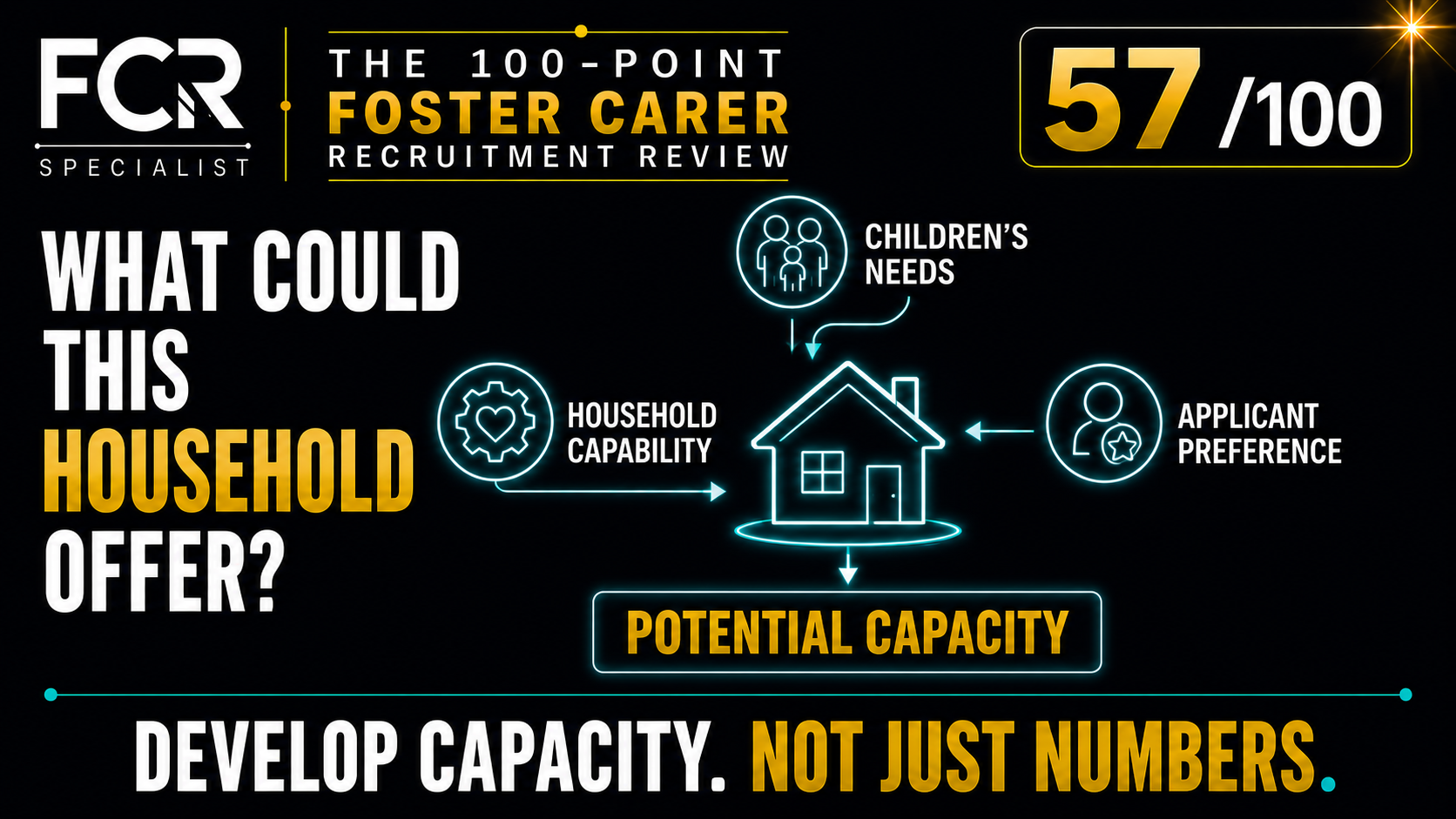
POINT 57/100 — WHAT COULD THIS HOUSEHOLD ACTUALLY OFFER?
POINT 57/100 — WHAT COULD THIS HOUSEHOLD ACTUALLY OFFER?
Imagine two prospective Foster Carer households.
Both have been through a positive Initial Visit.
Both appear potentially suitable.
Both have a spare bedroom.
Both may eventually become approved Foster Carers.
Are they therefore the same recruitment outcome?
Not remotely.
One household might realistically provide:
one long-term placement for a primary-school-aged child.
Another might have the space, experience and family support to care for:
three siblings.
Another could potentially be particularly strong with:
teenagers.
Another may have professional experience relevant to:
children with disabilities or complex needs.
Another might be suitable for:
parent and child fostering.
Another may be ideally located for children who need to remain close to a particular school, family network or community.
This is where Foster Carer Recruitment needs to reconnect with sufficiency.
AN APPROVED HOUSEHOLD IS NOT A UNIT OF GENERIC CAPACITY.
It is a particular household with particular strengths, limitations, preferences, geography and potential.
THE NATIONAL PROBLEM IS NOT SIMPLY “NOT ENOUGH FOSTER CARERS”
England absolutely does need more Foster Carers.
Ofsted reported that there were 42,190 fostering households across all forms of fostering at 31 March 2025, with mainstream Foster Carer numbers continuing to decline. Among mainstream fostering households, the number leaving continued to exceed the number joining.
Government has consequently committed to creating up to 10,000 additional foster-care places during this Parliament.
But the latest national sufficiency analysis adds an important qualification.
The Department for Education's July 2026 publication says children's social-care sufficiency is shaped by a complex interaction of:
- availability;
- suitability;
- geography;
- workforce;
- and children's particular needs.
It specifically finds that shortages of Foster Carers are associated with more — and younger — children entering children's homes, while wider system pressure contributes to children being placed further from home when appropriate specialist provision is not available locally.
So:
THE PROBLEM IS NOT ONLY QUANTITY.
IT IS THE RIGHT CAPACITY, IN THE RIGHT PLACE, FOR THE RIGHT CHILDREN.
That is why Point 57 belongs at the Initial Visit.
THIS CONNECTS DIRECTLY BACK TO SUFFICIENCY
Earlier in the 100-Point Review we argued that recruitment strategy should begin with:
Which children need placements?
Where?
What type of Foster Carer capacity is missing?
If your sufficiency analysis tells you that your major gaps are:
- teenagers;
- sibling groups;
- children with disabilities;
- children with more complex needs;
- long-term care;
- emergency capacity;
- parent-and-child placements;
- or a particular geography;
that intelligence should not disappear once somebody enquires.
It should inform the conversation.
Not dominate it.
Inform it.
Local authorities are already explicitly identifying these kinds of priorities. Hertfordshire, for example, currently highlights sibling groups, children over 10 and teenagers, children with disabilities, children with complex health and emotional needs and children needing long-term placements among its priority groups.
Hackney similarly describes current need across children aged 4–12, teenagers, sibling groups, children with disabilities, specialist fostering and parent-and-child fostering.
These are not universal national recruitment specifications.
Every area is different.
That is exactly the point.
YOUR RECRUITMENT CONVERSATIONS SHOULD KNOW WHAT YOUR SUFFICIENCY STRATEGY SAYS.
THREE THINGS NEED TO OVERLAP
I think there is a very simple way to approach this.
At the Initial Visit, begin exploring three things.
1. CHILDREN'S NEEDS
What Foster Carer capacity does your organisation actually need?
2. HOUSEHOLD CAPABILITY
What could this household realistically develop the capacity to provide?
3. APPLICANT PREFERENCE
What kinds of fostering can this household realistically imagine and genuinely wants to explore?
Where those three things overlap, you potentially have:
SUSTAINABLE FOSTER CARER CAPACITY.
If one is missing, problems begin.
DON'T LET SUFFICIENCY BECOME SALES PRESSURE
Imagine your service desperately needs Foster Carers for teenagers.
A prospective Foster Carer says:
“I think we'd be much more comfortable with a child under eight.”
The temptation may be to sell.
“Teenagers are brilliant.”
“You'd be perfect.”
“Actually we really need teenage carers.”
There is nothing wrong with giving accurate information or challenging stereotypes.
People's initial preferences can be based on misconceptions.
Someone may imagine:
teenager = serious behavioural difficulty
without ever having had an informed conversation about teenage fostering.
So absolutely explain.
Let them meet Foster Carers.
Let them hear lived experience.
Help them understand.
But there is a line between:
BROADENING UNDERSTANDING
and:
PUSHING SOMEBODY INTO YOUR VACANCY.
A fostering household that reluctantly agrees to a type of fostering it never really wanted has not solved your sufficiency problem.
It may simply have deferred it.
APPLICANT PREFERENCES MATTER
Current GOV.UK guidance explicitly recognises that applicants will state preferences about the children they are willing to care for, for example around age or gender.
Those preferences may change through:
- information;
- preparation training;
- assessment;
- meeting existing Foster Carers;
- greater understanding of children's needs;
- and increased confidence.
That is normal.
But the process should be developmental rather than coercive.
A useful conversation is:
“Tell me what you've imagined so far.”
Then:
“What makes you feel that age group would suit you?”
Then:
“Is there anything you definitely don't feel comfortable with?”
Then:
“Would it be useful if I explained some of the other kinds of fostering we need locally?”
That is exploration.
HOUSEHOLD CAPABILITY IS MUCH BROADER THAN A BEDROOM
Point 56 established that:
SPARE ROOM ≠ HOUSEHOLD CAPACITY.
So what should we start exploring?
LOCATION
Where does the household live?
This is not merely postcode administration.
Location affects:
- school continuity;
- family contact;
- travel;
- existing relationships;
- community;
- health provision;
- and the ability to keep children connected to the area they know.
Local placement sufficiency matters because national evidence shows that shortage of suitable local provision contributes to children being placed further from home.
A fantastic Foster Carer in the wrong location for a particular child's needs may not be the right match for that child.
BEDROOMS
One bedroom?
Two?
Potentially more?
Could siblings be accommodated?
Would children have appropriate space?
But don't turn bedrooms into automatic capacity.
Three spare rooms do not automatically mean:
“Great — sibling group of three.”
The household must have the emotional, practical and relational capacity too.
HOUSEHOLD COMPOSITION
What are the ages of the Foster Carers' own children?
What other children live there?
What relationships already exist?
This may influence the age and needs of children who could potentially fit safely and positively within the household.
Again, not a final matching decision.
An early capacity hypothesis.
EMPLOYMENT AND AVAILABILITY
What does their working life look like?
Could someone be available at short notice?
Would emergency fostering be realistic?
Could long-term fostering fit better?
Could employment adapt later?
The Government itself now recognises the need for models of fostering that better reflect modern lifestyles rather than historic assumptions that one person must simply be available full-time. Its 2026 Fostering Innovation Fund specifically targets more flexible models and household structures.
So do not use yesterday's idea of an “ideal Foster Carer”.
Understand today's household.
TRANSPORT
Can they drive?
Do they have access to a vehicle?
What is public transport like?
Would school transport be realistic?
What about family time/contact?
Training?
Health appointments?
Again, none of those questions should become crude pass/fail tests.
They tell us what kinds of fostering may fit.
EXPERIENCE
What have they actually done?
Parenting is relevant.
But so are:
- teaching;
- youth work;
- social care;
- healthcare;
- SEND experience;
- mentoring;
- coaching;
- caring for relatives;
- community work;
- military experience;
- managing teams;
- working with trauma;
- disability;
- mental health;
- conflict;
- or simply life experience.
Do not recruit only from a stereotype of somebody who has already raised three children.
Government assessment guidance itself asks about useful skills and previous experience caring for children, rather than defining one single route into fostering.
SUPPORT
What does the household's support network realistically enable?
A strong support network may make more demanding forms of fostering sustainable.
But, as Point 56 established, we need to distinguish between:
people who exist
and:
people who can actually help.
STRENGTHS
Perhaps the applicant is calm under pressure.
Excellent at building relationships with teenagers.
Experienced with disability.
Strong in education.
Very organised.
Highly emotionally available.
Deeply connected to a particular cultural community.
Good at supporting family relationships.
Experienced with young parents.
What could those strengths mean for children?
That is where recruitment begins becoming more sophisticated.
THINK IN TERMS OF POTENTIAL CAPACITY — NOT LABELS
At this stage I would not want a worker writing:
“Teenage Foster Carer.”
or:
“Sibling-group household.”
as though a decision had already been made.
I would rather record something like:
POTENTIAL CAPACITY PROFILE
Location: strong for local school/community continuity
Space: two potentially available bedrooms
Household: own children aged 17 and 20
Employment: one flexible/home-based worker
Experience: extensive youth-work background
Transport: two drivers
Support: grandparents nearby + established wider network
Current applicant interest: 8–15, short or long term
Possible development: teenage fostering / siblings worth exploring
Questions to resolve: impact on own teenager; applicant confidence around higher levels of need
That is not approval.
It is not matching.
It is recruitment intelligence.
And crucially:
IT CAN DEVELOP.
DON'T FREEZE PEOPLE AT THEIR FIRST PREFERENCE
A person may say during the first enquiry:
“Probably babies.”
By the Initial Visit:
“Maybe primary-school age.”
After preparation training:
“Actually, we really connected with the discussion about teenagers.”
After assessment:
“We think 10–15 is where our family could offer most.”
Nothing has gone wrong.
Their understanding has improved.
Preferences should therefore be recorded as:
CURRENT THINKING
not:
PERMANENT CATEGORY.
This is another reason not to sell too hard during the Initial Visit.
Let the person's understanding develop.
SUFFICIENCY SHOULD SHAPE THE QUESTIONS
Suppose a local authority needs more households in one particular town because too many children are travelling long distances.
A household enquires in exactly that area.
That matters.
Suppose the service needs sibling capacity and discovers a potentially suitable household with:
- two bedrooms;
- strong family support;
- flexible employment;
- and experience supporting several children.
That matters too.
Suppose someone has extensive experience with disability.
Explore it.
This does not mean:
“Great, that's what we're short of — that's what you're doing.”
It means:
“That's potentially significant. Would you be comfortable talking more about how that experience might relate to fostering?”
Recruitment intelligence should guide curiosity.
THIS IS WHERE MARKETING, RECRUITMENT AND SUFFICIENCY SHOULD FINALLY CONNECT
Think back to the earlier Stages of the Review.
The organisation identified:
WHO it needs.
Then built recruitment activity aimed at reaching those people.
Now somebody has responded.
Point 57 is where we start discovering:
DID THE STRATEGY ACTUALLY FIND THE CAPACITY WE WERE LOOKING FOR?
For example:
Sufficiency gap: Foster Carers for teenagers.
Campaign: adults with youth-work, education and community experience.
Enquiry: former youth worker, flexible employment, own children grown up.
Initial Visit: applicant initially thinking age 5–10.
Now there is a useful conversation.
Not:
“You need to foster teenagers.”
But:
“Given your experience, would you be interested in hearing more about why we particularly need homes for older children?”
That is targeted recruitment completing the circle.
SOME CHILDREN ARE CONSISTENTLY HARDER TO FIND HOMES FOR
This is not a new problem.
The Competition and Markets Authority's children's social-care market study found widespread concern about shortages for children with more complex needs, older children and sibling groups.
Current local sufficiency strategies continue to identify the same pressures.
Solihull's 2025–29 strategy, for example, identifies difficulties around teenagers, complex need, larger sibling groups and parent-and-child capacity.
Buckinghamshire's 2026–30 planning similarly identifies insufficient Foster Carer capacity for teenagers, sibling groups and children with complex behaviours.
This should tell recruitment teams something.
GENERAL RECRUITMENT NUMBERS CAN HIDE SPECIFIC SUFFICIENCY FAILURE.
You might recruit 20 new Foster Carers and still fail to improve your capacity for the children you struggle most to place.
SIBLINGS MAKE THE ISSUE PARTICULARLY VISIBLE
Sibling groups are a powerful example because placement capacity can directly affect children's relationships.
The Children's Commissioner previously estimated that around 37% of children in care who had a sibling were separated from at least one sibling, with children themselves reporting that lack of available placements could be a reason.
Government has continued strengthening the emphasis on sibling relationships, including new 2026 measures to promote and facilitate sibling contact where children cannot live together.
This does not mean every sibling group should always be placed together irrespective of individual welfare.
It means that where keeping siblings together is the right plan, the system needs households capable of doing it.
That makes recruitment capacity a children's-outcomes issue.
LOCATION IS ALSO A CHILDREN'S-OUTCOMES ISSUE
A Foster Carer ten miles away and a Foster Carer 150 miles away are not equivalent capacity.
Again, this is not because distance is automatically wrong.
There are circumstances where an out-of-area placement is necessary or positively chosen.
But care-planning guidance generally places importance on proximity to home, continuity of education, sibling relationships and the individual needs of the child.
So:
POSTCODE CAN BE PART OF SUFFICIENCY.
That is why hyperlocal recruitment matters.
MATCHING STARTS WITH KNOWING WHAT YOUR CARERS CAN ACTUALLY OFFER
Ofsted's work on foster-care matching found that stronger matches depend on properly understanding both:
the individual needs of the child
and:
the skills and experience of Foster Carers.
Point 57 is obviously much earlier than actual matching.
There is no child being matched at the Initial Visit.
But this is where the service can start developing better information about what the household might eventually be capable of offering.
The alternative is recruiting generic Foster Carers first and trying to work out later whether anybody actually meets current placement need.
HERE IS THE TEST…
Take your last 20 Initial Visits.
For every household, ask:
WHAT POTENTIAL CAPACITY DID WE IDENTIFY?
Not merely:
Did they progress?
Look at:
- location;
- bedrooms;
- household composition;
- age of own children;
- employment;
- availability;
- driving/transport;
- experience;
- skills;
- cultural/community connections;
- support;
- stated preferences;
- potential fostering types;
- areas of uncertainty;
- and possible development.
Then compare that with your sufficiency strategy.
NOW ASK:
- What are our five biggest current Foster Carer shortages?
- Can every recruiter name them?
- Can every Social Worker conducting Initial Visits name them?
- Do those priorities change by geography?
- Are they based on current data or institutional memory?
- When did recruitment last receive a formal sufficiency update?
- Do Initial Visit records capture potential capacity?
- Are applicant preferences recorded as evolving rather than fixed?
- Do we actively challenge myths about teenagers or particular fostering types without applying pressure?
- Are households with relevant experience being identified?
- Do we know how many enquiries could potentially offer two or more bedrooms?
- Do we know where prospective households are geographically?
- Are transport and employment explored as capacity variables rather than crude barriers?
- Do we understand which households could potentially develop into specialist fostering?
- Are people ever pushed towards a type of fostering because the service needs it?
- Do we later track whether the potential identified at Initial Visit becomes actual approval capacity?
- Are we recruiting more Foster Carers while still failing to recruit the categories we actually need?
Then ask the management question:
IF I GAVE YOU THE LAST 30 INITIAL VISITS, COULD YOU TELL ME WHAT POTENTIAL FOSTERING CAPACITY THEY REPRESENT?
If the answer is no, you are tracking people through a process.
You are not yet managing recruitment capacity.
CREATE A SIMPLE POTENTIAL-CAPACITY PROFILE
This does not need another giant form.
I would suggest no more than ten headings:
1. Geography
2. Potential bedroom capacity
3. Household composition
4. Work/availability
5. Transport
6. Relevant experience
7. Skills/strengths
8. Support network
9. Current fostering preferences
10. Potential areas worth exploring
And attach a clear status:
EXPLORATORY — NOT APPROVAL TERMS.
That single sentence matters.
The profile is a recruitment tool.
Formal assessment determines suitability and eventual terms of approval.
DON'T RECRUIT THE HISTORIC “IDEAL FOSTER CARER”
Point 57 also challenges a deeply ingrained problem.
If the service has a mental picture of the ideal Foster Carer, it will repeatedly look for households resembling people it has approved before.
That creates a circular recruitment model:
We recruit who we already have.
Then:
We approve who we already understand.
Then:
We continue having the same sufficiency gaps.
The Government's current reform agenda explicitly recognises that fostering needs to become more compatible with modern lifestyles and household structures and move away from outdated assumptions about what a Foster Carer household should look like.
So the better question is not:
“Do they look like our successful Foster Carers?”
It is:
“WHAT COULD THIS HOUSEHOLD SAFELY AND EFFECTIVELY OFFER CHILDREN?”
That opens the recruitment market.
CAPABILITY AGAINST CHILDREN'S NEEDS
This is ultimately the principle.
A Foster Carer is not valuable because they match a historic profile.
They are valuable because they can provide safe, stable, loving care to children whose needs fit their capabilities.
That might be:
one child.
three siblings.
a teenager.
a disabled child.
a young parent and baby.
emergency care.
long-term stability.
short-term support.
Or something the prospective Foster Carer had never considered until they received good information.
CHILDREN'S NEEDS
HOUSEHOLD CAPABILITY
APPLICANT PREFERENCE
=
POTENTIAL FOSTERING CAPACITY.
That is much more useful than:
“Looks promising — progress to assessment.”
THE INITIAL VISIT SHOULD LEAVE US KNOWING MORE THAN WHETHER THEY PASSED
At the end of a good Initial Visit, we should have begun understanding:
who this household is
and:
what it could potentially become.
Not definitively.
Not permanently.
Not before assessment.
But sufficiently to guide the next conversation intelligently.
Because if Foster Carer Recruitment is genuinely being driven by sufficiency, recruitment cannot finish its job at:
“We found another applicant.”
It needs to ask:
“WHAT CHILDREN COULD THIS HOUSEHOLD POTENTIALLY HELP US PROVIDE THE RIGHT HOME FOR?”
Without forcing.
Without stereotyping.
Without premature matching.
And always with the child's needs ultimately at the centre.
DON'T RECRUIT NUMBERS.
DEVELOP CAPACITY.
That takes us directly into Point 58.
Because before somebody says yes to progressing, there is something else they need from us: