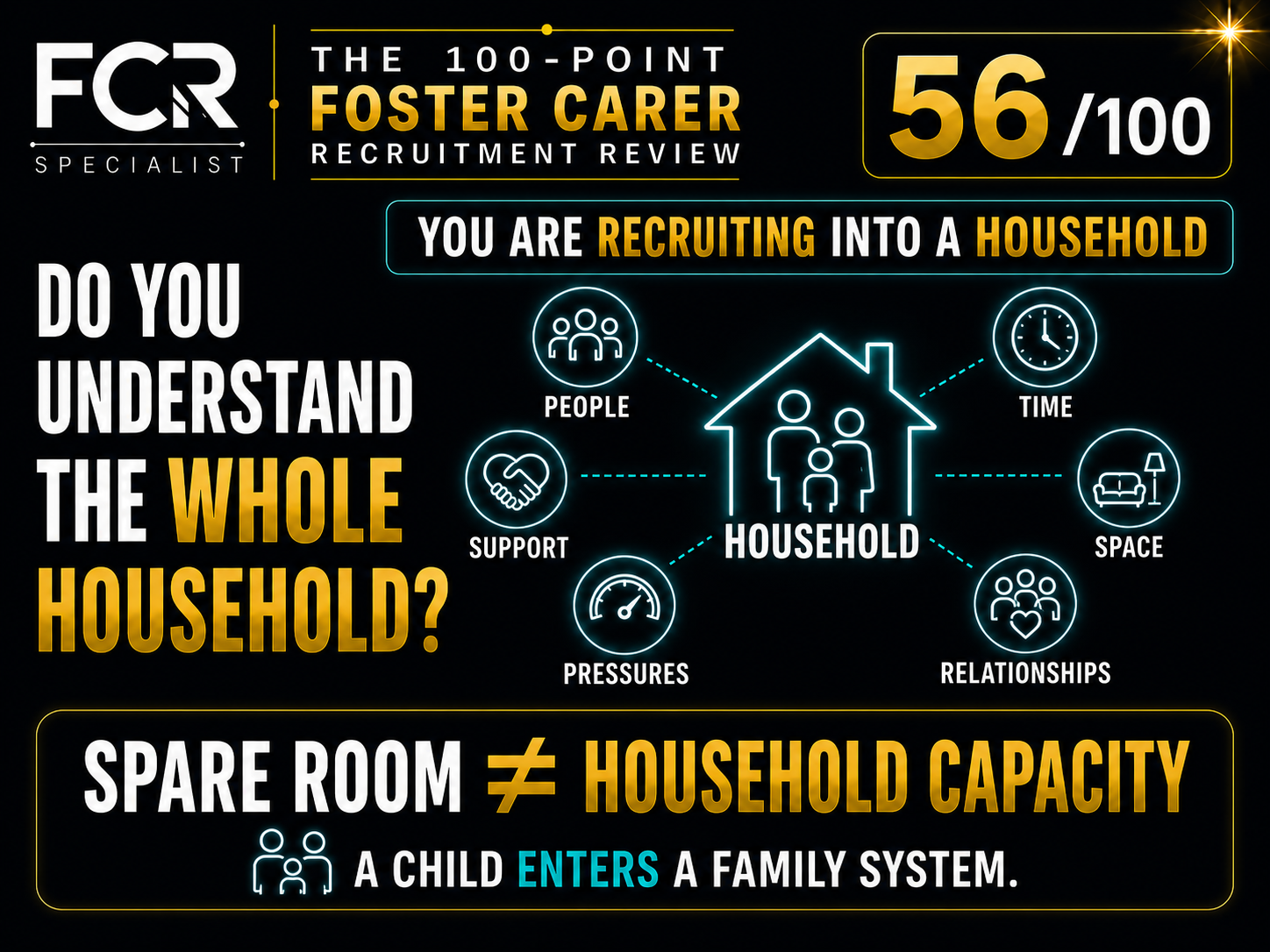
POINT 56/100 — DO YOU UNDERSTAND THE WHOLE HOUSEHOLD — NOT JUST THE APPLICANT?
POINT 56/100 — DO YOU UNDERSTAND THE WHOLE HOUSEHOLD — NOT JUST THE APPLICANT?
There is a deceptively simple question asked throughout Foster Carer Recruitment:
“Do you have a spare bedroom?”
It is an important question.
For most mainstream fostering, having an appropriate bedroom is essential.
But sometimes that question acquires far too much importance.
A spare bedroom does not tell us whether a household has capacity to foster.
It tells us that the household has a room.
Those are very different things.
A person may have:
- a spare bedroom;
- considerable childcare experience;
- excellent motivation;
- a stable home;
- and all the characteristics that initially make somebody sound like a strong prospective Foster Carer.
But that person exists inside a life.
They may have:
- a partner;
- young children;
- teenagers;
- adult children who frequently return home;
- elderly parents requiring support;
- grandchildren;
- another relative living with them;
- a demanding job;
- irregular shifts;
- a business;
- established social commitments;
- pets;
- significant community involvement;
- or a support network that currently depends heavily on them.
That is why Point 56 begins with a different principle:
YOU ARE NOT RECRUITING A SPARE BEDROOM.
YOU ARE RECRUITING INTO A HOUSEHOLD.
FOSTERING DOES NOT HAPPEN TO ONE PERSON
Government guidance on fostering assessment makes this very clear.
Formal assessment considers not just the applicant, but:
- who else lives in the household;
- other children in the family who do not live there;
- relationship history;
- employment;
- family circumstances;
- caring experience;
- and other relevant skills and circumstances.
The National Minimum Standards similarly recognise that the wider fostering household matters.
They specifically require consideration of support needed by the sons and daughters of Foster Carers, and expect appropriate safer-care training to be available to household members of sufficient age and understanding.
So the system already acknowledges an important truth:
Fostering changes more than the life of the approved Foster Carer.
The recruitment process needs to acknowledge that truth early.
BUT THIS IS STILL AN INITIAL VISIT
That qualification matters.
Point 54 argued strongly that the Initial Visit should inform the assessment, not become the assessment.
So Point 56 is not an argument for interviewing every member of the extended family.
We do not need to produce:
- a complete genogram;
- a formal support-network analysis;
- individual assessments of every child;
- comprehensive employment analysis;
- or detailed family-history interviews.
Not yet.
The question at Initial Visit stage is more proportionate:
WHAT DOES THIS HOUSEHOLD LOOK LIKE — AND CAN WE BEGIN TO SEE HOW FOSTERING MIGHT FIT WITHIN IT?
That is exploration.
The formal assessment can do the deeper work later.
DON'T JUST ASK “WHO LIVES HERE?”
It is administratively useful to know who lives at the address.
But the better recruitment question is:
HOW DOES THIS HOUSEHOLD WORK?
Consider two households.
Both contain:
- two adults;
- two children;
- three bedrooms;
- two cars.
On paper they look remarkably similar.
But one household might have:
- one parent working from home;
- one working three days a week;
- grandparents living ten minutes away;
- children who are extremely enthusiastic about fostering;
- established family routines;
- and a strong local support network.
The other might have:
- both adults working long shifts;
- a child facing major examinations;
- one parent regularly caring for an elderly relative;
- no nearby family;
- and a partner who is still highly uncertain about fostering.
Same demographic profile.
Completely different household reality.
That is why tick-box profiling is insufficient.
TWO QUESTIONS CHANGE THE CONVERSATION
Instead of simply:
“Who lives here?”
try:
“TALK ME THROUGH A NORMAL WEEK IN YOUR HOUSEHOLD.”
That can reveal considerably more.
Who gets up first?
Who takes children to school?
Who works when?
Who cooks?
Who travels?
Who provides childcare?
When is the house busiest?
What happens at weekends?
Who visits regularly?
Who relies on whom?
Then ask:
“IF A FOSTERED CHILD CAME TO LIVE HERE, WHAT DO YOU THINK WOULD CHANGE?”
That is not assessment by stealth.
It is helping the household begin thinking realistically.
And often their answer is more valuable than ours.
THE PARTNER WHO IS “FINE WITH IT”
A prospective Foster Carer may say:
“My partner is absolutely fine with me fostering.”
That sounds positive.
But “fine with it” can cover an enormous range.
It could mean:
“We have talked about this for two years and we both really want to do it.”
Or:
“It's mostly their idea, but I'll go along with it.”
Or:
“I thought they meant fostering sometime in the future.”
Or:
“I don't really understand how much I will be involved.”
Point 53 established that where a partner will share the fostering household, they should be appropriately included.
Point 56 asks something slightly different:
HOW WILL FOSTERING AFFECT THEIR LIFE TOO?
Their:
- privacy;
- routines;
- finances;
- relationships;
- home;
- holidays;
- social life;
- responsibilities;
- and expectations.
This is particularly important if one applicant sees themselves as the Foster Carer while the partner imagines fostering as something their spouse will primarily do.
The child placed in the home will not experience that distinction so neatly.
OWN CHILDREN ARE CENTRAL — NOT PERIPHERAL
This deserves particular attention.
There has historically been a tendency to describe Foster Carers' own children almost as an additional assessment consideration.
But they actually live the fostering experience.
Research has repeatedly shown that sons and daughters of Foster Carers can form meaningful, sibling-like relationships with children who come into their family.
A 2022 British Journal of Social Work study found that participants frequently continued to regard former fostered children as siblings well into adulthood.
That is the positive side of fostering as family life.
But there is another side.
A 2024 Child Abuse Review study, based on retrospective narrative interviews with 12 adults raised in fostering households, found that Foster Carers' own children could be exposed to distressing accounts of trauma and, in some cases, risk or harm within the fostering household. The study's small qualitative sample means we should not generalise prevalence from it, but its findings reinforce the need to take Foster Carers' own children seriously as people affected by fostering.
Earlier research reviews have similarly concluded that fostering can substantially reshape the everyday lives of Foster Carers' sons and daughters and that their contribution and support needs need greater recognition.
The National Minimum Standards reflect that principle by explicitly requiring consideration of support needed by Foster Carers' sons and daughters.
So:
OWN CHILDREN ARE NOT AN APPENDIX TO THE FOSTERING APPLICATION.
They are members of the fostering household.
DON'T ASK CHILDREN TO “APPROVE” THE APPLICATION
There is a subtle issue here.
Children's views matter enormously.
But we should be careful about placing responsibility on them for an adult decision.
Imagine asking a ten-year-old:
“Are you happy for Mum and Dad to foster?”
What answer are they supposed to give?
If their parents are excited, they may feel pressure to say yes.
They may not understand fostering sufficiently well to make that judgement.
They may imagine gaining an instant playmate.
They may fear that saying no will disappoint their parents.
So rather than seeking simplistic consent, explore their understanding.
Depending on age:
“What have Mum and Dad told you about fostering?”
“What do you think might be good about it?”
“Is there anything you're worried about?”
“What do you think might change at home?”
“Who would you talk to if something was bothering you?”
Those answers tell us far more.
HEAR CHILDREN'S VIEWS WITHOUT MAKING THEM RESPONSIBLE FOR THE DECISION.
ADULT CHILDREN CAN MATTER TOO
Suppose the applicants' children are 24 and 27 and live elsewhere.
Are they irrelevant?
Not necessarily.
Perhaps they:
- return home every weekend;
- rely on their parents for childcare;
- bring grandchildren regularly;
- still regard the spare bedroom as theirs;
- are major sources of emotional support;
- or strongly influence family decisions.
The statutory assessment process recognises children within the family who do not live in the household.
At Initial Visit level, we simply need to understand their place within family life.
Again:
HOUSEHOLD DOES NOT ALWAYS END AT THE FRONT DOOR.
THE SUPPORT NETWORK — OR THE SUPPORT ASSUMPTION?
Prospective Foster Carers are frequently asked:
“Do you have a good support network?”
Most people say yes.
That question is almost useless by itself.
Instead ask:
“Who would you actually call if you were exhausted at seven o'clock on a Friday evening?”
Or:
“If you needed someone to collect your own child from school because a fostering meeting overran, who might realistically help?”
Or:
“Who knows you are considering fostering?”
The answers reveal the difference between:
having people in your life
and:
having people who could realistically support fostering.
But we should also avoid assuming extended family must become unpaid auxiliary Foster Carers.
The support network supplements the fostering service.
It does not replace it.
A service cannot say:
“They have a large family, so support won't be a problem.”
Remember the National Minimum Standards already place significant support obligations on fostering services themselves.
SOMETIMES THE APPLICANT IS THE SUPPORT NETWORK
Here is another easily missed issue.
A prospective Foster Carer may tell you:
“I have loads of family around me.”
Good.
But what role do they currently play in that network?
Perhaps they are the person everybody else calls.
They:
- care for their mother;
- collect grandchildren;
- support an adult child;
- help a sibling with disability;
- provide childcare every Friday;
- run the family business;
- organise everything.
Their social network is strong.
But much of its capacity currently flows outwards from them.
Fostering could change that.
So ask:
WHO SUPPORTS YOU?
and separately:
WHO CURRENTLY DEPENDS ON YOU?
That second question can reveal significant competing pressures.
EMPLOYMENT IS PART OF THE HOUSEHOLD SYSTEM
Point 52 discussed appointment flexibility.
Point 56 asks a different employment question.
Not:
“Will you give up work?”
But:
“How does work currently fit into your household?”
Government information is clear that Foster Carers may be able to work alongside fostering, depending on the child's circumstances and the fostering service.
The eventual assessment will need far more detail.
At Initial Visit level we are looking for the shape of the household.
Does somebody:
- work from home?
- commute two hours?
- work nights?
- have flexible hours?
- work offshore?
- run their own business?
- travel frequently?
- work term-time?
- have another caring role?
Those factors do not automatically determine whether somebody can foster.
They help us understand what kind of fostering may realistically fit.
That becomes particularly important in Point 57.
ROUTINES MATTER BECAUSE CHILDREN ENTER REAL LIFE
A fostering household does not reset when a child arrives.
It has existing rhythms.
School runs.
Football practice.
Sunday lunch.
Shift work.
Religious observance.
Caring responsibilities.
Pets.
Grandchildren.
Friends visiting.
Bedrooms used by returning university students.
Family holidays.
These things are neither good nor bad.
They are simply the life into which a child might be introduced.
Understanding them is therefore not searching for barriers.
It is identifying:
WHAT WOULD NEED TO ADAPT?
and:
WHAT COULD REMAIN A STRENGTH?
DON'T ONLY LOOK FOR PROBLEMS
This is very important.
Whole-household thinking can easily become another risk exercise.
Partner uncertain.
Child anxious.
Grandmother dependent.
Working hours complicated.
But the household can also reveal tremendous recruitment strengths.
Perhaps:
- the teenagers are thoughtful and enthusiastic;
- grandparents live nearby and understand fostering;
- one applicant has an exceptionally flexible employer;
- the family is deeply connected to its community;
- they have strong extended-family relationships;
- adult children are supportive;
- their normal routines offer considerable stability;
- or they already have experience accommodating children with different needs.
So don't merely ask:
“What could go wrong?”
Ask:
WHAT STRENGTH EXISTS IN THIS HOUSEHOLD THAT A FOSTERED CHILD COULD BENEFIT FROM?
That is recruitment thinking.
A SIMPLE HOUSEHOLD MAP
At the Initial Visit, I would mentally — or operationally — look across six areas.
PEOPLE
Who genuinely forms part of family life?
TIME
What consumes the household's week?
SPACE
How is the home actually used?
RELATIONSHIPS
Who relies on whom?
SUPPORT
Who could realistically help?
PRESSURES
What is already demanding attention?
This does not need a six-page form.
It needs a skilled conversation.
And then ask:
WHAT WOULD FOSTERING ADD TO THIS SYSTEM?
Because fostering adds:
- another child;
- another set of relationships;
- professionals;
- appointments;
- school;
- contact arrangements;
- training;
- emotional demands;
- uncertainty;
- and potentially tremendous meaning and reward.
HERE IS THE TEST…
Take the last 20 households that reached Initial Visit.
Ignore the applicant for a moment.
Look at the household.
For each one ask:
- Who lived there?
- Who was regularly part of family life but lived elsewhere?
- Was the partner present at the Initial Visit?
- What did the partner actually understand about fostering?
- Were own children present or appropriately involved?
- Were their views explored?
- How were those views recorded?
- Were adult children discussed?
- Were significant caring responsibilities identified?
- What did the working week actually look like?
- Who currently depended on the prospective Foster Carer?
- Who could realistically support them?
- Did the service assume “large family = strong support”?
- Were normal routines explored?
- Were household strengths recorded as clearly as household risks?
- Did the worker ask what fostering might change?
- Did anyone ask what the family feared losing?
- Did anyone ask what the family hoped fostering might add?
- Were pets, space and practical circumstances considered proportionately?
- Did the service identify potential supports that could make fostering workable?
- Did any household get rejected or paused because of something that could perhaps have been explored differently?
- Did anybody progress because the applicant looked excellent while wider household uncertainty was insufficiently understood?
Then ask:
DOES OUR INITIAL VISIT RECORD DESCRIBE AN APPLICANT — OR DOES IT HELP US UNDERSTAND A HOUSEHOLD?
That is the real test.
THE HOUSEHOLD SHOULD ALSO KNOW WHAT THE SERVICE WILL PROVIDE
There is another side to this.
If we ask families:
“Who will support you?”
they should be allowed to ask:
“Who will support us?”
Government information says fostering families should have access to professional, practical and emotional support, out-of-hours help, training and opportunities for breaks.
The current National Minimum Standards also specifically recognise social-work support, peer support, breaks and the support needs of Foster Carers' sons and daughters.
That matters because fostering is not supposed to work only if a family can privately absorb every additional pressure.
A good service should be able to describe the support wrapped around the household.
A HOUSEHOLD CAN BE READY EVEN IF EVERYONE IS NOT EQUALLY ENTHUSIASTIC
We should also avoid another unrealistic standard.
Families are rarely unanimous about major life decisions at precisely the same emotional intensity.
One partner may be enthusiastic.
The other cautiously positive.
A teenager may be excited but nervous.
An adult child may initially question the decision.
That does not necessarily mean:
STOP.
The question is whether concerns can be understood and worked through.
Remember:
HESITATION ≠ RESISTANCE.
And:
PROGRESS + RESOLVE.
If a child says:
“I'm worried Mum won't have time for me anymore,”
that is not an inconvenient objection.
It is extremely useful information.
It tells the family and the fostering service what needs to be thought about.
A good recruitment process brings those concerns into the open before a fostered child arrives.
THE CENTRAL PRINCIPLE
A fostering service ultimately approves Foster Carers.
But children experience fostering households.
That distinction should shape recruitment from the Initial Visit onwards.
So don't stop at:
“Who lives here?”
Ask:
“How does life work here?”
Then:
HOW COULD FOSTERING FIT THIS HOUSEHOLD?
and:
HOW COULD FOSTERING AFFECT THIS HOUSEHOLD?
Because:
YOU DON'T PLACE A FOSTERED CHILD INTO A SPARE BEDROOM.
YOU PLACE THEM INTO A FAMILY SYSTEM.
And that takes us directly into Point 57.
Once we genuinely understand the household, we can ask a much more useful recruitment and sufficiency question: