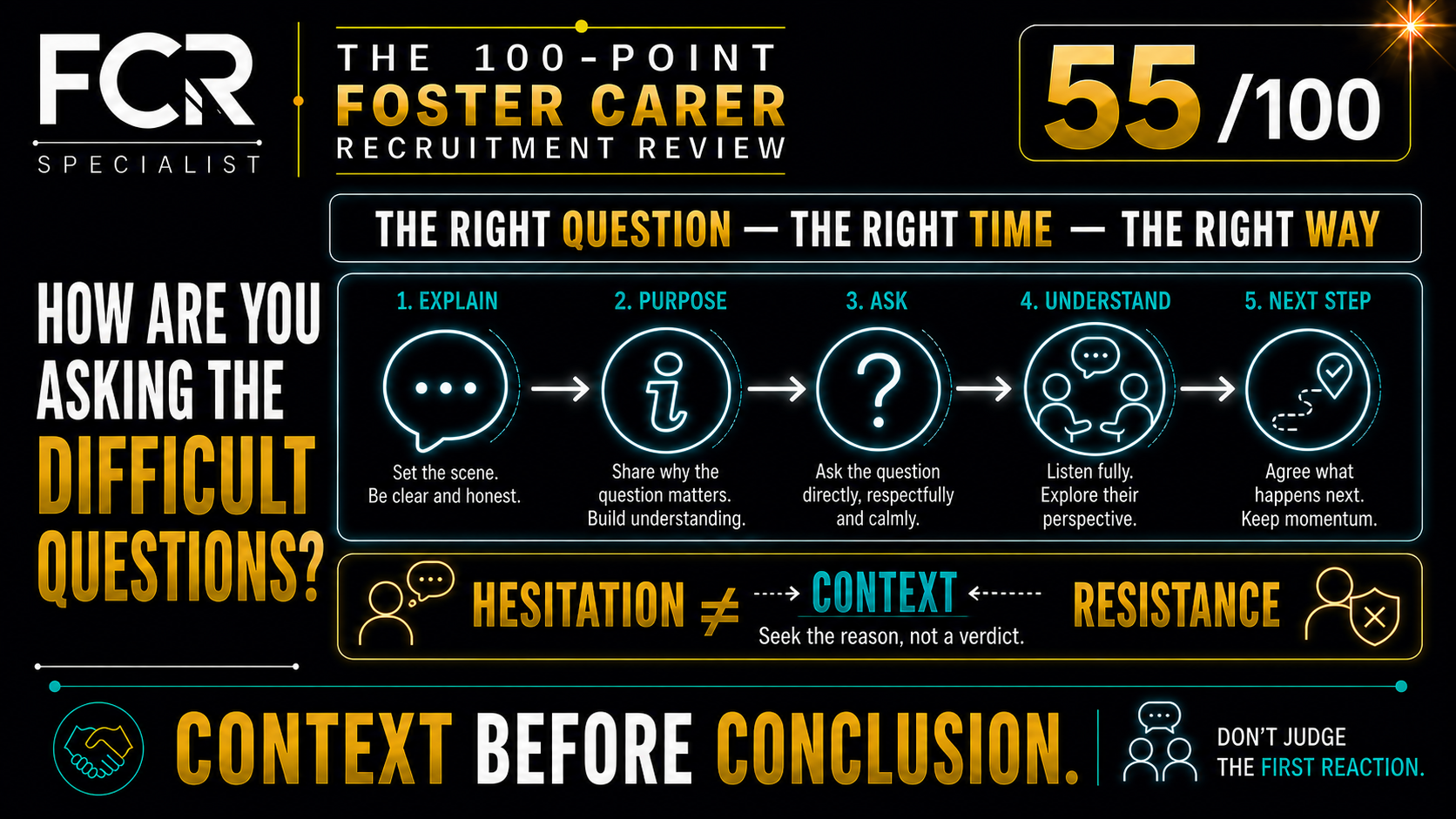
POINT 55/100 — ARE YOU ASKING THE RIGHT QUESTIONS AT THE RIGHT TIME — AND IN THE RIGHT WAY?
POINT 55/100 — ARE YOU ASKING THE RIGHT QUESTIONS AT THE RIGHT TIME — AND IN THE RIGHT WAY?
There are questions in Foster Carer Recruitment that are never going to feel entirely comfortable.
They shouldn't necessarily feel comfortable.
Fostering involves responsibility for children who may have experienced abuse, neglect, instability and trauma.
A fostering service needs to understand the people it approves very thoroughly.
That can require conversations about:
- previous relationships;
- former partners;
- children from previous relationships;
- health;
- mental health;
- criminal history;
- previous allegations;
- safeguarding involvement;
- difficult family experiences;
- bereavement;
- trauma;
- previous involvement with social care;
- and significant events across a person's life.
The answer is not to avoid difficult questions.
The answer is to ask:
WHAT NEEDS TO BE ASKED?
WHEN DOES IT NEED TO BE ASKED?
WHY ARE WE ASKING IT?
and crucially:
HOW ARE WE EXPLAINING IT?
Because a necessary question asked badly can still damage a recruitment relationship.
THERE IS A DIFFERENCE BETWEEN TRANSPARENCY AND PREMATURE INTRUSION
I strongly support telling prospective Foster Carers early that fostering assessment is thorough.
We should not present the process as something light and easy and then surprise somebody later.
They need to understand that there will be:
- DBS checks;
- health information and a medical report;
- references;
- relationship history;
- information about household members;
- exploration of their experience and background;
- and detailed assessment of their ability to care safely for a child.
Those are real features of the process.
The regulations require many of them. For example, Schedule 3 of the Fostering Services Regulations requires health information supported by a medical report, details of household members and children, personal references, enhanced criminal-record certificates and details of current and previous marriage, civil partnership or similar relationships.
But:
TRANSPARENCY EARLY DOES NOT MEAN INTRUSIVE EXPLORATION PREMATURELY.
There is an enormous difference between saying:
“If you decide to apply, the assessment will look carefully at your relationship history, health, family circumstances and checks because we have a responsibility to understand whether fostering will be safe and appropriate.”
and opening an initial enquiry call with:
“Give me the names of every ex-partner you've had.”
The first prepares.
The second can alarm.
THE DfE HAS ALREADY IDENTIFIED THIS PROBLEM
The Department for Education's 2023 research recorded that prospective Foster Carers can experience the recruitment and assessment journey as invasive.
Participants specifically identified discussions involving former partners and physical or mental health as potentially distressing, and some questions were described as hard-hitting or appearing unjustifiably personal to applicants.
The same research also found that the Initial Visit itself can feel particularly intense.
Its recommendation is not that services stop gathering necessary information.
Rather, it describes a shift towards a more balanced approach: giving prospective Foster Carers the information they need, creating space for their questions, allowing them to evaluate the service themselves, and exercising judgement about the timing and amount of information introduced.
That is exactly the issue here.
SOMETIMES HESITATION MEANS SOMEBODY NEEDS AN EXPLANATION
Suppose you say:
“We may need information about previous partners.”
The person immediately looks uncomfortable.
What does that mean?
It might mean:
“I have something to hide.”
But it might equally mean:
“My ex-partner was abusive.”
Or:
“We haven't spoken for twenty years.”
Or:
“There was a terrible custody dispute.”
Or:
“My current partner doesn't know all the details.”
Or simply:
“Why on earth would somebody I divorced fifteen years ago get a say in whether I can foster?”
Those are fundamentally different circumstances.
Yet if the professional interprets the initial hesitation before understanding its cause, the conclusion can precede the evidence.
So return to one of the core principles of this Review:
UNDERSTAND BEFORE YOU CONCLUDE.
And:
CONTEXT BEFORE CONCLUSION.
FORMER PARTNERS — WHAT DOES THE LAW ACTUALLY SAY?
This is one of those areas where fostering practice can gradually become described as regulation.
So I went back to the actual regulatory wording.
Following the 2013 amendments to the Fostering Services (England) Regulations 2011, Schedule 3 requires a fostering service assessing an applicant to obtain:
details of current and previous marriage, civil partnership or similar relationship.
It also requires personal references, but these are described separately as persons nominated by the applicant.
There is no universal wording in that Schedule saying every former partner must always be contacted.
That does not mean former partners are irrelevant.
Far from it.
Previous significant relationships can provide extremely important information, particularly where:
- children were parented together;
- the couple lived together;
- there are safeguarding concerns;
- the relationship was significant;
- or evidence about someone's parenting and relationships needs verification.
Many fostering services consequently operate policies requiring or routinely seeking former-partner references in such circumstances.
But that is not the same thing as saying:
“The law says we must contact every ex you've ever had.”
It doesn't.
CURRENT FORM F PRACTICE IS MORE NUANCED TOO
The 2025 CoramBAAF Form F asks whether applicants have co-parented with former partners and whether they have lived with them.
It asks for information about significant previous relationships.
Importantly, it also asks assessors to record:
- unsuccessful attempts to contact former partners;
- reasons why contact attempts were not made;
- and alternative confirmation obtained.
CoramBAAF describes the revised Form F as deliberately more accessible, strengths-based and trauma-informed.
That gives us a much more useful conversation with applicants.
Not:
“Every ex-partner must be contacted. End of discussion.”
But:
“Your relationship history is relevant to assessment. In significant previous relationships, particularly where there was shared parenting or living together, the service may need information or verification. Let's understand your circumstances first, including whether there are any safety or other serious concerns about contact.”
That is both transparent and professionally responsible.
WHAT IF THE PREVIOUS RELATIONSHIP WAS ABUSIVE?
This is where rigid scripts can become genuinely problematic.
Imagine telling somebody who has experienced domestic abuse:
“We will be contacting your former partner.”
before asking anything about the circumstances.
The immediate response may be fear.
That fear should not be interpreted as evasiveness.
Some current fostering-service procedures explicitly recognise this. For example, Hertfordshire's published procedure says that where contact with an ex-partner may create safety concerns or is too difficult, the issue should be escalated for a management decision and alternative corroboration can be sought.
That is consistent with the current Form F structure, which allows reasons for non-contact and alternative confirmation to be recorded.
This does not mean an applicant can simply veto a legitimate safeguarding enquiry.
It means:
SAFETY AND EVIDENCE BOTH NEED TO BE CONSIDERED.
The service still needs enough reliable information to make a safe assessment.
But it should not create another risk while trying to investigate the first one.
HEALTH — ANOTHER AREA WHERE LANGUAGE MATTERS
Health is another example.
The regulations require health information supported by a medical report.
So health cannot simply be ignored.
But there is a very important difference between asking:
“Do you have any health conditions?”
and implying:
“If you have a health condition you probably cannot foster.”
The Fostering Network's current guidance is clear that health information forms only one part of the wider assessment.
It states that there is no named illness, disability, medication or treatment in the regulations that automatically requires an application to be turned down; the relevant question is whether the person can safely care for and meet the needs of children.
The Government's 2026 fostering reform material similarly challenges myths that disability or minor/historic criminal convictions automatically exclude people.
So instead of:
“You've got diabetes?”
followed by a worried expression,
the conversation should be closer to:
“We'll need medical information as part of assessment. The purpose is to understand whether anything affects your ability to foster safely, and the medical adviser helps the service interpret that information.”
Explanation changes the experience.
THE SAME APPLIES TO CRIMINAL HISTORY
Enhanced criminal-record checks are required for the applicant and adult household members during assessment.
There are specified offences that can legally disqualify a person from ordinary fostering approval, subject to particular exceptions in the regulations.
But the existence of any criminal record is not synonymous with automatic rejection.
Government's 2026 reform material explicitly identifies the belief that any criminal record means automatic rejection as a fostering myth and states that minor or historic convictions do not necessarily prevent fostering.
So ask about criminal history honestly and early enough.
But don't create the impression that:
“Conviction = no.”
The relevant questions include:
- What happened?
- When?
- How old was the person?
- What was the nature of the offence?
- What has happened since?
- Is there a legal disqualification?
- What does it tell us, if anything, about current capacity and risk?
Again:
CONTEXT BEFORE CONCLUSION.
AND WHAT ABOUT ALLEGATIONS?
This needs even more care.
Some people considering fostering may previously have:
- worked with children;
- worked in social care;
- taught;
- been healthcare professionals;
- fostered before;
- volunteered with vulnerable people;
- or been involved in complex family disputes.
An allegation may have been made.
The mere word “allegation” should not automatically be treated as synonymous with:
“proved wrongdoing.”
Equally, a service cannot simply ignore relevant safeguarding history.
The professional task is to establish:
- what was alleged;
- when;
- what investigation occurred;
- what outcome was reached;
- whether other records exist;
- what evidence is available;
- and what significance, if any, it has for fostering.
That is exactly the sort of issue where:
UNDERSTAND BEFORE YOU CONCLUDE
becomes more than a recruitment slogan.
It becomes sound professional practice.
WHEN SHOULD THESE THINGS BE RAISED?
This is perhaps the central question in Point 55.
My answer would be:
EXPLAIN EARLY. EXPLORE AT THE APPROPRIATE DEPTH.
At the initial-enquiry stage, somebody should understand that fostering involves rigorous assessment.
They should not discover six weeks later that references, health information or relationship history will be considered.
At the Initial Visit, there may be value in asking whether there is anything within those areas that the person already knows could be complicated or needs explanation.
For example:
“I want to explain some of the checks that would happen if you progress. We look at relationships, health, references, DBS information and family history. Is there anything in those areas you think it would be helpful for us to understand before we decide the next step?”
That opens the door.
It does not kick it down.
If they say:
“Actually yes, there is something about my former partner.”
then ask enough to understand what needs to happen next.
You do not necessarily need the complete relationship chronology there and then.
That is what assessment is for.
THE PROFESSIONAL EXPLANATION SHOULD COME BEFORE THE SENSITIVE QUESTION
A remarkably simple improvement is to explain why before asking what.
Instead of:
“Have you ever had mental-health problems?”
try:
“Because Foster Carers can be caring for children through very stressful situations, assessment includes health information. It isn't about expecting perfect health. We need to understand whether there is anything that might affect your ability to foster safely or what support might be useful. Can we talk about your health history?”
Instead of:
“Who are your ex-partners?”
try:
“Assessment looks at significant previous relationships because they can tell us about family life, parenting and experiences that may be relevant. That doesn't mean every situation is handled identically. Can we start by understanding your relationship history?”
Instead of:
“Have you ever been accused of anything?”
try:
“Because safeguarding is central to fostering, if there has ever been a professional investigation or allegation involving children or vulnerable adults we may need to understand what happened and what the outcome was. Is there anything you think we should know about?”
The information requested may ultimately be very similar.
The experience is completely different.
A FIRST REACTION IS NOT AN ASSESSMENT FINDING
This may be the most important principle in Point 55.
Imagine telling someone:
“We'll need to speak to your former husband.”
They respond:
“Absolutely not.”
It would be easy to write:
“Applicant resistant to checks.”
But what happens if the next sentence would have been:
“He was convicted of assaulting me and doesn't know where I now live.”
The first reaction has suddenly changed meaning completely.
Or the person says:
“I don't want my GP involved.”
Perhaps they believe the service will receive their entire medical record.
Explain what the process actually involves.
Or they look nervous about DBS checks.
Perhaps they received a conviction at 18 and genuinely believe that automatically ends the conversation.
Explain before interpreting.
DON'T TURN CONFUSION INTO NON-COMPLIANCE.
DON'T TURN ANXIETY INTO SUSPICION.
DON'T TURN HESITATION INTO A CONCLUSION.
THIS IS NOT ABOUT LOWERING SAFEGUARDING STANDARDS
It is worth repeating this very clearly.
Sensitive questioning exists for good reasons.
Children need safe Foster Carers.
Assessment needs to be rigorous.
Information sometimes needs to be corroborated.
Difficult histories sometimes reveal legitimate concerns.
A prospective Foster Carer who refuses all relevant checks or will not allow necessary information to be explored may ultimately be unable to progress.
But professional rigour does not require unnecessary brusqueness.
In fact, skilled explanation can produce better information.
People disclose more accurately when they understand:
- why information is needed;
- who will see it;
- how it will be used;
- what the process is;
- and that complexity does not automatically equal rejection.
That makes safeguarding stronger, not weaker.
HERE IS THE TEST…
Listen to, observe or quality-assure a sample of your enquiry calls and Initial Visits.
Look specifically at sensitive questions.
For every one ask:
WAS THE REASON EXPLAINED BEFORE THE QUESTION?
Then examine:
- When are prospective Foster Carers first told the assessment will consider previous relationships?
- What exact words are used?
- Are workers saying “every ex-partner has to be contacted by law”?
- If so, can they identify the actual regulation?
- Does your written policy go beyond the statutory requirement?
- If it does, are staff able to distinguish service policy from law?
- Does your policy explain how significant relationships are defined?
- What happens where there has been domestic abuse?
- Who authorises a decision not to contact a former partner?
- What alternative evidence can be considered?
- Is the rationale recorded?
- Are applicants told this before being asked for details?
- Are health questions framed around capacity rather than diagnosis?
- Are applicants incorrectly told particular illnesses automatically prevent fostering?
- Are criminal records discussed accurately?
- Do staff distinguish a conviction from an automatic disqualification?
- What happens when somebody discloses a historic allegation?
- Is an allegation recorded as an allegation — or subtly transformed into a finding?
- Are initial expressions of anxiety described in case notes as “resistance”?
- Are sensitive conversations held privately?
- If a Foster Carer buddy is involved, are they asked to step out?
- Are applicants given time to process unexpected information?
- Are workers trained to explain the reason behind intrusive questions?
- Do different workers give different explanations of the same requirement?
- How often does management check that staff are describing regulatory requirements accurately?
And perhaps the most revealing question:
ARE WE MEASURING WHAT SOMEONE TELLS US — OR HOW COMPLIANT THEY LOOK WHILE TELLING US?
Those are not the same thing.
BUILD A SIMPLE SENSITIVE-CONVERSATION STANDARD
For any potentially intrusive requirement, use five steps:
1. EXPLAIN
What are we about to discuss?
2. PURPOSE
Why does fostering assessment need this information?
3. ASK
What is the relevant question?
4. UNDERSTAND
What is the context behind the answer or reaction?
5. AGREE
What needs to happen next?
So:
EXPLAIN → PURPOSE → ASK → UNDERSTAND → AGREE.
This is not a script designed to make Social Workers robotic.
It is a reminder not to begin at Step 3.
THE RECRUITMENT PRINCIPLE
Prospective Foster Carers should know from early in their journey that assessment will be thorough.
Nothing should be hidden.
Nothing necessary should be avoided.
But thoroughness does not require us to explore every painful detail at the earliest possible opportunity.
It requires us to gather the right information at the right stage, with enough context to interpret it properly.
TRANSPARENCY EARLY.
DEPTH WHEN APPROPRIATE.
CONTEXT ALWAYS.
And above all:
DON'T SPRING A SENSITIVE REQUIREMENT ON SOMEONE AND THEN JUDGE THEIR FIRST REACTION TO IT.
That brings us naturally to Point 56.
Because once we start understanding someone's relationships, history and circumstances, we need to widen the lens beyond the named applicant: