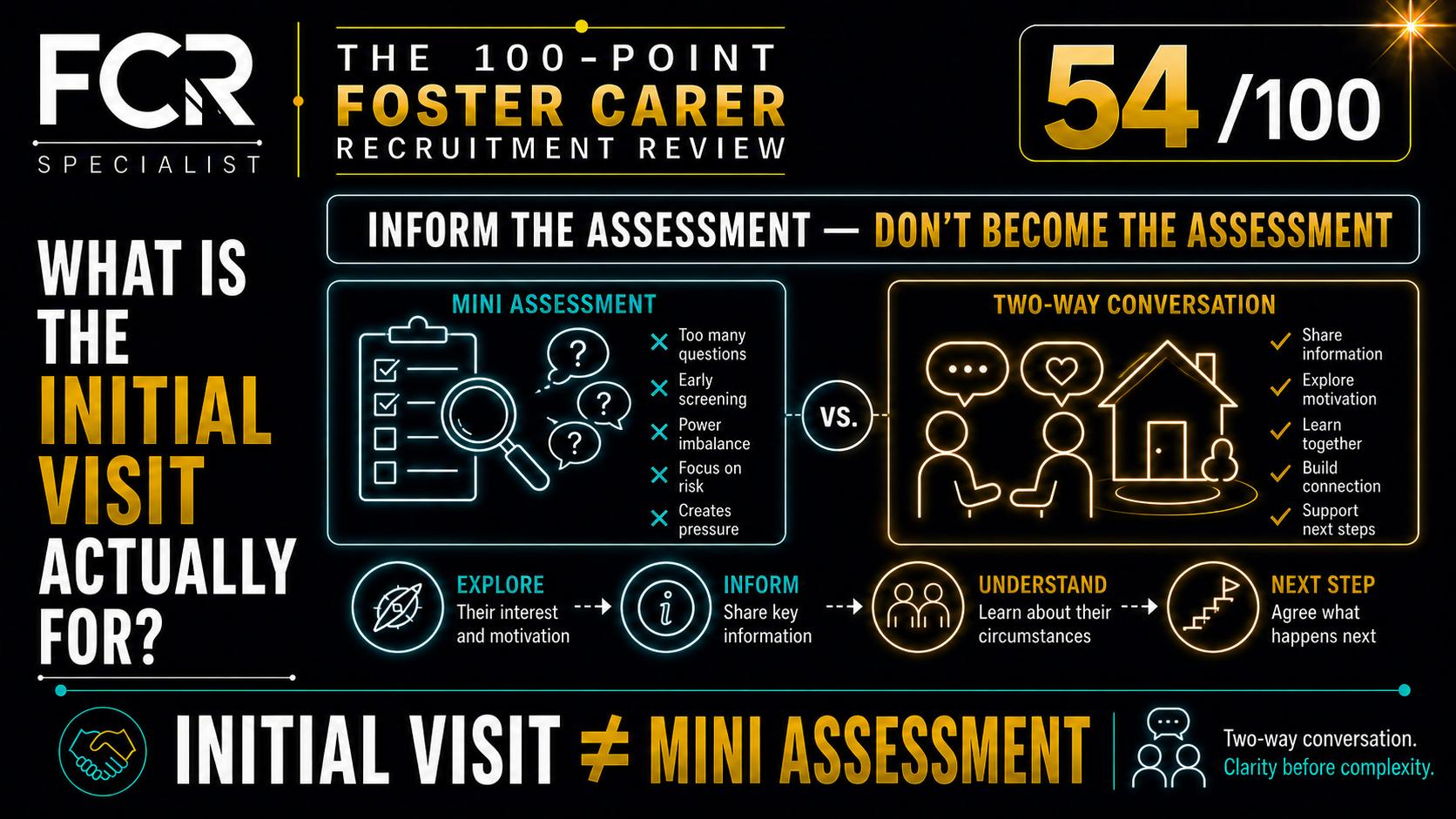
POINT 54/100 — WHAT IS THE INITIAL VISIT ACTUALLY FOR?
POINT 54/100 — WHAT IS THE INITIAL VISIT ACTUALLY FOR?
Ask ten fostering services what an Initial Visit is for and you may receive ten slightly different answers.
For some it is relatively informal.
For others it is an extensive screening exercise.
Some use it before a formal application.
Others have already collected substantial information before anybody enters the home.
Some visits last an hour.
Others can feel considerably closer to the beginning of a full assessment.
This variation matters because if we don't clearly define the purpose of the Initial Visit, it can gradually accumulate tasks.
Another question gets added.
Another section is added to the form.
Another piece of information is requested “while we're there”.
And eventually the Initial Visit becomes:
A MINI FORM F BEFORE THE FORM F.
I don't think that is what this stage should be.
THERE IS AN IMPORTANT LEGAL DISTINCTION
We need to be precise.
The statutory guidance governing foster-carer assessment in England describes a formal two-stage assessment process once a person applies to become a Foster Carer.
Stage 1 requires specified basic information and checks.
Stage 2 gathers the more detailed information needed to assess suitability, including personality, family circumstances, employment, caring experience, skills and capacity.
The statutory guidance does not prescribe a universal pre-application stage called an “Initial Visit” with one nationally defined purpose.
That helps explain why services organise this stage differently.
For example, Surrey currently describes its Initial Home Visit as a chance for the Social Worker to learn more about the person's environment, experiences and motivations while the prospective Foster Carer asks questions, expresses concerns and reflects on readiness. It describes the appointment as informal, informative and without an obligation to continue.
Southwark's published process gives its Initial Home Visit a considerably wider information-gathering function, including family background, employment history, personal history, criminal matters, accommodation and information about assessment.
That variation is exactly why every service should ask:
WHAT ARE WE TRYING TO ACHIEVE DURING THIS VISIT?
TWO DECISIONS ARE TAKING PLACE
The first decision belongs to the fostering service.
Could fostering realistically work for this household?
Not:
“Have I proved that this person should ultimately be approved?”
There is nowhere near enough information for that.
But there should normally be enough conversation to begin understanding whether there appears to be a sensible route forward.
The second decision belongs to the household.
Having learned considerably more, do we still want to explore fostering?
That second question is sometimes overlooked.
The Initial Visit is not simply the point at which the organisation obtains more information from the applicant.
The prospective Foster Carer should be obtaining information from the organisation too.
The DfE's 2023 research is particularly useful here.
Participants acknowledged that the initial enquiry process could feel quite intense and invasive, particularly around the home visit. Importantly, services described trying to shift away from a sole focus on gathering information towards equally helping prospective Foster Carers obtain the information they need, judge whether the service is right for them and make their own decision about applying.
That is a very different philosophy.
THE INITIAL VISIT IS A TWO-WAY PROFESSIONAL CONVERSATION.
WHAT SHOULD WE KNOW BY THE END?
I would expect a good Initial Visit to give us a considerably clearer picture in five areas.
1. Why are they considering fostering?
Not an interrogation about “motivation”.
A conversation.
Where has the idea come from?
How long have they been thinking about it?
What do they currently imagine fostering to be?
What appeals to them?
What concerns them?
What questions are still unresolved?
You are beginning to understand motivation without pretending you have fully assessed it.
2. How might fostering fit the household?
Who lives there?
What does family life broadly look like?
How does work fit?
What does the household understand about fostering?
Is there a spare bedroom where one will be required?
Are there obvious practical matters that need discussion?
Again, this is not a complete household assessment.
It is orientation.
3. Is there anything that genuinely needs addressing before progression?
Sometimes something important will emerge.
That may require:
PROGRESS
PROGRESS + RESOLVE
MANAGED PAUSE
or occasionally:
STOP
But that is very different from searching the conversation for a reason not to proceed.
The principle from the previous Stage remains:
UNDERSTAND BEFORE YOU CONCLUDE.
4. Does the household understand fostering better than when you arrived?
They should.
A successful Initial Visit should not simply leave the organisation with more information.
It should leave the household with more information too.
They should understand more about:
- the role;
- the process;
- the realities;
- the types of children needing homes;
- training;
- support;
- assessment;
- expectations;
- and what happens next.
Point 58 will go much deeper into the realistic picture we should provide.
But even now, the prospective Foster Carer should leave more informed than they entered.
5. Is there an agreed next step?
Not an assumed one.
An agreed one.
“Having talked everything through, how are you feeling about progressing?”
That question matters.
THE INITIAL VISIT IS NOT AN INSPECTION
Clearly, if a Social Worker visits someone's home, they are going to observe it.
They may need to understand:
- space;
- bedrooms;
- accessibility;
- pets;
- location;
- obvious safety issues;
- household composition;
- and whether the home could realistically support fostering.
That is sensible professional practice.
But walking around the property should not feel like somebody has arrived with a white glove.
At this stage the question is generally:
COULD THIS HOME REALISTICALLY WORK FOR FOSTERING?
rather than:
IS THIS HOME COMPLETELY READY FOR A CHILD TOMORROW?
There may be things that need changing.
A bedroom might need decorating.
Medication might eventually need secure storage.
A garden issue might need addressing.
The household may be planning a move.
That brings us back to a principle we will explore more deeply in Point 59:
A POSSIBLE ISSUE IS NOT AUTOMATICALLY A PRESENT BARRIER.
THE INITIAL VISIT IS NOT A MEMORY TEST
There is another operational problem.
The DfE's 2023 study found that fostering services sometimes request the same information repeatedly at enquiry, home visit, application and assessment stages. The report specifically suggests sharing information already collected between colleagues to reduce duplication.
That should make every fostering service examine its Initial Visit form.
If the recruitment team has already established:
- who lives in the household;
- contact details;
- basic accommodation information;
- employment;
- initial fostering interests;
- and other preliminary information;
why does the Social Worker need to ask all of those questions from the beginning again?
There may be good reasons to verify or expand something.
But:
DON'T ASK AGAIN SIMPLY BECAUSE THE NEXT FORM HAS THE SAME BOX.
Remember:
ONE HOUSEHOLD. ONE JOURNEY RECORD. MANY TOUCHPOINTS.
Information should travel through the recruitment journey with the prospective Foster Carer.
The prospective Foster Carer should not have to carry it manually by repeatedly telling the organisation the same story.
PROFESSIONAL JUDGEMENT STILL MATTERS
None of this means turning the Initial Visit into an unstructured friendly chat.
It is professional work.
There are legitimate reasons why a service may conclude after an Initial Visit that progression is not appropriate.
There may be:
- an obvious safeguarding issue;
- a fundamental accommodation barrier;
- a serious conflict within the household;
- information directly incompatible with fostering;
- or circumstances suggesting that this is genuinely the wrong time.
Those issues should not be ignored in the name of recruitment.
But neither should the visit operate primarily as:
“Let's see what we can find.”
There is a subtle but important difference between:
EXPLORING WHETHER A SAFE ROUTE FORWARD EXISTS
and
SEARCHING FOR A REASON TO RULE SOMEBODY OUT.
Good professional judgement can tell the difference.
DON'T COMPLETE TOMORROW'S WORK TODAY
The formal fostering assessment exists for a reason.
It gathers substantial information.
It involves checks.
It explores relationships.
It considers history.
It examines capacity.
It provides evidence for professional decision-making.
The Initial Visit should help determine whether proceeding towards that more substantial work appears appropriate.
It does not need to reproduce it in advance.
The statutory guidance itself distinguishes between the basic information required in Stage 1 and the much more detailed information gathered during Stage 2.
There is therefore an obvious efficiency question:
Why collect Stage 2-depth information before you even know whether the person and service want to proceed together?
Time is a resource.
For the professional.
And for the prospective Foster Carer.
THE GOVERNMENT IS NOW LOOKING AT THE EXPERIENCE, NOT JUST THE PROCESS
This is increasingly relevant because the Government's 2026 Renewing Fostering programme specifically proposes clearer recruitment standards across fostering services.
Those standards are expected to cover:
- applicant-focused initial contact;
- responsive and prompt home visits;
- effective preparation;
- buddying and peer mentoring;
- continuity of support;
- and stronger data and quality assurance.
The Government also wants an end-to-end applicant journey that is clearer, more predictable and less prone to dropout at critical points.
That makes the quality of the Initial Visit a management issue, not simply an individual Social Worker practice issue.
A SIMPLE PURPOSE STATEMENT
If I were reviewing a fostering service, I would want the team to be able to explain the purpose of its Initial Visit in something close to one sentence:
To help the prospective Foster Carer and the fostering service understand whether fostering appears realistically possible for this household, provide sufficient information for both sides to make an informed decision about progressing, and identify any issues that require further exploration or resolution.
If your Initial Visit needs three pages to explain what it is trying to achieve, it may be trying to achieve too much.
HERE IS THE TEST…
Take the template or recording framework used for your Initial Visits.
Then examine every question on it.
For each one ask:
WHY ARE WE ASKING THIS NOW?
Is it required to determine whether progression is sensible?
Is it needed to answer an applicant's question?
Does it identify something that genuinely matters at this stage?
Or is it there because it has always been there?
Then ask:
- How long does your average Initial Visit take?
- How much of that time is the professional talking?
- How much is the applicant talking?
- How much opportunity does the applicant have to ask questions?
- Does the visit begin with an explanation of its purpose?
- Does the applicant know it is a two-way conversation?
- Are you collecting information already held elsewhere?
- How many questions belong more appropriately in formal assessment?
- Are workers unintentionally starting a chronology?
- Are they exploring previous relationships in detail prematurely?
- Are they gathering information “just in case”?
- Does the property discussion feel like exploration or inspection?
- Are obvious issues distinguished from matters that can be resolved later?
- Does the visit help the person understand what fostering will actually involve?
- Does the worker explicitly ask whether the household wants to continue?
- Are applicants given permission to say they need time?
- Do different workers conduct substantially different versions of the Initial Visit?
- Have managers ever observed or quality-assured one?
- When was the Initial Visit template last reviewed?
- Has anything ever been removed from it?
That last question is important.
Processes have a tendency to grow.
Someone encounters a problem.
A new question is added.
Another situation occurs.
Another box appears.
Ten years later, the Initial Visit form is twice the length it was originally intended to be.
GOOD PROCESS DESIGN IS SOMETIMES ABOUT TAKING THINGS OUT.
WHAT DOES SUCCESS LOOK LIKE?
A good Initial Visit does not necessarily end with:
APPLICATION FORM COMPLETED.
Success might be:
“Yes. We understand this much better and would like to proceed.”
It might be:
“We would like to proceed, but we need to resolve this particular issue.”
It might be:
“We need a week to talk this through as a family.”
And occasionally:
“Having understood fostering properly, we don't think this is right for us.”
That last outcome is not automatically recruitment failure.
If the person has reached an informed decision before substantial assessment resources have been committed, the Initial Visit may have done exactly what it was supposed to do.
INFORMED PROGRESSION IS MORE VALUABLE THAN AUTOMATIC PROGRESSION.
THE PRINCIPLE
The Initial Visit sits at an important boundary.
It is no longer simply an enquiry.
But it should not yet behave like a full assessment.
It needs enough professional exploration to identify whether there appears to be a realistic and safe route forward.
And enough recruitment skill to help the household understand what they are actually considering.
So perhaps the simplest description is:
EXPLORE. INFORM. UNDERSTAND. DECIDE THE NEXT STEP.
Not:
INTERROGATE. INSPECT. COMPLETE THE FORM.
The Initial Visit should inform the assessment — not try to become the assessment.
And that leads directly to Point 55.
Because once we understand what the Initial Visit is for, we need to confront one of the most difficult areas of Foster Carer Recruitment: