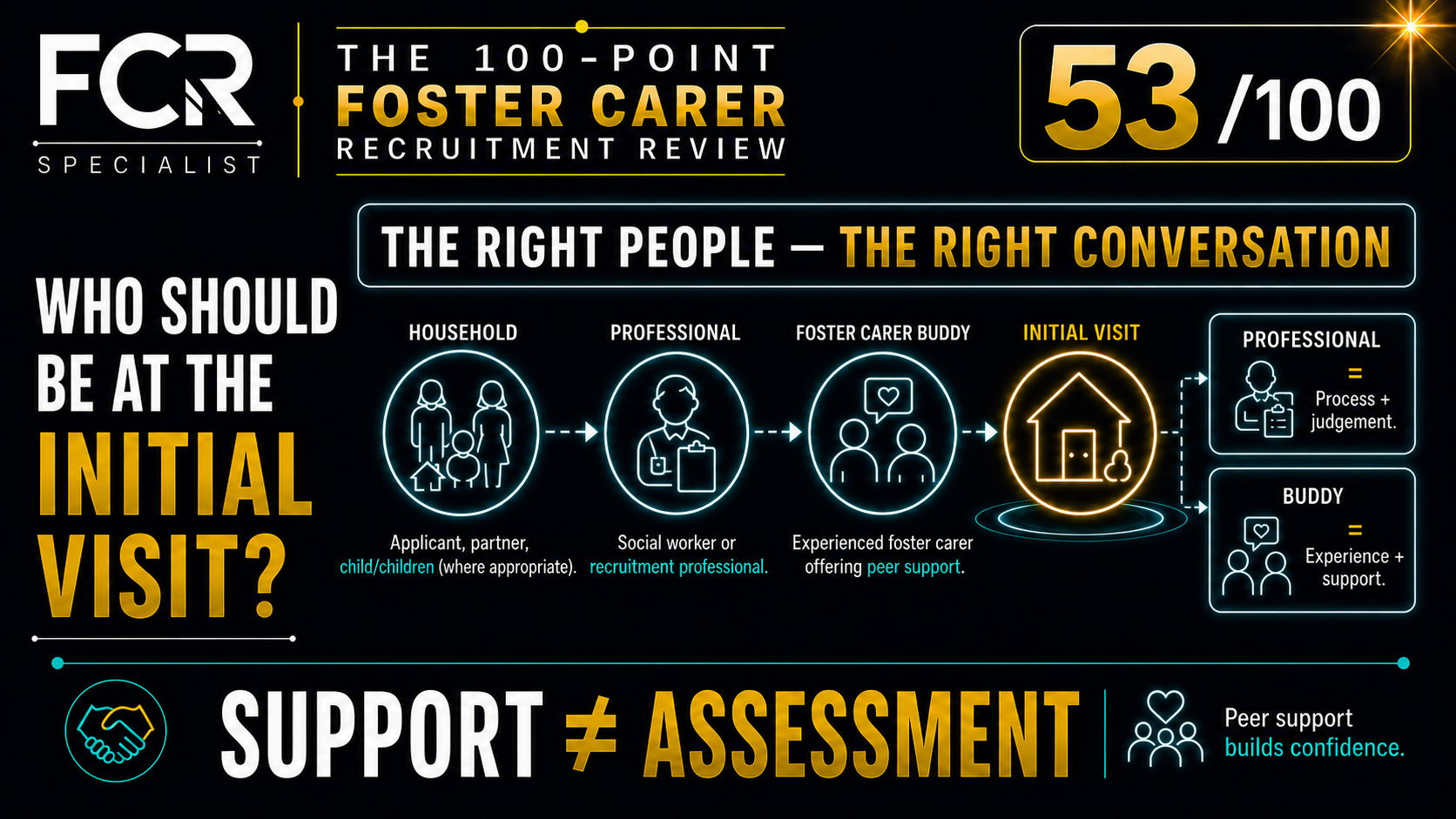
POINT 53/100 — WHO SHOULD BE AT THE INITIAL VISIT?
POINT 53/100 — WHO SHOULD BE AT THE INITIAL VISIT?
An Initial Visit is often described as though the participants are obvious.
A prospective Foster Carer.
A Social Worker.
A conversation.
But fostering is rarely that simple.
The person sitting opposite the Social Worker may have:
- a partner;
- children;
- adult children;
- other adults living in the home;
- relatives who regularly visit;
- existing caring responsibilities;
- and a wider support network that may eventually become important to their fostering.
Fostering does not happen to an applicant in isolation.
FOSTERING ENTERS A HOUSEHOLD.
So the Initial Visit needs to begin understanding the household — without turning into a miniature Form F assessment.
And I think there is another opportunity worth considering.
SHOULD AN EXPERIENCED FOSTER CARER BECOME PART OF THE JOURNEY THIS EARLY?
Not as an assessor.
Not as another person scrutinising the household.
As a peer.
A buddy.
Someone who has already travelled the road the prospective Foster Carer is contemplating.
WHO NEEDS TO BE INVOLVED?
There is no single composition that will be right for every household.
That itself is important.
The question should not be:
“Who does our standard Initial Visit form say must sit at the table?”
It should be:
WHO NEEDS TO BE INVOLVED FOR THIS HOUSEHOLD TO HAVE A USEFUL, HONEST AND INFORMED CONVERSATION?
The prospective Foster Carer
Clearly.
But even here we should remember Point 51.
They should know what the visit is and want it to happen.
A partner
Where two people will share the care of a fostered child, statutory guidance says they should be jointly assessed and approved. The formal assessment also considers the family and household.
So if someone enquires and says:
“My husband isn't really involved — this is something I want to do.”
but they live together and would effectively share the fostering household, that is something to understand early.
Not aggressively.
Not:
“He has to be here or the visit can't happen.”
But:
“Fostering will affect both of you and, if you progress, we would need to understand how it would work for you together. It would therefore be really useful if he could be part of at least some of this conversation.”
That is explanation rather than instruction.
Children in the household
Own children can be enormously affected by fostering.
But that does not mean a nine-year-old should be positioned at the dining-room table for two hours while adults discuss every aspect of family history.
There is a difference between:
including children
and
over-involving children.
At an Initial Visit it may be entirely appropriate to meet them, explain simply why the professional is visiting, hear something of what they understand about fostering and give them permission to ask questions.
Depending on age and circumstances, deeper exploration can happen later.
The important principle is:
CHILDREN SHOULD BE INCLUDED WITHOUT BEING PUT ON THE SPOT.
Other adults in the home
If an adult child, relative, lodger or another adult lives in the household, they will become relevant to the eventual assessment.
Government guidance makes clear that formal fostering assessment includes information about who else lives in the home and checks relating to adults in the household.
Again, this does not mean every adult needs to sit through every minute of the Initial Visit.
It means they should not be invisible.
THEN THERE IS THE PROFESSIONAL
Who conducts the Initial Visit will differ between services.
It might be:
- a recruitment Social Worker;
- an Assessing Social Worker;
- another suitably skilled fostering professional;
- or somebody within a regional recruitment structure.
Whoever conducts it needs to understand two things simultaneously.
They are exercising professional judgement.
And they are still recruiting.
The DfE's 2023 research identified consistency of relationships as helpful and described collaborative relationships between prospective Foster Carers and staff as creating more of a sense of teamwork than a formal assessor/applicant dynamic.
That feels particularly relevant here.
The person entering the home should not arrive behaving as though the household has already entered a formal examination.
PROFESSIONAL CURIOSITY DOES NOT REQUIRE AN INTERROGATION.
NOW ADD SOMEONE DIFFERENT: AN EXPERIENCED FOSTER CARER
This is where I think many services could do something interesting.
What if an experienced Foster Carer was introduced around the Initial Visit stage and, where both parties were comfortable, became a consistent peer contact through the assessment journey?
The evidence supports the broader principle.
The Fostering Network's current best-practice toolkit recommends assigning applicants a peer mentor who can provide practical insight, emotional support, reassurance and positive reinforcement during assessment.
Its recruitment and retention work has also recommended buddy or mentor schemes providing wraparound support throughout approval.
Lancashire currently tells applicants that assessment includes support from an experienced Foster Carer mentor.
And the regional Lancashire/Cumbria recruitment hub has used a buddy scheme offering regular check-ins with existing Foster Carers and young people.
This therefore isn't an abstract idea.
What I am suggesting is taking that principle and asking:
WHY WAIT UNTIL LATER IN ASSESSMENT TO CREATE THAT RELATIONSHIP?
TWO PEOPLE CAN ANSWER TWO VERY DIFFERENT QUESTIONS
A professional might say:
“During assessment we will need to explore your family history, relationships, support network and experience.”
An experienced Foster Carer can say:
“When they explored that with me, this is how it felt and this is why I eventually understood they needed to ask.”
The professional might explain:
“You will need to complete preparation training.”
The Foster Carer can say:
“This was the part of the training that really changed how I thought about fostering.”
The professional might explain allegations procedures.
The Foster Carer can explain why allegations can feel so significant in real family life.
The professional can describe contact, meetings, matching and support.
The Foster Carer can describe what those things actually look like on a Wednesday morning when a child is living in your home.
Neither replaces the other.
PROFESSIONAL KNOWLEDGE + LIVED EXPERIENCE.
That combination can be extremely powerful.
BUT DO NOT PUT AN EXTRA STRANGER INTO A PRIVATE CONVERSATION
This is where the idea needs careful boundaries.
The Initial Visit may move into very sensitive territory.
It could touch on:
- previous relationships;
- family breakdown;
- health;
- criminal history;
- allegations;
- bereavement;
- trauma;
- involvement with children's services;
- domestic abuse;
- difficult experiences in childhood;
- or highly personal household circumstances.
An applicant may be entirely comfortable discussing those things with a Social Worker whose professional role they understand.
They may not be comfortable discussing them with another Foster Carer from their local community.
That must be respected.
So the answer is not:
“Every Initial Visit now includes a Foster Carer.”
The answer is:
USE PEER SUPPORT PURPOSEFULLY — AND WITH CONSENT.
A THREE-PART INITIAL VISIT COULD WORK VERY WELL
For example:
PART ONE — WELCOME AND REALITY
Prospective Foster Carer, relevant family members, professional and Foster Carer buddy.
Talk about:
- what fostering is really like;
- why the household became interested;
- broad questions;
- the fostering service;
- the journey ahead;
- practical lived experience;
- support;
- training;
- opportunities and realities.
Then the Foster Carer leaves the conversation.
PART TWO — PRIVATE PROFESSIONAL CONVERSATION
The professional and prospective Foster Carer — and partner where appropriate — can discuss more private matters.
This is where professional judgement and confidentiality become paramount.
PART THREE — REJOIN AND NEXT STEPS
Where appropriate, the Foster Carer buddy can rejoin.
Questions can be picked up.
The applicant can hear what happens next.
If everybody wishes to continue, the buddy relationship can begin.
That creates continuity rather than introducing a succession of strangers.
THE BUDDY MUST HAVE A CLEAR ROLE
This cannot be informal in the sense of:
“Here's one of our carers — have a chat.”
If a service wants Foster Carers involved in recruitment and assessment support, they need boundaries.
The buddy should know:
- they are not assessing the applicant;
- they are not there to recommend approval or rejection;
- they do not need access to confidential assessment information;
- they should not probe sensitive subjects;
- they should not promise outcomes;
- they should not present their own fostering experience as universally typical;
- they need to understand confidentiality;
- and they need a clear route for escalating any genuine safeguarding concern disclosed to them.
That protects the applicant.
It also protects the Foster Carer buddy.
A PEER MENTOR IS A SUPPORT ROLE — NOT A SHADOW ASSESSOR.
CHOOSE THE BUDDY CAREFULLY
Not every excellent Foster Carer will make an excellent buddy.
The strongest buddy is not necessarily your longest-serving or most vocal Foster Carer.
Look for someone who can:
- listen;
- avoid dominating;
- respect different families;
- talk honestly about difficulties without frightening people;
- talk positively without selling;
- understand boundaries;
- respect confidentiality;
- avoid turning their own experience into “the way fostering works”;
- and tell an applicant when a question needs a professional answer.
There is another important point.
Matching the buddy may matter.
A single prospective Foster Carer may value speaking to another single Foster Carer.
Someone with young birth children may particularly value contact with a fostering family who has navigated that.
Someone considering fostering alongside employment may want to know how another working household manages.
That does not mean we must match people by demographic characteristics mechanically.
It means:
MAKE LIVED EXPERIENCE RELEVANT.
COULD THIS BECOME ONE CONTINUOUS RELATIONSHIP?
The Government's 2026 Renewing Fostering programme describes an ambition for regional hubs to provide a “journey guide” from enquiry to approval, alongside an established support network for carers.
I think peer support can sit naturally alongside that idea.
Imagine:
INITIAL VISIT
↓
ASSESSMENT BEGINS
↓
PREPARATION TRAINING
↓
DIFFICULT WEEK IN ASSESSMENT
↓
PANEL APPROACHES
↓
APPROVAL
And alongside the professional relationship sits one experienced Foster Carer who periodically says:
“How are you getting on?”
Not chasing.
Not assessing.
Supporting.
That may be particularly useful at the points where anxiety rises.
WHAT ABOUT THE APPLICANT WHO DOES NOT WANT A BUDDY?
Then don't give them one.
Applicant-centred practice includes the right to say:
“I'd rather keep the process between us and the professional team.”
Peer support should be an offer, not another hurdle.
The applicant might prefer:
- one-to-one buddying;
- group contact with Foster Carers;
- meeting somebody at preparation training;
- telephone contact;
- or no peer support at that stage.
The objective is not uniformity.
It is useful support.
HERE IS THE TEST…
Take your last 20 Initial Visits and ask:
Who was present?
- prospective Foster Carer only?
- partner?
- children?
- other household adults?
- recruitment worker?
- Assessing Social Worker?
- existing Foster Carer?
Then go further.
- Was the partner appropriately involved?
- If not, why not?
- Were children acknowledged and included appropriately?
- Were children accidentally excluded from a decision that may significantly affect them?
- Or were they expected to remain through adult conversations that were inappropriate for them?
- Were relevant household adults understood?
- Did the applicant meet anyone with actual lived experience of fostering?
- If they did, when did that first happen?
- During an information event?
- During preparation training?
- Halfway through assessment?
- Only after approval?
- Could peer contact have been useful earlier?
- Does your service have a buddy or mentor scheme?
- How many applicants actually use it?
- Is the buddy role defined?
- Are buddies trained?
- Is confidentiality clear?
- Is safeguarding escalation clear?
- Are buddies inadvertently being asked for views about suitability?
- Do applicants choose whether they want peer support?
- Can the applicant speak to their buddy independently of the assessing professional?
- Do applicants retain the same peer contact through assessment?
- What do applicants say about the support?
Then ask:
ARE WE SURROUNDING APPLICANTS WITH THE RIGHT SUPPORT — OR SIMPLY MOVING THEM FROM ONE PROFESSIONAL APPOINTMENT TO THE NEXT?
That is a different way of looking at recruitment.
THE INITIAL VISIT SHOULD NOT BECOME A CROWD
There is a final caution.
The answer to Point 53 is not to fill someone's living room.
Imagine:
two applicants,
three children,
a recruitment worker,
an Assessing Social Worker,
and a Foster Carer mentor.
Suddenly a welcoming Initial Visit has become a committee meeting.
That is not what I am advocating.
The principle is:
THE RIGHT PEOPLE — AT THE RIGHT PART OF THE CONVERSATION.
Sometimes that means two people.
Sometimes more.
Sometimes somebody joins for only 20 minutes.
The structure should serve the household and the purpose of the visit.
THE RECRUITMENT OPPORTUNITY
Prospective Foster Carers need professional expertise.
But sometimes the answer they really want is not:
“What does policy say?”
It is:
“What was this actually like for someone like me?”
An existing Foster Carer can answer a question no recruitment brochure can answer with the same authenticity.
Done properly, peer support can provide:
continuity
reassurance
realism
belonging
and perhaps most importantly:
someone who understands what the applicant is experiencing because they have experienced it themselves.
PEER SUPPORT SHOULD CREATE CONFIDENCE — NOT COMPROMISE PRIVACY.
And that takes us directly into Point 54:
WHAT IS THE INITIAL VISIT ACTUALLY FOR?
Because before we decide what information to gather, we need to be absolutely clear about the purpose of the conversation.