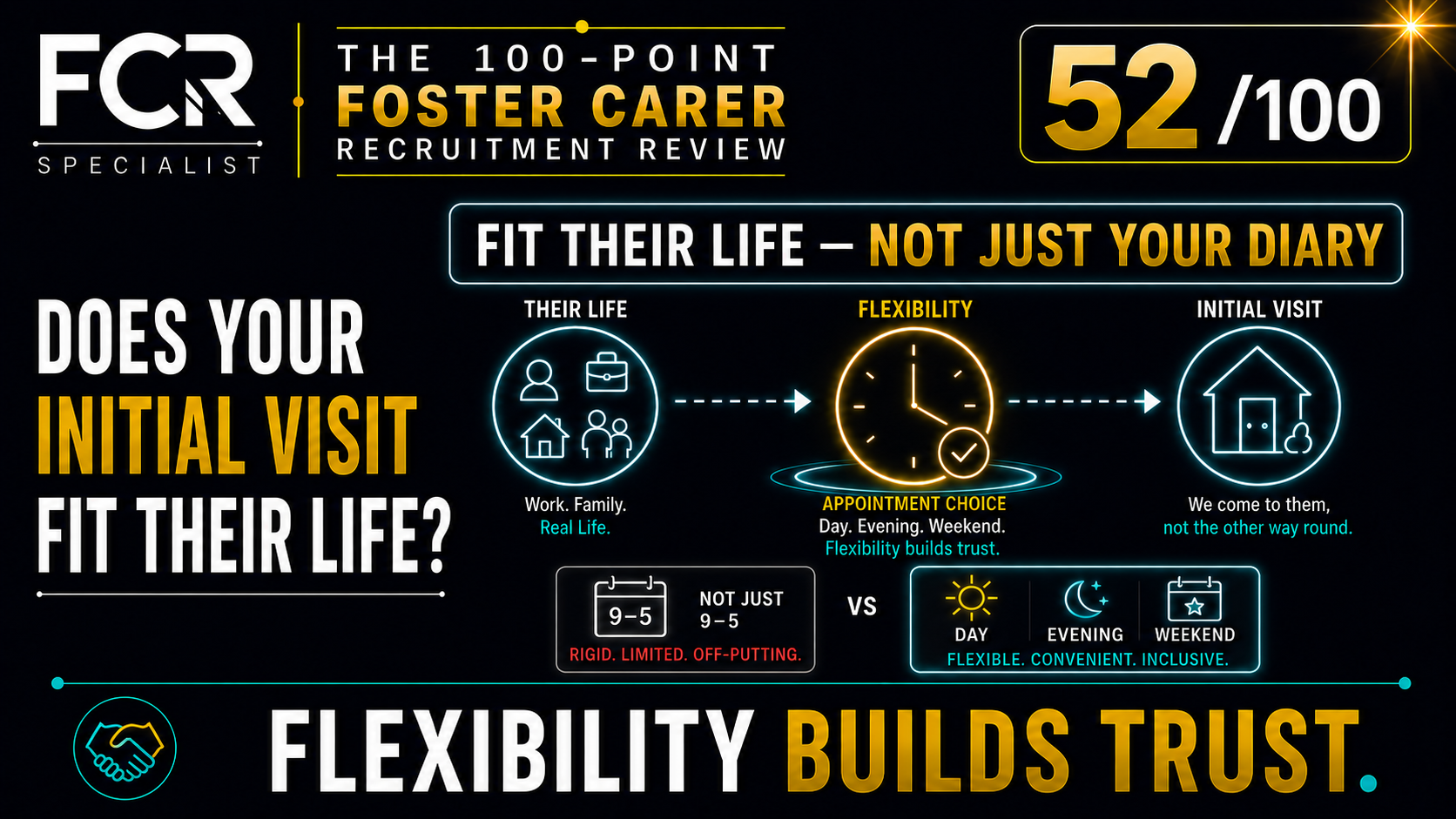
POINT 52/100 — DOES YOUR INITIAL VISIT FIT THEIR LIFE — OR YOURS?
POINT 52/100 — DOES YOUR INITIAL VISIT FIT THEIR LIFE — OR YOURS?
Let us imagine a prospective Foster Carer.
They are 42.
They work full-time.
They have two children at school.
They have a spare bedroom.
They have been thinking about fostering for several years.
They have now spoken to your recruitment team, asked sensible questions and decided that they are ready for an Initial Visit.
Excellent.
Then comes the conversation:
“When can somebody come to see us?”
And the answer is:
“Monday to Friday, between 9am and 4pm.”
The prospective Foster Carer explains that they work.
They ask whether an evening appointment might be possible.
And occasionally, somewhere within the system, an assumption begins to form:
“If they are serious about fostering, surely they can take a day off.”
I think that assumption deserves considerable scrutiny.
THEY ARE NOT YET A FOSTER CARER.
They are somebody your organisation is trying to recruit.
That distinction matters.
WHAT ARE WE ACTUALLY TESTING?
There will be many legitimate questions about employment as somebody progresses through fostering.
Can their working pattern accommodate the children they hope to care for?
What flexibility does their employment provide?
Who will be available when a child is not at school?
How will meetings, contact arrangements, training and emergencies be managed?
Employment history and circumstances form part of the eventual fostering assessment. GOV.UK itself makes clear that employment history is one of the areas explored during assessment.
Those are legitimate professional questions.
But they are not the same question as:
“Will you use a day's annual leave so that our organisation can conduct its recruitment appointment during its preferred working hours?”
One tests the prospective Foster Carer's future capacity.
The other may simply test how conveniently they can fit around the organisation.
DO NOT TURN YOUR OPERATING HOURS INTO AN UNOFFICIAL ELIGIBILITY CRITERION.
THE EVIDENCE ALREADY POINTS TOWARDS FLEXIBILITY
The Department for Education's 2023 qualitative research into Foster Carer Recruitment is unusually explicit on this issue.
Participants said a one-size-fits-all approach did not meet prospective Foster Carers' needs and preferences.
The report identified flexibility in communication methods and flexibility about when staff are available, including some evening and weekend hours, as potentially helpful. It also argued more broadly for recruitment and assessment processes that better accommodate people's needs and preferences.
That principle has now moved closer to the centre of national policy.
The Government's February 2026 Renewing Fostering programme states that forthcoming recruitment standards will address:
- applicant-focused initial contact;
- responsive and prompt home visits;
- effective preparation and training;
- and the wider quality of the applicant experience.
There is therefore a straightforward operational question for fostering services:
HOW CAN A HOME VISIT BE “APPLICANT-FOCUSED” IF THE APPLICANT HAS ALMOST NO CHOICE ABOUT WHEN IT CAN HAPPEN?
THIS IS NOT AN ARGUMENT FOR 24/7 SOCIAL WORKING
It is important to be precise here.
I am not suggesting:
- every Social Worker must work evenings;
- every Assessing Social Worker should give up weekends;
- applicants should dictate appointments;
- managers should create unhealthy working expectations;
- or staff wellbeing should be sacrificed in the name of recruitment.
That would simply move the problem from one group of people to another.
This is a service-design issue.
An organisation recruiting Foster Carers should collectively have enough flexibility to meet reasonable applicant needs.
That could mean:
A rota
Perhaps one or two members of the team cover early evening appointments on agreed days.
Flexible hours
A worker who undertakes a 6.30pm Initial Visit starts later or finishes earlier elsewhere in the week.
Time off in lieu
Where appropriate within the organisation's employment arrangements.
Occasional planned weekend appointments
Not every Saturday. Not whenever anybody demands one. Simply enough capacity to remove an unnecessary obstacle.
Different team deployment
It does not necessarily have to be the same Social Worker who is available at every possible time.
The question is not:
“Can Jane work Tuesday night?”
The question is:
“Can our service offer reasonable appointment choice?”
That is a management responsibility.
THE ANNUAL-LEAVE TEST
Here is a useful way to think about the problem.
Imagine somebody has 25 days' annual leave.
At this stage they are not approved.
They are not in assessment.
They may not even have submitted a formal application.
They are considering one of the biggest decisions their household may ever make.
Should one of your earliest recruitment propositions really be:
“Use one of your limited days off work so we can decide whether we want to continue talking to you”?
For some people that may be fine.
They may happily choose to do that.
There is nothing inherently wrong with a daytime Initial Visit.
The problem appears when daytime becomes the only option and the applicant's inability or reluctance to accommodate it begins to acquire meaning.
“TAKE A DAY OFF TO PROVE YOU'RE COMMITTED” IS NOT A RECRUITMENT STRATEGY.
BE CAREFUL WITH THE WORD “COMMITMENT”
“Commitment” is one of those words that can become very powerful in fostering.
We understandably want committed Foster Carers.
Children need reliability.
The fostering task involves inconvenience, unpredictability, training, professional meetings and considerable responsibility.
But commitment should be evidenced against the realities of fostering.
It should not be inferred from compliance with avoidable organisational inconvenience.
A person can be deeply committed to becoming a Foster Carer and still say:
“I cannot easily take Wednesday afternoon off work.”
Those positions are entirely compatible.
Indeed, retaining people in employment while they explore fostering may be financially responsible.
We should remember that the prospective Foster Carer is still assessing whether fostering will work for them.
Point 51 established:
THE SERVICE SHOULD BE FAST. THE PERSON SHOULD NOT FEEL RUSHED.
Point 52 adds:
THE SERVICE SHOULD BE ACCESSIBLE. THE PERSON SHOULD NOT HAVE TO PROVE THEIR INTEREST BY OVERCOMING AVOIDABLE BARRIERS.
RECRUIT THE PEOPLE YOU SAY YOU WANT
There is another strategic contradiction worth considering.
Fostering services quite rightly say they want a diverse range of Foster Carers.
They want:
- younger households;
- single Foster Carers;
- people from different occupations;
- different communities;
- people bringing different skills and life experiences;
- working households where fostering arrangements can realistically be accommodated;
- and people who may never previously have considered themselves the traditional Foster Carer.
Then the recruitment process is sometimes structured around a model which assumes somebody can simply be at home during the working day.
That can narrow your recruitment market before assessment has properly begun.
Accessibility is therefore not simply customer service.
ACCESSIBILITY IS PART OF RECRUITMENT STRATEGY.
FLEXIBILITY ALREADY EXISTS IN PARTS OF THE SECTOR
This is not an entirely theoretical model.
Current fostering recruitment roles continue to be advertised with explicit expectations of flexible evening and weekend working. For example, a 2026 Coventry City Council fostering recruitment role specified a requirement for flexibility, including out-of-hours and weekend activity.
Other providers publish applicant journeys offering calls during some evenings, while some preparation programmes are delivered during evenings and weekends.
The principle is therefore already present:
when services decide accessibility matters, working arrangements can be designed around it.
The task is to make that thinking systematic rather than accidental.
BUT WHAT ABOUT STAFF WELLBEING?
This needs to be built into the model rather than treated as an afterthought.
A recruitment system that depends on enthusiastic individual Social Workers repeatedly sacrificing their evenings is not a sustainable system.
It creates:
- burnout;
- inconsistency;
- resentment;
- unequal workloads;
- dependence on particular individuals;
- and eventually withdrawal of the flexibility itself.
Good flexibility is planned flexibility.
Managers should know:
- what appointment windows are offered;
- who covers them;
- how often;
- how working time is adjusted;
- whether demand justifies the arrangement;
- and whether the model is sustainable.
The objective is not heroic staff behaviour.
It is good service design.
SOMETIMES THE PROBLEM IS NOT THE VISIT — IT IS THE WAIT
Imagine your team does offer evening appointments.
Excellent.
But the next evening appointment is three weeks away.
Meanwhile, daytime appointments are available tomorrow.
Technically, the service offers flexibility.
Operationally, it may still disadvantage working prospective Foster Carers.
That is why managers should not simply ask:
“Do we offer evenings?”
They should ask:
“How quickly can somebody actually get one?”
If working applicants routinely wait substantially longer than applicants who are free during office hours, the system may still contain an accessibility problem.
The 2026 Government reform direction towards responsive and prompt home visits makes that increasingly relevant.
HERE IS THE TEST…
Take your last 20 or 30 Initial Visits.
For each one, record:
When did the prospective Foster Carer say they were available?
Then compare that with:
What did the service actually offer?
Now examine:
- How many Initial Visits were offered only during office hours?
- How many early evening slots were available?
- Were any weekend appointments available?
- How long did someone requesting an evening appointment have to wait?
- Was that longer than someone accepting a daytime appointment?
- How many people took annual leave?
- Did they choose to, or because there was no alternative?
- How many appointments were cancelled or rearranged because of work?
- Do your records capture that reason?
- Are working prospective Foster Carers progressing differently from people with greater daytime availability?
- Does one particular worker provide most of your flexible appointments?
- Is that because the service has a system — or because that individual happens to be accommodating?
- Do prospective Foster Carers know from the outset that some flexibility is available?
- Does your website imply you work around applicants but your diary say otherwise?
- Are appointment slots based on applicant need or simply on staff calendar gaps?
- When was the last time management reviewed Initial Visit demand by day and time?
Then ask the more uncomfortable question:
HAVE WE EVER DESCRIBED SOMEBODY AS “NOT COMMITTED” WHEN THE REAL ISSUE WAS THAT OUR APPOINTMENT SYSTEM WAS INFLEXIBLE?
That is worth knowing.
BUILD A SIMPLE ACCESSIBILITY STANDARD
You do not need a complicated policy.
A service might simply agree:
Initial Visits should normally be offered within X working days.
I would not prescribe a universal number without evidence about local capacity.
But the organisation should know its own standard.
Then:
- offer more than one appointment where possible;
- include some capacity beyond traditional office hours;
- record applicant availability;
- record whether the appointment offered met it;
- review reasons for cancellation and rearrangement;
- monitor delays caused by appointment availability;
- and adjust the rota according to actual demand.
That turns flexibility from goodwill into an operating model.
ACCESSIBILITY BY DESIGN — NOT BY EXCEPTION.
THE RECRUITMENT PRINCIPLE
Fostering inevitably requires flexibility from Foster Carers.
Nobody should disguise that.
A realistic Initial Visit will eventually need to explore what fostering could mean for work, family routines and availability.
But there is a significant difference between explaining the future realities of fostering and creating unnecessary barriers during recruitment.
The person is still considering you.
You are still recruiting them.
And first impressions of the service matter.
If your early message is:
“We understand you have a job, a family and an existing life. We will work with you reasonably while we explore whether fostering could fit into it.”
that says something important about the organisation.
So does:
“We only visit Tuesday to Thursday before four.”
FLEXIBILITY BUILDS TRUST.
And that leads directly into Point 53.
Because once the visit is arranged at a time that works, we need to consider: