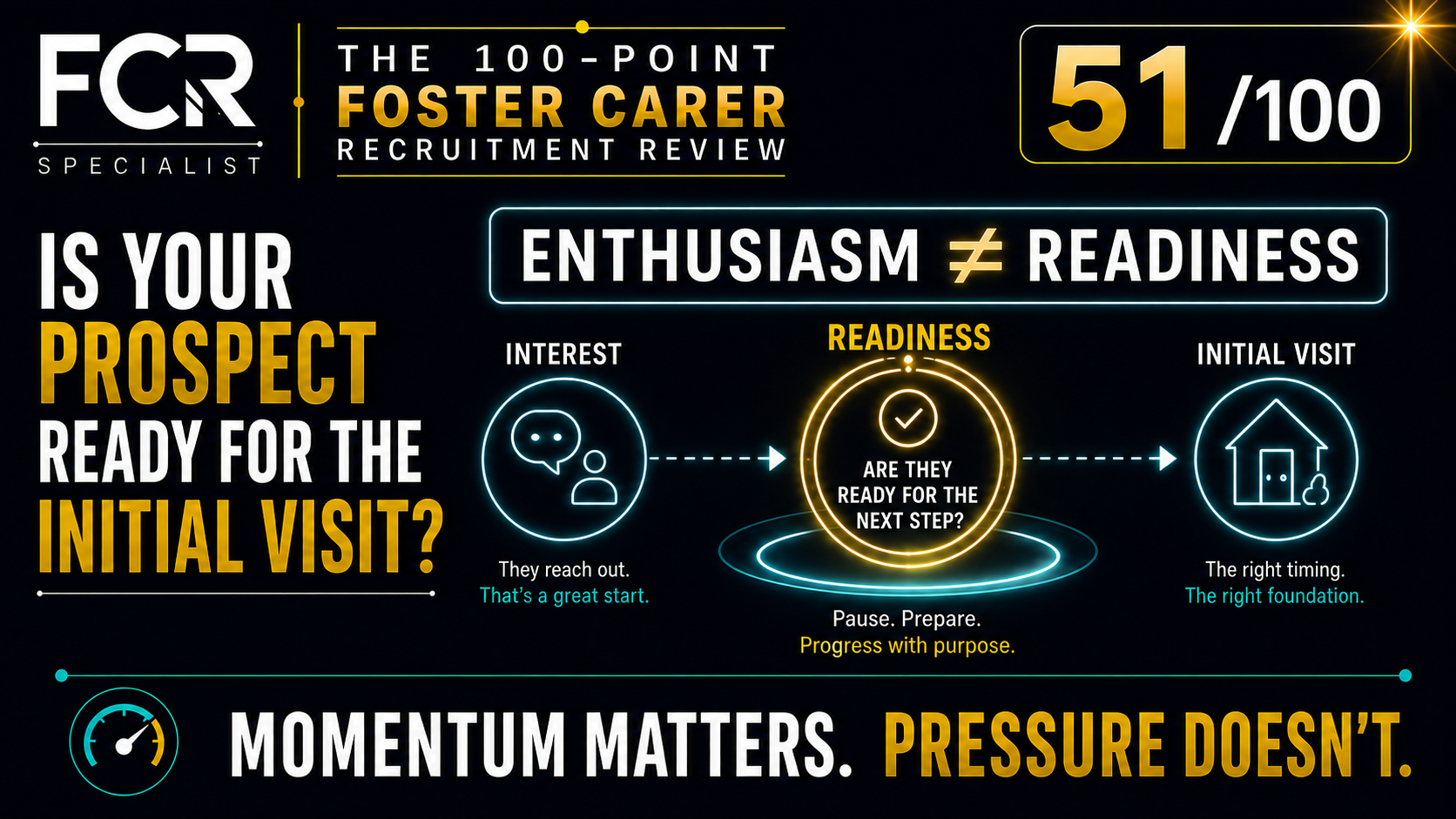
POINT 51/100 — ARE THEY READY FOR THE INITIAL VISIT — OR ARE YOU READY FOR THEM?
POINT 51/100 — ARE THEY READY FOR THE INITIAL VISIT — OR ARE YOU READY FOR THEM?
There can be a very tempting moment in Foster Carer Recruitment.
You have spoken to somebody who sounds excellent.
They have a spare room.
They appear enthusiastic.
They are asking sensible questions.
They seem genuinely interested in fostering.
The recruitment instinct can immediately become:
“Get an Initial Visit booked.”
That instinct is understandable.
Foster Carer Recruitment teams are under pressure to recruit. Managers want progression. Services need additional Foster Carers. Nobody wants a good prospective Foster Carer sitting unnecessarily in an enquiry pipeline.
But there is an important distinction to make.
ENTHUSIASM IS NOT THE SAME AS READINESS.
The recruiter may finish a conversation thinking:
“This person is ready for an Initial Visit.”
The prospective Foster Carer may finish exactly the same conversation thinking:
“That was really interesting. I need to think about this.”
Both responses can be perfectly reasonable.
The mistake occurs when the organisation's desire to maintain momentum overtakes the person's confidence in taking the next step.
FAST SERVICE. NOT A RUSHED PERSON.
There is an apparent tension here.
We know that slow Foster Carer Recruitment processes can lose people.
The Government's 2026 Renewing Fostering programme explicitly identifies timely, responsive practice, consistent points of contact, clear information, early conversations and flexibility as features associated with better progression. It also says new standards will address applicant-focused initial contact and responsive, prompt home visits.
So I am certainly not arguing for slower recruitment.
I am arguing for better-paced recruitment.
There are two different clocks running.
The service clock should move quickly.
Calls should be answered.
Information should arrive promptly.
Questions should receive answers.
Available appointments should not be weeks away because of administrative delay.
The prospective Foster Carer's decision clock may require something different.
They may need to:
- talk to their partner;
- speak to their children;
- think about employment;
- consider their home;
- understand the financial implications;
- digest what they have just been told;
- ask another question tomorrow;
- or simply sleep on an enormous decision.
These two things are not contradictory.
REMOVE DELAY WITHOUT MANUFACTURING URGENCY.
That is good recruitment.
WHAT DOES THE EVIDENCE TELL US?
The DfE's 2023 qualitative research into Foster Carer Recruitment and conversion is particularly relevant here.
Participants described the initial enquiry process as potentially quite intense and sometimes invasive, particularly when it moved towards the home visit. The research highlighted a move away from simply gathering information from prospective Foster Carers and towards enabling them to obtain the information they need, evaluate whether the service is right for them and make their own decision about progressing. Importantly, the report specifically identifies the timing of information as significant.
The earlier DfE behavioural-insights research into fostering and adoption found another important psychological issue: some prospective applicants did not experience an enquiry as a casual request for information. They perceived it as the beginning of a formal process and therefore as a significant commitment. The research identified the importance of creating a safe point at which people can ask questions without feeling judged.
That matters enormously.
What feels to an experienced recruiter like:
“Let's just get somebody out to see you.”
may feel to the person enquiring like:
“I have now formally started becoming a Foster Carer.”
Those are very different perceptions of the same appointment.
EXPLAIN THE INITIAL VISIT BEFORE SELLING THE INITIAL VISIT
Before somebody agrees to an Initial Visit, they should have a reasonable understanding of what they are agreeing to.
That does not require a 45-minute briefing.
It requires clarity.
Explain:
- what an Initial Visit is;
- why the service undertakes it;
- who would normally attend;
- who from their household may need to be involved;
- the broad areas likely to be discussed;
- that they will have plenty of opportunity to ask questions;
- that fostering is still a two-way decision;
- and what may happen afterwards if everybody agrees that progression is appropriate.
Then there is a very simple question:
“Having talked through that, does an Initial Visit feel like the right next step for you?”
That is very different from:
“I can get somebody to you Thursday at four.”
The first checks readiness.
The second assumes it.
A BOOKING IS NOT THE SAME AS COMMITMENT
A diary appointment can create the appearance of progression.
That does not mean confidence has progressed with it.
If an Initial Visit is booked before the person has psychologically caught up with the process, what may happen next?
They cancel.
They postpone.
They rearrange repeatedly.
They stop answering calls.
They send an email saying things have become busy.
Or they simply disappear.
None of those outcomes proves that the Initial Visit was booked prematurely.
People have jobs.
Children become ill.
Work shifts change.
Life happens.
A cancelled or rearranged appointment must therefore never automatically be interpreted as a lack of commitment.
But it is still recruitment intelligence.
If it happens repeatedly across a service, the management question should be:
DID WE MOVE FASTER THAN THEIR CONFIDENCE?
That is a much more useful question than:
“Why are applicants so unreliable?”
WHAT DOES READINESS LOOK LIKE?
Readiness should not become another eligibility test.
There should not be a bureaucratic “Initial Visit Readiness Form”.
This is about the quality of the recruitment conversation.
Before booking, can you reasonably say:
1. They understand the purpose of the visit.
It has not been presented vaguely as somebody “popping round”.
2. They know broadly what will happen.
There should not be a large gap between what they imagine and what actually occurs.
3. Important household conversations have at least started.
If somebody has a partner who knows nothing about the enquiry, immediately booking a household visit may create exactly the wrong kind of momentum.
4. Their immediate questions have been answered.
Not every possible fostering question — simply the questions they need answered to make the next decision.
5. They are choosing the next step rather than acquiescing to it.
There is a surprisingly important difference between:
“Yes, okay, if you think that's what I need to do.”
and:
“Yes, I'd like to arrange that.”
A skilled recruiter hears that difference.
RESPONSIVENESS DOES NOT MEAN PRESSURE
The sector needs to be careful not to misread the current push for faster recruitment.
Ofsted's latest published data show that only around 6% of fostering enquiries progressed to application in the year ending March 2025. The Government has itself described low conversion as a serious concern.
That statistic does not tell us that 94% of enquirers should have applied.
They should not.
Some will discover fostering is unsuitable.
Some are researching for the future.
Some will enquire with multiple organisations.
Some will encounter legitimate reasons not to progress.
And services do not all define an enquiry identically — a limitation already recognised in Ofsted and DfE research.
The objective is therefore not maximum conversion at any cost.
It is:
MAXIMUM APPROPRIATE CONVERSION — MINIMUM AVOIDABLE LOSS.
Pressure can actually work against that objective.
A diary full of quickly booked Initial Visits is not a strong recruitment outcome if too many of those appointments are subsequently cancelled because the people involved were not ready for them.
THE RECRUITER'S JOB CHANGES HERE
At the beginning of an enquiry, the recruiter's role is heavily informational.
Listen.
Understand.
Answer.
Explore.
At this transition point, another recruitment skill becomes important:
JUDGING PACE.
That means recognising the difference between someone who needs encouragement and someone who needs breathing room.
Someone saying:
“I need to talk to my partner tonight.”
does not necessarily need a follow-up call tomorrow morning asking whether they have decided.
They may need:
“Of course. I'll send you the information we discussed. Have a conversation together and, when you're ready, let's pick this up again. If any questions come up in the meantime, contact me.”
That maintains the relationship without applying pressure.
Remember the principle from the previous Stage:
NURTURE — DON'T CHASE.
HERE IS THE TEST…
Take the last 20 or 30 prospective Foster Carers for whom an Initial Visit was discussed.
Do not only look at how many Initial Visits were booked.
Ask:
- At what point in the first conversation was the Initial Visit introduced?
- Was its purpose properly explained?
- Did the person understand what would happen?
- Were they given an opportunity to ask questions before booking?
- Were partners and household circumstances considered before the appointment was arranged?
- How frequently was an appointment booked during the very first contact?
- How many Initial Visits were subsequently cancelled?
- How many were rearranged?
- How soon after booking did cancellations occur?
- What reasons were recorded?
- Did the applicant initiate the booking, or did the worker primarily drive it?
- Are cancellation or rearrangement rates noticeably different between workers?
- Are some recruiters excellent at obtaining bookings but weaker at getting those bookings to actually happen?
- Do your CRM records distinguish Initial Visit offered, Initial Visit discussed, Initial Visit booked and Initial Visit attended?
- When somebody says, “I need some time to think,” what happens next?
- Does the organisation have a thoughtful nurture route — or does the person simply become another unconverted enquiry?
And perhaps most importantly:
ARE YOU MEASURING APPOINTMENTS — OR READINESS?
Those are not necessarily the same thing.
A GOOD OUTCOME
The objective is not to persuade somebody to allow a Social Worker into their home as quickly as possible.
The objective is to get them to the point where they understand the Initial Visit sufficiently well that they genuinely want it to happen.
They may arrive at that point during the first call.
Excellent.
Book it.
They may arrive there two days later after talking with their partner.
Excellent.
Book it then.
They may decide they are not yet ready.
That may become a nurture opportunity rather than a lost enquiry.
And occasionally they will decide they do not want to continue.
That is also part of an informed recruitment process.
DON'T SELL THE NEXT STEP BEFORE THEY ARE READY TO TAKE IT.
The best Foster Carer Recruitment processes combine speed with judgement, momentum with consent, and responsiveness with respect.
The service should be ready immediately.
The prospective Foster Carer should progress when their understanding and confidence are ready too.
NEXT — POINT 52/100
Once somebody genuinely wants the Initial Visit, another question immediately follows:
DOES YOUR INITIAL VISIT FIT THEIR LIFE — OR YOURS?
Because accessibility does not stop once the enquiry has been converted into an appointment.