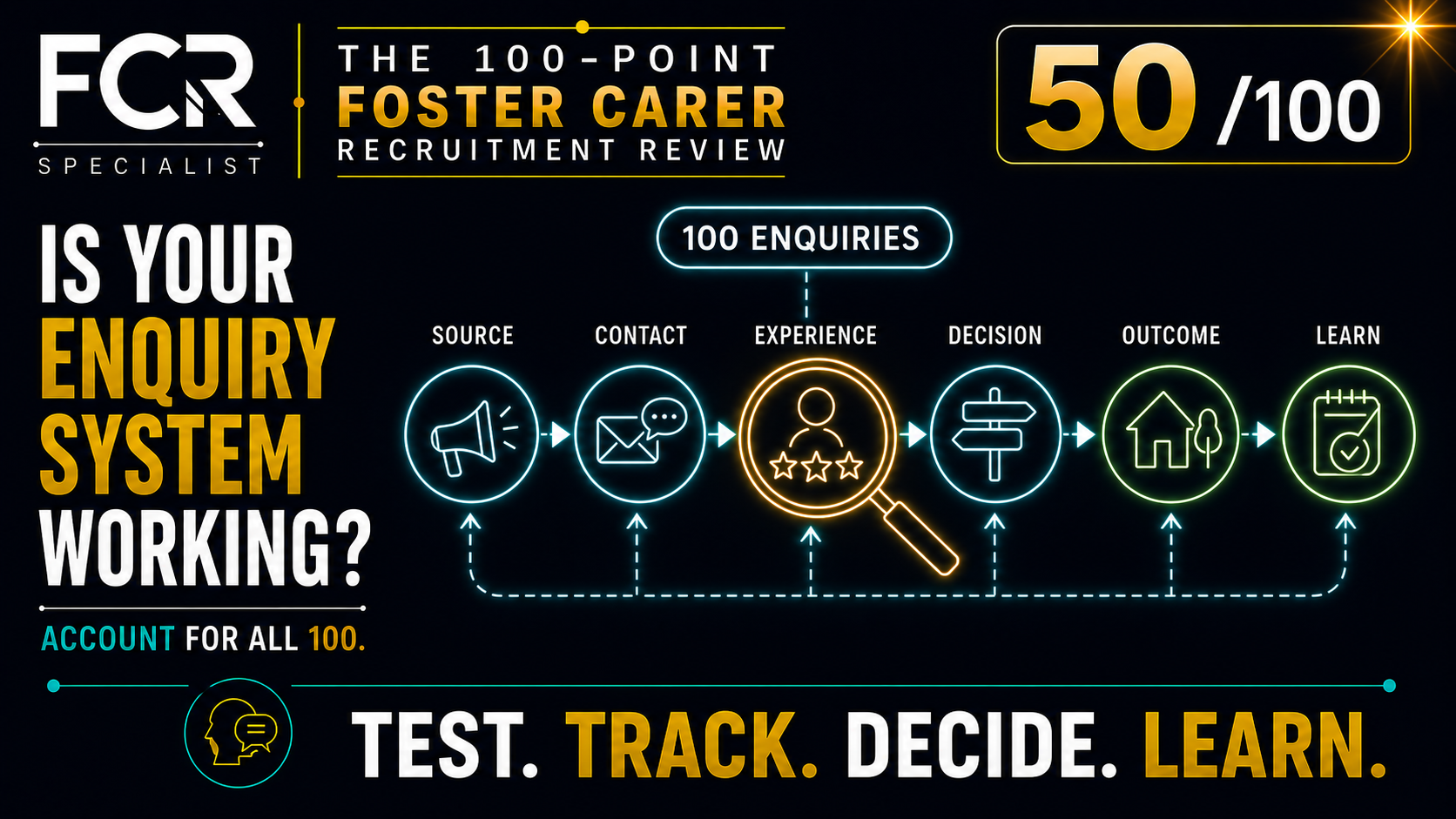
Point 50/100 — Is Your Initial Enquiry System Actually Working?
Point 50/100 — Is Your Initial Enquiry System Actually Working?
We have reached Point 50.
Halfway through The 100-Point Foster Carer Recruitment Review.
And this is a good moment to stop.
Not because Foster Carer Recruitment stops here.
Quite the opposite.
We haven't even reached the Initial Visit yet.
But before moving somebody deeper into the recruitment and assessment journey, I think senior managers, recruitment managers and fostering leaders should be able to answer one fundamental question:
IS YOUR INITIAL ENQUIRY SYSTEM ACTUALLY WORKING?
Not:
Do you have an enquiry form?
Not:
Does somebody answer the telephone?
Not:
Do you have a CRM?
Not even:
How many enquiries did you receive?
The test is whether all those things operate together as a coherent recruitment system.
The national numbers should make us pay attention
The Government's February 2026 Renewing Fostering plan reports that, in the year ending March 2025, only around 6% of enquiries progressed to application.
The Government describes such low conversion as deeply concerning and identifies several features associated with stronger progression: timely and responsive handling, maintaining momentum, consistent points of contact and trusted relationships.
There are important caveats.
Enquiry data has historically suffered from variations in definition and may include people making more than one enquiry.
So I would not use 6% to declare automatically that:
94% of prospective Foster Carers have been lost.
That would be too simplistic.
But 6% should certainly make every organisation ask:
WHAT IS HAPPENING BETWEEN ENQUIRY AND APPLICATION?
That has effectively been the purpose of Points 41–49.
Point 50 joins the pieces together
Let's revisit the journey.
POINT 41 — CAN PEOPLE EASILY ENQUIRE?
Have you created unnecessary barriers before somebody has even spoken to you?
POINT 42 — WHAT HAPPENS WHEN THEY DO?
How quickly and effectively does somebody respond?
POINT 43 — WHERE DOES THE ENQUIRY GO?
Is there one household record?
One owner?
One journey?
Can you trace the original recruitment source?
POINT 44 — WHAT DOES FIRST CONTACT FEEL LIKE?
Welcoming?
Interested?
Human?
Or administrative, judgemental and transactional?
POINT 45 — ARE YOU ANSWERING THEIR QUESTIONS?
Or are you simply gathering the information your organisation wants?
POINT 46 — ARE YOU SCREENING THEM OUT TOO EARLY?
Are legitimate standards being applied?
Or are assumptions being mistaken for rules?
POINT 47 — IS THERE A ROUTE FORWARD?
When an issue appears, do you manage it where appropriate?
Or tell a potentially viable Foster Carer to go away and come back in six months?
POINT 48 — WHAT HAPPENED TO EVERYONE WHO DIDN'T PROGRESS?
Did they leave?
Did you reject them?
Were they genuinely Not Now?
Could you not contact them?
Or did the recruitment process lose them?
POINT 49 — WHAT HAPPENS TO NOT NOW?
Do you nurture an appropriate future relationship?
Or close the record and hope they remember you several years later?
Point 50 is therefore not another separate piece of recruitment activity.
IT IS THE SYSTEM CHECK.
Take 100 enquiries
I think this is one of the simplest reviews a fostering service could conduct.
Take the last 100 genuine, actionable Foster Carer household enquiries.
Not a selected sample of your best ones.
Not just people who progressed.
Not just Meta leads.
Not only those handled by your strongest recruiter.
The last 100.
Then trace them from beginning to end.
For each household I would want a simple set of information. QuestionWhat are we trying to understand?SOURCEWhere did this household originate?DATE/TIMEWhen did they enquire?FIRST RESPONSEWhat happened next and how long did it take?CONTACTWas meaningful contact actually achieved?OWNERWho was responsible for the journey?EXPERIENCEWhat concerns/questions arose?DECISIONDid we progress, pause, redirect or stop?NEXT ACTIONWhat was agreed, by whom and by when?OUTCOMEWhat ultimately happened?REASONWhy?LAST CONTACTWhen was the last meaningful interaction?LEARNINGWhat does this case tell us?
That isn't a complicated national reporting standard.
It is management visibility.
Then account for all 100
This is where I would become very disciplined.
If your answer eventually looks like:
100 enquiries
↓
17 applications
↓
83 didn't convert
you have not completed the exercise.
What happened to the 83?
Point 48 gave us the categories.
Perhaps:
Applicant chose not to progress.
Provider decided not to progress.
Not Now.
Unable to contact.
Referred elsewhere.
Still actively progressing.
Process-created loss.
Unknown.
The numbers will be different for every provider.
That is fine.
What matters is:
ACCOUNT FOR ALL 100.
Don't fear an honest “unknown”
Some organisations may look at this exercise and discover:
We genuinely don't know what happened to 31 people.
That isn't a reason to manipulate the categories.
It is valuable information.
It tells you:
THE SYSTEM HAS A VISIBILITY GAP.
The DfE's 2023 qualitative research found precisely this problem. Services often collect much less qualitative information during enquiry and may therefore struggle to understand who does not progress and why. Participants argued for understanding the story behind the numbers and collecting more feedback about non-progression.
Unknown is therefore not merely a disappointing database field.
It is a management finding.
The organisation needs numbers AND explanations
This is where Foster Carer Recruitment reporting can go wrong.
Senior management may receive:
437 enquiries
82 information-event attendees
37 Initial Visits
19 applications
Those are useful activity figures.
But they are not sufficient.
We also need to understand:
WHY?
Why did 120 Meta enquiries never become conversations?
Why did referral enquiries progress differently?
Why are people disappearing after financial discussions?
Why are certain workers recording far more early non-progressions?
Why are so many people saying:
“Not the right time”?
Why do we have 40 enquiries recorded as active when nobody has spoken to them for six weeks?
The DfE research specifically found that qualitative information can help explain the story behind conversion figures and inform improvements to recruitment strategy.
Bring Point 39 and Point 40 back into the room
This is also where the previous ten Points reconnect with this Stage.
Point 39 established:
TEST. TRACK. DECIDE. LEARN.
Point 40 established that success should be defined before money is spent.
Point 50 asks whether that discipline continues beyond the advertisement.
Imagine:
CAMPAIGN A
£5,000 spend.
150 enquiries.
CAMPAIGN B
£2,000 spend.
40 enquiries.
If analysis stops at cost per enquiry, Campaign A may look much stronger.
But now follow the journeys.
What if Campaign A generates:
150 enquiries
40 meaningful contacts
8 potential progressions
2 applications
while Campaign B generates:
40 enquiries
35 meaningful contacts
18 progressions
8 applications?
Now you know something entirely different.
The campaign did not finish when someone clicked Submit.
RECRUITMENT PERFORMANCE CONTINUES THROUGH THE JOURNEY.
That is why Point 43's original-source tracking matters.
Stop treating enquiry volume as recruitment success
This should be one of the strongest management messages in Point 50.
Lots of enquiries can feel encouraging.
The marketing worked.
The telephone rang.
The social advert generated leads.
But if:
people cannot be contacted,
callbacks are slow,
initial conversations repel them,
screening removes viable households,
potentially manageable issues become pauses,
and Not Nows disappear,
then increasing enquiry volume may simply increase the number of people entering a poor system.
MORE ENQUIRIES INTO A LEAKING PIPELINE DO NOT FIX THE PIPELINE.
They can make the leakage more expensive.
The 2026 policy direction is now explicitly end-to-end
This is why the Government's current reforms are particularly relevant.
The Renewing Fostering plan proposes a journey guide from enquiry to approval, providing responsive, dedicated support from first enquiry to decision.
It also proposes digital tools intended to:
- make the recruitment journey clearer
- reduce friction
- create a more predictable experience
- improve applicant tracking
- identify delay
- understand what improves conversion
- reduce dropout at critical points.
The plan also says future standards will strengthen expectations around applicant-focused initial contact and data quality.
Whatever happens structurally through fostering hubs and Regional Care Cooperatives, the operational message is already clear.
THE JOURNEY HAS TO JOIN UP.
One household should not repeatedly become a new person
This brings Point 43 back again.
A person sees your advertisement.
Fills out a form.
Receives a callback.
Talks to recruitment.
Speaks to a Social Worker.
Gets invited somewhere.
Moves forward.
At each point, are they:
the same household moving through one recruitment journey?
Or:
another new record in another departmental system?
The DfE's 2023 research found that services can use several databases, making recruitment information more difficult to collect, access and analyse. Participants suggested more streamlined systems or, where that is not possible, better read-across between them.
Technology is not the purpose.
Continuity is.
What should senior management see?
I don't think every Chief Executive, Director of Children's Services, Registered Manager or Head of Fostering needs to study every CRM field.
But they should be capable of asking a few intelligent questions.
For a defined cohort:
How many genuine enquiries did we receive?
Where did they come from?
How many did we actually speak to?
What happened to those we didn't?
How many progressed?
Why did others not progress?
How many were our decision?
How many were theirs?
How many were Not Now?
Are we still in contact with them?
How many were lost through our own process?
How much remains unknown?
What are we changing as a result?
If senior management cannot get those answers, I would question whether it can meaningfully interrogate Foster Carer Recruitment performance.
Don't turn this into another giant dashboard
We discussed this in Stage Four.
Many organisations already have reporting systems.
The answer isn't necessarily another complicated dashboard.
The answer is making sure the existing one can answer the right questions.
A useful set of standard headings could be:
VOLUME
How many genuine household enquiries?
SOURCE
Which recruitment activity generated them?
CONTACT
Did meaningful conversation happen?
PROGRESSION
Where did people move?
NON-PROGRESSION
Where did they stop?
REASON
Why?
TIMING
Where are delays?
OWNERSHIP
Who has the next action?
NURTURE
Who remains a future prospect?
LEARNING
What are we changing?
Those ten headings could sit inside almost any reporting system.
“Days since last meaningful contact” may reveal more than status
Consider these two CRM records.
ACTIVE
and:
ACTIVE
They look identical.
Then discover:
Candidate A spoke to recruitment yesterday and has an action booked for Friday.
Candidate B last spoke to anybody 39 days ago and nobody owns the next action.
Both are recorded:
ACTIVE.
Only one really is.
That is why a simple measure such as:
DAYS SINCE LAST MEANINGFUL CONTACT
can be useful as a local warning mechanism.
I am not proposing a universal sector benchmark.
You decide what is appropriate for your service.
But you should be able to identify enquiries quietly drifting out of the recruitment process.
The scarce-resource argument matters
There is another management challenge running underneath Points 46–49.
Staff time.
Recruiters are busy.
Social Workers are busy.
Assessing Social Workers are busy.
The instinct can therefore be:
Only spend time on people who are definitely ready.
I understand the logic.
But the sector's recruitment numbers make the opposite risk impossible to ignore.
During 2024–25, 4,430 mainstream fostering households joined the sector while 4,690 deregistered. The total number of mainstream applications was only 8,290 nationally.
We are not operating with an unlimited supply of potential Foster Carers.
So:
TIME IS A SCARCE RESOURCE.
But:
SO IS A POTENTIAL FOSTER CARER.
The answer is not indiscriminately spending Assessing Social Worker time on every enquiry.
The answer is proportionate resource allocation.
Recruitment can own:
- early relationship
- information
- follow-up
- nurture
- events
- communication
- tracking
Social work expertise can enter when an issue genuinely needs professional interpretation.
Full assessment resource should intensify as readiness and progression increase.
That is much more intelligent than:
full ASW investment or nothing.
“What if we invest time and they pull out?”
Some will.
Ofsted's latest figures show considerable attrition even after application: of 5,370 applications completed in 2024–25, 3,290 ended in withdrawal.
But that does not lead logically to:
invest as little time as possible in people.
It leads to:
UNDERSTAND WHY PEOPLE WITHDRAW.
Some withdrawals are entirely appropriate.
Better early information may actually enable somebody to decide sooner that fostering isn't right for them.
That can save applicant and ASW time.
The answer to professional-resource pressure is therefore not premature rejection.
It is:
BETTER INFORMATION.
BETTER EARLY CONVERSATIONS.
BETTER TRIAGE.
BETTER TRACKING.
BETTER DECISIONS.
Avoid measuring success simply by maximum conversion
This is important.
Point 50 is not:
GET EVERYONE THROUGH.
Some people should not progress.
Some will choose not to.
Some circumstances will not work.
Some decisions will be professionally appropriate.
A service with a 100% enquiry-to-application conversion rate would raise questions of its own.
The DfE's 2023 research specifically warned against treating low conversion automatically as poor performance because robust recruitment should appropriately prevent unsuitable applicants progressing.
The objective is not maximum conversion.
It is:
MAXIMUM APPROPRIATE CONVERSION WITH MINIMUM AVOIDABLE LOSS.
That is a much better management objective.
Run the 100-Enquiry Review quarterly
This could become a very practical management habit.
Every quarter — or at another interval appropriate to your enquiry volume — take a recent cohort.
Follow every household.
Not just a headline dashboard.
Look at:
SOURCE → RESPONSE → CONTACT → EXPERIENCE → DECISION → NEXT ACTION → OUTCOME → REASON → LEARNING.
Then ask:
What pattern has changed?
What worked?
What didn't?
Where did people stall?
Where did we make mistakes?
What campaign generated the best quality progression, rather than simply the most leads?
Which staff need support?
Which policy creates unnecessary barriers?
Which FAQ needs improving?
Which Not Now population should we nurture?
What should we stop doing?
This brings the entire Stage Four discipline into Stage Five.
TEST.
TRACK.
DECIDE.
LEARN.
Again.
And again.
The Point 50 management scorecard
If I were sitting with a senior fostering team reviewing this stage, I would want a confident yes to these questions:
- Can people enquire without unnecessary friction?
- Do we know where every genuine enquiry originated?
- Does somebody respond appropriately and promptly?
- Is every household recorded consistently?
- Does every enquiry have an owner?
- Does first contact build trust?
- Do we properly answer the person's questions?
- Do we distinguish genuine barriers from assumptions?
- Do we look for safe routes forward before unnecessarily stopping people?
- Does every conversation have a next action?
- Can we explain why every non-progression occurred — or clearly identify it as unknown?
- Do we distinguish applicant withdrawal from provider decision?
- Do we distinguish Not Now from Never?
- Do we have appropriate future contact for Not Nows who want it?
- Can we see enquiries that have stalled?
- Do we know which campaigns ultimately generate useful progression?
- Do we use qualitative feedback as well as numbers?
- Do staff apply criteria consistently?
- Do senior managers regularly review what is being learned?
- Can we demonstrate what we changed because of the evidence?
If several answers are:
“I'm not sure.”
that is the finding.
HERE IS THE FINAL TEST FOR THIS STAGE
Take the last:
100 ENQUIRIES.
For every one, tell me:
WHERE DID THEY COME FROM?
WHAT DID WE DO?
WHAT DID THEY EXPERIENCE?
WHERE ARE THEY NOW?
WHY?
WHAT DID WE LEARN?
Then tell me what you changed.
If you can do that, you have something approaching a genuine Foster Carer Recruitment system.
If you cannot, more advertising isn't necessarily the first answer.
Because the biggest recruitment opportunity may not be at the top of your funnel.
It may be inside the process you already have.
The principles at Point 50 are therefore:
DON'T JUST GENERATE ENQUIRIES — MANAGE THE JOURNEY.
DON'T JUST COUNT CONVERSION — UNDERSTAND IT.
TIME IS A RESOURCE — BUT SO IS A POTENTIAL FOSTER CARER.
MAXIMISE APPROPRIATE CONVERSION. MINIMISE AVOIDABLE LOSS.
TEST. TRACK. DECIDE. LEARN.
And that closes this part of the Review.
We have taken the prospective Foster Carer from the moment they decide:
“I think I might contact somebody about fostering.”
through to the point where we have had a meaningful initial recruitment conversation and know what should happen next.
Only now are we ready to move further into the journey.