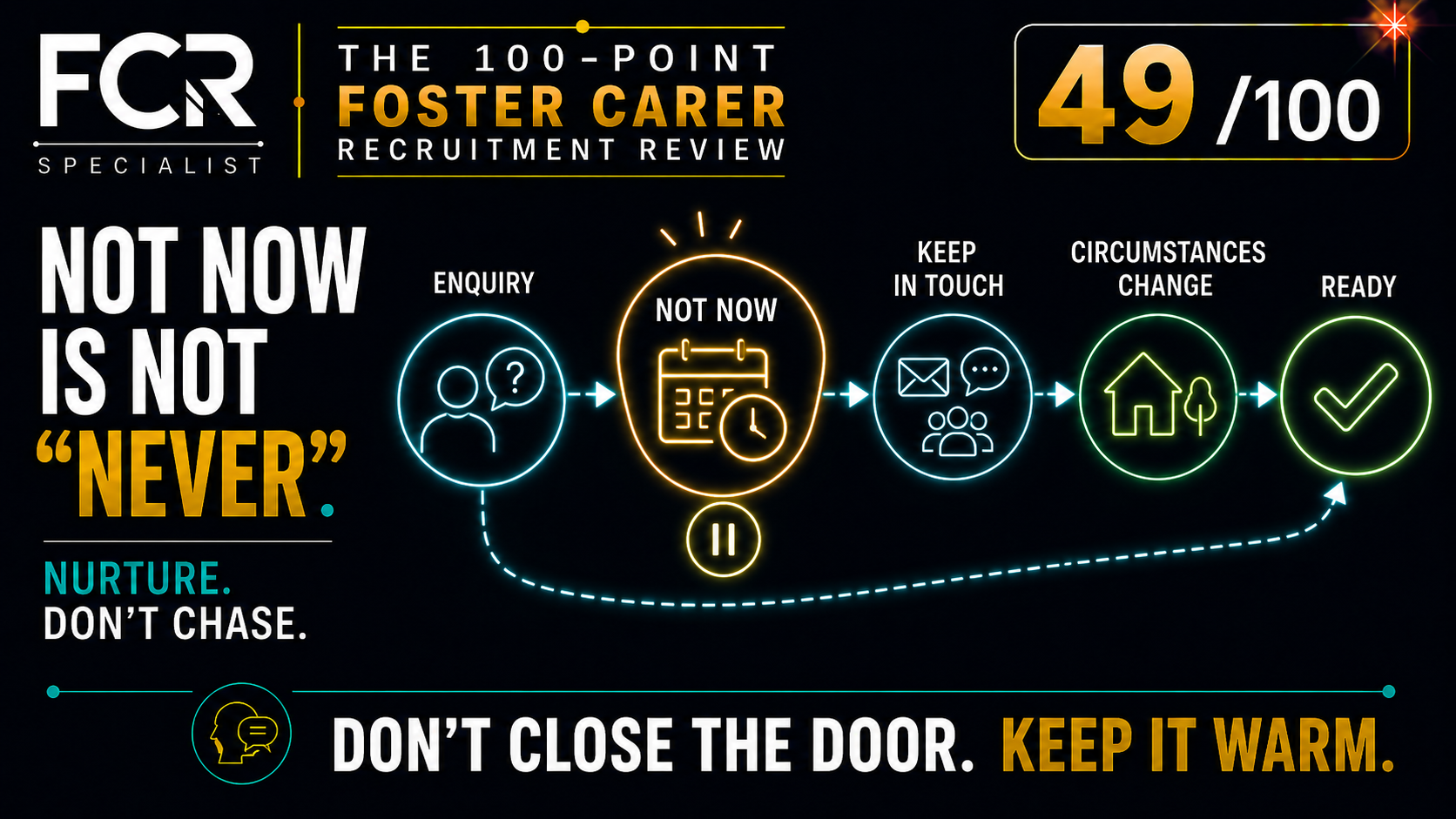
Point 49/100 — “Not Now” Is Not “Never”: Are You Nurturing Future Foster Carers?
Point 49/100 — “Not Now” Is Not “Never”: Are You Nurturing Future Foster Carers?
Someone enquires about fostering.
You respond.
You have a good conversation.
They seem potentially viable.
They ask sensible questions.
There is no obvious reason why they could never foster.
Then they say:
“I really am interested. I just don't think now is the right time.”
What happens next?
In too many recruitment systems I suspect the answer is:
CLOSED.
Perhaps with:
Reason: Not Ready.
And the organisation hopes:
They'll come back.
Point 47 already challenged that assumption.
Point 48 showed us why we need to understand exactly what happened to everyone who did not progress.
Point 49 now concentrates on a particularly important group:
THE PEOPLE WHO ARE NOT SAYING “NO”.
THEY ARE SAYING “NOT NOW”.
We have strong evidence that Foster Carer decision-making can take years
This is probably the most important piece of evidence in this Point.
The Department for Education's 2023 Foster Carer Recruitment research raised a major limitation in annual conversion statistics.
An enquiry does not necessarily become an application within the same year.
The research notes that enquiries can lead to applications two to five years later.
That changes how we should think about an apparently unsuccessful enquiry.
Imagine:
2026
Sarah enquires.
She is interested but her youngest child is still at home and preparing for university.
She decides:
Not now.
Your annual dashboard says:
Enquiry — did not convert.
2027
Sarah continues reading about fostering.
2028
Her circumstances change.
She thinks seriously about fostering again.
2029
She applies.
Was the 2026 enquiry unsuccessful?
Not necessarily.
It may have been:
THE BEGINNING OF THE RECRUITMENT JOURNEY.
The problem was our measurement window.
The Fostering Network found “not the right time” directly
The Fostering Network's 2023 research gives us more evidence.
Among survey respondents who had made an enquiry but decided not to apply, the three most common reasons were:
32% — decided to apply to another fostering service
17% — felt it was not the right time
11% — realised they could not afford to foster.
That 17% matters enormously.
They did not necessarily say:
“I never want to Foster Carer.”
They said:
“THE TIMING DOESN'T WORK FOR ME NOW.”
That is an entirely different recruitment population.
Essex found exactly the same phenomenon
Essex County Council analysed its No Further Action fostering enquiries.
It found many early NFAs where contact could not be established.
But when contact had been established and people had moved further through the recruitment journey, more than half of those NFA enquiries ended because the person said it was not the right time to foster.
Essex then asked the obvious question:
What does “the right time” actually mean?
And identified improved follow-up engagement with those potential Foster Carers as an area for development.
That is precisely Point 49.
Don't simply record:
Not right time.
Understand:
WHY NOT NOW?
and:
WHAT MIGHT MAKE THE TIME RIGHT?
There are many different “Not Nows”
Someone can be Not Now because:
CHILDREN
Their own child needs more time.
Their youngest child may soon leave home.
Their household needs to understand fostering better.
HOME
They're planning to move.
A bedroom will become available later.
Practical work is being completed.
EMPLOYMENT
Their working arrangements are changing.
They expect to reduce hours.
Retirement is approaching.
An employer needs to understand what fostering could require.
RELATIONSHIP / HOUSEHOLD
A partner is interested but needs more information.
Another household member has concerns.
MONEY
They're interested but currently uncertain whether fostering is financially viable.
HEALTH / LIFE EVENT
A temporary health matter needs resolving.
There has been a bereavement.
They're caring for somebody.
Life is simply unusually unsettled.
CONFIDENCE
They aren't yet sure they could do it.
That last category should not be underestimated.
DfE behavioural research says nurturing is important in helping prospective applicants build confidence in their own capabilities and argues that people need to feel they are “pushing at an open door”, supported to explore questions rather than encountering dead ends.
Some Not Nows may therefore need:
time + information + confidence
rather than:
time + organisational silence.
But don't turn nurture into chasing
There is a very important distinction.
FOLLOW-UP
The person is actively progressing.
There is an agreed next action.
For example:
“I'll call you next Thursday after you've spoken to your partner.”
That is follow-up.
NURTURE
The person is genuinely not ready to progress but wants to remain connected.
For example:
“The house move is likely to be six months away. Would you be happy for us to keep you updated and contact you again around February?”
That is nurture.
CHASING
The organisation repeatedly telephones or emails because it wants the person to make a decision.
That is different.
Nurture should be:
- permission-based
- useful
- proportionate
- relevant
- low pressure
- easy to stop
The Fostering Network specifically recommends that services seek the relevant permissions to store details and keep in touch with people who enquire but do not submit an application or who subsequently withdraw. It suggests ongoing engagement such as newsletters and invitations to follow-up events.
That gives us a good operational principle:
DON'T ASSUME PERMISSION TO NURTURE.
AGREE IT.
Ask three questions before closing a Not Now conversation
This can be extremely simple.
WHY NOT NOW?
Understand the actual issue.
Not:
Status = Not Ready.
Perhaps:
“We are moving house in November.”
That gives us something useful.
WHAT MIGHT CHANGE?
Is there a realistic trigger?
House move.
Retirement.
Child leaving home.
Employment change.
Partner wanting more information.
Financial circumstances.
WHEN SHOULD WE SPEAK AGAIN?
Agree it.
Not:
“Give us a call sometime.”
Instead perhaps:
“Would it be useful if I contacted you again in February?”
If they say yes:
record it.
Own it.
Do it.
The date should relate to the reason
This is another improvement.
I wouldn't simply create a blanket rule:
Contact every Not Now person every month.
That risks turning nurture into automated noise.
The follow-up should relate to the person's circumstances.
MOVING IN NOVEMBER
Perhaps reconnect after the move.
RETIRING NEXT YEAR
Agree a sensible point beforehand.
PARTNER UNCERTAIN
Perhaps offer an information conversation relatively soon rather than waiting six months.
FINANCIAL CONCERN
Send meaningful financial information now and agree whether they want another conversation.
JUST NOT READY
Perhaps lighter ongoing contact is more appropriate.
The point is:
NURTURE THE PERSON — NOT THE CRM CATEGORY.
What should nurture actually contain?
Not:
“Are you ready to foster yet?”
every four weeks.
Give people something useful.
For example:
REAL FOSTER CARER STORIES
What made somebody finally decide?
What worried them beforehand?
EVENTS
Low-pressure opportunities to hear more.
Q&A SESSIONS
Especially with existing Foster Carers.
FINANCIAL INFORMATION
If that was the barrier.
WORK AND FOSTERING
If employment was the issue.
FOSTERING YOUR OWN CHILDREN
If household impact was the concern.
DIFFERENT TYPES OF FOSTERING
Their situation may fit something they had not previously understood.
CHANGES TO YOUR OFFER
Payments.
Support.
Training.
Local opportunities.
SIMPLE HUMAN CONTACT
Sometimes:
“You asked us to reconnect around September. How are things going?”
may be more valuable than another marketing newsletter.
Existing Foster Carers can be useful here too
Some people do not need more organisational marketing.
They need to hear from someone who has already made the decision.
A prospective Foster Carer wondering:
“Will this work with my family?”
may benefit from an appropriate conversation with an existing Foster Carer.
Someone worried about working may want to hear how another Foster Carer manages their employment.
Someone anxious about assessment may want to know what it actually feels like.
The Fostering Network's research recommends greater lived-experience involvement throughout recruitment and approval and reports that putting more time into relationships and following up individual enquiries had been effective for fostering services.
This connects directly back to Point 38 and Foster Carer advocacy.
“We don't have time”
This is where I think we need to confront the resource argument directly.
A team may say:
“We don't have time to keep in touch with people who aren't ready.”
I understand the concern.
Recruitment staff are busy.
Social Workers are busy.
Assessing Social Workers are a scarce professional resource.
So don't allocate a full assessment resource to someone who is nowhere near ready.
But that is not the same as abandoning them.
A graduated model makes far more sense.
NOT NOW — RECRUITMENT-OWNED
Low-resource relationship.
Appropriate communications.
Planned callback.
Events.
Useful information.
ISSUE NEEDING PROFESSIONAL CLARIFICATION
Obtain limited Social Worker/ASW input where it is genuinely required.
Then return ownership to recruitment.
READY TO PROGRESS
Increase professional resource appropriately.
ASSESSMENT
Now ASW investment becomes significantly greater.
The choice isn't:
FULL ASSESSMENT
or:
NOTHING.
There is a very large space in between.
Time is a resource — but so is a potential Foster Carer
This is the management argument at the heart of Point 49.
Someone might say:
“What if we spend time on them and they never apply?”
That may happen.
But we should also ask:
WHAT IF WE DON'T SPEND THE TIME — AND LOSE SOMEONE WHO WOULD HAVE FOSTERED?
The sector is not overwhelmed with excess Foster Carer applicants.
The Government's 2026 plan exists precisely because of the sharp decline in Foster Carers and the need for substantially more homes.
The question is therefore not whether staff time matters.
It obviously does.
It is:
HOW DO WE INVEST LIMITED TIME IN THE MOST INTELLIGENT WAY?
An agreed future callback does not consume a six-month assessment.
An invitation to an event is not a Form F.
A useful email is not an ASW visit.
Keeping a relationship alive can be relatively low-intensity.
Losing the person completely may require the organisation to pay to generate an entirely new enquiry later.
What if they pull out during assessment anyway?
They might.
Point 48 showed us that applicants do withdraw.
That is not a reason to minimise all relationship investment.
It is a reason to improve early information and preparation.
The Fostering Network's research found poor communication, unanswered questions, insufficient information and unexpected delays contributed to negative application experiences.
It also found fostering services reporting success from spending more time forming relationships with prospective Foster Carers and following up individual enquiries.
The better efficiency argument is therefore:
DON'T SAVE TIME BY PUSHING PEOPLE AWAY.
SAVE TIME BY HELPING PEOPLE MAKE BETTER-INFORMED DECISIONS EARLIER.
Some will properly decide:
fostering isn't for me.
That's fine.
Some will decide:
not yet.
Keep the door open.
Some will say:
yes — now I understand it properly, let's continue.
That is intelligent allocation of recruitment time.
Not Now should be a pipeline — not a graveyard
This is where Point 43's tracking discipline returns.
If the system contains:
Not Now: 87
what does that tell us?
Not enough.
For every Not Now household, ideally understand:
- why
- date recorded
- who owns the relationship
- permission/preferences for keeping in touch
- likely future trigger where known
- agreed next-contact date
- preferred contact method
- last meaningful contact
- what information would be useful
- whether they later reactivated
- eventual outcome
That turns:
NOT NOW
from an endpoint into:
A RECRUITMENT PIPELINE.
Keep the original source too
This also reconnects to Point 39 and Point 43.
Suppose a Google campaign generates Sarah's enquiry in 2026.
She becomes Not Now.
She is appropriately nurtured.
In 2028 she applies.
In 2029 she is approved.
Your recruitment system should ideally still know:
THE ORIGINAL RELATIONSHIP STARTED WITH THAT 2026 CAMPAIGN.
Otherwise long-term recruitment value disappears from your marketing analysis.
This is another reason annual conversion alone can be misleading.
DfE researchers explicitly highlight the problem created by the long period between enquiry and later application.
Don't create an endless database of dead leads
There is an opposite danger.
Not every inactive enquiry belongs in nurture forever.
People may say:
No, please don't contact me again.
Respect it.
Someone may definitively decide:
Fostering is not for us.
Record it.
Someone may cease responding after reasonable attempts.
Do not endlessly pursue them.
Someone may no longer be realistically relevant.
Not Now nurture should therefore be a living relationship, not database hoarding.
This is about people who have indicated some continuing future interest and where appropriate contact can legitimately continue.
The Government's direction supports continuity
The 2026 Renewing Fostering plan proposes a “journey guide” providing responsive, dedicated support from first enquiry to decision, as part of an end-to-end regional model.
It also expects enhanced pipeline data to track progress and identify delay.
That is relevant beyond regional hubs.
The principle is:
DON'T TREAT THE RECRUITMENT JOURNEY AS A SERIES OF DISCONNECTED TRANSACTIONS.
Maintain continuity.
Know where somebody is.
Know why.
Know what happens next.
HERE IS THE TEST…
Take all the prospective Foster Carers recorded as:
NOT NOW
during the last twelve months.
Ask:
- How many are there?
- Why was each person Not Now?
- Do we actually know the reason?
- Was Not Now their decision or ours?
- Was the issue temporary?
- What would potentially change the situation?
- Did they give appropriate permission for future contact?
- Did we agree how they wanted us to stay in touch?
- Did we agree when to reconnect?
- Who owns that relationship?
- Was a follow-up action actually recorded?
- Did it happen?
- What useful information have we provided since?
- Were they invited to appropriate events?
- Could Foster Carer lived experience help them?
- Are we providing information relevant to their barrier?
- Are we nurturing them — or simply repeatedly asking if they're ready?
- How many have reactivated?
- How many eventually applied?
- How many have simply disappeared?
- Are we still attributing later progression back to the original recruitment source?
- How much staff time is actually required to manage this group intelligently?
Then ask the management question:
HOW MANY FUTURE FOSTER CARERS ARE ALREADY SITTING IN OUR DATABASE?
We may keep spending thousands of pounds trying to find new people while ignoring the people who have already:
seen us,
considered fostering,
trusted us enough to enquire,
spoken to us,
and told us:
“MAYBE — JUST NOT YET.”
Point 48 told us:
Study who you lost.
Point 49 says:
DON'T LOSE THE PEOPLE WHO AREN'T ACTUALLY LOST.
“NOT NOW” IS NOT “NEVER”.
NURTURE — DON'T CHASE.
TIME IS A RESOURCE, BUT SO IS A POTENTIAL FOSTER CARER.
And that takes us to Point 50.
Because after ten Points examining the initial-enquiry experience, senior managers should now be able to answer one question: