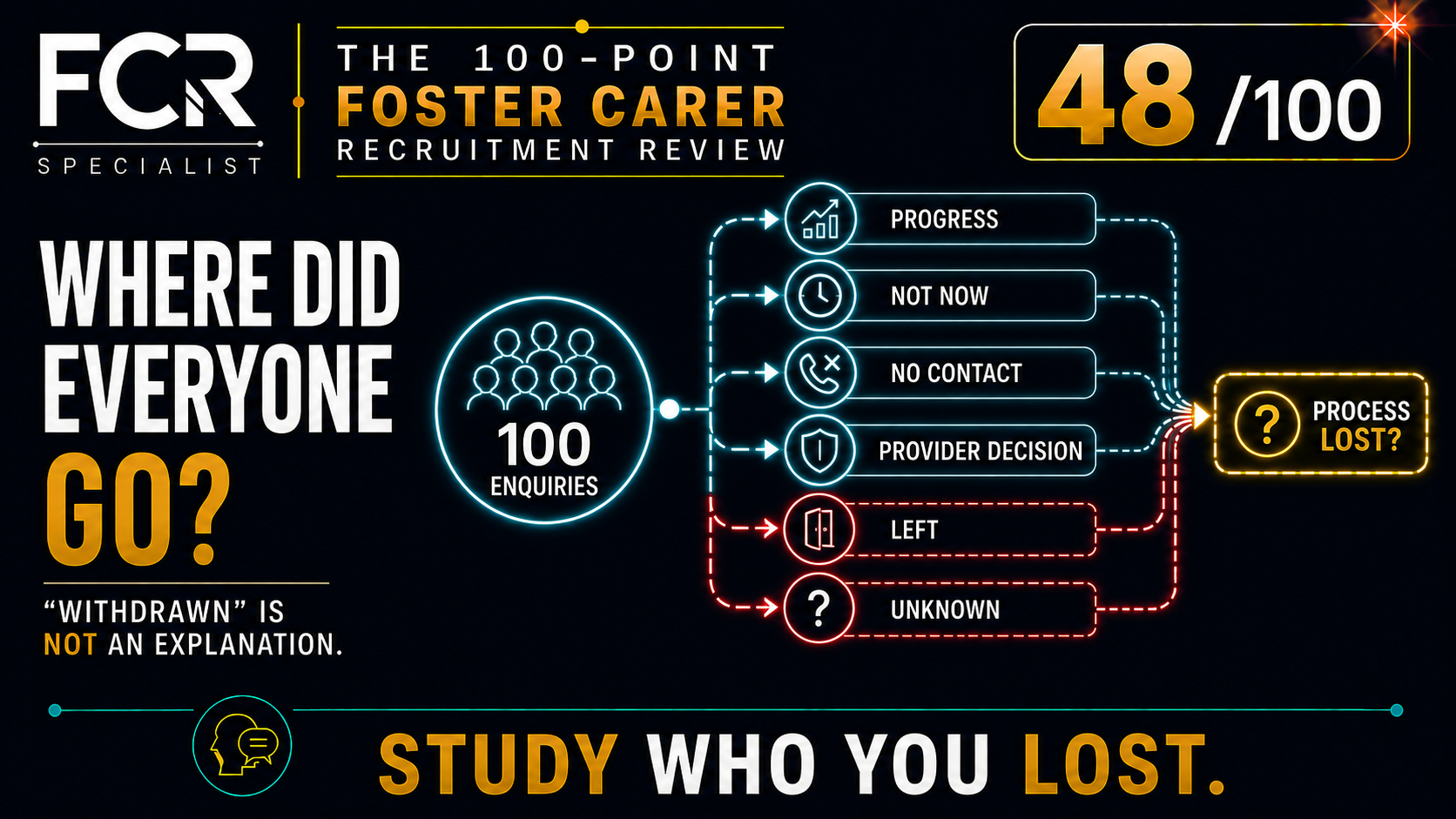
Point 48/100 — What Actually Happened to Everyone Who Didn’t Progress?
Point 48/100 — What Actually Happened to Everyone Who Didn’t Progress?
Imagine your fostering service receives:
100 ENQUIRIES.
At the end of your initial-enquiry process:
20 have progressed.
What happened to the other 80?
That sounds like a very basic management question.
I am not convinced every fostering organisation can answer it properly.
Perhaps the dashboard says:
Withdrawn.
No further action.
Unable to contact.
Not suitable.
Not progressing.
Closed.
But those are mostly statuses.
They don't necessarily tell us what actually happened.
Point 48 therefore asks:
WHAT ACTUALLY HAPPENED TO EVERYONE WHO DIDN’T PROGRESS?
This matters because the national conversion rate is extraordinarily low
The Government's February 2026 Renewing Fostering plan says that in the year ending 31 March 2025, only 6% of fostering enquiries progressed to application.
The Government describes those low conversion rates as deeply concerning and says better recruitment practice, more consistent contact, clearer information, flexibility and better end-to-end processes are required.
There are important qualifications around enquiry data.
Individuals may make more than one enquiry and fostering services have historically defined enquiries differently. Ofsted has tightened its definition so that an initial enquiry must now be actionable and only one enquiry should be recorded per household.
So we should not assume:
94% of people were “lost”.
Some enquiries will appropriately go no further.
But when only a small proportion progress, the recruitment question becomes unavoidable:
WHY?
“Dropout” is too broad
There are fundamentally different things hiding inside that word.
Someone might decide:
“I've learned enough about fostering and it isn't right for me.”
That is not necessarily recruitment failure.
Someone might have circumstances which genuinely prevent progression.
Someone may appropriately be screened out.
Someone may choose another fostering provider.
Someone may genuinely need to pause.
Someone may never respond after completing a social-media form.
All of those are different.
But there is another group.
People whose journey ended because:
- the callback was too slow
- nobody returned the call
- an enquiry was lost between systems
- they were repeatedly asked for information already provided
- the first conversation felt judgemental
- conflicting information was given
- there was no clear next action
- somebody told them to “come back later”
- a handover failed
- nobody followed up
Those are not simply:
“candidate withdrawals.”
THOSE MAY BE PROCESS-CREATED LOSSES.
The distinction matters enormously.
The evidence says services struggle to understand the “why”
The Department for Education's 2023 Foster Carer Recruitment research found that some services simply could not contact or engage people after they enquired, particularly some enquiries generated through social media.
Some prospective carers never returned the first call and never explained why they had stopped engaging.
Services also reported people who initially appeared highly interested simply disappearing, sometimes because they may have chosen another fostering provider.
The same research makes another important point.
Much less information tends to be collected at enquiry stage than later in assessment. There are legitimate reasons for that — we do not want an intrusive enquiry form — but it means organisations often lack enough qualitative information to understand why people did not progress.
The research specifically identifies the need to capture the story behind the numbers rather than relying only on quantitative conversion rates.
That is exactly what Point 48 is about.
DON'T JUST RECORD WHAT HAPPENED.
UNDERSTAND WHY.
Ofsted has started doing exactly this
The latest Ofsted statistics demonstrate why broad withdrawal categories are inadequate.
During 2024–25:
8,290 mainstream fostering applications were received.
Of the 5,370 applications completed during the year:
- 2,050 ended in approval
- 3,290 ended in withdrawal
- only 30 ended in rejection
In other words, 61% of completed applications ended in withdrawal.
Of those withdrawn:
2,175 were withdrawn by the applicant
and
1,115 by the fostering service.
That is already revealing.
But Ofsted now asks a better question:
Why did applicants withdraw?
For applications started during the year and withdrawn by the applicant, the most frequently recorded reasons were:
36% — household circumstances changed
35% — other or unknown
20% — fostering was not as the applicant expected.
Ofsted's withdrawal categories also now include:
- assessment not being as expected
- inability to continue for financial reasons
- concern about the risk of allegations
alongside household change and other/unknown.
That is significant.
Ofsted itself has effectively recognised:
“WITHDRAWN” IS AN OUTCOME.
IT IS NOT AN EXPLANATION.
And 35% “other or unknown” should make us uncomfortable
Sometimes we genuinely will not know.
People have every right simply to stop engaging.
Recruitment services cannot force somebody to give an exit interview.
But unknown should remain visible as unknown.
Do not quietly turn it into:
Not interested.
Those are different things.
If 30% of your non-progressing Foster Carer enquiries have an unknown outcome, that tells management something.
It means:
WE HAVE AN INFORMATION GAP.
That gap itself deserves investigation.
Essex gives us a brilliant practical example
Essex County Council did exactly the sort of analysis I am advocating here.
Instead of simply accepting its No Further Action figures, its data team examined where NFA enquiries were occurring and why.
It found that most happened shortly after initial contact, often because contact with the enquirer could not be established.
But where contact had been established and the recruitment journey progressed, more than half of those NFA enquiries ended because the person said it was not the right time to foster.
Essex then asked precisely the right question:
What does “the right time” actually mean?
And it identified better feedback and follow-up engagement with potential Foster Carers as areas to develop.
That is excellent Foster Carer Recruitment analysis.
Not:
NFA = 74.
But:
WHY WERE THEY NFA?
“Unable to contact” requires investigation too
Suppose the record says:
UNABLE TO CONTACT.
What does that mean?
One call?
Three?
Six?
When were they made?
A prospective Foster Carer tells you:
“I work Monday to Friday.”
Then the organisation calls them at:
10.10am Tuesday.
11.30am Wednesday.
2.15pm Thursday.
Nobody answers.
Record:
UNABLE TO CONTACT.
Were they actually difficult to contact?
Or did we repeatedly contact them at a time when we already knew they were unavailable?
Point 42 dealt with responsiveness.
Point 48 now asks whether contact failure itself contains recruitment intelligence.
For every unable-to-contact outcome I would want to know:
- how quickly the first attempt happened
- number of attempts
- different times attempted
- whether voicemail was left
- whether email was used
- whether SMS or another agreed channel was used where appropriate
- whether the person's preferred contact method was known
- whether the message clearly explained who was contacting them and why
Not because every enquiry should be chased indefinitely.
But because:
“WE COULDN’T CONTACT THEM” SHOULD DESCRIBE A REASONABLE CONTACT PROCESS — NOT ONE MISSED CALL.
No response is not the same as not interested
That distinction deserves its own line:
NO RESPONSE ≠ NOT INTERESTED.
Someone may:
- be working
- be caring for children
- not recognise the telephone number
- forget to return a voicemail
- prefer email
- be unsure what they want to say
- have become nervous
- still be considering fostering
- be comparing providers
They might also simply no longer be interested.
Fine.
But if we do not know, record what we actually know:
No response after agreed contact attempts.
Not:
Not interested.
Good data begins with intellectual honesty.
Did they withdraw — or did we withdraw?
This is another critical distinction.
Ofsted's latest figures explicitly separate:
withdrawn by applicant
from:
withdrawn by service.
Your initial-enquiry data should do something similar.
Suppose somebody does not progress.
Was the decision:
THEIRS?
or:
OURS?
And if it was ours, what was the reason?
Point 46 already established that we should distinguish:
eligibility
suitability
readiness
current recruitment fit
from:
assumption.
Point 48 now needs to preserve that distinction in the data.
If the organisation stopped progression because the person's proposed fostering offer did not meet current need, say that.
Do not simply code:
Applicant unsuitable.
What about the people we told to “come back later”?
Point 47 makes this especially important.
Imagine somebody was told:
“Come back after your house move.”
They never do.
Six months later the record says:
Candidate did not progress.
That is technically true.
But is it the whole story?
The organisation explicitly removed them from active progression and placed responsibility for restarting the journey entirely on the prospective Foster Carer.
So Point 48 should have a category such as:
PAUSED / ASKED TO RETURN — DID NOT RE-ENGAGE.
That lets management discover whether the organisation's own pausing behaviour is producing losses.
Point 49 will deal with what we should do about those people.
Here we simply need to see them.
A useful 100-enquiry model
Take 100 real enquiries.
I would want every household to end up, at least provisionally, in a meaningful category such as:
PROGRESSED / STILL ACTIVE
The journey remains live.
APPLICANT-LED NON-PROGRESSION
They decided not to continue.
Where known, record why.
PROVIDER-LED NON-PROGRESSION
The organisation decided not to continue.
Record the actual reason.
NOT NOW / TEMPORARY CIRCUMSTANCE
Potential future value remains, but now is genuinely not right.
UNABLE TO CONTACT
After a defined and reasonable contact process.
REFERRED / REDIRECTED
Another fostering provider, geography or route was more appropriate.
DUPLICATE / INFORMATION-ONLY
Not another separate prospective household.
PROCESS-CREATED LOSS
Something in our recruitment process appears materially to have contributed.
UNKNOWN
We genuinely do not know.
That last category is allowed.
What is not useful is disguising unknown as something more comfortable.
Process-created loss needs to become visible
This category could be particularly important.
Examples might include:
response delayed
enquiry lost
handover failure
wrong contact route
promised callback never happened
conflicting advice
premature screening
unnecessary pause
no agreed next action
excessive repetition
long silence
If those outcomes are simply recorded as:
withdrawal
then the organisation protects itself from learning.
The candidate appears to have caused the loss.
The process disappears from the story.
So ask:
DID THEY LEAVE THE PROCESS?
or:
DID THE PROCESS DROP THEM?
Sometimes the answer will genuinely be unclear.
That is still a better question.
“Active” can be another misleading category
I would also add one very simple operational indicator:
DAYS SINCE LAST MEANINGFUL CONTACT.
Not as a national KPI.
Not as some invented target.
As a local warning measure.
Imagine your CRM says:
ACTIVE — 27 enquiries.
Excellent.
Then discover:
Eight have had no meaningful contact for more than a month.
Are they really active?
Perhaps.
But management needs to see it.
“ACTIVE” DOESN’T MEAN ACTIVE IF NOTHING IS HAPPENING.
Point 43 established that every enquiry needs an owner.
Point 47 established that every meaningful interaction needs a route forward.
Point 48 now tests whether those disciplines are actually happening.
Analyse by source too
This reconnects us to Stage Four.
Suppose:
Meta generates 200 enquiries.
Referral generates 20.
The temptation is to say:
Meta is ten times better.
But what if:
Meta produces very high unable-to-contact numbers,
while Foster Carer referral produces much higher progression?
Now we have learned something useful.
Do not assess the channel only by:
NUMBER OF ENQUIRIES.
Follow them into:
- contact
- meaningful conversation
- progression
- Not Now
- application
- eventual approval
The DfE's 2023 research specifically recommends capturing the journey and adding greater granularity to recruitment data rather than relying on one headline conversion rate.
That is exactly the Point 39 → Point 43 → Point 48 chain.
Don't turn this into another giant dashboard
This does not require a hugely complicated reporting system.
At minimum I want management to be able to answer:
How many enquiries?
How many contacted?
How many progressed?
How many did not?
Why?
Who made the decision?
Where in the journey did we lose them?
Which losses might have been preventable?
What are we changing because of it?
That last question is the reason for collecting the data.
If we categorise 500 dropouts beautifully and never change anything, we have created administration rather than intelligence.
Review losses regularly
The recruitment team should periodically look at non-progressions together.
Not to blame staff.
To look for patterns.
For example:
Why are so many Facebook enquiries unreachable?
Why are so many people saying the process wasn't what they expected?
Why do people disappear after financial conversations?
Why does one recruiter have twice as many early non-progressions?
Why are renters being stopped at one location but progressing at another?
Why are Not Now cases repeatedly closed?
Why are so many outcomes simply unknown?
This is exactly the kind of qualitative learning DfE research says services need if they are going to understand the story behind their conversion data.
Ask people why — when you reasonably can
Where somebody chooses to stop and is willing to talk, ask.
Not:
“Please complete our 28-question exit survey.”
Perhaps simply:
“Before I close your enquiry, would you mind telling me what influenced your decision? It genuinely helps us improve how we support people considering fostering.”
They may say:
nothing you did — my circumstances changed.
Useful.
They may say:
I've chosen another provider.
Useful.
They may say:
the money doesn't work for us.
Useful.
They may say:
I felt judged during the first call.
Uncomfortable.
But incredibly useful.
The objective isn't to argue them back into fostering.
It is to learn.
The Fostering Network reinforces the value of earlier understanding
The Fostering Network's 2023 recruitment and retention research found applicants were not always receiving enough information early enough to make a properly informed decision.
That meant individuals and services could both invest considerable time and resources before discovering that fostering was not the right fit.
That connects directly back to Point 45:
ANSWER THEIR QUESTIONS PROPERLY.
And it gives Point 48 another question:
Could this later withdrawal have been avoided — or identified earlier — by better information?
That does not mean every withdrawal should have been prevented.
Sometimes early informed withdrawal is actually evidence that the recruitment system worked.
A person understands fostering properly and says:
“This isn't right for me.”
Good.
Far better than discovering it after months of assessment.
A low conversion rate is not automatically bad
This needs saying.
The DfE research specifically warns against assuming every low conversion rate equals poor performance.
A robust recruitment process should appropriately prevent unsuitable applicants from progressing.
So Point 48 does not say:
MAXIMISE CONVERSION AT ALL COSTS.
It says:
UNDERSTAND THE CONVERSION.
There is a huge difference.
We want:
appropriate progression
and:
appropriate non-progression
while minimising:
AVOIDABLE LOSS.
HERE IS THE TEST…
Take the last 100 actionable Foster Carer enquiries received by your organisation.
Account for all 100.
For every household ask:
- Did we make meaningful contact?
- If not, how many appropriate contact attempts were made?
- What channels and times were used?
- Did they progress?
- If not, whose decision was it?
- What was the actual reason?
- Was the reason confirmed or assumed?
- Was it a genuine Not Now?
- Were they referred elsewhere?
- Did another provider recruit them?
- Were they screened out?
- Was that decision properly understood?
- Had they been put on hold?
- Did they ever re-engage?
- Did our response speed contribute?
- Did an internal handoff contribute?
- Did conflicting information contribute?
- Was there a clear next action?
- How many days passed since the last meaningful contact?
- Could the process reasonably have contributed to the loss?
- Is the true reason simply unknown?
- What are we changing because of what we learned?
Then separate your non-progressions into:
APPROPRIATE OUTCOMES
and:
POTENTIALLY AVOIDABLE LOSSES.
That is where the insight sits.
Because:
“WITHDRAWN” IS AN OUTCOME. IT IS NOT AN EXPLANATION.
“NO RESPONSE” IS NOT AUTOMATICALLY “NOT INTERESTED.”
SOME PEOPLE LEAVE THE PROCESS.
SOMETIMES THE PROCESS LOSES THE PERSON.
And the Point 48 principle is:
DON'T JUST COUNT WHO PROGRESSED.
STUDY WHO YOU LOST.
That takes us perfectly into Point 49.
Because amongst the people who did not progress today is one group we should definitely not simply throw away: