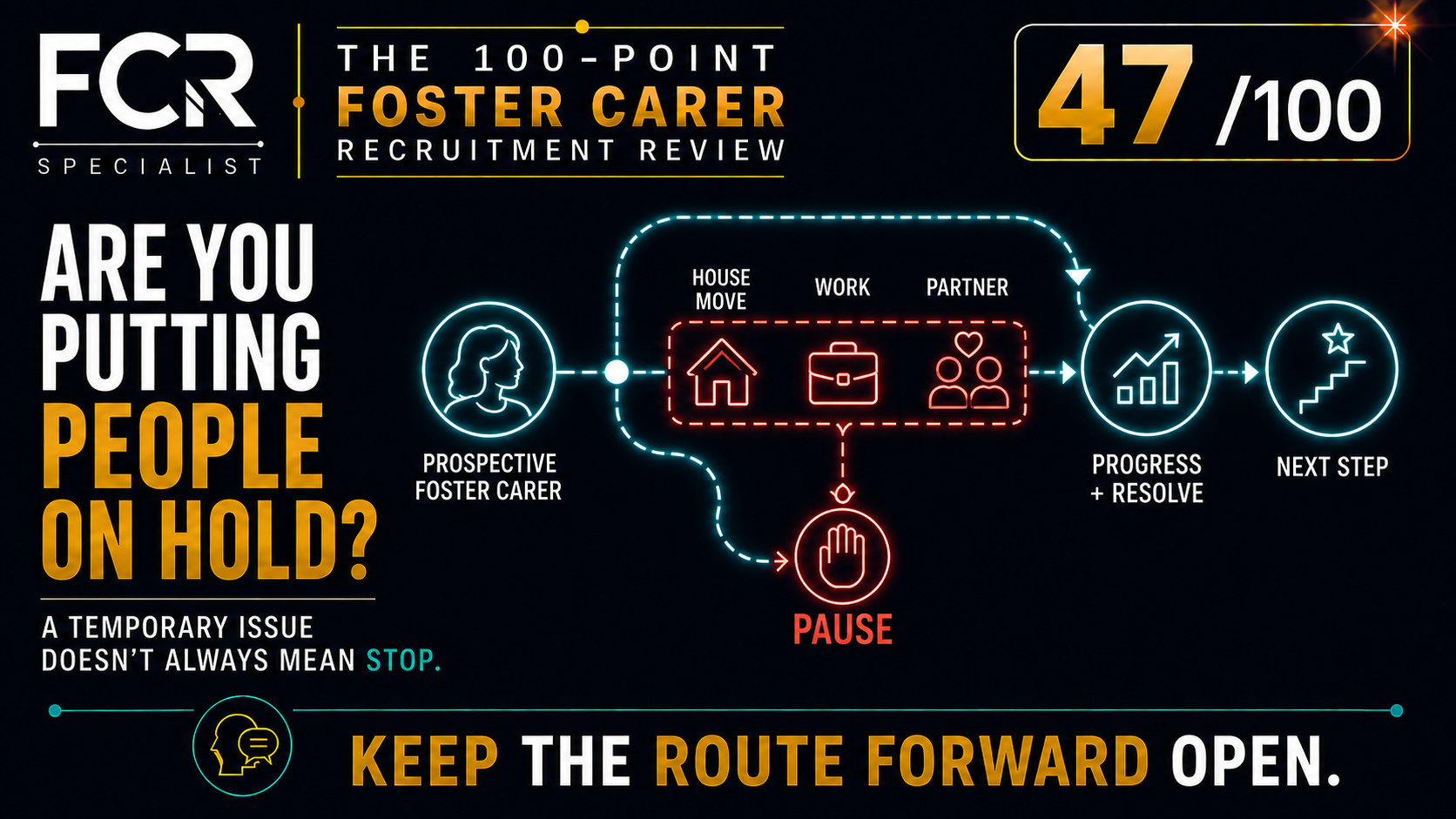
Point 47/100 — Does Every Enquiry Have a Clear Route Forward?
Point 46 asked an important question:
ARE YOU SCREENING PEOPLE OUT BEFORE YOU UNDERSTAND THEM?
Point 47 goes one stage further.
Suppose we have understood them.
They appear potentially viable.
They are still interested.
There is no clear reason why fostering could never work.
But there is an issue.
Perhaps:
- they are moving house
- their work arrangements may change
- a partner isn't completely ready
- an adult child is temporarily living at home
- a health matter is being clarified
- some work needs doing to the house
- finances are changing
- a family circumstance is likely to settle over the coming months
What happens?
Too often I think the answer is:
“Come back to us when that's sorted.”
And the enquiry is effectively closed.
The organisation thinks:
They'll come back.
But will they?
That's the issue at the heart of Point 47.
DOES EVERY ENQUIRY HAVE A CLEAR ROUTE FORWARD?
Foster Carer Recruitment should look for the route forward
I think there is an important difference between the recruitment mindset and an overly defensive screening mindset.
The defensive question is:
WHAT MIGHT STOP THIS PERSON?
The recruitment question should be:
IS THERE A SAFE, REALISTIC AND APPROPRIATE WAY FOR THIS PERSON TO KEEP MOVING FORWARD?
That does not mean ignoring concerns.
It does not mean weakening safeguarding.
It does not mean everybody progresses regardless.
Sometimes:
STOP
is absolutely the correct decision.
But sometimes there is something to work through, rather than something requiring the whole recruitment relationship to stop.
And those two things should not be confused.
A temporary issue is not automatically a reason to stop the journey
Imagine a prospective Foster Carer says:
“We're moving house in about three months.”
The immediate response might be:
“Contact us when you've moved.”
But why?
Perhaps there are things that genuinely cannot be completed until the new accommodation is known.
Fine.
But could we meanwhile:
- continue conversations?
- provide preparation?
- answer questions?
- understand motivation?
- involve the partner?
- introduce Foster Carer experience?
- discuss types of fostering?
- prepare for the next stage?
- agree exactly what needs reviewing after the move?
Maybe.
The question is not:
Can we pretend the house move isn't happening?
It is:
WHAT CAN WE KEEP DOING WHILE IT HAPPENS?
That is a fundamentally different recruitment mindset.
The fostering journey already takes months
This makes unnecessary pauses particularly questionable.
Current GOV.UK describes the fostering application-to-decision process as potentially taking up to eight months.
Many fostering services operate around a two-stage model of approximately two months plus four months. For example, Cornwall's current fostering information describes Stage One as two months and Stage Two as four months, with the whole process normally taking four to six months depending on whether stages overlap.
More importantly, the Government's February 2026 Renewing Fostering plan says it intends to establish an expectation in guidance that fostering assessment should not exceed six months. It also reports that only 41% of Local Authority approvals and 61% of IFA approvals were being completed within six months, and identifies longer assessment and response times as a factor that can discourage applicants.
So consider the logic.
Someone has a temporary issue likely to resolve in:
two or three months.
We tell them:
“Go away for three months and contact us again.”
Then, if they do return, we begin a recruitment and assessment journey that itself takes several more months.
What exactly did the three-month exclusion achieve?
Sometimes there will be a good answer.
But I think we should require one.
DON'T PAUSE THE PERSON JUST BECAUSE THERE IS SOMETHING TO WORK THROUGH.
The 2026 direction is explicitly end-to-end
The Government's current direction makes this Point particularly timely.
Its redesigned regional fostering-hub model includes:
- a single front door
- a “journey guide” from enquiry to approval
- responsive, dedicated support from first enquiry to decision
- regional assessment designed to enable quick progress and decisions
- pipeline data to track progress and identify delays.
The wider plan also proposes digital improvements specifically intended to reduce friction and dropout at critical stages of the recruitment journey.
That is almost the opposite of:
“Come back when everything in your life is perfect.”
The direction is:
SUPPORT THE JOURNEY.
IDENTIFY DELAYS.
KEEP PEOPLE MOVING WHERE IT IS APPROPRIATE TO DO SO.
There are several different outcomes — don't collapse them all into “pause”
After an initial enquiry and conversation, I would distinguish several possibilities.
1. PROGRESS
There is no identified reason not to take the next appropriate step.
Good.
Agree it.
Record it.
Do it.
2. PROGRESS WITH AN ISSUE TO RESOLVE
This is the category I think is frequently underused.
Something needs:
- clarification
- monitoring
- evidence
- discussion
- practical change
but it does not currently justify ending the recruitment journey.
Record it.
Own it.
Review it.
But keep moving the other things that can move.
3. GENUINE NOT NOW
The person could potentially Foster Carer in future but their current circumstances genuinely make progression inappropriate.
That is legitimate.
But call it what it is.
Not Now.
Do not quietly code it:
Closed.
Point 49 will deal properly with how those people should be nurtured.
4. REFER / REDIRECT
Perhaps their offer isn't right for your current need.
Point 46 established:
Not right for us is not always unsuitable to foster.
Can another:
- provider
- fostering type
- geographical area
- scheme
offer an appropriate route?
5. STOP
There is sufficient information to conclude that progression genuinely should not continue.
Then stop.
Clearly.
Professionally.
Respectfully.
Do not create false hope.
Those five outcomes are much more useful than:
Progress / Don't Progress.
“Come back in three months” is not a recruitment strategy
This phrase deserves challenging.
“Contact us after you've moved.”
“Come back when your partner is more certain.”
“Call us when your work situation changes.”
“Get back in touch when that's resolved.”
Who owns that next action?
The prospective Foster Carer.
Completely.
We have effectively taken someone who had:
- found us
- engaged
- enquired
- spoken to us
- started building trust
and thrown them back outside the recruitment funnel.
Then we hope that, several months later, they will independently:
remember us,
remain interested,
find the contact details,
and start again.
Some will.
Others will:
- lose momentum
- decide fostering is not for them
- speak with another provider
- become busy
- forget
- assume our earlier hesitation meant we did not want them
We should therefore ask:
IF WE SEND THIS PERSON AWAY FOR THREE MONTHS, WHAT MAKES US THINK THEY WILL ACTUALLY COME BACK?
That is not cynical.
It is recruitment reality.
Progress the person and manage the issue
I think this should become the central Point 47 principle:
PROGRESS THE PERSON AND MANAGE THE ISSUE — UNLESS THE ISSUE GENUINELY PREVENTS PROGRESSION.
Let's use some examples.
MOVING HOUSE
Possible response:
Stop everything for three months.
Alternative:
Understand:
- expected move date
- likely area
- accommodation requirement
- what cannot reasonably be completed until the new home is known
Then continue whatever appropriate recruitment preparation can continue.
WORK CHANGE
Perhaps someone is changing role in two months.
Do we need everything settled before another conversation occurs?
Or can we understand:
- likely hours
- flexibility
- employer support
- partner arrangements
- fostering ambitions
and revisit the remaining uncertainty when more information exists?
PARTNER UNCERTAIN
“Come back when your partner has decided.”
Or:
Would it be helpful for us to talk together?
What are their concerns?
Money?
Impact on their children?
Privacy?
Allegations?
Loss of freedom?
Maybe Point 45 has already taught us what to do.
ANSWER THEIR QUESTIONS.
TEMPORARY HOUSEHOLD ISSUE
An adult child is staying temporarily.
Perhaps accommodation arrangements need resolving before approval.
Does that mean the entire recruitment relationship needs to disappear?
Not necessarily.
HEALTH MATTER
Health needs proper professional consideration.
Sometimes further information will genuinely be required before a responsible decision can be made.
But again ask:
Does this information prevent every aspect of progression?
or:
Does it mean one particular decision must wait?
Those are not automatically the same thing.
Don't create problems before they exist
There is another recruitment behaviour worth challenging.
Sometimes we appear to deal with a possible future issue as though it is already a confirmed present barrier.
For example:
“Your work might be a problem.”
Has it become one?
“Your partner may struggle.”
Do we know that?
“The house move could complicate things.”
Has it?
This does not mean ignoring foreseeable issues.
Good recruitment should identify them early.
But:
IDENTIFYING A POSSIBLE ISSUE IS NOT THE SAME AS PROVING THE ISSUE PREVENTS PROGRESSION.
Use the available time to understand it.
Social work and recruitment thinking need to coexist
This Point is not about blaming Social Workers.
Nor is it saying recruiters should override professional concerns.
The two disciplines have different but complementary perspectives.
Social work asks:
What needs understanding before this person can safely care for vulnerable children?
Recruitment asks:
How do we keep a potentially appropriate person engaged while that understanding develops?
The strongest process needs both.
What I would not want is a system where professional caution unintentionally produces:
“There is something to explore, therefore stop recruitment.”
The better response can sometimes be:
“There is something to explore, therefore let's explore it properly while maintaining momentum.”
The person should know exactly where they stand
Suppose an issue exists.
Tell them.
Not:
“We'll be in touch.”
Say:
“There is one thing we need to clarify around X. It doesn't necessarily mean you can't continue, but we need to understand it properly. Sarah will check Y by Friday. We'll speak again next Tuesday. In the meantime we'll send you Z.”
Now the prospective Foster Carer knows:
THE ISSUE
THE OWNER
THE ACTION
THE DATE
WHAT CONTINUES
That is completely different from limbo.
Every meaningful conversation needs an agreed next action
This remains the original Point 47 discipline.
A conversation might end with:
NEXT CONVERSATION
Date booked.
INFORMATION
Specific information promised.
PARTNER / HOUSEHOLD CONVERSATION
Agreed and arranged.
INFORMATION SESSION
Booking made.
FOSTER CARER CONVERSATION
Where appropriate.
CLARIFICATION
A particular issue being checked by a named person.
INITIAL VISIT
Discussed or arranged — without moving into the content of the initial visit, which comes later in this Review.
NOT NOW
Properly recorded with an agreed future approach.
REFER ELSEWHERE
Warmly and clearly.
STOP
Clear outcome and reason.
But avoid:
“I'll send you some information.”
with no understanding of what happens afterwards.
Use four questions at the end of the call
I think this is the simplest operational framework in the Point.
WHAT HAPPENS NEXT?
The action.
WHO OWNS IT?
Named person or clear role.
BY WHEN?
A date or meaningful timeframe.
WHAT CONTINUES IN THE MEANTIME?
Particularly where an issue is being resolved.
That fourth question is the new one.
It prevents a single issue from freezing the whole journey.
If something really does require a pause, make it a managed pause
Sometimes the correct decision will genuinely be:
Pause.
Fine.
But a professional pause should not mean:
disappear from the recruitment system until the applicant decides to return.
A managed pause should identify:
WHY
What genuinely prevents progression?
WHAT NEEDS TO CHANGE
Be specific.
WHO OWNS CONTACT
Applicant or organisation — preferably clear rather than assumed.
REVIEW DATE
Not “sometime in the future.”
WHAT CONTACT IS APPROPRIATE
With consent.
This begins to overlap with Point 49's Not Now strategy, so we will develop it fully there.
But the Point 47 principle is:
A PAUSE SHOULD HAVE AN EXIT ROUTE.
Don't confuse administrative convenience with a recruitment reason
Sometimes pausing a person is operationally easier.
An incomplete case complicates:
- workload
- dashboards
- supervision
- pipeline statistics
- targets
Closing the enquiry makes everything tidier.
But recruitment systems exist to recruit Foster Carers.
Prospective Foster Carers do not exist to keep our dashboards tidy.
Ask:
ARE WE PAUSING THIS PERSON BECAUSE THEIR CIRCUMSTANCES REQUIRE IT — OR BECAUSE OUR SYSTEM FINDS THEM INCONVENIENT TO MANAGE?
That may occasionally be an uncomfortable question.
It is worth asking.
Momentum matters
We should be cautious about inventing a precise fostering-specific mathematical relationship between delay and dropout.
But the current evidence is clear enough about the overall direction.
The Government's 2026 fostering plan explicitly states that longer assessment and response times can discourage applicants.
Its digital-recruitment programme is being designed specifically to improve the end-to-end journey and reduce dropout at critical points.
The 2023 DfE recruitment study similarly identified:
- streamlined processes
- relational approaches
- empowering and supporting applicants
as recruitment enablers, while unexpected changes in applicant circumstances were identified as one of the challenges services encounter.
That combination matters.
Unexpected circumstances happen.
The answer should not automatically be disengagement.
Don't restart the relationship unnecessarily
Another consequence of “come back later” is that a returning prospective Foster Carer may discover they have to begin again.
New form.
New recruiter.
Same questions.
Repeat their circumstances.
Explain their motivation again.
That damages continuity.
The Government's redesigned hub model is explicitly moving towards a journey-guide approach with dedicated support from enquiry through to decision.
Whether you are:
- an IFA
- an LA
- a regional hub
- a small fostering provider
the principle can still apply:
KEEP OWNERSHIP OF THE JOURNEY.
This doesn't mean artificially pushing people forward
There is an important counterpoint.
Point 47 should not become:
“Never pause anyone.”
That would be just as poor.
If someone's life is genuinely unstable, adding assessment activity may not help them.
If a major issue requires resolution before meaningful assessment can continue, pause.
If the person themselves needs space, respect that.
If safeguarding or suitability evidence says stop, stop.
The distinction is:
INTENTIONAL PAUSE
versus:
DEFAULT PAUSE.
One is professional judgement.
The other can become organisational habit.
A simple Route Forward decision
After the initial enquiry stage, ask:
CAN THEY PROGRESS?
Yes?
Move.
CAN THEY PROGRESS WHILE SOMETHING IS RESOLVED?
Yes?
Move and manage the issue.
DO THEY GENUINELY NEED TO PAUSE?
Create a managed pause.
WOULD ANOTHER ROUTE BE BETTER?
Refer.
IS THERE A SOUND REASON TO STOP?
Stop clearly.
That creates a very different recruitment pipeline.
PROGRESS
PROGRESS + RESOLVE
MANAGED PAUSE
REFER
STOP
Every enquiry should have one.
Not:
DRIFT.
Point 43 becomes important again here
Point 43 told us:
ONE HOUSEHOLD. ONE JOURNEY RECORD. MANY TOUCHPOINTS.
So record:
- current route
- unresolved issue
- next action
- owner
- review date
- status
Then management can eventually ask:
How many prospects are sitting in:
PROGRESS + RESOLVE?
How many are:
PAUSED?
How long?
Why?
How many came back?
Where are delays occurring?
This is exactly the sort of end-to-end pipeline visibility the Government's current fostering reforms are seeking to strengthen.
HERE IS THE TEST…
Take the last 20 Foster Carer enquiries your organisation:
paused
or told:
“come back later.”
Ask:
- Why did we pause them?
- Did the issue genuinely prevent progression?
- Which parts of the recruitment journey could have continued?
- Was the issue definite or merely possible?
- Was there anything we could have done to help resolve it?
- Was someone named as owner?
- Was there a review date?
- Did the organisation agree to contact them again?
- Or did we put all responsibility back on the prospective Foster Carer?
- Did they know exactly what needed to change?
- Did we keep answering questions?
- Did we maintain the relationship?
- Was another fostering route considered?
- Was another provider considered?
- Did the person eventually return?
- If not, do we know why?
- Did another organisation recruit them?
- Was the pause actually for our administrative convenience?
- Would another member of staff have made the same decision?
- Looking back, could we safely have continued progressing them?
And one final question:
IF WE TELL THIS PERSON TO COME BACK IN THREE MONTHS, WHAT MAKES US THINK THEY ACTUALLY WILL?
That is the recruitment question.
Point 46 told us:
UNDERSTAND BEFORE YOU SAY NO.
Point 47 now says:
ONCE YOU UNDERSTAND THEM, LOOK FOR THE ROUTE FORWARD.
And the central principle is:
PROGRESS THE PERSON AND MANAGE THE ISSUE — UNLESS THE ISSUE GENUINELY PREVENTS PROGRESSION.
Because every unnecessary pause creates another opportunity to lose a prospective Foster Carer.
Point 48 now asks the obvious next question: