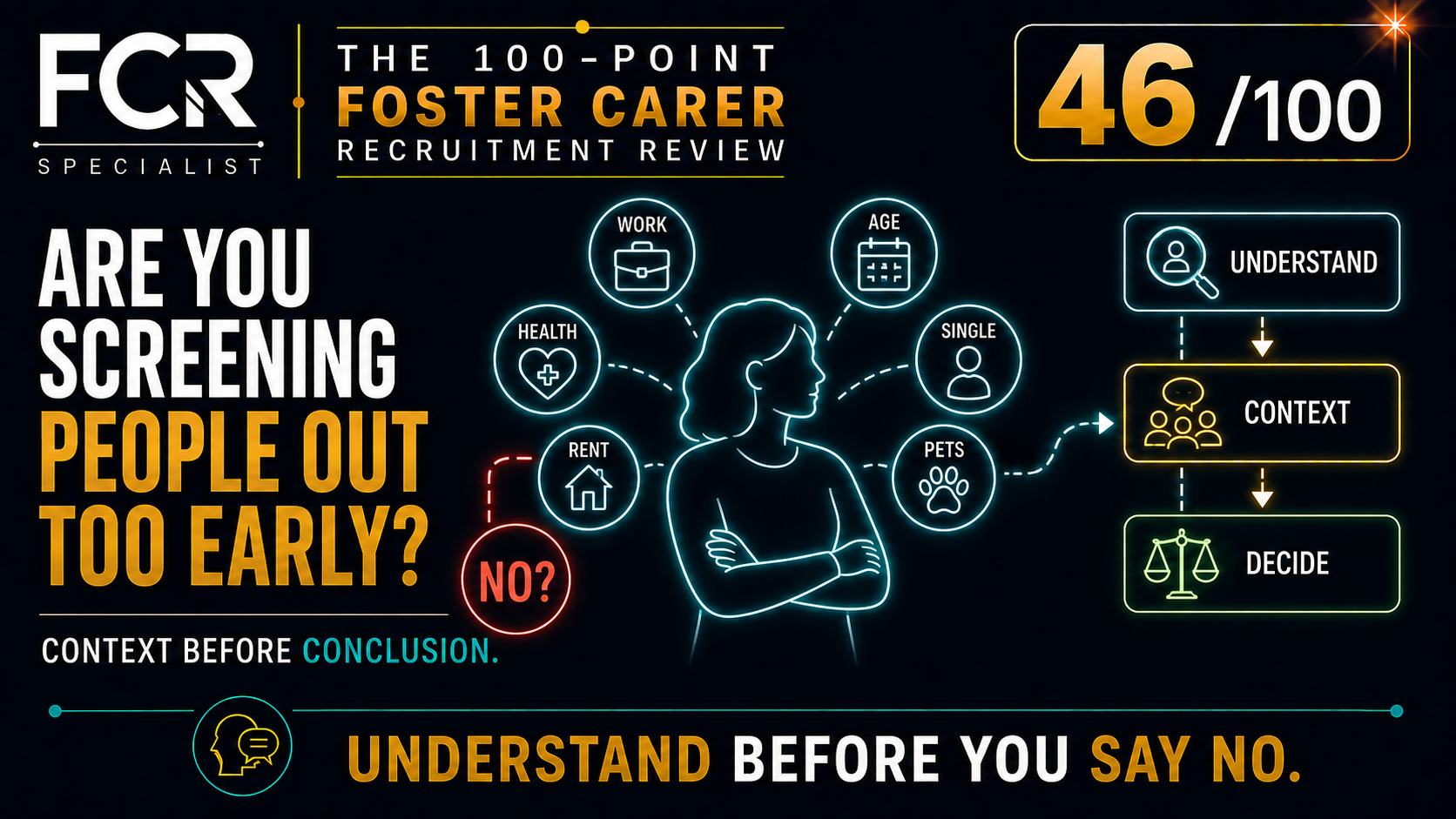
Point 46/100 — Are You Screening People Out Before You Understand Them?
Point 46/100 — Are You Screening People Out Before You Understand Them?
A prospective Foster Carer says:
“I work full-time.”
What happens inside the recruiter's head?
Problem.
Someone says:
“I'm 58.”
Too old?
“I'm single.”
Not enough support?
“I rent.”
Housing problem?
“I've had some mental-health difficulties in the past.”
Health concern?
“I've got three dogs.”
Pets problem?
“I don't drive.”
Practical problem?
In professional recruitment, one of the most dangerous moments is when a single fact becomes an entire conclusion.
And in Foster Carer Recruitment, the consequences can be significant.
Because the person you politely turn away today may have had the potential to become an excellent Foster Carer.
So Point 46 asks:
ARE YOU SCREENING PEOPLE OUT BEFORE YOU UNDERSTAND THEM?
Let me make one thing very clear first
This is not an argument for lowering Foster Carer standards.
It is not an argument for:
- progressing everybody
- overlooking safeguarding
- ignoring statutory requirements
- disregarding health
- ignoring household circumstances
- pretending practical barriers do not exist
The statutory guidance on Foster Carer assessment puts the fundamental principle very clearly:
Nobody has a right to become a Foster Carer.
The interests of children must drive fostering decisions.
Regulation 26 of the Fostering Services (England) Regulations 2011 requires formal assessment of suitability and includes circumstances in which specified offences mean a person is not suitable to foster.
Rigour is essential.
But:
RIGOUR AND PREMATURE REJECTION ARE NOT THE SAME THING.
A proper assessment process exists precisely because suitability is often more complicated than one answer on an initial telephone call.
The Government is now explicitly challenging fostering myths
This Point has become even more relevant in 2026.
The Government's Renewing Fostering: homes for 10,000 more children programme includes a section challenging myths that discourage prospective Foster Carers.
It specifically addresses assumptions around:
- smoking or vaping
- pets
- being single
- renting rather than owning
- disability
- age
- historic/minor criminal convictions
- driving
The underlying message is that many of these circumstances require individual consideration, rather than operating as automatic universal exclusions.
Current GOV.UK guidance similarly says people may be able to work and foster depending upon the child's circumstances and the fostering service, and that Foster Carers do not need to own their home, although a spare bedroom is usually required.
That should make every recruitment team stop and consider how many unofficial rules may have developed around the official ones.
DfE research has already warned us about this
The Department for Education's 2023 Foster Carer Recruitment research found services reporting a significant shift towards being more open to prospective-carer profiles that might previously have been turned away.
But the same research identified eligibility checks eliminating people straight away as one of the challenges in the recruitment process.
The 2022 behavioural research went further.
It concluded that the characteristics of a “quality” prospective Foster Carer were better understood through factors such as:
- potential
- capability
- opportunity
- motivation
- preparedness
- resources
- resilience
rather than a simple demographic or lifestyle profile.
It also warned that difficult experiences in someone's past can sometimes provide strengths rather than automatically undermining suitability, and that stereotypical ideas of the “perfect family” can discourage people who may have potential.
That is a major recruitment lesson.
DON'T RECRUIT A STEREOTYPE.
UNDERSTAND A PERSON.
Four different questions are getting confused
For this Point I would use four practical distinctions.
They are not new regulatory categories.
They are a way of improving recruitment thinking.
1. ELIGIBILITY
Is there a clear legal or fundamental requirement that means the person genuinely cannot proceed?
There are circumstances where the answer will be no.
Specified offences are an obvious example within the regulations.
The important discipline is:
Is this actually a clear requirement — or have we turned organisational preference into one?
2. SUITABILITY
This is much more complex.
Can this person safely and effectively meet children's needs?
Formal fostering assessment explores matters including:
- household
- relationships
- health
- family
- property
- employment
- experience
- personal characteristics
- relevant skills
precisely because suitability requires information and professional judgement.
One initial answer seldom tells you everything.
3. READINESS
Could somebody potentially foster but not be ready now?
For example:
- about to move house
- major work change
- partner needs more time
- recent bereavement
- household circumstances changing
- own child going through a difficult period
- finances currently unstable
- simply needs more time to consider the decision
That is potentially:
NOT NOW.
It isn't automatically:
NEVER.
We will return to those people properly in Point 49.
4. ASSUMPTION
This is the dangerous category.
“They're probably too old.”
“Single people will struggle.”
“Full-time workers aren't really suitable.”
“That health condition sounds difficult.”
“They don't look like our usual Foster Carers.”
“They've had a complicated life.”
Now we are no longer dealing with an established requirement.
We are potentially dealing with someone's mental model of the ideal Foster Carer.
And that mental model can become an invisible recruitment filter.
I would add one more practical distinction: recruitment fit
This is different again.
Statutory guidance recognises that a fostering service may decide not to take a formal applicant into assessment if it is not currently recruiting or the person's fostering offer does not align with its current recruitment objectives.
The guidance gives the example of someone wanting to foster babies when the service is currently recruiting carers for teenagers, and suggests the applicant might be directed towards another fostering service.
That is very important.
Because:
“NOT WHAT WE CURRENTLY NEED”
does not necessarily mean:
“UNSUITABLE TO FOSTER.”
Those are completely different conclusions.
A strong recruitment service should be capable of saying:
“Your circumstances may be better aligned with another type of fostering or another provider.”
rather than:
“You're not suitable.”
That distinction respects the person and improves recruitment across the wider sector.
“I work full-time”
Let's take some common examples.
Someone tells you:
“I work full-time.”
Current GOV.UK guidance explicitly says people may be able to work and foster, depending upon the child's circumstances and the fostering service.
So the useful questions are more like:
- What do you do?
- What hours?
- How flexible is your employer?
- Do you work remotely?
- Does a partner work?
- What support exists?
- What type of fostering interests you?
- What would happen during school holidays?
- How would appointments and meetings work?
The eventual conclusion may still be:
your current arrangements are not compatible with the fostering you want to offer.
But now we have reached that conclusion through understanding.
Not assumption.
“I'm 58”
The Government's 2026 action plan specifically challenges the myth that someone is simply “too old” to foster and states that there is no upper age limit, with capacity to care being the important consideration.
The question therefore becomes:
What does this individual person's capability look like?
Not:
What number appears beside date of birth?
“I'm disabled”
Again, the 2026 government plan explicitly challenges disability as an automatic disqualification and focuses instead on whether the person can meet children's needs, with appropriate support where relevant.
Health absolutely matters.
The formal assessment requires health information.
But:
DIAGNOSIS IS INFORMATION.
IT IS NOT, BY ITSELF, THE WHOLE SUITABILITY DECISION.
“I'm single”
Single status is not an automatic barrier to fostering, and the 2026 government plan explicitly myth-busts that assumption.
The legitimate recruitment question may instead concern:
- support networks
- practical arrangements
- resilience
- availability
Those are reasonable areas to understand.
But they should be explored.
Not assumed.
“I rent”
Current GOV.UK guidance says home ownership is not required.
So:
“I rent”
should generate questions about the actual housing situation.
It should not automatically produce:
“No.”
“I've got pets”
Pets need considering.
Some animals may create genuine safeguarding or practical concerns.
But the Government's 2026 fostering plan explicitly challenges the idea that having pets automatically rules somebody out.
So ask about:
- animal
- temperament
- environment
- safety
- management
Again:
CONTEXT BEFORE CONCLUSION.
“I've got a criminal record”
This is where nuance becomes particularly important.
Some specified offences create statutory barriers.
But the 2026 Government action plan also makes clear that a criminal record as a broad category does not automatically mean rejection, particularly where convictions are minor or historic.
So the recruitment worker should not improvise.
They need to know when to:
- explain the rules accurately
- obtain further information
- escalate the question
- avoid giving premature reassurance
- avoid premature rejection
This is exactly why staff training matters.
“I don't drive”
Again, the Government's 2026 myth-busting material says driving itself is not universally required; reliable access to transport and the ability to support a child's routines and appointments are what need considering.
That creates a much better question:
How would you practically get a child to school, contact, meetings and appointments?
The person may have an excellent answer.
Or they may not.
But ask.
Past difficulty can sometimes be relevant strength
This is one of the most interesting findings in the DfE behavioural research.
It suggested recruitment messaging should explicitly challenge the idea that applicants need perfect lives or perfect histories and recognise that difficult experiences in someone's past can potentially contribute positive qualities rather than simply undermining suitability.
Think of potential attributes such experiences might sometimes develop:
- resilience
- empathy
- understanding of adversity
- insight
- perseverance
- ability to seek support
That does not mean difficult history automatically makes somebody suitable either.
It means:
EXPLORE THE EXPERIENCE.
DON'T REDUCE THE PERSON TO THE EXPERIENCE.
The “ideal Foster Carer” can become dangerous
Most organisations probably have an informal picture of who has historically fostered successfully.
Perhaps:
couple.
Mid-40s to 60s.
Own home.
Children grown up.
One person working limited hours.
Spare bedrooms.
Drives.
Stable finances.
That profile may indeed describe many existing Foster Carers.
DfE research found similar traditional profiles in participating services.
But there is a dangerous leap from:
“Many of our current carers look like this.”
to:
“Good Foster Carers look like this.”
Those are not the same proposition.
If recruitment teams unconsciously select for the historic profile, the organisation may continuously reproduce its existing workforce instead of discovering new capacity.
Ask one more question before saying no
This could be one of the simplest practical disciplines in the whole Review.
When somebody gives an answer that initially concerns you, do not immediately ask:
“Can we reject them?”
Ask:
WHAT ELSE DO WE NEED TO UNDERSTAND?
Examples:
“I work full-time.”
→ Tell me how work operates.
“I'm single.”
→ Tell me about your support.
“I've had depression.”
→ Tell me about your circumstances, recovery, health and current wellbeing; appropriate professional assessment will follow.
“I rent.”
→ Tell me about your accommodation and tenancy.
“I have a conviction.”
→ What was it, when, and what do the regulations actually say?
“My partner isn't completely sure.”
→ What concerns do they have?
“I'm 62.”
→ What does your health, lifestyle and capacity actually look like?
That one extra question may turn a label into information.
Who is allowed to say no?
I think every fostering service should know this.
Can:
- receptionist?
- call-centre worker?
- administrator?
- recruiter?
- Social Worker?
- team manager?
- regional hub?
decide that an enquiry should not progress?
And on what basis?
There should be a difference between:
gathering information
and:
making a professional decision.
Where a genuine concern exists, the first-contact worker may need to say:
“I'd like to check that properly before giving you an answer.”
That is professionally stronger than guessing.
Create a “pause before no” discipline
Before closing an enquiry because of someone's circumstances, ask:
1. WHAT EXACTLY IS THE CONCERN?
Be specific.
2. WHAT TYPE OF ISSUE IS IT?
Is it:
a clear statutory/fundamental requirement?
a suitability issue needing further understanding?
a readiness issue?
our current recruitment requirement?
or:
an assumption?
3. WHAT INFORMATION ARE WE MISSING?
Could one more conversation materially change our understanding?
4. IS THERE ANOTHER FOSTERING ROUTE?
Different type of fostering?
Different timing?
Different provider?
5. WHO SHOULD MAKE THE DECISION?
Does this require professional or managerial review?
6. WHAT WILL WE RECORD?
Not:
“unsuitable.”
Something meaningful enough to understand later.
This links directly back to Point 43.
Because if early-screening decisions are being made, the organisation should be capable of seeing why.
Record the reason properly
Suppose 100 people enquire.
Twenty are screened out before progressing.
What are the reasons?
If the system records:
Not suitable — 20
we have learned almost nothing.
Instead, management might eventually need to understand categories such as:
- clear statutory issue
- accommodation
- current recruitment mismatch
- availability
- work arrangements
- household circumstances
- health requiring further consideration
- applicant chose not to progress
- provider decision after further discussion
- referred elsewhere
- Not Now
Point 48 will examine this whole population properly.
For Point 46, the principle is:
IF WE SAY NO, WE SHOULD KNOW WHAT THE NO ACTUALLY MEANS.
Inconsistency is another risk
Imagine the same prospective Foster Carer telephones two different staff members.
Recruiter A says:
“Full-time work won't work for us.”
Recruiter B says:
“Let's understand your working arrangements.”
That is not merely inconsistency in communication.
It changes recruitment outcomes.
So organisations should periodically test:
Would different members of the team make the same initial decision from the same information?
If not, ask why.
It may reveal:
- unclear criteria
- outdated assumptions
- inadequate training
- individual risk tolerance
- local practice that has become mistaken for regulation
Calibration matters.
Screening should serve sufficiency — not fight it
This connects back to our earliest Stages.
Suppose your sufficiency analysis says you urgently need:
more Foster Carers capable of supporting teenagers.
A 55-year-old single person working flexibly with extensive experience supporting adolescents enquires.
Yet they do not fit the organisation's historic idea of:
“our usual Foster Carer.”
Which should dominate?
Historic familiarity?
Or evidence about what the person might actually offer?
Recruitment needs to look for:
CAPABILITY AGAINST NEED.
Not familiarity against stereotype.
HERE IS THE TEST…
Take your last 20 enquiries that did not progress because the organisation identified a concern.
Do not include people who simply disappeared — Point 48 will deal with those.
For each one ask:
- What was the exact concern?
- Was the person clearly ineligible?
- Was it actually a suitability issue?
- Was it a readiness issue?
- Was their offer simply inconsistent with our current recruitment need?
- Was it an organisational policy?
- Was that policy current?
- Was it based on regulation?
- Was an assumption involved?
- What further information was obtained?
- Was one fact allowed to determine the whole decision?
- Who made the decision?
- Were they authorised and trained to make it?
- Was professional advice sought where necessary?
- Could another type of fostering have worked?
- Could another provider have been appropriate?
- Could this have been a Not Now rather than a No?
- Was the reason properly recorded?
- Would another member of staff probably have reached the same conclusion?
- Could we explain the decision clearly and respectfully to the person concerned?
And finally:
HAVE WE GOT ENOUGH INFORMATION TO JUSTIFY THE CONCLUSION WE ARE ABOUT TO REACH?
That does not lower standards.
It raises the standard of the decision-making.
My Point 46 principles are:
UNDERSTAND BEFORE YOU CONCLUDE.
CONTEXT BEFORE CONCLUSION.
NOT RIGHT FOR US IS NOT ALWAYS UNSUITABLE TO FOSTER.
“NOT NOW” IS NOT AUTOMATICALLY “NEVER”.
DON'T RECRUIT A STEREOTYPE.
And once a conversation has reached an appropriate conclusion — whether progression, more information, Not Now or another route — something needs to happen.
That takes us to Point 47: