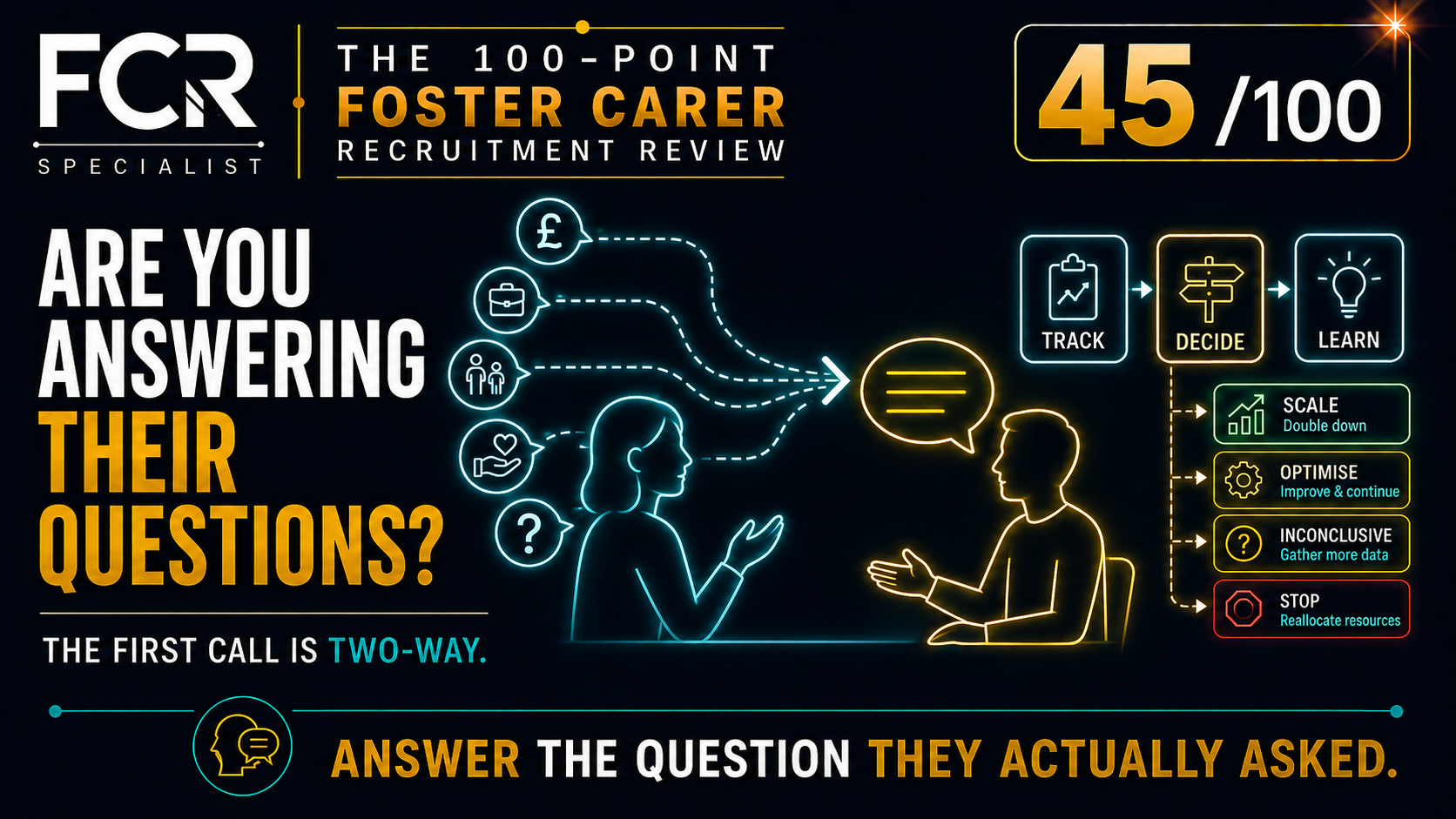
Point 45/100 — Are You Answering Their Questions — or Just Asking Yours?
Point 45/100 — Are You Answering Their Questions — or Just Asking Yours?
Imagine the first Foster Carer Recruitment conversation.
The recruiter has questions.
Lots of them.
Where do you live?
Who lives with you?
Do you have children?
Do you work?
How many bedrooms?
Why are you interested in fostering?
All understandable.
But there is somebody else on the call.
And they have questions too.
Perhaps questions they have been thinking about for months.
Perhaps questions they couldn't answer through your website.
Perhaps questions they feel slightly embarrassed asking.
Perhaps one question that will determine whether they ever speak to you again.
So Point 45 asks:
ARE YOU ANSWERING THEIR QUESTIONS — OR JUST ASKING YOURS?
There is a genuine information problem
Department for Education behavioural research published in 2022 found that prospective Foster Carers and adopters often experienced information as fragmented and difficult to navigate.
People particularly struggled to find specific answers around:
- eligibility
- process requirements
- what to expect
- everyday realities
The research found that online information could feel broad and indistinguishable and sometimes appeared to offer a more positive or “rose-tinted” account rather than answering the precise question the person wanted answered.
That is important.
Because we can publish an enormous amount of content and still fail to answer people's questions.
Information volume is not the same as information usefulness.
Some people are frightened to ask
This may be even more important.
The same DfE behavioural research found prospective applicants could be reluctant to ask questions because they feared being judged.
Some worried that asking about a sensitive subject could somehow damage their chances before the process had really begun.
The research consequently recommended creating a safe space where people can ask questions and explore options without believing that an imperfect question will prejudice them.
Think about what that means for Foster Carer Recruitment.
Someone may want to ask:
“How much will I actually receive?”
but fear appearing motivated by money.
Someone may ask:
“Can I still work?”
but worry you will think fostering isn't important enough to them.
Someone may want to know:
“What happens if a child makes an allegation against me?”
but feel uncomfortable even raising the subject.
Someone may ask:
“What if I struggle?”
and worry the recruiter hears:
“I won't cope.”
Someone may ask about respite and worry it sounds as though they already want time away from fostering.
These are not necessarily negative questions.
They are real questions about a major life decision.
THE QUESTION THEY ARE AFRAID TO ASK MAY BE THE QUESTION THEY MOST NEED ANSWERED.
The first conversation has two information flows
Too often the information flow looks like this:
ORGANISATION → QUESTIONS → PROSPECTIVE FOSTER CARER
I think the better model is:
ORGANISATION ↔ PROSPECTIVE FOSTER CARER.
You need information about them.
They need information about you, fostering and what becoming a Foster Carer could mean for their household.
DfE's 2023 Foster Carer Recruitment research describes services trying to move away from an initial process focused solely on gathering information towards giving prospective Foster Carers space to ask for the information they need, assess whether the service is a good fit and make their own informed decision about whether to apply.
That is recruitment.
Not persuasion.
Not gatekeeping.
Mutual exploration.
Start by giving permission
One of the simplest things a recruiter can say is:
“Before I ask you lots of questions, what would you particularly like to know about fostering?”
Or:
“There really aren't any silly questions at this stage. What has been on your mind?”
That immediately changes the power balance.
The prospective Foster Carer has permission to use the conversation too.
Another useful question is:
“What have you already found out about fostering, and what still isn't clear?”
That prevents the recruiter spending fifteen minutes repeating information the person has already read while never reaching the subject they actually care about.
What are prospective Foster Carers likely to ask?
There is no universal list.
But your recruitment team should be prepared for questions around areas such as:
WORK
Can I foster and continue working?
What happens if both of us work?
Would my working pattern matter?
MONEY
What do Foster Carers receive?
What is an allowance?
What other payments apply?
Does it vary depending upon the child or type of fostering?
What happens when I do not have a placement?
The DfE's 2023 recruitment research specifically found that financial compensation was a key piece of information prospective Foster Carers looked for when enquiring.
So avoiding money because it feels uncomfortable does not make the question disappear.
TALKING ABOUT MONEY DOES NOT MEAN SOMEBODY IS FOSTERING FOR THE MONEY.
They need to know whether fostering is financially viable for their household.
THEIR OWN CHILDREN
What will fostering mean for my children?
What involvement will they have?
What if they find it difficult?
HOME
Do I need to own my home?
What does the spare-room requirement mean in my circumstances?
Will somebody inspect my home?
RELATIONSHIPS AND HOUSEHOLD
Can single people foster?
What happens if my partner isn't quite as ready as I am?
Who in my household needs to be involved?
AGE AND HEALTH
Am I too old?
What if I have a health condition?
What does the medical process involve?
Point 46 will examine the danger of turning broad characteristics into premature rejection.
At Point 45, our responsibility is to answer honestly without jumping immediately to a conclusion.
SUPPORT
Who helps me when things are difficult?
Is somebody available outside office hours?
What training would I receive?
What happens if I need advice?
RESPITE AND BREAKS
Can Foster Carers have holidays?
What happens if I need a break?
How does respite work?
ALLEGATIONS
What happens if an allegation is made?
Who supports the Foster Carer?
What process follows?
This may not be a comfortable recruitment subject.
That doesn't make it unimportant.
CHILDREN AND MATCHING
Can I choose which children I foster?
How are matches made?
What information do I receive?
Can I say no?
ASSESSMENT
How long does the process normally take?
What will you need to know?
Who will you speak to?
What checks are involved?
How intrusive is it?
THE REALITY
What is the hardest part?
What do existing Foster Carers wish they had known?
What causes Foster Carers to stop?
These may be some of the most useful questions of all.
Don't answer a different question
This is a recruitment skill in itself.
Prospective Foster Carer:
“Can I afford to foster?”
Weak answer:
“Our Foster Carers receive a competitive package of financial support.”
That is marketing language.
It has not answered the question.
A useful response should explain:
- the provider's actual arrangements
- what is fixed and what varies
- what the allowance/payment is intended to cover
- any relevant circumstances that affect it
- where the person can see the information in writing
The answer will vary between providers.
But the principle won't:
ANSWER THE QUESTION THEY ACTUALLY ASKED.
Don't hide behind “it depends”
Some fostering questions genuinely have no immediate yes/no answer.
That is fine.
But there is a world of difference between:
“It depends.”
and:
“There isn't a single answer because it depends on X and Y. Let me explain how we would look at your particular circumstances.”
The second answer acknowledges complexity while remaining useful.
Similarly:
“We'd look at that during assessment.”
may sometimes be technically correct.
But if it is the issue determining whether somebody is willing to enter assessment, delaying all explanation until later is not helpful.
Give as much accurate information as reasonably possible at the stage when the person needs it.
If you don't know — say so
Recruiters do not have to know everything.
In fact, pretending to know can be much more damaging.
A good answer can be:
“I don't want to give you the wrong information on that. Let me check with the right person and come back to you.”
Then do it.
Point 43 gave every enquiry an owner.
Point 47 will give every meaningful conversation a next action.
So an unanswered question should become:
QUESTION RECORDED → OWNER → ANSWER OBTAINED → RESPONSE GIVEN.
Not:
“I'll find out.”
followed by silence.
Accuracy is more important than reassurance
Someone asks:
“Would that stop me from fostering?”
The easiest recruitment answer may be:
“Probably not.”
But if you don't know, don't reassure simply because you want to keep them interested.
Trust built through Point 44 can be lost instantly when later information contradicts what the first recruiter said.
Use language such as:
“That isn't something I can give you an automatic yes or no to, but I can explain how it would normally be considered.”
Honesty is not a barrier to recruitment.
FALSE REASSURANCE IS.
Bring back QUESTION → ANSWER → EVIDENCE → EXPERIENCE
We introduced this earlier in the Review when examining recruitment content.
It is even more useful in a real conversation.
QUESTION
“Can I foster while working?”
ANSWER
Give the provider's actual position.
EVIDENCE
Explain why — depending upon the child's needs, household arrangements, availability, support and the type of fostering involved.
EXPERIENCE
Where appropriate:
“Let me explain how some of our existing Foster Carers manage this in practice.”
Another example:
QUESTION
“What happens if things get really difficult?”
ANSWER
Explain the support arrangements.
EVIDENCE
Who is available, when, and what support actually exists?
EXPERIENCE
How does a Foster Carer access that support in real life?
That final element matters.
There is a difference between:
“We offer 24-hour support.”
and explaining:
who answers the telephone at 11pm and what they can actually do.
Don't give the brochure answer
Prospective Foster Carers can often recognise polished language.
If someone asks:
“What is the hardest part of fostering?”
and receives:
“Fostering is challenging but incredibly rewarding.”
they have learned almost nothing.
The phrase may be true.
It is also generic.
A more useful answer might explain:
- uncertainty
- challenging behaviour
- working with professionals
- impact on family life
- difficult endings
- allegations
- contact arrangements
- emotional demands
and then discuss what support exists around those realities.
The DfE behavioural research specifically found concern that available information could appear overly positive rather than providing the comprehensive picture people wanted.
TRUST REQUIRES REALISM.
Let Foster Carer experience help answer the difficult questions
There will be questions where lived experience is particularly valuable.
For example:
“What did fostering do to your family life?”
A recruiter can answer organisationally.
A Foster Carer can sometimes answer experientially.
That does not mean handing every enquiry directly to a Foster Carer.
Nor should Foster Carers be expected to give professional advice.
But appropriately involving existing carers through:
- information events
- videos
- planned conversations
- FAQs
- testimonials
can give prospective carers access to a different kind of answer.
Point 38 already established the value of Foster Carer advocacy.
Point 45 shows another role:
helping prospective carers understand reality.
Questions should improve your recruitment content
If the same questions arrive every week, do something with that information.
Suppose recruiters repeatedly hear:
Can I foster if I work?
What do I actually get paid?
Am I too old?
Can single people foster?
What happens during allegations?
Those questions should inform:
- website FAQs
- videos
- social content
- information events
- recruiter training
- chatbot knowledge where used
- future campaign content
This creates a useful learning loop:
QUESTION ASKED
↓
ANSWERED WELL
↓
THEME RECORDED
↓
CONTENT IMPROVED
↓
FUTURE PROSPECTS GET BETTER INFORMATION.
This is how enquiry conversations can improve the recruitment system.
Different people need different amounts of information
One person may have researched fostering for two years.
Another saw an advertisement yesterday.
Do not give them identical information simply because the script says so.
Ask:
“How much do you already know?”
Then adapt.
DfE behavioural research identified different prospective-applicant tendencies, including people who wanted extensive information, time to ask questions and opportunities to think through different scenarios without feeling judged.
Good Foster Carer Recruitment recognises that somebody's need for information is not evidence of poor motivation.
Sometimes it is evidence that they are taking the decision seriously.
The provider is being assessed too
This is perhaps the biggest mindset change.
During the first conversation, the organisation is gathering information about the prospective Foster Carer.
But the prospective Foster Carer is also gathering information about the organisation.
They may be speaking with several providers.
They may be asking:
Which organisation seems honest?
Who answered my question properly?
Who listened?
Who explained the money clearly?
Who seemed uncomfortable when I asked about allegations?
Who actually described support rather than simply saying it was “excellent”?
Who treated me like an adult making a major decision?
DfE's 2023 recruitment research explicitly describes creating space for prospective carers to evaluate whether a service is a good fit for them.
That is important.
THEY ARE CHOOSING YOU TOO.
Create a question-friendly culture
A genuinely question-friendly first contact should communicate:
You can ask us about money.
You can ask us about difficulties.
You can tell us what worries you.
You can say you aren't sure.
You can ask what happens if fostering doesn't work out.
You can ask what support really means.
You can question us too.
The DfE's behavioural research summarised this direction very clearly: potential applicants need a safe space to ask questions, access reliable information and feel that questions will not prejudice them.
That is not an optional customer-service extra.
It is part of informed recruitment.
A simple first-contact question framework
I would train first-contact staff around seven actions:
1. INVITE
“What would you like to know?”
2. LISTEN
Let them finish.
3. CLARIFY
“When you ask about support, what are you most concerned about?”
4. ANSWER
Respond directly.
5. EXPLAIN
Give context where the answer is not simple.
6. CHECK
“Does that answer what you were worried about?”
7. CAPTURE
If you cannot answer, record the question, own it and come back.
The entire approach is reciprocal.
HERE IS THE TEST…
Take a sample of first-contact conversations or role-play them with your team.
Ask:
- Who asked most of the questions?
- Was the prospective Foster Carer explicitly invited to ask theirs?
- Did we establish what they already knew?
- Did we identify what they were actually worried about?
- Did we answer the question they asked?
- Did we use unexplained jargon?
- Did we avoid a difficult subject?
- Did we give vague marketing answers?
- Were financial questions answered openly?
- Did we explain where answers legitimately depend on individual circumstances?
- Did we say when we didn't know?
- Did somebody own unanswered questions?
- Did we distinguish reassurance from accuracy?
- Did we provide realistic information as well as positive information?
- Did we check whether our answer had actually helped?
- Did we provide written information where useful?
- Did repeated questions feed back into our recruitment content?
- Did the person leave knowing more than when they arrived?
- Did they feel safe asking difficult questions?
- Did they have enough information to make their own decision about the next step?
And then ask:
WOULD I MAKE A MAJOR DECISION ABOUT MY HOME, FAMILY, WORK AND LIFE BASED ON THE QUALITY OF INFORMATION WE JUST PROVIDED?
That is the standard.
Point 44 told us:
Listen first.
Point 45 adds:
ANSWER PROPERLY.
THE FIRST CALL IS A TWO-WAY CONVERSATION.
THEY ARE CHOOSING YOU TOO.
And once a person starts answering our questions, we need another discipline.
We must not take one answer and immediately turn it into a rejection.
That is Point 46: