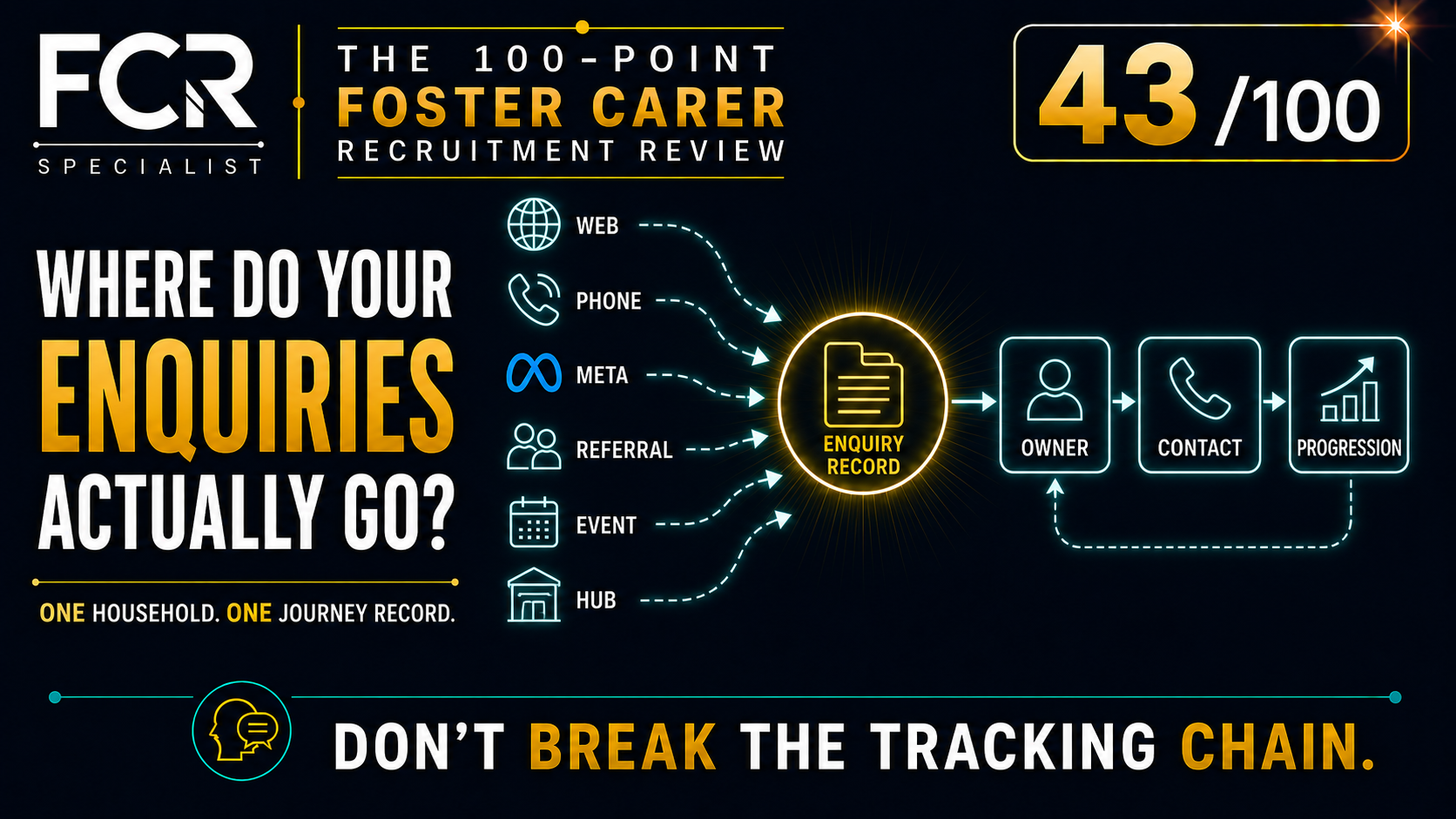
Point 43/100 — Where Do Your Enquiries Actually Go — and Can You Track Them?
Point 43/100 — Where Do Your Enquiries Actually Go — and Can You Track Them?
Someone clicks your Meta advert.
Another person finds you through Google.
Someone else talks to an existing Foster Carer.
Another meets your recruitment team at an event.
Someone sends you a Facebook message.
Another telephones.
One uses the website enquiry form.
Someone comes through a regional fostering hub.
Fantastic.
Now answer one deceptively simple question:
WHERE DID ALL THOSE ENQUIRIES ACTUALLY GO?
Not where they were supposed to go.
Where did they actually go?
Because there can be an extraordinary difference between:
“We have an enquiry-management process.”
and:
“I can account for every genuine Foster Carer enquiry entering that process.”
This Point connects Stage Four directly to Stage Five
Point 39 established:
TEST → TRACK → DECIDE → RECORD → REPEAT.
Point 40 then said:
EVERY CHANNEL — A JOB.
EVERY TEST — A QUESTION.
EVERY POUND — A PURPOSE.
EVERY RESULT — A DECISION.
That only works if the tracking survives the moment someone actually becomes an enquiry.
Suppose we spend £4,000 testing two different campaigns.
Campaign A creates 35 enquiries.
Campaign B creates 20.
If our recruitment system subsequently records all 55 simply as:
Source: Internet
what have we learned?
Very little.
We may know what the advertising platforms generated.
But if we cannot connect those records to:
- genuine contact
- progression
- application
- assessment
- eventual approval
then we cannot tell which campaign ultimately produced the better recruitment outcome.
THE TRACKING CHAIN MUST NOT BREAK AT ENQUIRY.
Where can enquiries arrive?
Potential Foster Carer enquiries might now arrive through:
- website forms
- telephone
- generic fostering email
- named recruiter email
- Facebook lead forms
- Facebook Messenger
- Instagram messages
- Google landing pages
- online chat
- AI chatbot escalation
- community events
- information sessions
- Foster Carer referrals
- employee referrals
- QR codes
- partner organisations
- regional recruitment hubs
- centralised recruitment teams
That is before we consider people who contact more than once using different routes.
Every active enquiry route needs an answer to three questions:
WHERE DOES IT LAND?
WHO SEES IT?
WHO OWNS WHAT HAPPENS NEXT?
If nobody can answer all three, there is a potential hole in the recruitment system.
An inbox is not necessarily an enquiry-management system
Imagine a generic email address:
fostering@organisation...
Who monitors it?
Every day?
Only during office hours?
Who covers annual leave?
Can two members of staff assume the other has replied?
Can an enquiry be marked as dealt with?
Can management see what is outstanding?
Can the original recruitment source be preserved?
What about Facebook Messenger?
What about Meta lead forms?
What about voicemail?
What about enquiries given directly to a recruiter at an event?
What about somebody who texts the mobile number of the person they met?
The risk is not necessarily poor staff performance.
The risk is fragmentation.
The enquiry exists.
But it exists in the wrong place.
The evidence says this is a genuine sector problem
Department for Education research into Foster Carer Recruitment found that services used a variety of databases and systems and that the technology itself could influence what data was collected and how effectively it could be analysed.
Some systems could not capture sufficiently detailed information.
Some could not track each stage of the recruitment journey or the time between stages.
Some could not connect to other data sources.
That could lead to providers maintaining several separate databases, making comparison and analysis more difficult.
The same research found potentially valuable qualitative information could end up buried in case notes, stored separately from the main database or not recorded at all.
This matters because Point 43 isn't really about software.
It is about continuity of information.
Source and enquiry route are different
This distinction is really important.
Imagine Sarah sees a Facebook advert.
She doesn't complete the Facebook form.
Instead, she Googles the provider the following evening and telephones.
What was the source?
Potentially:
Meta campaign
What was the enquiry route?
Telephone
Those are not the same answer.
Another person hears about fostering from their neighbour, who is an existing Foster Carer.
They visit the website and complete the form.
Origin:
Foster Carer referral / word of mouth
Enquiry route:
Website form
Another person sees a poster at a community event, later performs a Google search and submits a form.
Attribution becomes less certain.
That is fine.
Recruitment data does not need to pretend to know something it doesn't.
But don't collapse everything into:
Website
simply because the website happened to be the final doorway.
Track what the system knows automatically
Point 41 established an important principle:
DON'T MAKE THE PROSPECTIVE FOSTER CARER DO THE WORK YOUR SYSTEM SHOULD BE DOING.
Point 43 continues that.
Where technically and lawfully available, systems may already know things such as:
- landing page
- campaign identifier
- referral link
- form source
- date and time
- advertising campaign
- enquiry route
Preserve that information.
You may still appropriately ask:
“How did you first hear about us?”
because offline influence, referrals and multiple touchpoints are difficult for digital systems to identify.
But do not expect prospective Foster Carers to reconstruct your marketing attribution model for you.
One household can have many touchpoints
This is another reason simple enquiry counts can become misleading.
Someone might:
see a Facebook advert
↓
visit your website
↓
leave
↓
Google you three weeks later
↓
attend an information event
↓
talk to a Foster Carer
↓
finally telephone.
Was that six prospects?
No.
It was one household moving through a decision-making journey.
A useful internal principle is:
ONE HOUSEHOLD. ONE JOURNEY RECORD. MANY TOUCHPOINTS.
That does not mean deleting useful contact history.
Quite the opposite.
Keep the history attached to the same journey wherever possible.
It enables the organisation to understand the difference between:
number of marketing interactions
and
number of actual prospective Foster Carer households.
What should the minimum recruitment record contain?
This is where I would keep things deliberately practical.
The organisation does not need to collect half an assessment at enquiry stage.
Point 41 already dealt with that.
But the internal recruitment record should preserve enough operational information to follow the journey.
A useful structure might be: FieldWhy it mattersUnique enquiry/household referenceKeeps one journey togetherDate/time receivedLinks to Point 42 response performanceOriginal source where knownShows what generated interestEnquiry routeShows how the person contacted youCampaign/test ID where applicableConnects directly back to Point 39Referral/event source where applicablePreserves offline attributionBroad geographyLinks recruitment activity to sufficiencyNamed ownerStops enquiries becoming orphanedFirst contact attemptLinks response activity to the enquiryContact achieved?Separates receipt from actual contactCurrent statusShows where the enquiry is nowNext action/datePrevents driftEventual outcomeEnables downstream analysisReason where knownBuilds learning about progression/dropout
We will examine those outcome categories much more deeply in Point 48.
The important thing here is simply ensuring there is an authoritative record that can later answer:
What happened to this enquiry?
Do not build another spreadsheet merely because I have shown you a table
This is important.
I am not recommending that every fostering provider creates a new spreadsheet.
If your CRM does this already, use it.
If your fostering recruitment system does it, use that.
If your regional hub system provides it, use it.
For a very small provider, a carefully designed and consistently maintained recruitment tracker may be sufficient.
The principle is:
THE DISCIPLINE MATTERS MORE THAN THE SOFTWARE.
Before buying another system, ask whether the existing one is:
- understood
- accessible
- consistently used
- capable of producing the information management actually needs
A sophisticated system populated inconsistently will not produce reliable insight.
Every enquiry needs an owner
This may be the most basic management field of all:
WHO OWNS THIS ENQUIRY RIGHT NOW?
Not:
Recruitment team.
A name or clearly defined role.
Because an enquiry may pass between:
marketing
↓
central enquiry team
↓
regional hub
↓
Local Authority
↓
local recruitment team
↓
named recruiter.
Handoffs are not automatically a problem.
Unclear handoffs are.
At every transfer, somebody needs to know:
I now own the next action.
Point 42 asked how quickly somebody responds.
Point 43 asks whether anyone knows whose clock is currently running.
Central and regional recruitment makes this even more important
Current Ofsted methodology reflects the growing use of centralised arrangements.
For the 2024–25 fostering data collection, fostering hubs in the Local Authority sector could submit initial-enquiry data centrally, with the lead Local Authority reporting the total number of hub enquiries. Large IFA providers could also submit national-level initial-enquiry information centrally where it was collated in that way.
That makes sense for national reporting.
But operationally, providers still need enough local detail to understand what happened within the aggregate number.
If a hub reports:
2,000 enquiries
local management should still be able to understand:
- source
- area
- handoff
- contact
- progression
- eventual outcome
Otherwise the aggregate total becomes difficult to act upon.
This is not an argument against centralisation.
It is an argument for:
CENTRAL VISIBILITY + LOCAL GRANULARITY.
Foster with North East gives us a useful real-world example
The DfE's interim evaluation of Foster with North East describes a regional dashboard designed to give Local Authority fostering teams live monitoring data, including applications and approvals, with visualisations showing application source, recruitment pathways and other fostering insights.
But the evaluation also found that direct use of the dashboard was initially limited by issues including access and training; later, historical-data limitations also affected usefulness.
That demonstrates an important Point 43 lesson:
HAVING THE DASHBOARD IS NOT THE SAME AS USING THE DATA.
Technology alone doesn't create recruitment intelligence.
People need:
- access
- training
- consistent definitions
- reliable input
- ownership
- reasons to use the information
Define your terms
The DfE research also identified inconsistency in what fostering services called an enquiry.
Some counted very light engagement.
Others required contact details.
Others counted only once an initial conversation had taken place.
Ofsted has since clarified that, for its initial-enquiry data, the enquiry needs to be actionable, with enough identifying/contact information to enable the fostering service to respond.
Your internal system should therefore be very clear about its stages.
For example:
MARKETING INTERACTION
is not necessarily:
ENQUIRY
which is not necessarily:
CONTACT ACHIEVED
which is not:
PROGRESSION
If different members of the team use those terms differently, the dashboard may look precise while measuring different things.
Don't let attribution disappear at the handoff
Imagine this chain:
META-TEENAGERS-AREA-A-03
↓
37 enquiries
↓
regional/central team
↓
12 passed to local recruitment
↓
local spreadsheet records:
Source: Hub
What happened?
We have just lost the campaign.
“Hub” describes the handoff route.
It does not necessarily describe the recruitment source.
Both pieces of information can matter:
ORIGINAL SOURCE: Meta campaign
TRANSFER ROUTE: Regional hub
CURRENT OWNER: Area A recruitment
That means, months later, Point 39 can still answer:
Did META-TEENAGERS-AREA-A-03 actually create useful Foster Carer capacity?
Without that continuity, the advertising team sees one set of results and the fostering team sees another.
Nobody sees the whole recruitment journey.
What happens with duplicates?
Someone completes a form.
Then telephones because they haven't heard back.
Then sends a Facebook message.
Three records can appear.
That creates false volume.
So the system needs a sensible way of recognising:
same household — multiple contacts.
Do not lose the additional contact information.
It may tell you something useful.
For example, repeated contact might demonstrate high motivation — or that your response system failed.
But don't casually count the same household as three different prospective Foster Carers.
Track uncertainty honestly
Attribution will never be perfect.
Someone may genuinely say:
“I can't remember — I've seen fostering everywhere recently.”
Fine.
Record:
unknown / multiple / unable to determine
if that is the truthful answer.
False precision is worse than acknowledged uncertainty.
The point is to improve the data, not manufacture certainty.
HERE IS THE TEST…
Take the last 20 genuine Foster Carer enquiries received by your organisation.
For every one, answer:
- When did it arrive?
- Where did it physically land?
- What generated it?
- How did the person contact you?
- Can you identify the original campaign/test where relevant?
- Was it a referral?
- What geography?
- Who first owned it?
- When was contact attempted?
- Was contact achieved?
- Who owns it now?
- What is its current status?
- What is the next action?
- Is there a duplicate record elsewhere?
- Can you follow it all the way back to the original source?
- Will you eventually be able to connect it to application/approval/capacity?
Then ask:
IF THIS PERSON BECOMES A FOSTER CARER IN SIX MONTHS' TIME, WILL WE STILL KNOW WHAT RECRUITMENT ACTIVITY BROUGHT THEM TO US?
If the answer is no, Stage Four's learning has disappeared inside Stage Five.
My Point 43 principles are:
THE TRACKING CHAIN MUST NOT BREAK AT ENQUIRY.
ONE HOUSEHOLD. ONE JOURNEY RECORD. MANY TOUCHPOINTS.
EVERY ENQUIRY NEEDS AN OWNER.
IF YOU CAN'T FOLLOW THE ENQUIRY, YOU CAN'T PROPERLY EVALUATE THE RECRUITMENT.
And once we know where the person is, who owns the enquiry and how quickly we responded, the next question becomes much more human.
Point 44: