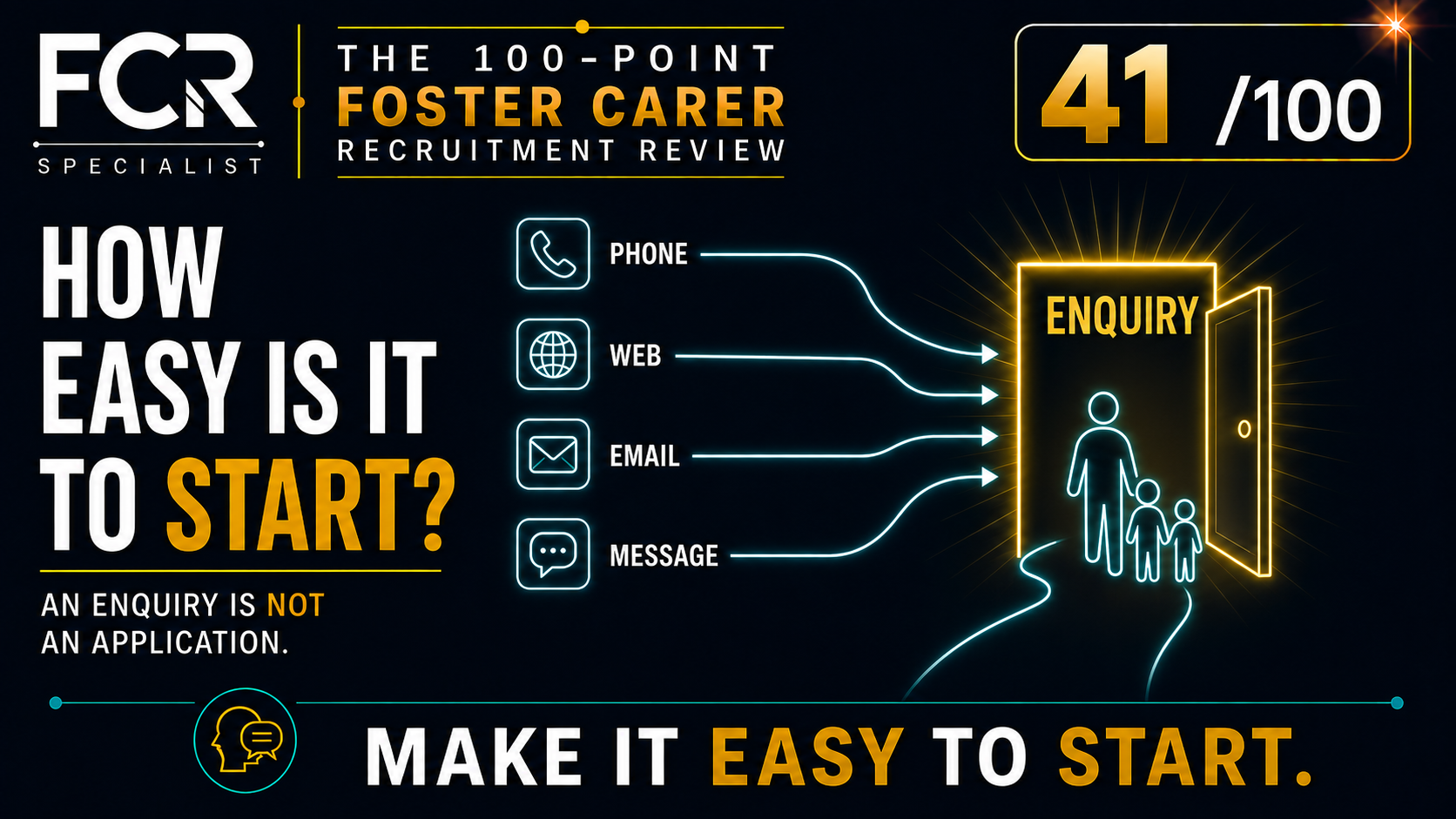
Point 41/100 — Can a Prospective Foster Carer Actually Enquire Easily?
Point 41/100 — Can a Prospective Foster Carer Actually Enquire Easily?
Imagine somebody sitting at home at 9.15 tonight.
They have been thinking about fostering for months.
Perhaps they have seen one of your Facebook adverts.
Perhaps they searched Google.
Perhaps they watched one of your Foster Carer videos.
Perhaps an existing Foster Carer spoke to them.
Perhaps they saw you at a community event.
Whatever the route, something has finally happened.
They have moved from:
“I've wondered about fostering.”
to:
“I think I'm ready to talk to somebody.”
That moment matters.
Over Points 31–40 we have spent considerable time examining how fostering organisations generate that moment.
Channels.
Advertising.
Community activity.
Referrals.
Campaigns.
Testing.
Budgets.
Now the person actually arrives.
So here's the first question in Stage Five:
CAN THEY ACTUALLY ENQUIRE EASILY?
We may be making a very simple decision unnecessarily difficult
Visit your fostering website as though you know nothing about your organisation.
Try to enquire.
How quickly can you work out what to do?
Is there an obvious:
Talk to us
Ask a question
Find out about fostering
or
Request a conversation
route?
Or does the prospective Foster Carer have to navigate:
Home → Children's Services → Fostering → Become a Foster Carer → Information → Eligibility → Apply Now?
Now try it on a mobile phone.
Now imagine doing it while commuting.
Or with children around you.
Or after work at 9pm.
Or when you're interested but still nervous about whether fostering is actually right for you.
The recruitment system should meet that person where they currently are.
They are not necessarily ready to apply.
They may simply be ready to talk.
That distinction is fundamental.
AN ENQUIRY IS NOT AN APPLICATION.
What is an enquiry?
This is more complicated across the fostering sector than it perhaps should be.
Department for Education research found significant variation in how fostering services defined enquiries. Some organisations could treat fairly light engagement as an enquiry, while others counted people who had actually provided contact details or spoken with somebody.
Ofsted has subsequently clarified the definition used within its fostering data collection.
For an initial enquiry to be counted, it needs to be actionable — in other words, it needs sufficient identifying and contact information to enable the fostering service to respond. Only one enquiry is counted per household. Examples can include requesting information by phone or email, making an initial telephone contact, booking or attending an information session, or requesting a home visit.
That is useful for this Point because it reinforces something important.
An enquiry does not require somebody to complete everything you might eventually need to know about them.
It requires enough to begin the recruitment relationship.
How much information do you actually need?
This is where I think Foster Carer Recruitment needs to be quite disciplined.
Ask:
WHAT IS THE MINIMUM INFORMATION WE GENUINELY NEED TO START A USEFUL CONVERSATION?
Possibly:
- name
- telephone number and/or email
- broad location/postcode where genuinely necessary
- preferred contact route
- perhaps preferred contact time
Not automatically:
- full employment history
- detailed household composition
- detailed health information
- ethnicity
- financial circumstances
- previous relationships
- lengthy motivation statements
- complete accommodation details
- full fostering experience
- extensive suitability information
Some of those things may eventually be important.
That does not mean they all need to be collected now.
The DfE's 2023 qualitative research found that participating fostering services often collected only names and contact details at initial enquiry. Participants said one reason was GDPR; another was avoiding appearing intrusive and deterring people from enquiring.
That also fits the Information Commissioner's data-minimisation principle: organisations should collect personal data that is adequate and relevant for the purpose, but limited to what is necessary.
So the question isn't:
“Could this information eventually be useful?”
It is:
“Do we need this information to fulfil the purpose of this particular stage?”
Those are different tests.
The “Application Form” problem
One of the quickest ways to introduce unnecessary psychological friction may be to label the initial contact route:
APPLY NOW.
Think about what that phrase means to somebody still exploring.
They may interpret it as:
I am now formally applying to become a Foster Carer.
But perhaps all they want to know is:
Can I foster while working?
What would I be paid?
Would being single matter?
What happens because I have my own children?
Is my spare room suitable?
How long does the process take?
Would my previous experience matter?
Can I speak to an actual Foster Carer?
They haven't necessarily decided to apply.
They have decided to find out.
And DfE research into actual fostering-service practice found a common process in which an enquiry was handled first, often followed by further discussion and a home visit, before progression to a formal application form.
So make the language match the stage.
Possible calls to action include:
Talk to our fostering team
Ask us a question
Start a conversation
Find out more
Request a call
I'm interested in fostering
The precise wording should fit the organisation.
The principle is more important:
DON'T ASK FOR COMMITMENT BEFORE YOU HAVE BUILT ENOUGH CONFIDENCE TO JUSTIFY IT.
How many enquiry routes should there be?
People communicate differently.
Some would much rather telephone.
Others actively avoid telephone calls.
Someone may be happy to send an email.
Another person may want to complete a ten-second web form and be called back.
Someone who discovers fostering through Instagram may instinctively send a direct message.
A person at a community event may simply give a recruiter their details.
A referral may come through an existing Foster Carer.
Increasingly, somebody may initially use a live-chat or AI-supported question-and-answer service.
None of those routes is automatically right or wrong.
The important thing is that the organisation understands which routes it genuinely supports.
Possible routes include:
- telephone
- short website enquiry
- social-media direct message
- information event
- community event
- Foster Carer referral
- live chat
- AI chatbot for appropriate initial information
- QR code linking directly to an enquiry route
But don't create channels merely to look accessible.
If you advertise WhatsApp, somebody has to manage it.
If you invite Facebook messages, somebody has to see them.
If Instagram says “DM us”, that DM has to become a real recruitment enquiry.
If a chatbot can answer basic questions, it must also make the route to a human conversation absolutely clear.
And that takes us naturally into later Points concerning response and tracking.
For Point 41, our concern is simply:
Can the person get through the front door?
Don't force everyone down your preferred route
This is another useful diagnostic.
A prospective Foster Carer telephones and says:
“I've got a couple of questions about fostering.”
Do you answer them?
Or say:
“You'll need to complete the website form first.”
Someone sends an Instagram message.
Do you start an appropriate conversation or simply reply:
“Please visit our website.”
Someone meets your recruiter at a local event.
Does the recruiter make it easy to reconnect?
Or hand over a leaflet containing another set of instructions?
Every transfer creates another opportunity to lose somebody.
That doesn't mean every channel can complete every task.
It means:
DON'T CREATE AN EXTRA STEP UNLESS THE EXTRA STEP HAS A PURPOSE.
Test your website on a telephone
This sounds almost too obvious.
But it matters.
Do not assess your enquiry journey only on a large office monitor.
Open it on a typical mobile phone.
Can you:
- find the fostering page?
- find the enquiry route?
- read the form comfortably?
- use the correct keyboard for telephone/email fields?
- understand which fields are compulsory?
- complete it without excessive scrolling?
- correct an error easily?
- see what happens after pressing submit?
- understand what will happen next?
And ask a more uncomfortable question:
How many fields are there?
Then challenge every one.
Why do we need it at this point?
Accessibility is recruitment
Accessibility should not be considered a technical compliance exercise sitting separately from recruitment.
If somebody:
- uses assistive technology
- has dyslexia
- has limited digital confidence
- speaks English as an additional language
- struggles with complicated written forms
- cannot easily use a telephone during working hours
then the enquiry route still needs to work.
Not every person requires the same route.
That is precisely why choice matters.
A genuinely accessible recruitment system says:
Here are several straightforward ways to start a conversation.
Tell people what happens next
Uncertainty creates friction too.
Imagine two buttons.
Option A
SUBMIT
Option B
Request a conversation
Leave your name and preferred contact details. A member of our fostering team will contact you to answer your questions. This is an enquiry, not an application.
Which gives the prospective Foster Carer greater clarity?
You do not need paragraphs of explanation.
Just tell them:
- what they are doing
- what information you need
- why
- what happens next
Point 42 will examine how quickly that next step should happen.
Point 41 merely ensures the person understands what they have initiated.
Don't confuse data collection with recruitment
There is a tension here.
Point 39 argued strongly for better recruitment data.
Point 43 will shortly examine where enquiries arrive, how they are recorded and whether source attribution survives the journey.
That absolutely does not mean the answer is to interrogate the prospective Foster Carer with an enormous form.
Better tracking and lighter candidate experience can coexist.
For example, the system might already know:
- landing page
- campaign
- source
- referral code
- date/time
- advertising creative
- geographic campaign
without asking the individual to type any of it.
We should collect useful recruitment intelligence wherever legitimately possible.
But:
DON'T MAKE THE PROSPECTIVE FOSTER CARER DO THE WORK YOUR SYSTEM SHOULD BE DOING.
That becomes an important bridge back to Stage Four.
Marketing created the interest.
Tracking should preserve its source.
But the person should not face a questionnaire simply because the organisation's internal systems are poor.
HERE IS THE TEST…
Tonight, not during office hours, use your own Foster Carer Recruitment system as a member of the public.
Use a mobile phone.
Start from Google.
Then start from Facebook or another active recruitment channel.
Then start from your website homepage.
Try to make an enquiry.
Ask:
- How many clicks did it take?
- Was the enquiry route obvious?
- Did it look like an enquiry or an application?
- How many fields were compulsory?
- Why was each field required?
- Could I choose how I wanted to be contacted?
- Could I ask a question without committing myself?
- Was there an alternative to the form?
- Did it work properly on mobile?
- Was the language clear?
- Was the route accessible?
- Did I understand what would happen next?
- Could someone enquire outside office hours?
- Was I being asked for information that could reasonably wait?
- If I arrived through social media, could I enquire naturally from there?
- If I became uncertain halfway through, was there another easy way to talk to somebody?
Then ask one final question:
IF I WERE ONLY 60% SURE ABOUT FOSTERING, WOULD THIS PROCESS HELP ME TAKE THE NEXT STEP — OR GIVE ME A REASON TO LEAVE?
That is the real Point.
We spent Stage Four working out how to generate attention.
Point 41 is about making sure we don't waste it at the first doorway.
AN ENQUIRY IS NOT AN APPLICATION.
MAKE IT EASY TO START.
And once somebody has started?
That takes us to Point 42: