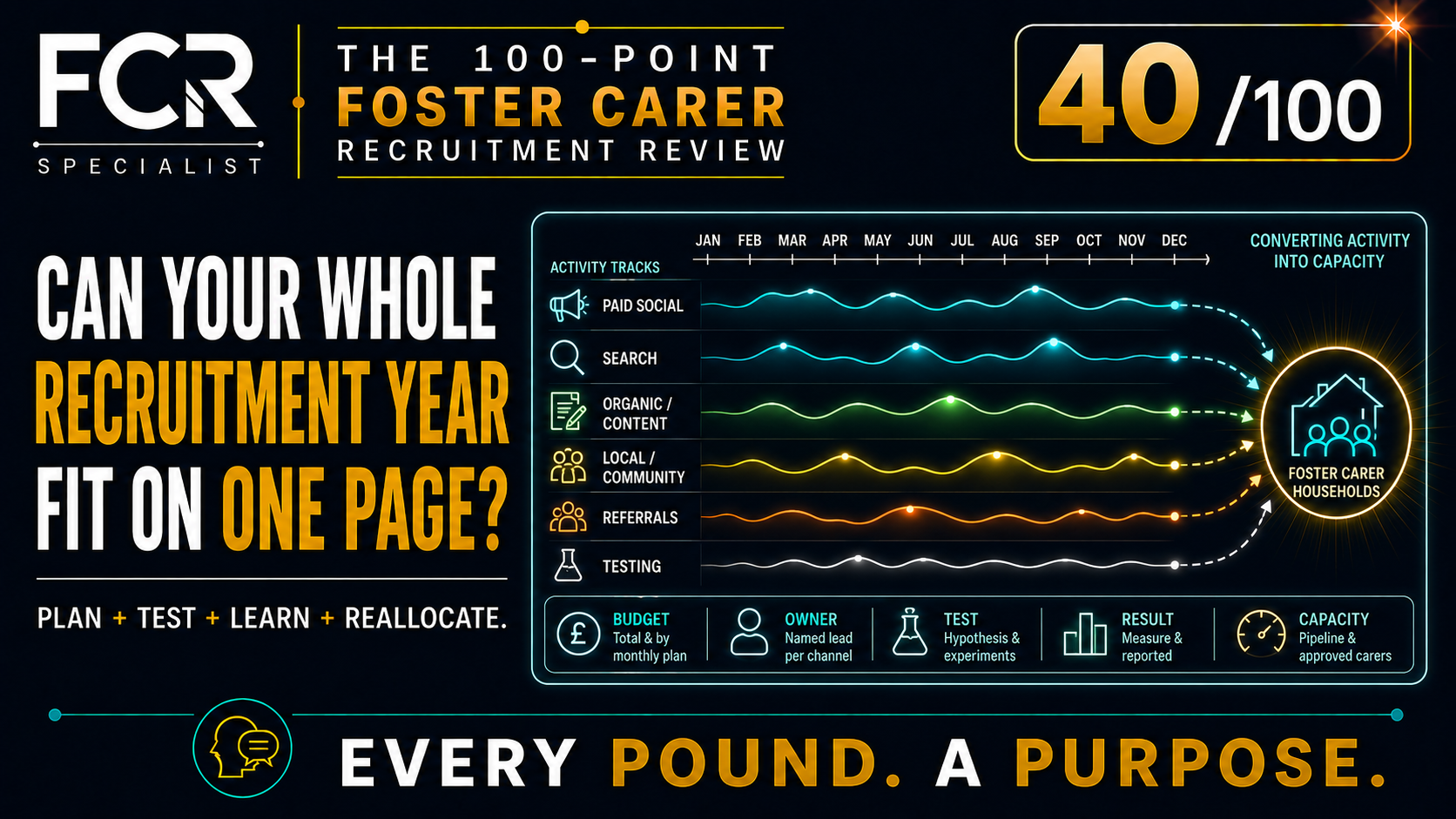
Point 40/100 — Can You Put Your Whole Foster Carer Recruitment Year on One Page?
Point 40/100 — Can You Put Your Whole Foster Carer Recruitment Year on One Page?
Over the previous nine Points of Stage Four we have looked at:
- always-on recruitment
- when activity should increase or reduce
- Meta
- Google Search
- organic social
- TikTok, X and emerging channels
- local online communities
- referrals and word of mouth
- testing, measurement and learning
But there is a danger.
We can understand every one of those things individually and still operate Foster Carer Recruitment as a collection of disconnected activities.
Facebook campaign over here.
Google campaign over there.
A Foster Care Fortnight initiative.
Three community events.
Some referral activity.
An agency retainer.
A monthly social-media schedule.
Some videos.
A few boosted posts.
A new landing page.
And eventually somebody asks:
“What is our Foster Carer Recruitment strategy this year?”
The answer should not require twenty PowerPoint slides and four different departments.
I think a senior manager should be capable of seeing the basic operating system on one page.
CAN YOU PUT YOUR WHOLE FOSTER CARER RECRUITMENT YEAR ON ONE PAGE?
Not every advert.
Not every post.
Not every metric.
The management architecture.
Start with sufficiency — not channels
This is perhaps the most important warning in Point 40.
Do not begin the annual plan with:
“How much are we spending on Facebook?”
Start with:
WHAT FOSTER CARER CAPACITY ARE WE TRYING TO CREATE?
For example, not simply:
20 new Foster Carers.
But perhaps:
- 4 households able to consider teenagers in Area A
- 3 households capable of supporting sibling groups around Area B
- 5 mainstream households around Area C
- additional respite capacity in a particular cluster
Immediately, the planning conversation changes.
Now we can ask:
Who might provide that capacity?
Where might they live?
What questions might they have?
Which recruitment channels could realistically reach them?
What proposition will matter to them?
What resources will recruitment need?
This is why channel strategy exists to serve sufficiency.
Not the other way around.
There is no single “best channel”
This is supported by the Department for Education's 2023 qualitative research into Foster Carer Recruitment.
Participating services described using a mixture of digital, physical, media and face-to-face methods and did not identify one universally superior marketing approach. The study also found significant variation in who owned marketing: dedicated teams, recruitment staff, service managers, centralised marketing functions, local teams and external agencies could all be involved.
That is important.
The objective of an annual recruitment plan is therefore not to prescribe the same channel mix to everybody.
It is to ensure that whatever mix you choose has logic behind it.
EVERY CHANNEL NEEDS A JOB.
The one-page questions
Across the top of my annual plan I would put nine questions.
WHO?
Which prospective Foster Carers are we trying to reach?
WHAT?
What proposition, message or question are we putting in front of them?
WHERE?
Which geography?
WHY?
What sufficiency requirement are we trying to address?
WHEN?
When will recruitment intensity change — and why?
HOW?
Which channels?
WHO OWNS IT?
Recruitment?
Corporate marketing?
External agency?
Local team?
Specialist?
A hybrid arrangement?
WHAT WILL IT COST?
Money and, where material, internal resource.
WHAT WILL WE MEASURE?
Not simply impressions and clicks.
The recruitment outcome.
Put those across one annual planning page and many organisations will immediately discover gaps.
Give each channel a defined job
A channel plan could look something like this.
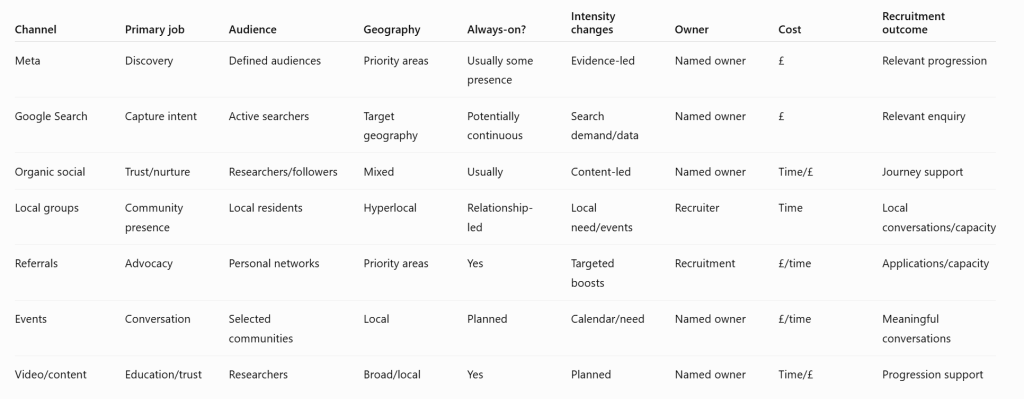
This is illustrative.
A small IFA may only need three or four channels.
A large multi-regional IFA may require a much more complex structure.
A Local Authority working through a regional hub may have a different division of responsibility again.
The important thing is being able to answer:
WHY IS THIS CHANNEL HERE?
Always on — but not always at the same intensity
This brings us straight back to Point 31.
My principle was:
ALWAYS ON DOES NOT MEAN ALWAYS SPENDING AT THE SAME LEVEL.
Your annual plan might show activity running across January to December.
But different lines rise and fall.
Google Search might maintain a relatively steady presence where sufficient search demand exists.
Meta could run at a baseline level and increase when evidence or sufficiency needs justify it.
Organic content continues.
Referral activity continues.
Local groups remain relationship-led.
Events rise around genuine local opportunities.
Targeted recruitment activity increases around emerging sufficiency needs.
What I would not do is automatically build a calendar saying:
January — high.
August — low.
December — stop.
Point 32 already dealt with that.
DON'T LET THE CALENDAR RUN YOUR RECRUITMENT.
LET THE EVIDENCE INFORM IT.
Build the budget differently
One of the biggest improvements I would make to an annual Foster Carer Recruitment budget is to stop thinking solely in channel headings.
Instead of:
Facebook — £X
Google — £Y
consider several different pots.
1. BASELINE BUDGET
Activity required to maintain recruitment visibility and continuity.
2. PLANNED CAMPAIGN BUDGET
Activity with enough evidence behind it to justify inclusion in the annual plan.
3. TEST BUDGET
Money deliberately set aside to learn.
This is important.
Testing should not depend upon finding £1,500 left over in a budget somewhere.
Learning should be planned.
4. SCALE RESERVE
One of my strongest recommendations in Point 40.
Suppose you run a carefully designed recruitment test in May.
It performs exceptionally well.
The evidence says:
Scale it.
But the budget is fully allocated until next April.
That is a management failure.
You found something that appears to be working and have no resource available to exploit it.
A scale reserve allows you to say:
This activity has earned additional investment.
5. COMMUNITY / LOCAL ACTIVITY
Events.
Local partnerships.
Materials.
Hyperlocal recruitment.
6. CONTENT / CREATIVE
Photography.
Video.
Design.
Landing pages.
Content production.
7. REFERRAL / ADVOCACY
Referral incentives and supporting activity.
8. FLEX / CONTINGENCY
Because the year's sufficiency requirement may change.
I would not prescribe percentages.
A £20,000 recruitment budget and a £500,000 recruitment budget require completely different structures.
The principle is:
DON'T ALLOCATE EVERY POUND BEFORE YOU'VE LEARNED ANYTHING.
Three budget questions
For every genuine test, ask:
WHAT CAN WE AFFORD TO LOSE?
Because tests can fail.
WHAT DO WE NEED TO SPEND TO LEARN SOMETHING USEFUL?
Because an underfunded test can also waste money.
WHAT CAN WE SPEND IF IT WORKS?
Because successful tests need somewhere to go.
That final question is commonly missing.
Who actually does all this?
This matters because fostering providers differ enormously.
SMALL IFA / SOCIAL-WORK-LED PROVIDER
You may have:
- an owner
- Registered Manager
- Social Workers
- an administrator
and no marketing department.
That does not mean you cannot run sensible recruitment.
Nor do you need to become a professional digital marketer.
But there is another question:
SHOULD YOU SPEND YOUR LIMITED TIME TRYING TO DO EVERYTHING?
Probably not.
The better principle is:
DO FEWER THINGS PROPERLY.
For example:
- good local Google presence
- modest, carefully managed Meta activity
- excellent Foster Carer referrals
- strong local-community relationships
- a competent website
might be considerably more valuable than maintaining six neglected social-media platforms.
And there is good official training available.
Google currently provides free self-paced Google Ads training through Skillshop, including Search and Measurement learning paths. LinkedIn Marketing Labs offers training on Campaign Manager, measurement and advertising strategy. TikTok Academy is TikTok's official learning platform for advertisers, with courses covering creative, ads, measurement and policy. Meta continues to provide Blueprint learning resources alongside its business-advertising guidance.
For YouTube, current official guidance directs creators to YouTube Creator Tips and YouTube for Creators for education and best practice; YouTube Certified is a narrower programme restricted to certain eligible creators and partners.
The message is not:
Become a marketer.
It is:
KNOW ENOUGH TO MANAGE YOUR MARKETING.
LOCAL AUTHORITY
A Local Authority may have:
- fostering recruitment
- Children's Services communications
- corporate marketing
- procurement
- external agencies
- regional structures
The risk is that control and accountability become separated.
Corporate marketing may control media buying.
That's fine.
But marketing should not decide independently:
- what Foster Carer capacity is required
- which geography matters
- what constitutes a useful enquiry
- what progression means
- whether the eventual recruitment outcome was valuable
Fostering and recruitment must retain ownership of the recruitment requirement.
LARGE IFA
A large IFA might have:
- specialist marketing teams
- external agencies
- central recruitment
- regional recruitment
- local fostering teams
- sophisticated CRM systems
The risk here is different.
Marketing reports:
“We produced 1,200 leads.”
Recruitment responds:
“They were poor.”
And everybody retreats into their own performance report.
The real question is:
WHO OWNS THE OUTCOME?
Somebody has to connect:
marketing → enquiry → recruitment → assessment → approval → capacity.
Without that connection, silos can all claim they succeeded while the organisation fails to recruit enough Foster Carers.
What can you outsource?
Quite a lot.
Technical Meta setup?
Yes.
Google campaign configuration?
Yes.
Photography?
Of course.
Video production?
Potentially.
Design?
Yes.
Website development?
Yes.
Specialist data work?
Possibly.
But there are things I would be extremely careful about outsourcing conceptually.
An agency cannot ultimately own your:
- sufficiency requirement
- recruitment geography
- Foster Carer proposition
- operational reality
- enquiry definition
- acceptable candidate quality
- recruitment outcome
My principle is:
OUTSOURCE THE TECHNICAL WORK IF YOU NEED TO.
DON'T OUTSOURCE THE RECRUITMENT THINKING.
What should you ask an agency?
Good agencies have valuable expertise.
The answer is not to become hostile towards them.
The answer is to become an informed commissioner.
Ask:
What exactly are we buying?
What counts as a lead?
Which geography?
Which audience?
Which campaign objective?
What landing page?
Who owns the advertising account?
Can we access the underlying data?
What is being tested?
What would make you scale?
What would make you change?
What would make you stop?
How will our recruitment team's feedback on lead quality get back into campaign decisions?
And particularly:
WHAT HAPPENS AFTER THE LEAD?
That question alone changes the conversation from marketing procurement to Foster Carer Recruitment management.
Build a management rhythm
An annual plan should not be written in January and reopened eleven months later.
I would use three levels.
MONTHLY — WHAT HAPPENED?
Look at:
- spend
- source
- enquiry quality
- progression
- tests
- operational problems
- emerging sufficiency needs
QUARTERLY — WHAT SHOULD CHANGE?
Ask whether to alter:
- channel mix
- geography
- audience
- sufficiency priorities
- creative
- budget allocation
- tests
- activity being scaled
- activity being stopped
ANNUALLY — WHAT DID WE LEARN?
Ask:
Which channels earned their place?
Which activities worked repeatedly?
What failed?
Why?
Which areas lack capacity?
What capability is missing internally?
What did agencies add?
What should be brought in-house?
What should be outsourced?
Where should next year's money move?
That gives us:
PLAN → DELIVER → TEST → MEASURE → LEARN → REALLOCATE.
The Department for Education's 2023 recruitment research is relevant here too. Participating services reported using recruitment data for internal budgeting and evaluation, but also said data was not always fully utilised because of issues including engagement and resource. The study recommended better data collection and greater sharing of learning.
Data has little value if it never changes a decision.
HERE IS THE TEST…
Imagine I walk into your organisation tomorrow and ask your senior team:
- Which Foster Carers are you trying to recruit?
- Where?
- Why?
- Which channels are you using?
- What job does each channel perform?
- Which activity stays always on?
- When and why does intensity change?
- What are you testing this year?
- What have you already learned?
- What is each activity costing?
- Who owns each activity?
- Who owns the overall recruitment outcome?
- What capability do you have internally?
- What have you outsourced?
- What happened to the enquiries?
- Which activities should you scale?
- Which should you optimise?
- Which should you stop?
- What budget remains if something starts working?
- What Foster Carer capacity did the whole investment create?
Can the answers be found on one management page?
If not, there is probably still work to do.
The one-page Foster Carer Recruitment operating plan
At its simplest, the page should connect:
SUFFICIENCY NEED
↓
AUDIENCE + GEOGRAPHY
↓
PROPOSITION
↓
CHANNEL MIX
↓
ALWAYS-ON + CAMPAIGN INTENSITY
↓
BUDGET
↓
OWNERSHIP
↓
TESTS
↓
MEASUREMENT
↓
DECISIONS
↓
FOSTER CARER CAPACITY
That is not a marketing calendar.
It is a Foster Carer Recruitment operating system.
And that is where I want Stage Four to end.
Because after ten Points examining recruitment reach, channels, campaigns, referrals and testing, the principles can now be reduced to four lines:
EVERY CHANNEL — A JOB.
EVERY TEST — A QUESTION.
EVERY POUND — A PURPOSE.
EVERY RESULT — A DECISION.
And underneath them all:
WHAT FOSTER CARER CAPACITY ARE WE TRYING TO CREATE?
That is the question that keeps marketing connected to recruitment.
And recruitment connected to sufficiency.