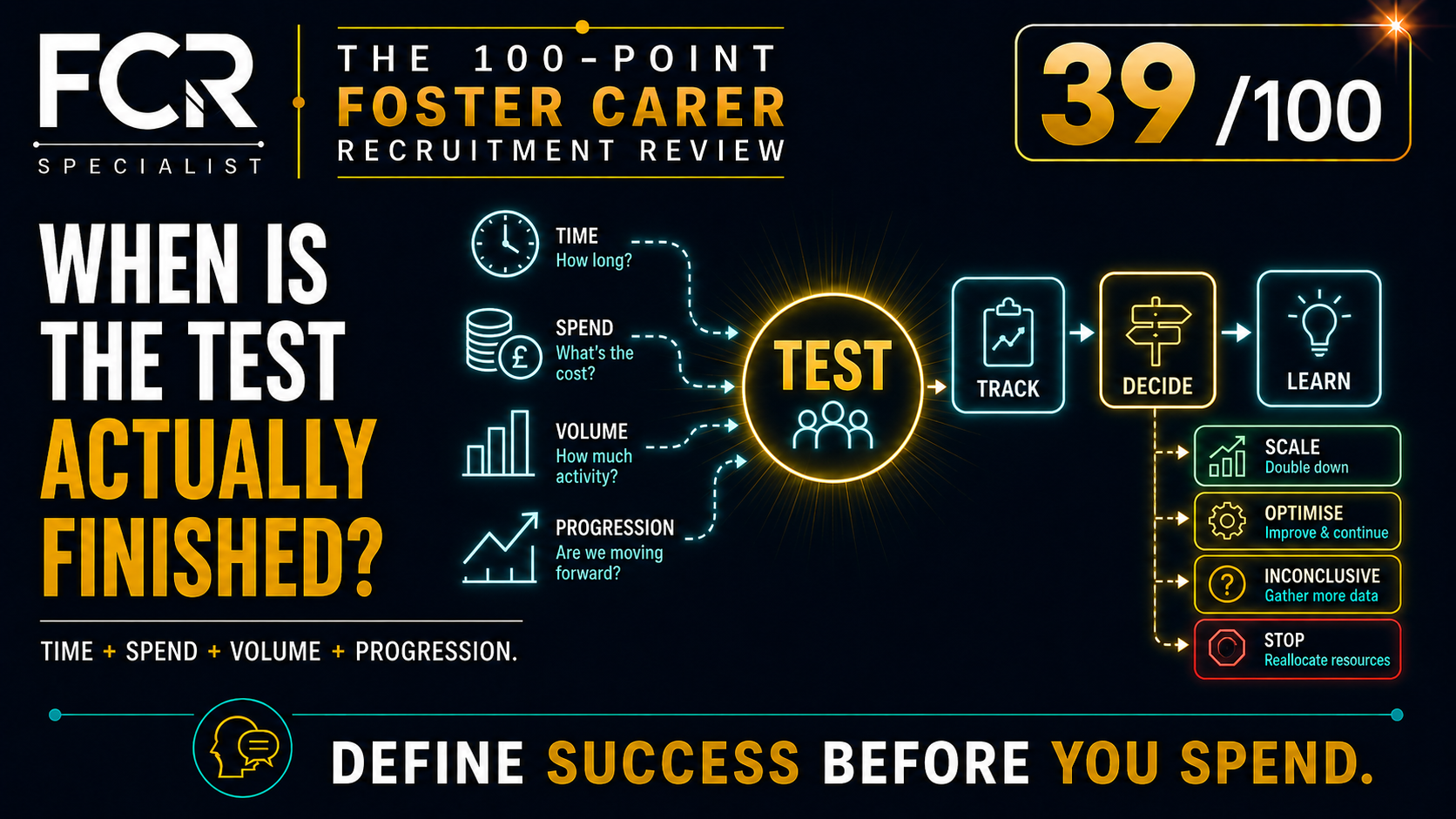
Point 39/100 — When Is a Foster Carer Recruitment Test Actually Finished?
Point 39/100 — When Is a Foster Carer Recruitment Test Actually Finished?
We use the word test remarkably casually in recruitment.
“We're testing Facebook.”
“We're trying Google.”
“We're running a six-week campaign.”
“We're trialling some events.”
“We've launched a referral scheme.”
Fine.
But here's my question:
WHEN IS THE TEST ACTUALLY FINISHED?
Is it finished because six weeks have passed?
Because the advertising budget has been spent?
Because 100 leads arrived?
Because somebody produced a PowerPoint showing reach and impressions?
Or because we now have enough evidence to make a sensible recruitment decision?
Those are very different things.
Throughout Stage Four of this 100-Point Review I have repeatedly used words such as:
test
track
measure
learn
optimise
scale
stop
Point 39 is where those words need to become an operating discipline.
My starting principle is simple:
IF YOU CAN'T TELL ME WHAT SUCCESS LOOKS LIKE BEFORE THE CAMPAIGN STARTS, YOU AREN'T READY TO SPEND THE MONEY.
Define success before you spend
Imagine I walked into your organisation on the morning a new £5,000 recruitment campaign was due to start and asked:
“What exactly are you testing?”
Could somebody answer?
Not:
“We're doing Facebook.”
Facebook is a channel.
Not:
“We need more Foster Carers.”
That is not yet a recruitment brief.
I mean:
What do we believe this particular activity will demonstrate?
For example:
Question-led Foster Carer videos targeted within a defined geography will produce more appropriate enquiries progressing to meaningful conversations than our existing generic static creative.
Now we have something capable of being tested.
We have:
- a hypothesis
- an audience
- a geography
- a channel
- a creative variable
- a comparator
- an outcome
That means we can start designing the measurement before launching the advertising.
This principle is entirely consistent with wider government evaluation practice. The 2026 Magenta Book emphasises building evaluation into intervention design, rather than trying to reconstruct afterwards what happened and why.
A test is not finished because four or six weeks have passed
There should not be a universal Foster Carer Recruitment rule saying:
Run everything for four weeks.
Or six weeks.
Or eight weeks.
Different activities produce useful evidence at different speeds.
A reasonably funded Meta campaign in a sizeable geography may produce significant activity relatively quickly.
A Google Search campaign covering a tight local geography might encounter relatively low search volume.
A hyperlocal community strategy could depend upon relationships developing over several months.
A Foster Carer referral programme may generate fewer introductions over a considerably longer period.
So:
DO NOT DEFINE A TEST ONLY BY TIME.
I would use four dimensions:
TIME + SPEND + VOLUME + PROGRESSION.
Time tells you how long it has operated.
Spend tells you how much resource has been exposed.
Volume tells you whether enough activity has occurred to interpret anything.
Progression tells you whether the activity actually contributed to recruitment outcomes.
All four matter.
Start with a simple campaign record
I am not proposing another complicated dashboard.
Use whatever credible system you already have:
- CRM
- recruitment system
- spreadsheet
- management dashboard
- agency reporting platform
The discipline matters more than the software.
Every meaningful recruitment test should have a simple record.
CAMPAIGN / TEST ID
Give it a unique identifier.
Something as basic as:
META-HALIFAX-WORKING-01
followed by:
META-HALIFAX-WORKING-02
means that twelve months later you can distinguish one version from another.
RECRUITMENT REQUIREMENT
What Foster Carer capacity are we attempting to create?
HYPOTHESIS
What do we believe?
AUDIENCE
Who?
GEOGRAPHY
Where?
CHANNEL
Meta, Google, referrals, local groups, events or something else?
MESSAGE / CREATIVE
What are we actually testing?
ENQUIRY ROUTE
Lead form?
Website?
Telephone?
Event?
Warm referral?
START DATE
Simple.
AGREED REVIEW INTERVALS
When will we check performance?
MAXIMUM TEST BUDGET
What are we prepared to risk in order to find out?
INTERNAL RESOURCE
How much staff or management time is likely to be required?
BASELINE / COMPARATOR
What are we comparing this with?
SUCCESS CRITERIA
What evidence would encourage us to continue or scale?
CHANGE / STOP CRITERIA
What would cause us to intervene?
RESULT
What actually happened?
DECISION
Scale?
Continue?
Optimise?
Inconclusive?
Stop?
LEARNING
This final heading may be one of the most valuable.
Because it creates organisational memory.
Not every number means the same thing
One of the great traps in recruitment reporting is placing all metrics on the same level.
They aren't.
I would use a hierarchy.
LEVEL 1 — MARKETING / ACTIVITY
Depending upon the channel, you might look at:
- spend
- impressions
- reach
- clicks
- click-through rate
- cost per click
- video views
- enquiries
- cost per enquiry
- event registrations
- direct messages
These numbers matter.
They can tell you whether something is happening.
But:
THESE ARE NOT FOSTER CARER CAPACITY.
A campaign can produce a spectacular-looking marketing report and virtually nothing useful downstream.
LEVEL 2 — ENQUIRY QUALITY
Now we start getting closer to recruitment.
Possible measures include:
Contactable rate
How many enquiries could actually be contacted?
Relevant geography rate
How many came from the area you needed?
Suitable-to-progress or relevant enquiry rate
Using whatever legitimate definition your organisation applies.
Cost per relevant enquiry
This can expose something that raw cost-per-lead completely hides.
Imagine two campaigns.
Campaign A
£15 per raw enquiry.
But only one in eight is relevant.
Cost per relevant enquiry:
approximately £120.
Campaign B
£40 per raw enquiry.
But a much higher proportion is relevant.
Cost per relevant enquiry:
£65.
The campaign that looks expensive on the advertising report can be cheaper when viewed as recruitment.
Those figures are purely illustrative.
The principle isn't.
LEVEL 3 — RECRUITMENT PROGRESSION
Now follow people.
Depending upon your process:
- enquiry → meaningful conversation
- enquiry → initial visit
- enquiry → application
- enquiry → assessment
- application → assessment
- assessment → panel
- panel → approval
- campaign → approval
And therefore:
- cost per meaningful conversation
- cost per initial visit
- cost per application
- cost per assessment start
- cost per approval
Different fostering providers have different recruitment processes, so I would not impose one universal progression model.
But every provider should be able to identify its own.
The Department for Education's foster carer recruitment research has previously highlighted weaknesses and inconsistency in recruitment data and the potential value of more granular analysis of the journey from enquiry through application and approval.
LEVEL 4 — FOSTER CARER CAPACITY
This is where Foster Carer Recruitment reporting needs ultimately to arrive.
How many households were approved?
But even that isn't quite enough.
What capacity did they create?
For example:
- mainstream
- teenagers
- sibling groups
- therapeutic fostering
- parent and child
- respite
- transfer
- particular geography
This suggests another potentially powerful measure:
COST PER REQUIRED CAPACITY.
Some providers will not recruit sufficient volume to produce statistically stable figures quickly.
That needs acknowledging.
But the direction of travel is important.
The ultimate management question is not:
“How cheaply did we get a lead?”
It is:
WHAT DID IT COST US TO CONTRIBUTE TO THE FOSTER CARER CAPACITY WE ACTUALLY NEEDED?
LEVEL 5 — OPERATIONAL COST
This is the level that advertising reports very often miss.
Campaigns create workload.
Suppose:
Campaign A
- £3,000 advertising
- 200 enquiries
- 70 staff hours following them up
- 4 applications
Campaign B
- £4,000 advertising
- 80 enquiries
- 25 staff hours following them up
- 9 applications
Again, purely illustrative.
Which was cheaper?
If we only look at media expenditure or cost per lead, possibly Campaign A.
If we look at recruitment and operational resource, the answer may look very different.
Track where practical:
- staff hours
- contact attempts
- duplicate enquiries
- unusable enquiries
- response workload
- time to first contact
- drop-out stage
- drop-out reason
This produces another useful principle:
TOTAL CAMPAIGN COST = MEDIA + CREATIVE + MANAGEMENT + INTERNAL RESOURCE.
You do not necessarily need to turn every staff hour into an exact financial calculation.
Even knowing that one campaign consumed three times more recruiter effort than another is valuable information.
What about ROI?
This is where I would be careful.
Conventional Return on Investment is often expressed as:
ROI = (Value Generated − Cost) ÷ Cost
The difficulty in Foster Carer Recruitment is defining value generated credibly.
For an Independent Fostering Agency there may eventually be a commercial value attached to an approved and utilised Foster Carer household.
For a Local Authority there could be wider financial implications around internal fostering capacity and alternative placement costs.
But approvals take time.
Capacity differs.
Placement utilisation differs.
Retention differs.
Children's needs differ.
We should therefore resist false financial precision.
HM Treasury's 2026 Green Book similarly cautions against reducing public-sector value-for-money judgements to one monetised ratio. It explicitly requires consideration of unmonetisable costs and benefits, risk and uncertainty alongside financial measures.
For Foster Carer Recruitment I would therefore prioritise:
COST PER RECRUITMENT OUTCOME
first.
And then, where Finance and fostering leadership can agree a defensible methodology:
RETURN ON RECRUITMENT INVESTMENT.
But I would not invent a universal Foster Carer ROI formula.
What should a senior-manager scorecard contain?
It doesn't need 57 measures.
A useful headline view might contain:
- Spend
- Enquiries
- Cost per enquiry
- Relevant/qualified enquiries
- Cost per relevant enquiry
- Applications
- Cost per application
- Approved/relevant capacity
Alongside:
- geography
- staff/resource impact
- key dropout
- decision
- learning
Platform specialists can have the detailed metrics underneath.
The senior team needs the recruitment story.
Review regularly — but don't keep interfering
Pre-agreed review intervals matter.
But different reviews have different purposes.
BEFORE LAUNCH — THE TEST GATE
Agree:
- hypothesis
- audience
- geography
- budget
- comparator
- success criteria
- stop/change criteria
- minimum evidence requirement
REGULARLY — THE OPERATIONAL CHECK
Ask:
Is the advertising actually running?
Is tracking working?
Is the geography correct?
Are enquiries contactable?
Is the landing page working?
Is budget being wasted?
Is anything reputationally or operationally wrong?
This is not permission to rewrite the campaign every Tuesday.
AGREED TEST REVIEW — THE DECISION CHECK
Now ask:
Do we have enough evidence?
What did it cost?
What was the enquiry quality?
What progressed?
What was the operational impact?
Then choose:
SCALE
CONTINUE
OPTIMISE
INCONCLUSIVE
STOP / DE-PRIORITISE
I particularly want INCONCLUSIVE in that list.
Because sometimes:
we don't know yet
is the correct professional answer.
Sometimes nothing failed
Imagine Google Search runs for four weeks in a very restricted geography.
Spend remains low because there simply isn't enough relevant search volume.
Four weeks pass.
Did Google fail?
No.
The evidence may simply be insufficient.
The correct conclusion could be:
INCONCLUSIVE — insufficient search volume within defined geography.
Equally, suppose Meta produces 150 low-cost leads but almost none can be contacted or progressed.
Did Meta succeed?
Not simply because the cost-per-lead graph is green.
The conclusion has to match the evidence.
Campaign finished does not mean evaluation finished
This is especially important in fostering.
Suppose a campaign stops on 30 June.
An enquiry generated on 28 June may not:
- apply until July
- begin assessment until August
- reach panel until much later
If you close your campaign report on 30 June and never revisit it, you have thrown away some of the most important information.
So:
CAMPAIGN FINISHED DOES NOT MEAN EVALUATION FINISHED.
Have an initial campaign review.
Then a later progression review.
Then, where appropriate, an eventual approval/capacity review.
I deliberately would not prescribe universal 30-day, 90-day or 180-day reviews.
Providers should align them with their own recruitment journey.
When should you stop early?
There is no virtue in spending the remainder of an agreed budget when something is demonstrably broken.
Intervene if:
- the wrong geography is running
- the enquiry form is broken
- tracking has failed
- the landing page is broken
- the creative is materially misleading
- traffic is overwhelmingly irrelevant
- safeguarding concerns arise
- reputational problems emerge
- the recruitment team cannot cope with the response
Nobody receives a medal for spending the final £2,000 because:
“We said we were running it for six weeks.”
But don't panic after three days
The opposite behaviour is equally destructive.
Monday:
Launch campaign.
Wednesday:
Change audience.
Thursday:
Change creative.
Friday:
Change landing page.
Monday:
Double budget.
Tuesday:
Ask:
“Which part worked?”
You may have made the answer impossible to determine.
CHANGE WITH INTENT — NOT NERVOUSNESS.
Give activity sufficient stability to generate interpretable evidence unless there is a genuine reason to intervene.
One successful test does not create a law
Suppose a campaign works brilliantly this year.
Next year you repeat it.
It disappoints.
Do not automatically conclude:
“Meta no longer works.”
“The agency has lost its touch.”
“Last year was a fluke.”
Ask:
WHAT CHANGED?
Perhaps:
- audience
- geography
- spend
- creative
- creative fatigue
- competition
- landing page
- proposition
- enquiry handling
- recruiter response time
- operational capacity
- timing
- platform behaviour
- local circumstances
A successful test creates:
EVIDENCE.
It does not create a permanent law.
If an approach produces comparable results repeatedly under reasonably comparable conditions, your confidence can increase.
Create organisational memory
One of the weakest sentences in any recruitment meeting is:
“Didn't we try that a few years ago?”
Maybe.
What happened?
Who ran it?
Where?
How much was spent?
What did the adverts say?
Who was targeted?
How many enquiries?
How many applications?
What happened to them?
Was tracking even working?
Often nobody knows.
So every meaningful recruitment test should leave behind a small historical record:
WHAT
WHEN
WHERE
AUDIENCE
MESSAGE
SPEND
RESULT
PROGRESSION
DECISION
LEARNING
Then when people change, the organisational knowledge doesn't disappear with them.
But be careful.
DO NOT TURN FAILURE INTO A PERMANENT BAN.
If Google supposedly “failed” three years ago when:
- the website was poor
- tracking was broken
- targeting was wrong
- follow-up was weak
then a later properly designed test could be entirely reasonable.
Record:
WHY WE THINK IT FAILED.
Not merely:
FAILED.
Blanket advertising can destroy learning
This becomes increasingly important when recruitment operates at regional scale.
Imagine a report saying:
REGIONAL CAMPAIGN
4,000 ENQUIRIES
20% INCREASE
Impressive.
But I would still ask:
Which area?
Which campaign?
Which postcode?
Which message?
Which channel?
Which enquiries were contactable?
Which were duplicated?
Which progressed?
Which applied?
Which began assessment?
Which were approved?
Which created relevant capacity?
And at what cost?
The bigger the campaign, the easier it can become for aggregate numbers to conceal significant local differences.
This is particularly relevant to regional fostering
This is not an argument against regionalisation.
The current direction of government policy is explicitly towards greater regional collaboration. In 2026 the Government expanded the Regional Care Cooperative programme and is developing more integrated fostering hubs. DfE describes RCCs as regional bodies responsible for areas including strategic planning, sufficiency and fostering.
The point is therefore:
REGIONALISATION MAKES GRANULAR PERFORMANCE MANAGEMENT MORE IMPORTANT — NOT LESS.
There is already evidence of why.
The Department for Education's interim evaluation of Foster with North East, covering 12 local authorities, describes a dashboard designed to provide both local and regional enquiry, progress and demographic data. It also found that inconsistent definitions of “enquiry” across authorities meant enquiries could not be included reliably in part of its quasi-experimental impact analysis.
That is a powerful management lesson.
If twelve areas call different things an “enquiry”, what exactly does a regional total mean?
The same evaluation also found no statistically significant effect on applications or approvals in its early six-month impact period — but explicitly warned that large, complex interventions may require more time to reveal their effect and that the short evaluation period constrained interpretation.
That is almost a perfect real-world demonstration of Point 39:
TIME ELAPSED DOES NOT AUTOMATICALLY MEAN EVIDENCE IS COMPLETE.
The correct answer can be:
too early
or:
insufficient evidence
or:
inconclusive.
That's not weakness.
That's proper analysis.
HERE IS THE TEST…
Take one recruitment campaign you currently have running.
Ask:
- What exactly are we testing?
- What is our hypothesis?
- What Foster Carer capacity do we need?
- Which audience?
- Which geography?
- What is the comparator?
- What is the maximum test budget?
- What is our minimum evidence requirement?
- What would make us scale?
- What would make us optimise?
- What would make us stop?
- What would make us say inconclusive?
- When will we review downstream progression?
- Are we counting staff resource?
- Are we recording what we learned?
If you can't answer those questions before launching, you aren't really testing.
You are spending money and hoping to interpret the result afterwards.
My Point 39 framework is:
TEST
↓
TRACK
↓
DECIDE
↓
RECORD
↓
REPEAT.
Or in more detail:
QUESTION / HYPOTHESIS
↓
DEFINE SUCCESS
↓
SET TIME + BUDGET + MINIMUM EVIDENCE
↓
RUN
↓
TRACK ACTIVITY + QUALITY + PROGRESSION + RESOURCE
↓
SCALE / CONTINUE / OPTIMISE / INCONCLUSIVE / STOP
↓
RECORD THE LEARNING
↓
REVIEW DOWNSTREAM
↓
RETEST WHERE JUSTIFIED
Because recruitment organisations should not have to keep paying to learn the same lessons.
And once every campaign has a purpose, a budget, a test and a decision...
we are finally ready to do something bigger.
Put the entire year together.
That is Point 40: