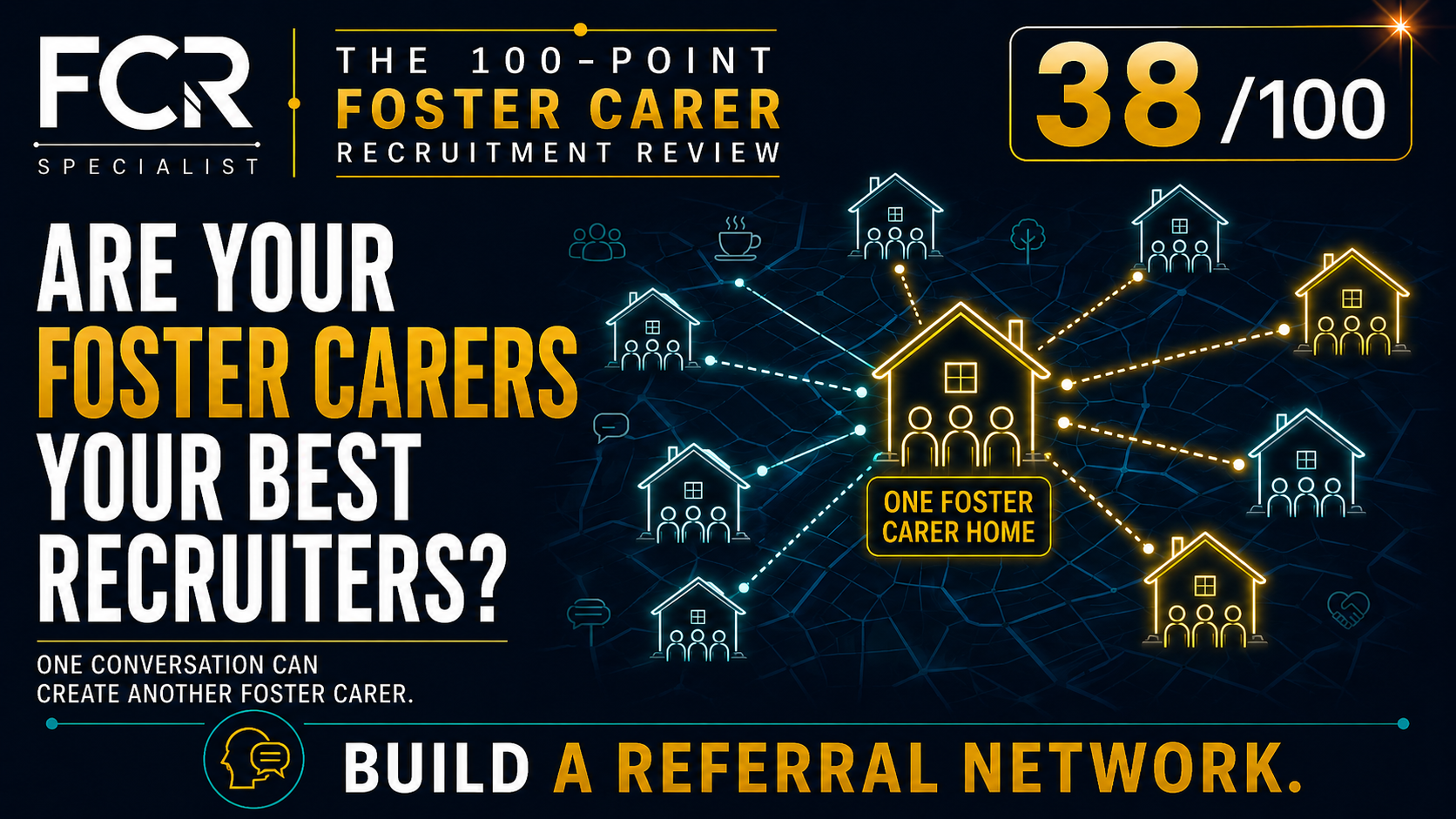
Point 38/100 — Referrals & Word of Mouth: Are Your Foster Carers Your Best Recruiters?
Point 38/100 — Referrals & Word of Mouth: Are Your Foster Carers Your Best Recruiters?
There is a recruitment channel available to almost every established fostering provider that can be overlooked while significant amounts of money are being spent on advertising.
It already knows what fostering is like.
It already understands many of the questions prospective Foster Carers will ask.
It probably has relationships throughout your local communities.
And, crucially, people may trust what it says precisely because it isn't your marketing department.
I am talking about your existing Foster Carers.
But there is an important distinction to make immediately:
A REFERRAL SCHEME IS NOT THE SAME AS A REFERRAL STRATEGY.
A referral scheme might say:
Introduce somebody who subsequently becomes an approved Foster Carer and receive a financial reward.
There is nothing inherently wrong with that.
The problem comes when we assume that putting a monetary amount beside the word referral means we now have a recruitment strategy.
We don't.
A genuine referral strategy asks a much broader question:
HOW CAN THE PEOPLE WHO ALREADY UNDERSTAND FOSTERING HELP US FIND THE NEXT GENERATION OF FOSTER CARERS?
There is evidence behind this
This isn't simply an attractive recruitment theory.
Department for Education qualitative research into foster carer recruitment and conversion, published in 2023, found that participating services regarded word of mouth as a strong recruitment approach. The research reported that enquiries originating through conversations with existing Foster Carers appeared more likely to become successful applications, with participants suggesting that these people often entered the process better informed, with more realistic expectations and an existing support connection.
That needs an important qualification.
It was a small-scale qualitative study. It does not give us permission to declare that referrals everywhere have a particular conversion rate or that they will automatically outperform Meta, Google or another channel.
It gives us something more useful:
a credible hypothesis that every provider can test against its own data.
That distinction matters throughout this 100-Point Review.
Ofsted's latest fostering statistics also remind us why every credible source of recruitment deserves attention. At March 2025, the number of mainstream fostering households in England was still below previous years, despite an increase in newly approved households during 2024–25. Across mainstream fostering there were 4,430 households joining the sector during the year and 4,690 deregistrations.
Recruitment therefore cannot simply be about producing more advertising activity.
It needs to create useful Foster Carer capacity.
What Point 37 taught us
In Point 37 we looked at recruiting where local communities already gather online.
Local Facebook groups.
Town and village pages.
Community networks.
Parent groups.
Local organisations.
Events.
And we established an important principle:
DON'T JUST TARGET PEOPLE. TARGET PLACES.
Point 38 takes that another step.
Because an existing Foster Carer can already be connected to those places.
They have neighbours.
Friends.
Work colleagues.
Family.
School networks.
Clubs.
Faith communities.
Sports groups.
Local businesses.
Professional networks.
They live inside the communities you are trying to reach.
That can create a very different recruitment journey:
EXISTING FOSTER CARER
↓
PERSONAL NETWORK
↓
LOCAL INTRODUCTION
↓
CONVERSATION
↓
ENQUIRY
↓
LOCAL FOSTER CARER CLUSTER
That last element matters.
Imagine you already have three Foster Carer households around a particular town.
Recruiting another two or three locally might potentially strengthen:
- peer support
- local Foster Carer relationships
- opportunities for local training
- informal support
- respite possibilities where appropriate
- recruiter/community presence
- local understanding of fostering
This is not simply about generating enquiries.
It can become part of a deliberate local capacity strategy.
Make referral easy
Here is a very simple test.
One of your Foster Carers is talking to somebody at a barbecue, school gate, football match or workplace.
The other person says:
“I've always wondered about fostering.”
What happens next?
Does your Foster Carer have to remember a telephone number?
Tell them to Google your organisation?
Find the correct website page?
Explain which form to complete?
Hope they eventually make contact?
Or can they say:
“I know the person you should speak to. Would you like me to introduce you?”
That is a very different experience.
A friction-light referral route could include:
- direct introduction to a named recruiter
- a simple telephone number
- permission for the recruiter to contact the interested person
- an informal coffee
- an information event
- a short Foster Carer video
- a useful FAQ page
- a QR code at an event
- an invitation to talk to another Foster Carer
- a low-pressure Teams or telephone conversation
The objective is not to force somebody into an application.
It is simply to make the next useful conversation easy.
Don't turn Foster Carers into salespeople
This is one of the most important boundaries in this Point.
Your Foster Carers do not need a script telling them that everything is wonderful.
In fact, that may destroy the very credibility that makes their voice valuable.
An authentic Foster Carer might say:
“There are difficult days.”
“The assessment was thorough.”
“Some parts of fostering have been harder than I expected.”
And then:
“This is the support that helped me.”
“This is what I've learned.”
“This is why I continue.”
That is potentially much more persuasive than polished recruitment copy because it helps someone make an informed decision, not merely an emotional one.
The 2023 DfE research contains an important warning here too. Some services reported finding it increasingly difficult to depend on Foster Carers for recruitment, with participants linking this partly to the growing demands of fostering and carers having less time or inclination to support recruitment activity.
That tells us something important.
ADVOCACY MUST BE VOLUNTARY.
Foster Carers should not become an unpaid extension of the recruitment department.
Nor should they be expected to:
- answer safeguarding questions
- adjudicate suitability
- deal with complaints
- defend the organisation publicly
- disclose confidential information
- manage hostile social-media conversations
- promise approval
- provide professional recruitment advice
The fostering provider remains responsible for the recruitment process.
What about referral payments?
Financial incentives can have a place.
The same DfE research found that some participating organisations used payments and refer-a-friend incentives to encourage word-of-mouth referrals.
But the financial reward should not become the whole strategy.
Ask Foster Carers what would actually motivate them to introduce somebody.
It may include money.
But it could also include wanting:
- more Foster Carers locally
- stronger support networks
- additional respite capacity
- more people who understand fostering
- stronger local communities
- improved placement choice for children
- less isolation
- friends or colleagues they believe would genuinely make good Foster Carers
There can be a huge difference between:
“Who can I refer so that I get £1,000?”
and:
“I know somebody who I genuinely think could do this.”
Both may result in a referral.
But psychologically they are not the same thing.
Don't just ask for referrals — create opportunities for them
A referral programme becomes much stronger when it becomes part of normal recruitment activity.
For example:
A Foster Carer attending a community event.
A Foster Carer joining an informal information evening.
A short video answering one genuine question.
An existing Foster Carer introducing the recruiter to a local group.
A coffee morning where interested people can speak informally.
A Foster Carer explaining what their first six months actually felt like.
A household sharing a recruitment post because the message genuinely reflects their experience.
The organisation creates the opportunity.
The Foster Carer supplies the authenticity.
The recruitment team manages the journey.
Recruitment could become more targeted too
Don't necessarily say:
“Please find us more Foster Carers.”
Tell existing carers what the actual sufficiency need is.
For example:
“We particularly need families around this part of the county.”
“We need more people able to consider teenagers.”
“We are trying to create a stronger group of Foster Carers around this town.”
“We particularly need people willing to explore sibling-group fostering.”
Existing Foster Carers may know people whose circumstances or experience fit that requirement.
That brings us right back to one of the core principles of this entire Review:
“WE NEED MORE FOSTER CARERS” IS NOT YET A RECRUITMENT BRIEF.
Referral activity should serve sufficiency just like every other recruitment channel.
Word of mouth extends beyond Foster Carers
Foster Carers should remain the centre of this strategy, but advocacy can extend further.
Potential advocates can include:
- current applicants
- former applicants where appropriate
- previous “Not Now” enquiries
- staff
- Social Workers
- community organisations
- local businesses
- employers
- schools
- supporters
- friends and family of Foster Carers
The principle remains the same:
People talk to people.
And fostering is a decision where credible human conversation can matter enormously.
Track referral performance properly
This may be where many referral schemes become weak.
An enquiry arrives.
Source:
Referral.
End of analysis.
That isn't enough.
Track:
REFERRAL → CONTACT → PROGRESSION → APPLICATION → ASSESSMENT → APPROVAL → CAPACITY.
Where practical, record:
- source
- referrer
- geography
- date
- enquiry
- contactability
- meaningful conversation
- application
- assessment
- approval
- type of Foster Carer capacity created
- reward cost
- time through the journey
And compare it with your other recruitment sources.
The Department for Education's 2023 research itself suggested that conversion data would be more useful if broken down by recruitment channel rather than relying solely on one overall conversion measure.
That becomes particularly important in Point 39.
Because once we create referral activity, Meta campaigns, Google campaigns, local-community campaigns and events, another question becomes unavoidable:
How do we know which actually worked?
HERE IS THE TEST…
Ask your Foster Carer Recruitment team these questions:
- How many Foster Carers actively understand our referral proposition?
- Is referring somebody easy?
- Is there a named person to introduce them to?
- Do Foster Carers know what capacity we particularly need?
- Do we give them useful content to share?
- Are there opportunities for them to participate locally?
- Is participation completely voluntary?
- Can they speak honestly?
- Are professional and safeguarding boundaries clear?
- Do we know how many referrals progressed?
- Do we know how many reached assessment?
- Do we know how many became approved?
- Do we know what capacity those approvals created?
- Do we know what the referral activity cost us?
- Do we know what we learned?
And then one bigger strategic question:
IF EVERY FOSTER CARER INTRODUCED JUST ONE SERIOUSLY INTERESTED PERSON THIS YEAR, WHAT WOULD THAT DO TO YOUR RECRUITMENT PIPELINE?
That isn't a prediction.
It is a management question.
Because the answer may reveal that one of the most underdeveloped recruitment networks in your organisation is already sitting around your Foster Carer support groups.
BUILD A REFERRAL NETWORK — NOT JUST A REFERRAL SCHEME.
And then measure it.
Because that takes us directly to Point 39:
WHEN IS A FOSTER CARER RECRUITMENT TEST ACTUALLY FINISHED?
The 100-Point Foster Carer Recruitment Review continues at FCR Specialist — www.fcrspecialist.com