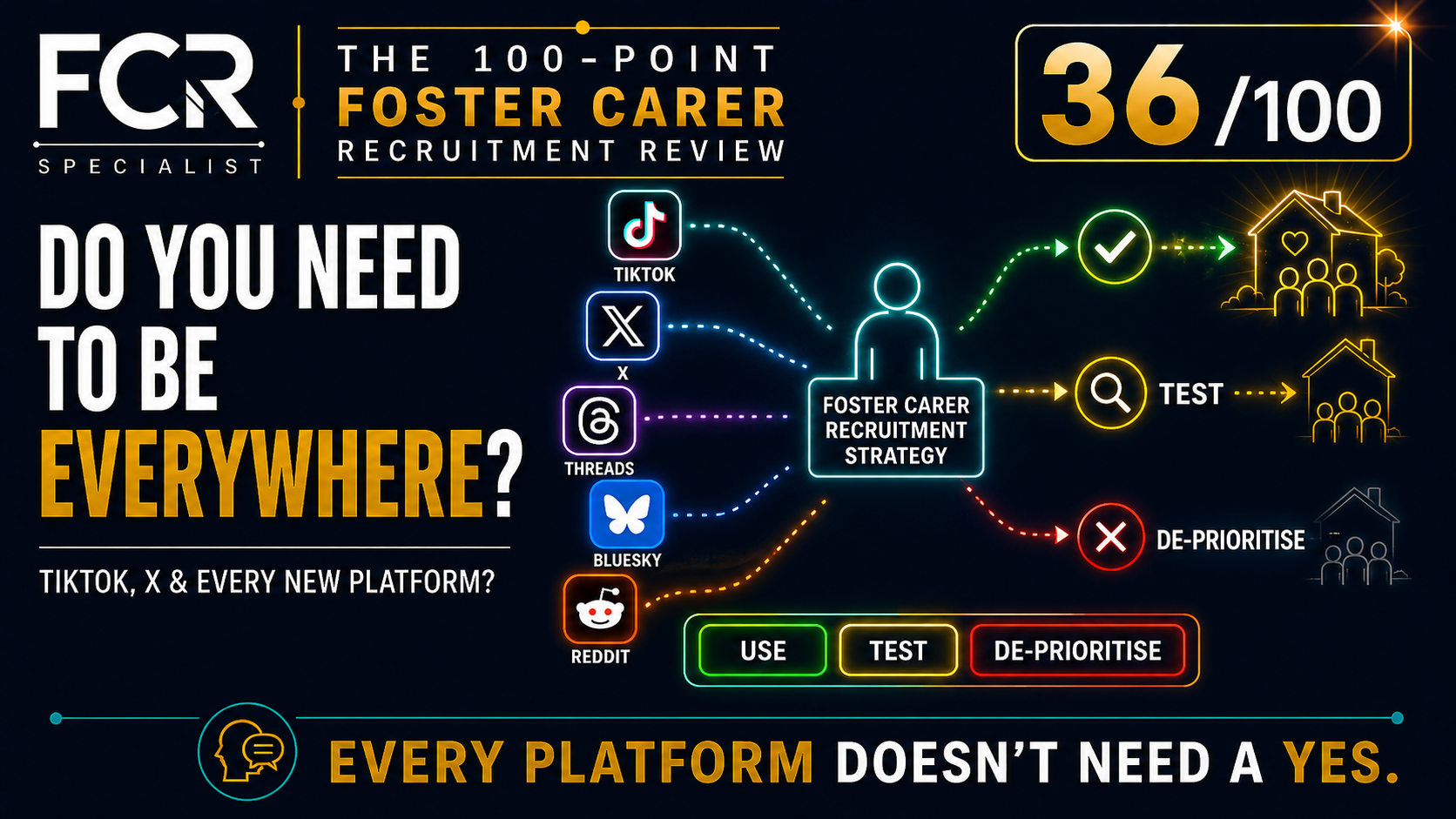
Point 36/100 — Should Foster Carer Recruitment Be on TikTok, X and Every New Platform?
Point 36/100 — Should Foster Carer Recruitment Be on TikTok, X and Every New Platform?
Someone comes into the meeting.
Perhaps an agency.
Perhaps a marketing colleague.
Perhaps a senior manager.
And says:
“We really need to be on TikTok.”
My first question would not be:
How quickly can we set up an account?
It would be:
WHY?
That is not resistance to innovation.
It is basic recruitment strategy.
Because in Point 35 we established:
AN ACCOUNT NEEDS A JOB.
Point 36 takes that principle one stage further.
Every new platform creates the temptation to add another channel to the recruitment plan.
TikTok.
X.
Threads.
Bluesky.
Reddit.
And eventually something that probably doesn't exist yet.
But:
BEING ABLE TO USE A CHANNEL IS NOT THE SAME AS NEEDING TO USE IT.
DON'T START WITH THE PLATFORM
Start with the recruitment requirement.
Who do you need?
Where?
What do you need them to understand?
Which stage of the recruitment journey are you trying to influence?
What action do you want them to take?
Only then ask:
Which channel helps us do that?
The wrong order is:
TikTok is popular → therefore we need TikTok → now what shall we post?
The better order is:
We need this audience → in this geography → with this message → for this purpose → which channels give us the best opportunity?
That's recruitment strategy.
TIKTOK — DON'T DISMISS IT AS A TEENAGE PLATFORM
Let's remove one stereotype immediately.
TikTok is not simply a platform populated by teenagers.
Ofcom's 2025 Online Nation research shows TikTok had substantial UK adult reach, with the wider report placing its adult visitor profile at approximately:
- 39% aged 18–34
- 37% aged 35–54
- 25% aged 55+
Ofcom also found TikTok visitors spent an average of around 28 minutes per day on the service in May 2025.
That is important.
A very substantial proportion of TikTok's adult audience falls well inside ages at which people may potentially consider fostering.
Ofcom's 2026 media-use research simultaneously confirms TikTok's strong younger skew: 83% of social-media users aged 16–24 reported using TikTok compared with 7% of those aged 75+.
Both can be true.
TikTok is disproportionately strong among younger adults.
But its adult audience is much broader than:
“TikTok is for kids.”
So I would not reject TikTok on age grounds alone.
THE BETTER TIKTOK QUESTION IS: CAN YOU COMMUNICATE THERE PROPERLY?
This is where the challenge begins.
TikTok is built around video and highly platform-native content.
Its own current business training strongly emphasises:
- creative;
- storytelling;
- native formats;
- advertising;
- measurement;
- content designed for the TikTok environment.
TikTok Academy remains its official education platform in 2026 and covers creative strategy, ads, measurement and advertising policy.
So imagine two fostering posts.
Version One
Corporate graphic.
Stock photograph.
Logo.
COULD YOU FOSTER?
Version Two
Actual Foster Carer talking naturally to camera:
“I nearly didn't enquire because I assumed I'd have to give up work.”
Then:
Here's what I discovered.
Which feels more native to short-form social video?
Probably the second.
TIKTOK COULD SUIT SOME FOSTERING CONTENT EXTREMELY WELL
Potential subjects include:
“Three things I wish I'd known before becoming a Foster Carer.”
“Can you foster if you're single?”
“Can you foster and work?”
“What actually happens during fostering assessment?”
“What did your own children think about fostering?”
“The question I was too embarrassed to ask about money.”
“What does a fostering Social Worker actually do?”
“I thought I was too old to foster.”
Notice what these are.
They are not advertisements pretending to be videos.
They are:
FOSTER CARER RECRUITMENT CONTENT.
That distinction matters.
BUT CAN YOU PRODUCE IT?
Here's the operational question.
Who is going to:
- identify the subjects;
- find Foster Carers willing to participate;
- arrange consent;
- record;
- edit;
- caption;
- publish;
- moderate;
- respond;
- analyse;
- repeat?
Not once.
Consistently.
Because opening the account is easy.
Feeding it properly is the difficult part.
This is why I would never tell a small fostering provider:
“You need TikTok.”
I would say:
TIKTOK MAY DESERVE A TEST.
That's very different.
GEOGRAPHY MAY MATTER EVEN MORE
Foster Carer Recruitment is unusually geographic.
A national retailer may be happy to sell almost anywhere.
A fostering provider may need carers:
- within a county;
- around a particular town;
- close to children's schools;
- within manageable Social Worker travel;
- near existing Foster Carer clusters.
TikTok currently supports UK location targeting including geographical areas such as cities and counties. However, its July 2026 help material states that postcode/ZIP-code targeting is currently available only in the United States. TikTok also cautions that location delivery depends on available signals and cannot be guaranteed perfectly accurate.
That could be perfectly adequate for some providers.
For others requiring extremely tight recruitment geography, it could make TikTok less attractive than another advertising channel.
Again:
THE PLATFORM HAS TO FIT THE RECRUITMENT REQUIREMENT.
ORGANIC TIKTOK AND PAID TIKTOK ARE DIFFERENT DECISIONS
This distinction matters.
You might conclude:
We don't currently have enough video-production capacity to build a strong organic TikTok account.
But still decide:
We have three excellent Foster Carer videos and want to test them through paid TikTok advertising in a suitable geography.
Perfectly rational.
Equally, a provider with charismatic Foster Carers producing excellent short videos might develop worthwhile organic visibility without making paid TikTok a priority.
Therefore ask separately:
Should we build an organic presence?
and:
Should we test paid advertising?
Do not treat them as the same decision.
MY TIKTOK VERDICT
Not:
YES.
Not:
NO.
My recommendation would be:
TEST SELECTIVELY.
Consider TikTok where:
- your intended audience is plausibly present;
- geography is workable;
- short-form video suits the message;
- authentic participants are available;
- you have enough resource to create content properly;
- you know what job TikTok will perform;
- you can measure useful outcomes.
If those conditions are absent:
DE-PRIORITISE.
That's not failure.
It's resource discipline.
NOW LET'S LOOK AT X
X presents a rather different case.
Ofcom's 2025 evidence shows that X remained the UK's largest microblogging service, reaching around 39% of UK online adults in May 2025.
So describing X as:
“dead”
would be factually wrong.
But Ofcom also found:
- monthly visitors had fallen 13% year-on-year;
- average daily time among visitors had fallen from approximately nine minutes to six minutes;
- X was the only top-ten social-media service in Ofcom's analysis with a clear male majority, at around 60% male.
That doesn't tell us:
don't use X.
It does tell us to ask harder questions.
WHAT JOB WOULD X ACTUALLY DO FOR FOSTERING?
X may remain useful for:
- sector commentary;
- government;
- policy;
- politics;
- journalists;
- public affairs;
- conferences;
- professional discussion;
- breaking news;
- Local Authority communications.
Those may all matter to a fostering organisation.
X also continues to offer substantial advertising targeting capabilities including geography, demographics, keywords, interests, events and conversations. Its current geo-targeting documentation includes countries, regions, cities and postal codes.
Its keyword targeting can use users' searches, posts and recent engagement as signals.
So X certainly still has advertising capability.
But capability is not the question.
The question is:
WOULD I PUT MY NEXT £5,000 OF FOSTER CARER RECRUITMENT MONEY HERE?
For many providers, I suspect other channels would deserve testing or investment first.
That's not a claim that X can never produce a Foster Carer.
It is a judgement about relative priority.
X MAY HAVE A JOB WITHOUT BEING A DIRECT RECRUITMENT PRIORITY
This is an important distinction.
Imagine a fostering CEO has a good professional profile on X.
They:
- engage with local politicians;
- interact with journalists;
- discuss children's social care;
- build regional relationships;
- promote fostering policy;
- comment during conferences.
That may be useful.
But that does not automatically mean the recruitment team also needs:
- an organic X calendar;
- five posts per week;
- paid Foster Carer acquisition campaigns;
- dedicated creative.
The job may be:
PROFESSIONAL INFLUENCE.
not:
DIRECT FOSTER CARER ACQUISITION.
And that's fine.
MY X VERDICT
For many fostering providers:
LOWER PRIORITY FOR DIRECT FOSTER CARER RECRUITMENT.
Potentially useful for:
- professional networks;
- public affairs;
- news;
- policy;
- stakeholder relationships.
But if resources are limited, I would want to see a strong recruitment case before taking money or staff time away from better-performing channels.
Again:
DE-PRIORITISE IS A LEGITIMATE DECISION.
WHAT ABOUT THREADS, BLUESKY AND WHATEVER COMES NEXT?
This is where the wider lesson becomes obvious.
Ofcom measured Threads at around 9% of UK online adults in May 2025 and Bluesky at around 6%.
By contrast, Reddit had grown strongly and reached around 60% of UK internet users in the same broad measurement period.
Should every fostering provider therefore immediately develop a Reddit strategy?
No.
And that's precisely the point.
Platform size cannot answer:
- who you need;
- where they are;
- why they are using the platform;
- whether fostering content belongs there;
- whether you can participate appropriately;
- whether you have the resource;
- whether another channel would perform better.
The fact that a platform has millions of users tells us only:
PEOPLE ARE THERE.
It does not tell us:
WE NEED TO BE THERE.
THE NEW PLATFORM TEST
Every time somebody proposes a new platform, put it through this test.
1. AUDIENCE
Are the people we actually need plausibly there?
Not:
“lots of people use it.”
2. GEOGRAPHY
Can we reach the places where we actually need Foster Carer capacity?
3. PURPOSE
What job will the channel perform?
- awareness?
- discovery?
- education?
- trust?
- community?
- professional networking?
- enquiry generation?
- referral?
4. CONTENT FIT
Does the content we can realistically produce belong naturally in that environment?
5. RESOURCE
What will it require in:
- staff time;
- creative;
- video;
- moderation;
- training;
- management;
- advertising?
6. MEASUREMENT
How will we know whether anything useful happened?
Not merely:
- views;
- followers;
- likes.
Connect it to the purpose.
7. OPPORTUNITY COST
And this may be the most important:
WHAT WILL WE STOP DOING TO RESOURCE IT?
This forces an organisation to acknowledge that staff time is finite.
THE SIX-HOUR QUESTION
Imagine a small IFA has one person doing most of the recruitment activity.
They have six spare marketing hours this week.
Possible uses:
Option A
Set up TikTok and create content.
Option B
Improve the Google Search campaign.
Option C
Film four Foster Carer FAQ videos for YouTube.
Option D
Contact previous “Not Now” prospects.
Option E
Build relationships with local Facebook-group administrators.
Option F
Strengthen the Foster Carer referral programme.
Which is best?
I cannot answer that without understanding the provider.
But:
“TikTok is popular”
is nowhere near enough information to decide.
Now we're talking about:
RESOURCE ALLOCATION.
That is a recruitment-management decision.
DON'T FORGET PAID VERSUS ORGANIC
For every platform ask two questions. QuestionDecisionShould we maintain an organic presence?Content/resource decisionShould we advertise there?Media/investment decision
You may answer:
yes / no
no / yes
yes / yes
or:
no / no.
All four combinations are legitimate.
WHAT ABOUT COST?
I don't think a Point like this should quote random internet CPM or CPC figures.
Campaign costs vary materially according to:
- audience;
- location;
- objective;
- competition;
- creative;
- bidding;
- timing;
- conversion definition.
X currently states that there is no minimum campaign spend and advertisers choose their own budget, but that tells us nothing about whether the resulting campaign will represent good Foster Carer Recruitment value.
The more important costs are:
Media spend
Content-production cost
Management cost
Staff time
Opportunity cost
A platform that costs £500 in media and consumes £4,000-worth of organisational effort isn't really a £500 experiment.
SAFEGUARDING AND REPUTATION STILL MATTER
There is another reason fostering cannot blindly copy consumer brands.
We deal with:
- vulnerable children;
- personal histories;
- Foster Carer households;
- family relationships;
- confidentiality;
- safeguarding.
Native social content often works precisely because it feels spontaneous.
But:
AUTHENTIC DOES NOT MEAN UNCONTROLLED.
Providers still need clear arrangements around:
- consent;
- identifying information;
- children appearing in content;
- confidentiality;
- comments;
- moderation;
- abusive responses;
- misinformation;
- staff behaviour;
- escalation.
Do not remove safeguarding discipline in pursuit of authenticity.
DON'T CHASE THE ALGORITHM AT THE EXPENSE OF THE MESSAGE
There is another temptation.
Once an organisation joins a platform, it may begin asking:
“What does the algorithm want?”
There is some value in understanding platform mechanics.
But Foster Carer Recruitment must still ask:
WHAT DOES THE PROSPECTIVE FOSTER CARER NEED?
The algorithm is a distribution system.
It is not your recruitment strategy.
Do not create increasingly sensational content simply because it generates more views.
Fostering deserves:
- honesty;
- accuracy;
- respect;
- realistic expectations.
Views are not sufficient reason to compromise that.
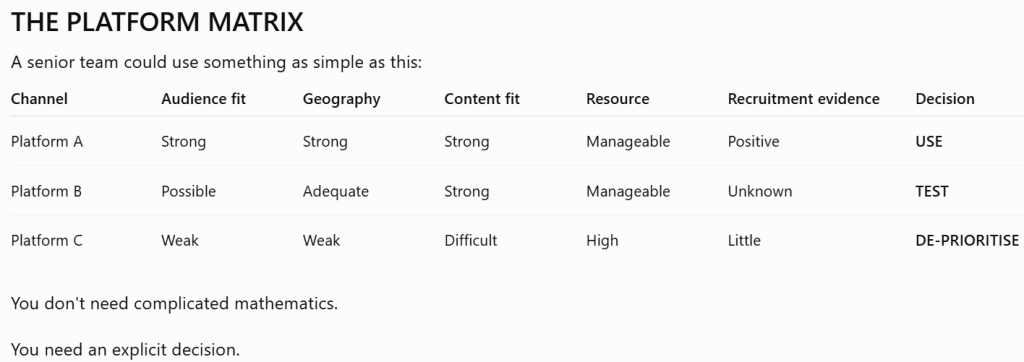
USE / TEST / DE-PRIORITISE
I prefer these three categories.
USE
There is enough evidence and strategic rationale to make this part of the channel mix.
TEST
There is a plausible case, but insufficient evidence.
Run a controlled experiment.
DE-PRIORITISE
Another use of the same money or time is currently more valuable.
Notice I am not using:
BAD PLATFORM.
That isn't the judgement.
The judgement is:
LOWER PRIORITY FOR THIS RECRUITMENT REQUIREMENT.
LEARN IT YOURSELF — TIKTOK
If TikTok is under serious consideration, don't learn it from somebody's three-year-old YouTube tutorial.
Use current official resources.
TikTok Academy
TikTok Academy is currently the platform's official learning destination for marketers and agencies, covering:
- creative;
- advertising;
- measurement;
- policy;
- business objectives.
There is also formal TikTok Media Buying Certification for practitioners wanting deeper expertise.
Again, a fostering manager does not need to become a TikTok media buyer.
They need to understand enough to ask:
Why are we here?
BEFORE YOU OPEN ANOTHER ACCOUNT...
Ask:
Which Foster Carers are we trying to recruit?
Are they plausibly here?
Can we reach the geography?
What job will this channel do?
What would we actually publish?
Can we sustain that?
Should we use it organically, paid, both or neither?
What will it cost in staff time?
What would good performance look like?
What will we stop doing to accommodate it?
Then make a decision.
HERE IS THE TEST
At your next marketing meeting, ask everyone to list your existing platforms.
Then add every platform people believe you should join.
Now give the organisation a fixed resource:
100 hours.
Not 300.
Not unlimited capacity.
How many hours does each platform receive?
Suddenly the conversation changes.
Because saying:
“We should be on TikTok”
is easy when the time appears free.
It becomes a much more serious decision when those six hours have to be removed from:
Facebook,
Google,
community recruitment,
referrals,
content creation,
or candidate nurturing.
That is the real test.
POINT 36 CONCLUSION
TikTok should not be dismissed because it is supposedly only for young people.
The evidence does not support that simplification.
X should not be declared useless because its UK audience has declined.
It still has substantial reach and particular strengths.
Threads is not automatically important because Meta owns it.
Reddit is not automatically essential because its UK audience has grown.
And the next new platform will not automatically deserve a place in the plan simply because everyone is talking about it.
The correct question is:
WHAT JOB WOULD IT DO FOR OUR FOSTER CARER RECRUITMENT STRATEGY?
Then examine:
AUDIENCE
↓
GEOGRAPHY
↓
PURPOSE
↓
CONTENT FIT
↓
RESOURCE
↓
MEASUREMENT
↓
USE / TEST / DE-PRIORITISE
And remember:
BEING ABLE TO USE A CHANNEL IS NOT THE SAME AS NEEDING TO USE IT.
Which takes us perfectly into Point 37.
Because perhaps instead of chasing another global social network, we should ask:
WHERE ARE PEOPLE IN THE ACTUAL TOWNS AND COMMUNITIES WHERE WE NEED FOSTER CARERS ALREADY TALKING TO EACH OTHER ONLINE?
That is:
Point 37/100 — Are You Recruiting Where Your Local Communities Already Gather Online?
FCR Specialist — Foster Carer Recruitment Diagnostic and Re-Tune
Identify what is working. Find where performance is being lost. Understand why. Make practical changes where required.