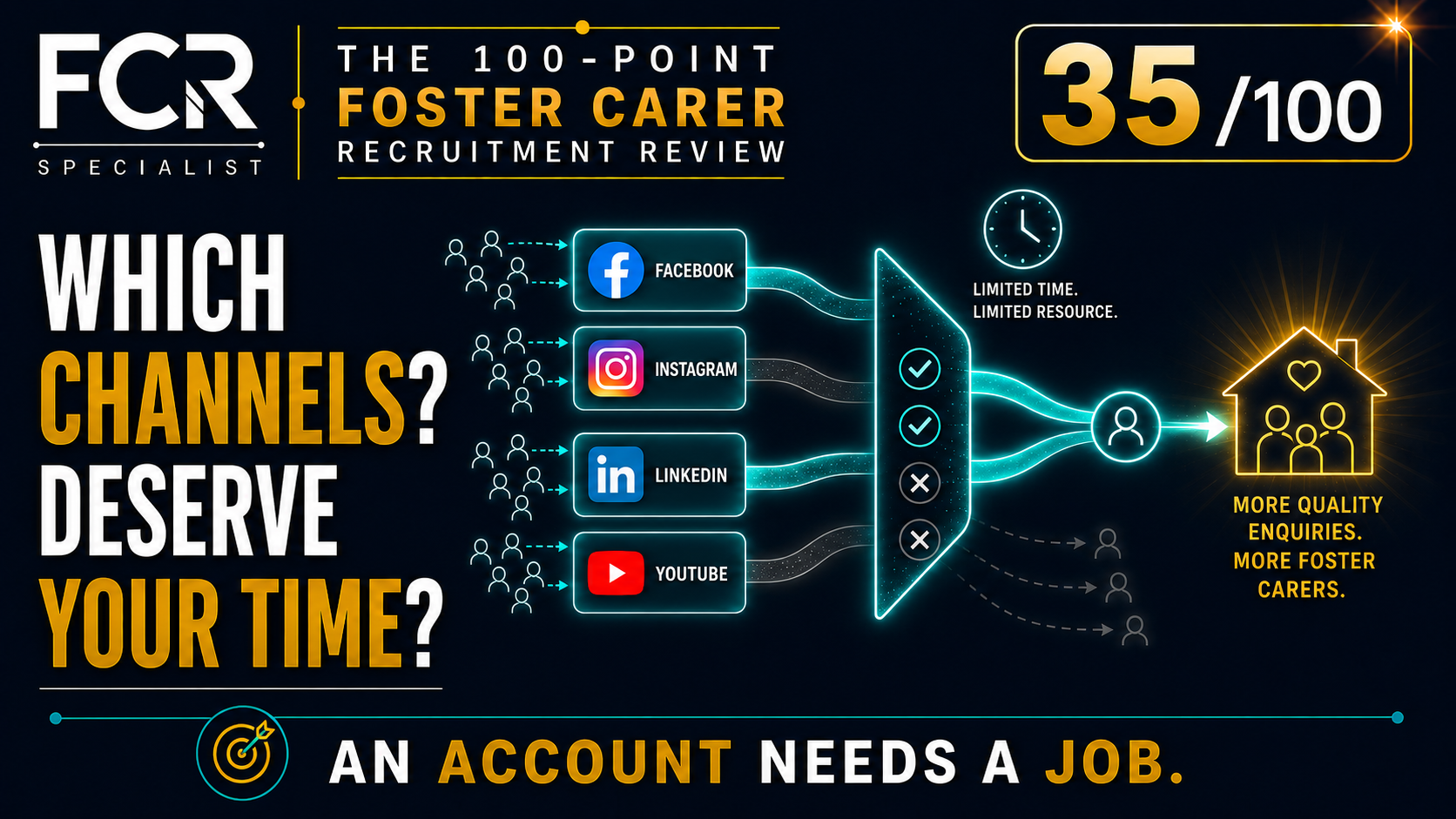
Point 35/100 — Organic Social Media: Which Platforms Actually Deserve Your Time?
Point 35/100 — Organic Social Media: Which Platforms Actually Deserve Your Time?
Facebook?
Instagram?
LinkedIn?
YouTube?
And perhaps several others.
Look at almost any fostering provider and you will find a collection of social-media accounts.
Some are active.
Some occasionally active.
Some appear to have been set up enthusiastically three years ago and largely forgotten.
Others publish regularly but generate almost no visible engagement.
And yet the activity continues.
Which leads me to a very simple question:
WHY DO WE HAVE AN ACCOUNT HERE?
Not:
“Why does our organisation have social media?”
That is too broad.
I mean platform by platform.
Why Facebook?
Why Instagram?
Why LinkedIn?
Why YouTube?
What particular job does each one perform within the Foster Carer Recruitment strategy?
If we cannot answer that, we may not have a channel strategy.
We may simply have accounts.
AN ACCOUNT IS NOT AUTOMATICALLY A RECRUITMENT CHANNEL
This distinction matters.
Creating a Facebook Page costs very little.
Creating an Instagram account costs very little.
Creating a LinkedIn Page costs very little.
But operating them properly requires:
- staff time;
- writing;
- photography;
- video;
- design;
- permissions;
- approvals;
- scheduling;
- monitoring;
- moderation;
- responding;
- analysis.
So I would challenge the phrase:
“Organic social is free.”
It isn't.
Perhaps there is no media invoice.
But there is absolutely a resource cost.
FREE TO PUBLISH DOES NOT MEAN FREE TO PRODUCE.
For a small fostering provider in particular, that time has an opportunity cost.
If a Registered Manager or recruiter spends three hours creating posts that almost nobody relevant sees, what were they not doing during those three hours?
That is a perfectly legitimate business question.
SOCIAL MEDIA IS STILL ENORMOUS
None of this is an argument for abandoning social media.
Quite the opposite.
Ofcom's latest evidence confirms just how embedded these platforms remain in UK life.
Its 2025 Online Nation data recorded monthly reach among UK online adults of approximately:
- YouTube — 94%
- Facebook/Messenger — 93%
- Instagram — 78%
- LinkedIn — 38%
These figures measure platform reach, not potential Foster Carers, and they should not be treated as recruitment-market percentages. But they demonstrate that very large parts of the UK adult population continue to use these environments.
Ofcom's April 2026 research adds another important piece.
While 89% of adult internet users use social media, the proportion actively posting, sharing or commenting has fallen to 49%.
People are increasingly passive and selective in how they participate.
That creates an important recruitment lesson.
VISIBLE ENGAGEMENT IS NOT THE SAME AS TOTAL ATTENTION.
A prospective Foster Carer might:
watch your video;
read your post;
look at your profile;
visit your website;
say nothing;
and return three months later.
But there is another side to that argument.
You also cannot say:
“Nobody engaged, but thousands probably found it really valuable.”
without evidence.
Both claims require discipline.
WHAT IS ORGANIC SOCIAL ACTUALLY GOOD FOR?
Paid advertising has one obvious attraction.
You can deliberately purchase additional distribution.
Organic social works differently.
Its strongest Foster Carer Recruitment roles may include:
Credibility
Someone sees your advert or finds your website.
Then they check your Facebook Page.
What do they discover?
A live fostering service?
Or a Page whose last post was seven months ago?
Organic content can reassure someone that the organisation is active.
Social proof
Real Foster Carers.
Real staff.
Real activities.
Training.
Support.
Celebrations.
Community.
Not as corporate claims, but as visible evidence.
If your website says:
“Our Foster Carers receive excellent support”
organic social can help show what that actually means.
Answering questions
Stage Three established:
QUESTION → ANSWER → EVIDENCE → EXPERIENCE.
Organic social is an excellent environment in which to use that.
For example:
Can I foster if I rent my home?
Then answer it.
Can I foster if I'm single?
Answer it.
Can I still work?
Answer it.
What happens during assessment?
Explain it.
Useful content gives people a reason to follow you before they are ready to enquire.
Humanising the organisation
Recruitment is a people activity.
Yet fostering organisations can sometimes communicate almost entirely through graphics.
Logo.
Stock image.
Corporate message.
Logo.
Another graphic.
Another campaign tile.
The potential Foster Carer sees almost nobody.
Organic social gives us the opportunity to show:
- Foster Carers;
- recruitment staff;
- Social Workers;
- leaders;
- support staff;
- training;
- community.
People buy into people.
Fostering is especially dependent upon trust.
Nurture
Someone may discover you through paid advertising and then follow you.
That person is no longer completely unknown.
They have created a route by which they can continue seeing your recruitment content.
That connects directly back to Point 31's always-on principle.
Paid activity can rise and fall.
Organic presence can continue the relationship.
BUT EACH PLATFORM NEEDS A JOB
Let's look at the obvious ones.
FACEBOOK — LOCAL VISIBILITY, PEOPLE AND COMMUNITY
Facebook remains enormous in the UK.
Ofcom recorded Facebook/Messenger monthly reach of 93% of UK online adults in May 2025.
That does not mean every potential Foster Carer will see your Page posts.
Nor does it mean everyone on Facebook is relevant.
But the platform's scale means dismissing it as:
“Facebook is old now”
would be extraordinarily simplistic.
For fostering, Facebook can be useful for:
- Foster Carer stories;
- events;
- local activity;
- photographs;
- videos;
- information;
- questions and answers;
- service updates;
- community credibility;
- comments and conversations.
And importantly, it fits naturally alongside the hyperlocal Facebook-group activity we will examine properly in Point 37.
But there is an important distinction.
HAVING A FACEBOOK PAGE IS NOT THE SAME AS HAVING LOCAL FACEBOOK REACH.
A Page with 700 followers does not magically provide access to every potential Foster Carer in your county.
Organic Page presence, paid Facebook advertising and participation in local Facebook communities are three different things.
They need different strategies.
INSTAGRAM — DON'T JUST COPY FACEBOOK
Instagram reached 78% of UK online adults in Ofcom's May 2025 measurement.
It is a highly visual environment.
That creates opportunities for fostering.
Real Foster Carer video.
Short questions.
Behind-the-scenes content.
Events.
Reels.
Stories.
Recruitment-team introductions.
Day-to-day fostering experiences, appropriately and safely presented.
Meta's current Blueprint training specifically encourages organisations to develop an Instagram plan around goals, audience connection, content and posting schedules rather than simply publishing randomly.
The mistake is thinking:
“Marketing has created the Facebook post. Put the same thing on Instagram.”
Sometimes repurposing works perfectly well.
But the platform experience may be different.
A portrait Reel may work.
A dense corporate landscape graphic squeezed into a mobile feed may not.
This is a useful distinction:
REPURPOSE THE IDEA.
DON'T AUTOMATICALLY DUPLICATE THE ASSET.
LINKEDIN — A DIFFERENT JOB
LinkedIn creates one of the more interesting Foster Carer Recruitment questions.
Ofcom's Online Nation 2025 measurement put LinkedIn's monthly reach at around 38% of UK online adults, considerably below Facebook, Instagram and YouTube.
Does that mean fostering providers should ignore it?
No.
Because reach alone does not determine strategic value.
LinkedIn is a professional environment.
That makes it potentially useful for a different set of recruitment activities.
For example:
- building organisational credibility;
- reaching employers;
- developing business partnerships;
- supporting community recruitment;
- engaging professionals who may themselves consider fostering;
- demonstrating thought leadership;
- employee advocacy;
- attracting professional networks;
- transfer recruitment where appropriate;
- influencing sector partners.
LinkedIn itself describes its Pages as a mechanism for organisations to build trust and community, and currently allows organic Page content to be targeted by factors including location, function, seniority and industry. It also provides Page analytics for organic reach and engagement.
That is useful.
But I would still ask:
ARE WE TRYING TO RECRUIT FOSTER CARERS HERE — OR BUILD THE NETWORK THAT CAN HELP US RECRUIT THEM?
Both can be valuable.
They are not the same objective.
PERSONAL LINKEDIN CAN BE DIFFERENT FROM THE COMPANY PAGE
This is also worth considering.
People often interact more naturally with people than logos.
A fostering leader, Registered Manager, recruiter, Foster Carer or CEO can build relationships through their professional profile in ways a corporate Page may struggle to replicate.
LinkedIn itself has recently emphasised authentic people and genuine conversations, while taking action against automated and inauthentic engagement.
That reinforces a principle relevant well beyond LinkedIn:
SOCIAL MEDIA SHOULD LOOK SOCIAL.
A stream of corporate tiles may satisfy the communications calendar.
It does not necessarily create relationships.
YOUTUBE — PERHAPS NOT JUST “ANOTHER SOCIAL ACCOUNT”
YouTube deserves a slightly different interpretation.
Ofcom recorded YouTube as the highest-reaching social/video platform among UK online adults in May 2025, at 94%.
But for Foster Carer Recruitment I would often think about YouTube less as:
another place where we need to post every Tuesday
and more as:
A LIBRARY OF USEFUL VIDEO ANSWERS.
Imagine a prospective Foster Carer researching:
Can I foster and work full-time?
You have a video.
What happens at the initial home visit?
Video.
What does fostering assessment involve?
Video.
How do my own children fit into fostering?
Video.
What support do Foster Carers receive?
Video.
YouTube's own current creator guidance recommends looking at analytics to understand which content attracts new, casual and returning viewers and focusing on repeatable, sustainable content rather than endlessly chasing trends.
That fits fostering extremely well.
Useful answers have longevity.
A CHANNEL DOESN'T HAVE TO CREATE THE FINAL ENQUIRY TO BE USEFUL
This is an important qualification.
Suppose someone:
sees a Facebook Foster Carer story;
watches another three posts;
goes to YouTube;
watches an assessment video;
searches your organisation on Google;
then visits your website directly;
and completes an enquiry.
Which channel produced the enquiry?
The website?
Google?
Facebook?
YouTube?
The answer may be:
THE JOURNEY DID.
This is why crude last-click attribution can undervalue organic content.
But again, avoid using complexity as an excuse never to measure anything.
There are still plenty of useful signals.
WHAT SHOULD WE MEASURE?
At platform level:
- reach;
- relevant followers;
- video views;
- watch time;
- profile visits;
- shares;
- saves;
- comments;
- direct messages;
- link clicks.
Then further downstream:
- website visits;
- information-event registrations;
- enquiries;
- conversations;
- source information;
- applications;
- progression.
But also look qualitatively.
Which subjects produce questions?
Which Foster Carer stories get shared?
Which videos retain attention?
Which posts cause people to message privately?
Which posts continue receiving traffic months later?
For YouTube specifically, its current guidance advises creators to compare their own historic performance rather than chasing a supposed universal benchmark.
That is excellent advice for Foster Carer Recruitment too.
FOLLOWERS CAN BECOME ANOTHER VANITY METRIC
Imagine:
Provider A
25,000 followers.
Almost all acquired nationally over many years.
Very little local interaction.
Provider B
2,000 followers.
Many are:
- Foster Carers;
- local people;
- community partners;
- applicants;
- former enquiries;
- staff;
- supporters.
Which has the better recruitment asset?
You cannot answer from follower count alone.
Ask:
WHO ARE THEY?
Follower quality matters just as audience quality mattered in Stage Two.
LOCAL AUTHORITIES HAVE A PARTICULAR PROBLEM
This is something I have seen repeatedly.
A Local Authority fostering service may not control its social-media channels.
Corporate communications controls the accounts.
That communications team is also responsible for:
- highways;
- bins;
- planning;
- adult social care;
- libraries;
- elections;
- public health;
- schools;
- council services;
- emergencies;
- corporate announcements.
Fostering is one service among many.
A Foster Carer Recruitment content plan may therefore exist.
But posts may be:
delayed;
reordered;
changed;
reduced;
or occasionally not published at all.
That doesn't necessarily mean the corporate marketing team is doing a poor job.
It may mean the organisational structure does not match the recruitment requirement.
And here is the uncomfortable truth:
A PLANNED POST THAT NEVER GOES LIVE HAS ZERO ORGANIC REACH.
So senior managers should know:
- who owns the content calendar;
- how far ahead content needs approval;
- what access fostering has;
- how quickly time-sensitive content can be published;
- whether recruitment priorities are protected;
- how performance feeds back to the fostering team.
CORPORATE LOCAL AUTHORITY ACCOUNTS ALSO HAVE AN ADVANTAGE
There is another side to this.
A major council account may have substantial local recognition and an established community following.
That can be extremely valuable.
The answer is not automatically:
create another separate fostering account.
A separate account starts at zero.
It must then be fed.
Managed.
Moderated.
Grown.
Again:
WHAT JOB WOULD THE ACCOUNT DO?
There is no universal answer.
IFAs HAVE ALMOST THE OPPOSITE PROBLEM
An IFA generally has greater control.
That can result in:
Facebook.
Instagram.
LinkedIn.
YouTube.
TikTok.
X.
Perhaps several regional accounts.
Now every channel needs feeding.
The same small marketing or recruitment team is attempting to keep six platforms alive.
The result can be thin content everywhere.
The better question may be:
WHAT COULD WE STOP DOING?
That is sometimes a much harder conversation than:
“Which new platform should we join?”
DO LESS, BETTER
Suppose you have resource to create:
three genuinely useful pieces of Foster Carer Recruitment content each week.
I would rather see those used intelligently than insist that every platform receives five posts.
For example, one Foster Carer conversation could create:
Website
Full Foster Carer story.
YouTube
Three-minute video.
Story extract and link.
45-second vertical Reel.
A professional reflection on employer flexibility and fostering.
Same underlying material.
Different reason for being there.
That is not creating five completely separate campaigns.
It is intelligent repurposing.
FREQUENCY — PLEASE DON'T INVENT A MAGIC NUMBER
You will encounter advice such as:
post Facebook five times per week
or:
LinkedIn every day
or:
Instagram twice daily.
Be careful.
LinkedIn currently says organisations posting weekly see stronger engagement than those posting less frequently, and its Page guidance encourages consistency. That is LinkedIn's own platform guidance, not evidence that a fostering provider must publish every day.
Meta's Blueprint training similarly focuses on goals, audiences, planning and posting schedules rather than prescribing one universal publishing frequency for every organisation.
Your correct frequency depends upon:
- audience;
- content quality;
- available material;
- resources;
- engagement;
- purpose;
- platform.
CONSISTENCY MATTERS.
VOLUME FOR ITS OWN SAKE DOES NOT.
CONTENT SHOULD EARN ITS PLACE
Before producing a social-media post, ask:
What does this help the prospective Foster Carer understand?
Perhaps:
- eligibility;
- support;
- money;
- working;
- assessment;
- children;
- respite;
- training;
- transferring;
- local need.
Or perhaps its purpose is different:
Does it create trust?
Does it provide social proof?
Does it humanise the service?
Does it reinforce local visibility?
Does it encourage referral?
Those are legitimate jobs.
But:
“It is Tuesday and we need a Tuesday post”
is not a recruitment objective.
STOCK IMAGES HAVE A PLACE — BUT REAL PEOPLE HAVE ANOTHER
Fostering organisations understandably need to protect children's identity and manage consent carefully.
That doesn't mean recruitment content has to become anonymous.
There are still opportunities to show:
- approved Foster Carers;
- recruitment staff;
- Social Workers;
- offices;
- training;
- events;
- community work;
- information sessions;
- Foster Carer voices.
One of the strongest organic assets any fostering provider has is the experience already inside the organisation.
Use it appropriately.
DON'T JUDGE EVERYTHING BY COMMENTS
Ofcom's 2026 evidence on increasingly passive social-media behaviour matters here.
Only around half of adult social-media users reported actively posting, sharing or commenting.
So a person may consume your content without ever writing:
“Great post!”
That does not mean comments are irrelevant.
It means engagement statistics need context.
Watch behaviour.
Shares.
Profile visits.
Website behaviour.
Direct messages.
Recruitment source.
All add information.
BUT DON'T KEEP DEAD ACCOUNTS ALIVE FOR APPEARANCES
Now reverse the argument.
A LinkedIn Page exists.
It has 87 followers.
Posts receive almost no reach.
The intended Foster Carer audience is not engaging.
Nobody can articulate another purpose.
The team spends two hours a week feeding it.
Why?
There may be a good answer.
Maybe it supports employer partnerships.
Maybe it creates sector credibility.
Maybe it is growing.
Maybe senior staff activity amplifies it.
Fine.
But if the answer is:
“We need a LinkedIn presence.”
I would ask:
WHY?
HERE IS A SIMPLE PLATFORM DIAGNOSTIC
For every organic social channel, complete this sentence:
THIS PLATFORM EXISTS TO...
Then answer six questions.
1. AUDIENCE
Who do we expect to reach here?
2. PURPOSE
What job does this platform perform?
3. CONTENT
What content genuinely belongs here?
4. CADENCE
How often can we produce that content well?
5. ACTION
What might we reasonably want someone to do next?
6. OUTCOME
How will we decide whether continuing the activity is worthwhile?
That gives us:
AUDIENCE → PURPOSE → CONTENT → CADENCE → ACTION → OUTCOME.
If a channel cannot survive that test, reconsider it.
WHAT DOES ORGANIC SOCIAL COST?
Platform media cost:
potentially nothing.
Actual organisational cost:
not nothing.
Consider:
- staff hours;
- video production;
- design;
- photography;
- copywriting;
- editing;
- scheduling;
- approval;
- moderation;
- analytics;
- training.
Then ask:
WHAT ELSE COULD THAT RESOURCE HAVE DONE?
This does not mean every activity needs direct financial attribution.
But resource should always have a purpose.
WHO SHOULD MANAGE IT?
There is no single answer.
It could be:
- recruiter;
- recruitment marketer;
- corporate communications;
- dedicated social-media specialist;
- fostering staff;
- agency;
- hybrid team.
What matters is the connection between content creation and recruitment understanding.
Someone producing fostering content needs access to:
- real applicant questions;
- Foster Carer experiences;
- recruitment priorities;
- sufficiency requirements;
- community activity;
- current recruitment data.
Otherwise content becomes detached from recruitment.
LEARN IT YOURSELF
You do not need a degree in social-media marketing to improve organic recruitment content.
There are useful free official resources.
Meta Blueprint — Creating Instagram content
Meta's current course covers setting goals, building an Instagram presence, connecting with the audience and creating a posting schedule.
Meta Blueprint — Create content that stands out on Instagram
Meta Blueprint — Strategic content for communities
This current course focuses on creating content around audience needs, community goals, trends, polls, events and insights.
Meta Blueprint — Strategic content decisions
LinkedIn Pages Best Practices
LinkedIn's current guidance covers Page setup, content, video, scheduling, organic targeting, employee advocacy and analytics.
YouTube — Learn what content to create
YouTube's official guidance focuses on audience data, sustainable content, patterns and repeatable formats rather than chasing every trend.
YouTube — Learn what content to create
Spend an hour understanding the platforms you are using.
Then ask whether your content plan still makes sense.
BEFORE YOU POST AGAIN...
Ask:
Why are we posting this?
Who is it for?
What should they learn, feel or do?
Why does it belong on this particular platform?
Could a real person tell the story better?
Are we creating something useful — or filling the calendar?
Could this content be repurposed intelligently elsewhere?
How will we know whether anybody relevant saw it?
Does this platform still deserve the resource?
Those are recruitment questions.
Not merely social-media questions.
HERE IS THE TEST
Open every social-media account belonging to your fostering service.
Do not look at it as an employee.
Look at it as somebody quietly considering fostering.
Ask:
Does this account look alive?
Do I see real people?
Do I learn anything useful?
Are my likely questions answered?
Can I understand what makes this organisation different?
Do I see evidence of Foster Carer support?
Does the content make me more confident?
Is there an obvious route to learn more?
Then ask the organisation:
WHY DO WE HAVE THIS ACCOUNT?
If the answers from the prospective Foster Carer and the organisation do not align, that platform needs attention.
POINT 35 CONCLUSION
Organic social media can be an important Foster Carer Recruitment asset.
It can create:
- trust;
- credibility;
- visibility;
- social proof;
- useful information;
- relationships;
- nurturing;
- referral;
- community.
But presence itself is not success.
A dormant account is not automatically an asset.
Nor is a busy account automatically productive.
The better principle is:
FEWER PURPOSEFUL CHANNELS CAN BE BETTER THAN MANY WEAK ONES.
And:
AN ACCOUNT NEEDS A JOB.
So for every platform ask:
WHY ARE WE HERE?
Who are we reaching?
What are we giving them?
What should happen next?
And what evidence tells us this is worth continuing?
Point 36 now takes this logic one stage further.
Because if Facebook, Instagram, LinkedIn and YouTube already require significant resource, what happens every time another platform becomes fashionable?
POINT 36/100 — SHOULD FOSTER CARER RECRUITMENT BE ON TIKTOK, X AND EVERY NEW PLATFORM?
FCR Specialist — Foster Carer Recruitment Diagnostic and Re-Tune
Identify what is working.
Find where performance is being lost.
Understand why.
Make practical changes where required.