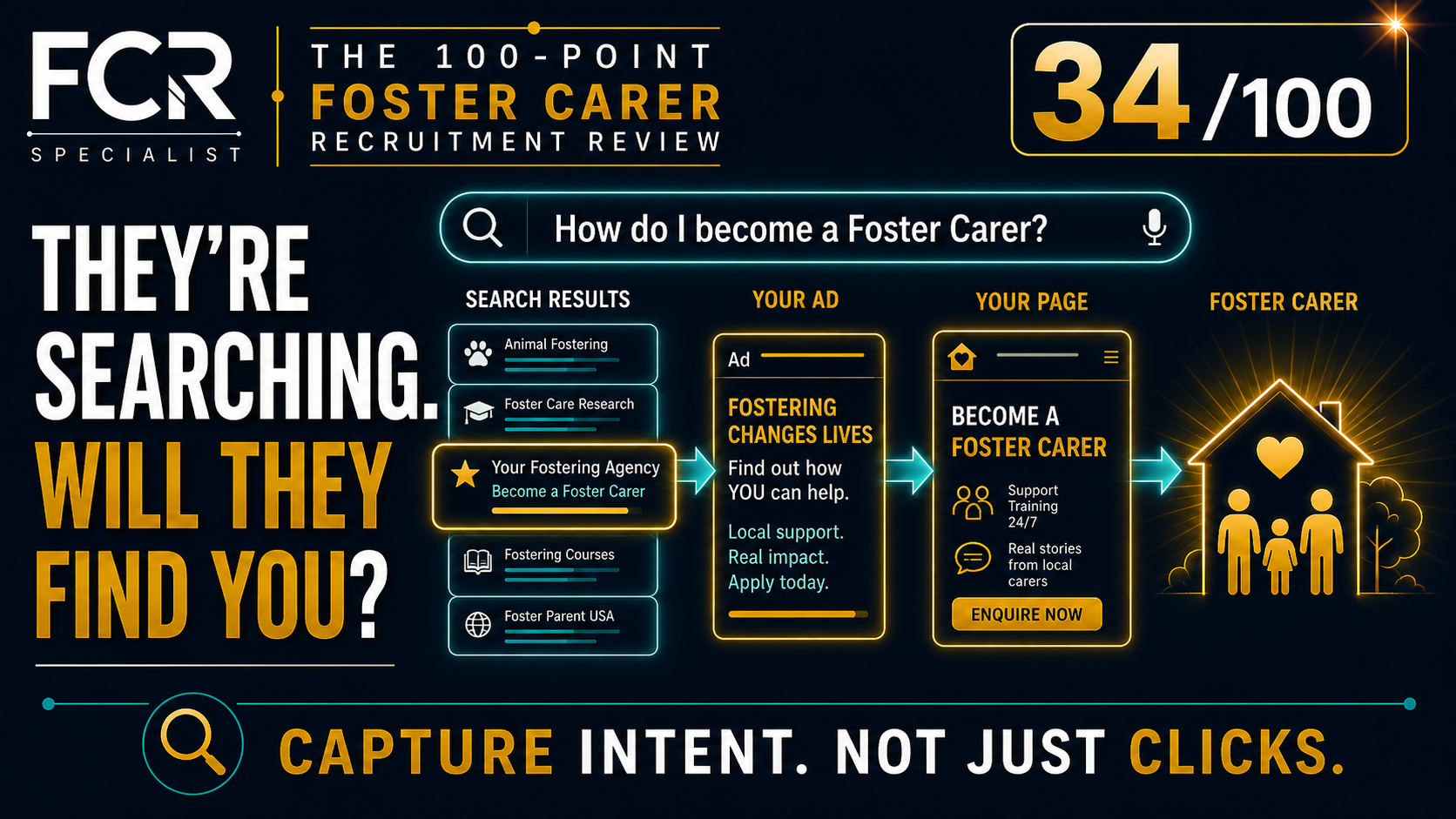
Point 34/100 — Google Search: Are You Capturing People Already Looking for Fostering?
In Point 33 we examined Facebook and Instagram advertising.
Its particular strategic strength is discovery.
Someone does not necessarily need to be thinking about fostering before your message appears.
Google Search operates differently.
Imagine somebody picks up their phone tonight and types:
how to become a Foster Carer
Or:
fostering agency near me
Or:
how much do Foster Carers get paid?
Or:
can I foster if I work full-time?
They have just done something very significant.
They have expressed intent.
They may only be researching.
They may be months from an enquiry.
They may ultimately decide fostering is not for them.
But they are no longer simply an audience that might be interested.
THEY ARE ACTIVELY LOOKING FOR INFORMATION ABOUT FOSTERING.
That makes Google Search potentially one of the most valuable channels in a Foster Carer Recruitment plan.
But it does not automatically make it effective.
META INTERRUPTS. SEARCH RESPONDS.
This is perhaps the cleanest distinction between Points 33 and 34.
Meta
The organisation says:
“Have you considered fostering?”
Google Search
The prospective Foster Carer says:
“Tell me about fostering.”
That is a significant behavioural difference.
Search demand already exists.
Your task is to capture relevant demand rather than manufacture it.
This also means Google Search cannot create unlimited volume.
If only a certain number of relevant people in your geography are searching for fostering, increasing the budget tenfold does not magically create ten times as many relevant searches.
That is an important limitation.
WHAT IS GOOGLE SEARCH GOOD AT?
1. Capturing expressed intent
This is its major strength.
Someone has actively typed a question.
They may search:
- become a Foster Carer;
- fostering near me;
- fostering agency;
- fostering allowance;
- can single people foster;
- Foster Carer requirements;
- can I foster and work;
- fostering children;
- transfer fostering agency.
Those searches reveal something about what the person wants to know.
And that presents an opportunity.
2. Answering specific questions
Search advertising should not necessarily use one generic message for everything.
Someone searching:
fostering allowance
has expressed a different immediate concern from somebody searching:
transfer fostering agency
or:
can I foster as a single person?
The closer you can align:
SEARCH → ADVERTISEMENT → LANDING PAGE
the more coherent the journey becomes.
Google itself treats this relevance seriously. Its current Quality Score diagnostic considers expected click-through rate, ad relevance and landing-page experience. Google specifically recommends aligning ad language with search intent and ensuring the landing page meets the expectations created by the advert.
That is good recruitment practice as well as good Google Ads practice.
THE MOST IMPORTANT QUESTION:
WHAT ARE PEOPLE ACTUALLY SEARCHING FOR?
There is a substantial difference between:
the keyword you bought
and:
the words somebody actually typed.
This is why the search terms report matters.
Google provides reporting showing the searches that triggered advertisements, and those data should be reviewed rather than campaigns simply being left unattended.
Imagine you bid on:
fostering
You might hope to reach people considering becoming Foster Carers.
But depending on the campaign configuration, search intent around that broad concept could be very varied.
Potential irrelevant searches might involve:
- fostering jobs;
- fostering social worker vacancies;
- foster care academic research;
- animal fostering;
- US foster-parent information;
- training courses;
- children's placement enquiries;
- people looking for services rather than becoming carers.
The exact pattern will differ by campaign.
That is why you must inspect the actual search terms.
NEGATIVE KEYWORDS — SOMETIMES WHAT YOU DON'T WANT MATTERS JUST AS MUCH
Negative keywords allow advertisers to prevent advertisements appearing for specified irrelevant searches.
Google describes them as a way to exclude search terms and focus spending on more relevant searches.
For a fostering provider, potential negatives might emerge around searches connected to:
- unrelated employment;
- animal fostering;
- academic material;
- unrelated services;
- geographies outside the service area.
But do not copy somebody else's negative-keyword list blindly.
For example, automatically excluding a word such as:
job
might also interfere with useful searches connected to employment and fostering.
The correct process is:
LOOK AT THE SEARCH TERMS.
IDENTIFY WASTE.
EXCLUDE CAREFULLY.
That is management.
BROAD, PHRASE AND EXACT MATCH — WITHOUT THE JARGON
You do not need to become a Google Ads technician to understand this.
Current Google Search advertising still has three principal keyword match types:
Broad match
Can match searches related to your keyword, including searches that do not contain the precise phrase.
Phrase match
Gives more control over the meaning of searches that can trigger the advert.
Exact match
Provides the greatest degree of steering of the three, but even “exact” no longer necessarily means the user typed precisely the same characters; Google can match equivalent meaning or intent.
Google currently recommends combining broad match with Smart Bidding where appropriate because its systems use contextual signals to decide which auctions may be valuable.
The important lesson for fostering managers isn't:
Broad match is good.
or:
Exact match is good.
It is:
KNOW WHAT YOUR CAMPAIGN IS DOING.
If your agency says it has moved heavily toward broad match and automation, ask:
Why?
What conversions is Google optimising toward?
What search terms are actually appearing?
What has happened to lead quality?
Those are entirely reasonable questions.
GOOGLE IS BECOMING MORE AUTOMATED
This is important because some managers may remember Google Ads from several years ago.
The platform has changed.
Google now increasingly describes Search as AI-powered.
Responsive Search Ads allow advertisers to supply multiple headlines and descriptions which Google combines according to the query and context. Current ads can use up to 15 headlines and four descriptions.
Keyword matching has also become increasingly based on meaning and intent rather than literal word matching.
Automation can be extremely useful.
But:
AUTOMATION STILL NEEDS A GOOD DESTINATION.
And:
AUTOMATION STILL NEEDS A MEANINGFUL CONVERSION SIGNAL.
If Google is optimising towards form completions, then the quality of that conversion definition matters enormously.
WHAT COUNTS AS A CONVERSION?
This takes us back to Point 33.
In digital advertising, a conversion could be defined as:
- enquiry form completed;
- telephone call;
- information-event registration;
- callback request;
- download;
- another meaningful action.
Google Ads currently allows organisations to define website conversion actions and telephone-call conversions so campaigns can be measured against those chosen outcomes.
But remember:
GOOGLE'S CONVERSION IS NOT NECESSARILY YOUR RECRUITMENT OUTCOME.
If somebody submits an enquiry form, Google can record:
conversion.
The Foster Carer Recruitment team might later discover:
- wrong geography;
- unsuitable circumstances;
- duplicate enquiry;
- cannot contact;
- not ready;
- decides against fostering.
Neither system is wrong.
They are measuring different stages.
This is why the reporting chain needs to continue:
SEARCH → CLICK → CONVERSION → ENQUIRY → PROGRESSION → APPLICATION → APPROVAL → CAPACITY.
GEOGRAPHY — THERE IS A VERY IMPORTANT GOOGLE SETTING HERE
For Foster Carer Recruitment this deserves special attention.
Google's default location-targeting option can include people who are:
- in or regularly in the location;
and
- people who have shown an interest in the location.
Google also provides a more restrictive Presence option that targets people likely to be physically in or regularly in the selected area.
Think about what that means.
Suppose your IFA needs Foster Carers within 25 miles of Peterborough.
Someone living in Birmingham searches:
Peterborough fostering agency
Under some location settings, they could potentially be eligible to see the advert because they have shown interest in Peterborough.
Perhaps that is useful.
Perhaps it isn't.
The important point is:
DID YOU KNOW YOUR CAMPAIGN COULD DO THAT?
For geographically constrained Foster Carer Recruitment, I would want whoever manages the campaign to explain exactly which location option has been selected and why.
Google also makes clear that its geographic identification is based on multiple signals and cannot guarantee 100% accuracy.
So monitor actual geography as well.
“FOSTERING NEAR ME” IS NOT ENOUGH OF A STRATEGY
It is tempting to build the entire campaign around obvious terms.
But prospective Foster Carers ask questions.
Those questions can reveal stages of consideration.
For example:
Early research
What is fostering?
Personal eligibility
Can I foster if I'm single?
Can I foster if I rent?
Can Foster Carers work?
Practical research
How much are Foster Carers paid?
What support do Foster Carers receive?
Provider selection
fostering agency near me
best fostering agency
Transfer
change fostering agency
transfer Foster Carer
Different searches may warrant different messages.
That is why keyword research is not simply a technical advertising exercise.
It is audience research.
GOOGLE'S KEYWORD PLANNER
Google's Keyword Planner can provide:
- keyword ideas;
- estimated monthly searches;
- cost information;
- forecasts.
Google itself cautions that actual performance varies according to factors including budget, bids, ad quality, location and user behaviour.
That makes it useful for planning.
Not prophecy.
If Keyword Planner says a term receives relatively little search activity, that may tell you something.
But don't interpret a forecast as guaranteed enquiry volume.
THE LANDING PAGE MAY BE THE MOST EXPENSIVE MISTAKE
Someone searches:
Can I foster if I work full-time?
Your advert says:
Working and fostering? Find out how it can work.
Excellent.
They click.
Then they arrive at:
WELCOME TO OUR CORPORATE WEBSITE.
News.
Vacancies.
Annual report.
Adult social care.
Children's services.
Procurement.
Somewhere underneath:
Fostering.
You have just paid to capture a person with active fostering intent and then made them start the search again.
That makes very little sense.
Google itself explicitly assesses landing-page relevance and usefulness as part of its Quality Score diagnostic.
From a recruitment perspective, the principle is even simpler:
CONTINUE THE CONVERSATION THE PERSON STARTED.
If they searched about working and fostering:
take them somewhere useful about working and fostering.
If they searched transfer fostering:
take them somewhere relevant to existing Foster Carers.
If they searched fostering allowance:
answer the financial question honestly.
SEARCH → AD → PAGE
These three should tell essentially the same story.
For example:
Search
Can I foster if I work full-time?
Advertisement
Working & Fostering? Learn What Is Possible
Landing page
Can Foster Carers Work?
Then:
- honest answer;
- circumstances;
- support;
- practical considerations;
- Foster Carer experience;
- clear next action.
That is vastly more coherent than:
Search → generic advert → homepage.
AD COPY MATTERS
Current Google Search advertisements are generally Responsive Search Ads.
Google combines different advertiser-supplied headlines and descriptions to produce relevant combinations.
But the recruitment team still needs to supply meaningful content.
Possible headline themes might include:
Become a Foster Carer
Fostering in Leeds
Can You Foster and Work?
Local Fostering Support
Thinking About Fostering?
Transfer Foster Carers Welcome
The precise wording depends on the recruitment requirement.
Don't simply use every available headline slot to repeat:
Foster. Foster. Fostering. Foster Carer.
Give the system useful messages to work with.
QUALITY SCORE — USEFUL, BUT DON'T TURN IT INTO ANOTHER VANITY KPI
Google provides a 1–10 Quality Score diagnostic based on:
- expected click-through rate;
- ad relevance;
- landing-page experience.
But Google explicitly says Quality Score is not a KPI and is not itself an input in the auction.
That is worth emphasising.
I don't want senior managers moving from:
“Our click-through rate is fantastic.”
to:
“Our Quality Score is 9.”
and believing they have solved Foster Carer Recruitment.
Use the metric diagnostically.
Then ask:
WHAT DID THE PEOPLE ACTUALLY DO?
WHAT ABOUT BRAND SEARCH?
This needs thought.
Someone searches the provider's name.
Should you advertise?
There may be arguments both ways.
If your organic result is already dominant, you might question whether paying for your own brand term adds sufficient value.
On the other hand:
- competitors may advertise around related searches;
- paid listings give greater control over messaging;
- a campaign can direct the user to a specific recruitment page;
- brand search can be highly relevant.
There isn't one universal answer.
Analyse:
- organic visibility;
- competitor activity;
- cost;
- conversion;
- incremental value.
Don't assume.
COMPETITOR SEARCHES
Providers sometimes ask whether they should target searches containing another fostering provider's name.
That needs careful strategic and legal/policy consideration.
Even where technically possible, ask:
- Why are we doing it?
- Is the user genuinely relevant?
- What does it cost?
- Can our advertising accurately represent who we are?
- Is this better than capturing category searches?
- Are we simply creating an expensive bidding battle?
This is not where I would begin a modest fostering Search campaign.
Start with relevant fostering intent.
GOOGLE SEARCH CAN BURN MONEY QUIETLY
Meta advertising is visibly advertising.
Search waste can be less obvious.
A campaign might continue generating:
- clicks;
- impressions;
- conversions.
The dashboard looks active.
Yet money could be disappearing through:
- irrelevant search terms;
- excessively broad geography;
- poor negative-keyword management;
- weak conversion definitions;
- wrong landing pages;
- unhelpful automation;
- bidding for searches unlikely to produce useful capacity.
Google Search campaigns therefore need management.
Not simply setup.
WHO SHOULD MANAGE IT?
Potentially:
- trained internal marketer;
- capable recruiter with digital training;
- Local Authority corporate marketing;
- agency;
- freelancer;
- specialist;
- hybrid arrangement.
Again, the title matters less than the competence.
Someone needs to understand:
- recruitment requirement;
- search intent;
- Google Ads;
- geography;
- landing pages;
- tracking;
- downstream recruitment outcomes.
A technically perfect Google campaign aimed at the wrong recruitment problem is still the wrong campaign.
WHAT SHOULD YOU MEASURE?
At the Google Ads level:
- impressions;
- search terms;
- clicks;
- cost;
- conversion;
- cost per conversion;
- calls;
- location;
- campaign/ad group performance.
Then connect those to Foster Carer Recruitment:
- genuine enquiries;
- appropriate geography;
- contactable;
- suitable to progress;
- initial visits/conversations;
- applications;
- assessment;
- approval;
- capacity.
That gives us:
SEARCH COST
↓
ENQUIRY COST
↓
PROGRESSION COST
↓
APPLICATION COST
↓
APPROVAL / CAPACITY COST.
The further down that chain you can responsibly measure, the more useful the management conversation becomes.
BEFORE YOU SPEND £1 ON GOOGLE SEARCH…
Ask:
1. What are prospective Foster Carers actually searching for?
Not what you think they search.
Research it.
2. Which searches matter to our recruitment requirement?
3. Which geography genuinely matters?
4. Which location-targeting option is being used?
This is particularly important.
5. What should we exclude?
Build and maintain negative keywords.
6. What is the campaign optimising towards?
7. What does the advert promise?
8. Does the landing page continue that promise?
9. Are forms and telephone calls being tracked?
10. Can we connect those conversions to actual Foster Carer progression?
If you cannot answer those questions, don't simply increase the budget.
LEARN IT YOURSELF
This is another channel where a small amount of learning can completely change the quality of the conversation with an agency.
Google's official Skillshop currently provides free Google Ads training, including a specific Google Ads Search learning path covering Search campaign fundamentals, keyword and bidding strategy and optimisation.
Useful starting points include:
Google Skillshop — Google Ads Search
Google describes this as training in creating and customising Search campaigns, keyword and bidding strategies and campaign performance.
Google Ads Help — Keyword Matching
Understand broad, phrase and exact match in their current forms.
Google Ads Help — Negative Keywords
Learn how exclusions prevent irrelevant searches consuming spend.
Google Ads Help — Location Options
Particularly important for local/regional Foster Carer Recruitment.
Google Ads Help — Conversion Measurement
Understand what Google considers a conversion and how website and telephone actions can be measured.
You do not need to become Google Ads certified.
Although you can — Google's certification remains available through Skillshop.
For most fostering leaders, the objective is simpler:
UNDERSTAND ENOUGH TO ASK INTELLIGENT QUESTIONS.
HERE IS THE TEST
Go to Google.
Imagine you are a genuine prospective Foster Carer living in one of your priority recruitment areas.
Search:
become a Foster Carer
Then try:
fostering agency near me
Then one of the questions your applicants regularly ask.
Look at the results.
Are you there?
If not:
why not?
If you are there:
what does the advert say?
Click it.
Where do you arrive?
Does that page answer the question?
Is the next action obvious?
Then go into the campaign data and ask:
WHAT SEARCHES ARE WE ACTUALLY PAYING FOR?
That may be one of the most valuable 20 minutes you spend on the campaign.
POINT 34 CONCLUSION
Facebook and Instagram can introduce fostering to someone.
Google Search does something different.
It gives you an opportunity to respond when somebody has already raised their hand — albeit digitally — and said:
I WANT TO KNOW SOMETHING ABOUT FOSTERING.
That makes Search potentially extremely valuable.
But intent alone does not guarantee success.
You still need:
- appropriate keywords;
- controlled geography;
- sensible exclusions;
- relevant advertising;
- good landing pages;
- conversion tracking;
- recruitment follow-through.
The central Point 34 principle is:
DON'T JUST BUY CLICKS.
CAPTURE INTENT — THEN CONTINUE THE CONVERSATION.
And next we move away from paid media.
Because plenty of fostering providers maintain Facebook, Instagram, LinkedIn and other social accounts without paying for advertising at all.
Which raises another question:
POINT 35/100 — ORGANIC SOCIAL MEDIA: WHICH PLATFORMS ACTUALLY DESERVE YOUR TIME?
FCR Specialist — Foster Carer Recruitment Diagnostic and Re-Tune
Identify what is working. Find where performance is being lost. Understand why. Make practical changes where required.