Point 37/100 — Are You Recruiting Where Your Local Communities Already Gather Online?
Point 37/100 — Are You Recruiting Where Your Local Communities Already Gather Online?
Imagine your sufficiency analysis tells you:
We need more Foster Carers around this particular town.
Perhaps you already have one excellent Foster Carer there.
Perhaps there are children you want to keep closer to their schools, birth families and communities.
Perhaps the nearest Foster Carer cluster is thirty miles away.
What happens next?
A conventional response might be:
- increase Facebook advertising;
- widen the campaign geography;
- create another generic fostering advert;
- hope somebody in that area sees it.
There is another approach.
FIND THE ONLINE COMMUNITIES THAT ALREADY EXIST IN THAT PLACE.
Not broadly:
“people aged 35–55 interested in family activities.”
I mean actual local communities.
The Facebook group containing thousands of residents of that town.
The village group.
The parents' network.
The neighbourhood noticeboard.
The community events Page.
The local business network.
The residents' association.
Perhaps Nextdoor.
And then ask:
CAN WE BECOME A USEFUL, WELCOME PART OF THAT CONVERSATION?
This is a very different form of digital recruitment.
And I believe it is significantly underused in fostering.
LOCAL ONLINE GROUPS ARE NOT FREE ADVERTISING SPACE
This is the first rule.
A community Facebook group exists because somebody has invested time building and moderating it.
Its members did not join because they wanted twenty organisations arriving every week to promote themselves.
They joined because they care about:
their community.
So if a recruiter joins and immediately posts:
BECOME A FOSTER CARER — APPLY TODAY
there is a reasonable chance that the reaction will be:
Who are you?
Why are you advertising here?
Or simply:
post removed.
That does not mean local groups don't work.
It may mean we treated a community like an advertising inventory.
APPROACH THE ADMIN FIRST
I would make this standard practice.
Before posting:
Identify the administrator or moderator.
Read the group description.
Read the rules.
Look at the kind of posts normally permitted.
Then contact the administrator.
Something simple:
Hi, I'm Sarah and I work locally in Foster Carer Recruitment with [provider]. We are particularly trying to raise awareness of fostering in this area. I wondered whether you would be comfortable with me occasionally posting useful fostering information or letting members know when we're attending local community events. I'm happy to work within your group rules and format things in whatever way works best for your community.
Notice what that is not:
Can I advertise here?
It is the beginning of a relationship.
Meta's own current group functionality reinforces why this matters. Group admins can decide whether Pages are permitted to join, can require participation or post approval, and can control some permitted post formats.
So your group's rules are not an inconvenience.
THEY ARE PART OF THE CHANNEL.
SOME GROUPS MAY NOT WANT YOUR VIDEO
This is easily missed.
You may have created a brilliant Foster Carer video.
That does not give you the right to post it everywhere.
Some community groups:
- restrict promotional content;
- restrict links;
- require admin approval;
- allow certain posts only on particular days;
- dislike repeated commercial posts;
- may have format preferences.
Facebook itself gives group administrators controls over participation and some posting formats.
So:
READ THE RULES EVERY TIME.
Do not assume that because one Halifax group allows your Reel, another Halifax group will.
BE A PERSON — BUT BE TRANSPARENT
This is particularly important.
I think community recruitment generally works better when the participant is:
Sarah, the local fostering recruiter
rather than:
CORPORATE FOSTERING SERVICES LTD
But there is an important distinction.
Do not pretend to be an ordinary resident if you are there professionally.
Be completely clear:
“I'm Sarah. I work in Foster Carer Recruitment for…”
Then communicate as a human being.
Answer questions.
Use your name.
Use normal language.
Talk about the area.
Respond personally.
If somebody met you at Saturday's community event, they should recognise the same person online on Monday.
That creates continuity.
HUMAN DOES NOT MEAN HIDDEN.
It means:
IDENTIFIABLE + TRANSPARENT + APPROACHABLE.
THE GROUP ADMINISTRATOR CAN BECOME AN IMPORTANT COMMUNITY RELATIONSHIP
Do not underestimate admins.
Someone running a 15,000-member local Facebook group may understand their area extraordinarily well.
They may know:
- which posts work;
- which issues irritate members;
- which community events matter;
- which other local groups exist;
- which neighbourhoods are active;
- how often promotional material is acceptable;
- which formats people respond to.
They may even say:
“Don't post the corporate graphic. Why don't you do a short Q&A instead?”
Good advice.
Or:
“We're running a community fair next month. Come along.”
Now digital recruitment has created an offline recruitment opportunity.
That is exactly what we want.
ONLINE + OFFLINE IS WHERE THIS CAN BECOME VERY POWERFUL
Suppose you are attending a community event on Saturday.
A week beforehand:
“Hi, I'm Rachel from the local fostering team. I'll be at the Brighouse Community Day on Saturday. If you've ever had a question about fostering — even if you're nowhere near ready to do it — come and say hello. No forms, no obligation, just a conversation.”
On Saturday:
Meet people.
Talk.
Listen.
Then afterwards:
“Thanks to everyone who spoke to me at Brighouse Community Day yesterday. The question I was asked most was whether you can foster while working full-time. The answer is often yes — but it depends on the fostering you want to do and your circumstances…”
Now:
ONLINE
supports:
OFFLINE
which creates:
NEW ONLINE CONTENT
which supports:
FURTHER CONVERSATIONS.
That's community recruitment.
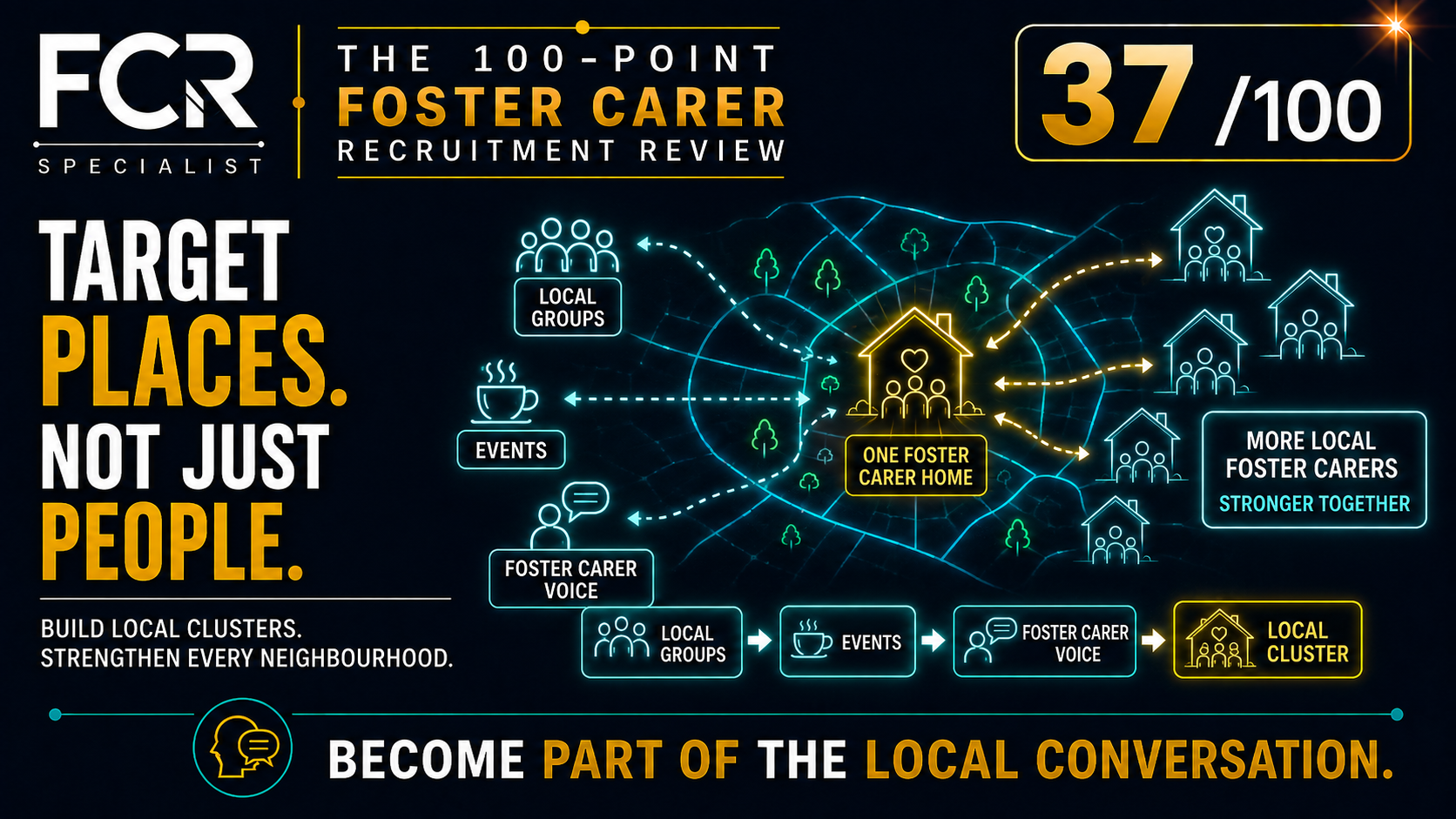
TARGET PLACES — NOT JUST PEOPLE
This is where Point 37 reconnects directly with Stage Two.
The recruitment brief should not simply be:
“Find more Foster Carers.”
It might be:
Recruit additional fostering households around these three towns because that is where we need more local capacity.
That changes the digital search completely.
Instead of asking:
Which social platform has the biggest audience?
we ask:
WHERE DO PEOPLE IN THIS PLACE ALREADY GATHER ONLINE?
A 7,000-member Facebook group in exactly the town you need may have far more strategic value than a national audience of millions.
Not because 7,000 is a large number.
Because:
THEY ARE THE RIGHT 7,000 PEOPLE GEOGRAPHICALLY.
THE POSTCODE-LEVEL OPPORTUNITY
This is particularly valuable for smaller IFAs.
Imagine an IFA already supports a Foster Carer in King's Lynn.
It would like another five or six Foster Carers around King's Lynn and nearby communities.
The organisation could map:
- King's Lynn community groups;
- surrounding village groups;
- local parenting groups;
- neighbourhood groups;
- local employer networks;
- schools/community Pages;
- local events;
- Nextdoor neighbourhoods.
Nextdoor itself currently offers UK neighbourhood-based communities, while its public-service tools include targeting down to postcode/neighbourhood level.
That does not mean every fostering provider should immediately use Nextdoor.
It means the hyperlocal digital environment extends beyond Facebook and deserves investigation.
START WITH THE FOSTER CARERS YOU ALREADY HAVE
This may be one of the most important parts of Point 37.
Take your Foster Carer map.
Suppose you have:
one very good Foster Carer in Town A.
Instead of simply thinking:
one Foster Carer in Town A
think:
COULD THIS BECOME THE START OF A CLUSTER?
What if you recruit another:
three?
five?
ten?
around that existing Foster Carer?
Now the recruitment target has a strategic purpose.
EXISTING FOSTER CARER → LOCAL CREDIBILITY → LOCAL COMMUNITY → NEW LOCAL FOSTER CARERS → STRONGER CLUSTER
And there are potentially several benefits.
More carers near one another can create opportunities for:
- peer support;
- local Foster Carer relationships;
- coffee mornings;
- training;
- informal support;
- Foster Carer events;
- shared community knowledge;
- more efficient organisation of support;
- potentially less dispersed travel for Supervising Social Workers.
The final point is operational logic rather than a promise of automatic savings: whether travel actually reduces depends on provider geography, caseload allocation and support arrangements.
But it is reasonable to ask:
If my Supervising Social Worker already travels to this area, can we build enough Foster Carer capacity there to create a viable local cluster?
THIS ISN'T A MADE-UP MODEL
There is already strong sector evidence for the value of Foster Carer communities and clusters.
The Fostering Network's Mockingbird model deliberately creates constellations of six to ten fostering families, built around peer support, relationships and a hub home.
Become's 2025 good-practice research similarly found Local Authorities describing these fostering networks and communities positively, and it specifically recorded concern that increased regionalisation could weaken individual local recruitment or the advantages available when Foster Carers and Social Workers are co-located.
I am not saying every local Foster Carer recruitment cluster should become a Mockingbird constellation.
I am saying the principle is important:
FOSTER CARERS DO NOT HAVE TO BE RANDOMLY SCATTERED ACROSS THE MAP.
Recruiting local clusters can support both recruitment and the wider fostering offer.
AND THERE IS AN EXISTING PRACTICAL EXAMPLE OF THIS THINKING
A 2025 recruitment strategy considered by Bridgend explicitly proposed:
- mapping where existing LA and IFA Foster Carers live;
- identifying three priority communities;
- combining local advertising, schools, events and community activity;
- using online community groups;
- developing local partnerships;
- involving liaison carers as ambassadors in their local areas.
That is very close to the approach I am advocating.
Not one channel.
A layered local recruitment plan.
LET THE LOCAL FOSTER CARER HELP
If the existing Foster Carer is willing, this can become much stronger.
Compare:
Recruiter post
“We are recruiting Foster Carers in Dewsbury.”
with:
Local Foster Carer post
“I've fostered here in Dewsbury for six years. When I first enquired I had lots of questions, particularly about support and how fostering would affect my own family. If anyone locally has ever thought about fostering, we're holding an informal coffee morning next Saturday and I'm happy to talk about what it has really been like for us.”
That is a completely different message.
The Foster Carer provides:
LOCAL SOCIAL PROOF.
They do not merely say:
fostering is good.
They demonstrate:
someone here actually does it.
BUT DO NOT TURN YOUR FOSTER CARER INTO THE RECRUITMENT DEPARTMENT
This needs boundaries.
The Foster Carer should:
- volunteer to participate;
- understand how their content may be used;
- choose what they are comfortable discussing;
- have support if comments become difficult.
They should not be expected to:
- discuss individual cases;
- answer safeguarding matters;
- resolve complaints;
- defend the organisation;
- disclose personal information;
- manage abusive commenters.
The recruiter/provider retains responsibility.
The Foster Carer's role is:
CREDIBLE LOCAL VOICE.
Not:
UNPAID COMMUNITY MANAGER.
WHAT HAPPENS WHEN THE COMMENTS TURN NEGATIVE?
This is one of the main reasons recruiters avoid these groups.
You post:
“Thinking about fostering?”
and somebody replies:
“Social services are useless.”
Or:
“Foster Carers only do it for money.”
Or:
“My experience with your organisation was terrible.”
Now what?
The answer cannot be:
never post again.
Nor should it be:
argue with them until they change their mind.
The correct principle is:
DON'T FEAR NEGATIVE COMMENTS.
PREPARE FOR THEM.
Meta's own Blueprint community-management training specifically includes managing conflict and applying community standards as core community-management skills.
If you are going into community spaces, conflict management is part of the job.
A SIMPLE COMMENT-MANAGEMENT PROTOCOL
1. GENUINE QUESTION
Example:
“Do Foster Carers actually get paid?”
Answer it.
Clearly.
Without defensiveness.
2. MISCONCEPTION
Example:
“You can't foster if you work.”
Correct it calmly.
“Actually, many Foster Carers do work, although the circumstances and type of fostering matter…”
Useful.
3. GENUINE NEGATIVE EXPERIENCE
Example:
“I fostered years ago and felt completely unsupported.”
Do not reply:
“That's not true.”
You don't know their experience.
A better response is:
“I'm sorry to hear you had that experience. Support is obviously incredibly important in fostering. I can't discuss an individual situation in a public group, but if you'd like to contact me privately I can make sure you have the appropriate route to raise it.”
You have not admitted something you cannot verify.
You have not dismissed them.
You have behaved professionally.
4. CURRENT COMPLAINT OR CASE
Move it away from the thread.
Do not investigate personal fostering matters in a Facebook comments section.
Use the appropriate complaints/service route.
5. CONFIDENTIAL OR IDENTIFYING INFORMATION
Do not continue the discussion publicly.
Protect:
- children;
- families;
- Foster Carers;
- staff;
- case information.
Escalate appropriately.
6. ABUSE, THREATS OR DISCRIMINATORY CONTENT
Follow:
- group rules;
- organisational policy;
- platform reporting processes;
- safeguarding/security procedures where necessary.
You are not required to tolerate abuse in order to demonstrate openness.
7. TROLLING
Not every provocation requires a response.
Sometimes the correct response is:
none.
NEGATIVE COMMENTS CAN ALSO SHOW PEOPLE HOW YOU BEHAVE
This is worth remembering.
Prospective Foster Carers may be watching.
If somebody challenges you and you respond:
- calmly;
- respectfully;
- accurately;
- without defensiveness;
that itself communicates something about the organisation.
People don't only judge the original post.
They judge:
HOW YOU RESPOND WHEN THINGS ARE DIFFICULT.
In fostering, that may matter a great deal.
COMMENTS ARE ALSO FREE LOCAL MARKET RESEARCH
Imagine that every time you post in local groups people ask:
Can I foster if I'm single?
That's data.
Or:
What happens if I work shifts?
Data.
Do I need to own my home?
Data.
How much does fostering pay?
Data.
What happens if an allegation is made?
Data.
Can my own children still live at home?
Data.
Those questions can become:
- next week's social content;
- your next video;
- website FAQs;
- event topics;
- recruiter training;
- advertising creative.
This makes local groups more than distribution.
They become:
LOCAL RECRUITMENT INTELLIGENCE.
DO NOT COPY AND PASTE INTO TWENTY GROUPS
This is another major mistake.
Monday morning.
9:00am.
Recruiter joins twenty community groups.
9:05:
same post.
9:06:
same post.
9:07:
same post.
That isn't community recruitment.
It is spam conducted manually.
A better post should answer:
WHY HERE?
For example:
“We're particularly looking to speak to people around Pontefract because we want more children who need fostering to have the opportunity to remain closer to their existing schools and communities.”
Now the location matters.
Or:
“We already support Foster Carers locally and would like to grow a stronger local network around them.”
Now the reader understands:
why their community.
LOCALISE THE CONTENT
Instead of:
Generic
Could you foster?
try:
Local
Could you foster in Halifax?
Or more useful:
“We already have Foster Carers supporting children here in Halifax and we'd like to build a stronger local community around them.”
Then:
- local event;
- local Foster Carer;
- local recruiter;
- local contact;
- locally relevant reason.
This makes the recruitment message belong there.
BUILD A COMMUNITY MAP
I would encourage every fostering recruitment team to create one.
Start with the priority geography.
For each town/postcode identify:
Existing Foster Carers
Local Facebook groups
Parent/community groups
Local businesses
Schools
Faith/community organisations
Sports clubs
Local employers
Nextdoor/local platforms
Local events
Existing partners
Group admins/community leaders
Now you aren't looking at:
social media.
You are looking at:
THE LOCAL RECRUITMENT ECOSYSTEM.
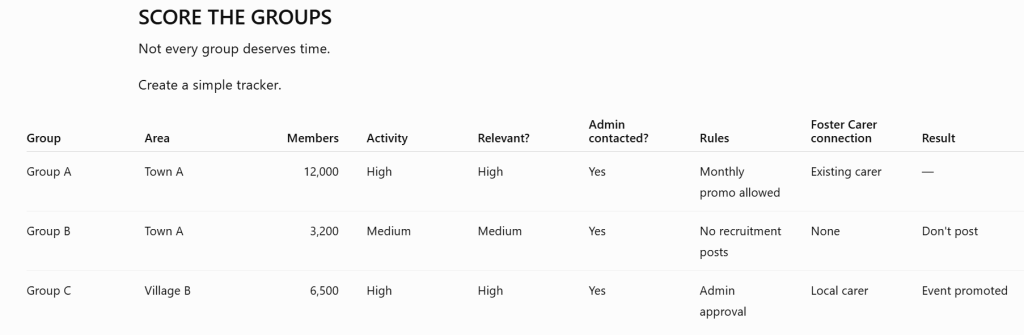
THE ADMIN RELATIONSHIP SHOULD BE RECORDED
If recruitment staff change, don't lose the community relationship.
Record:
- administrator name;
- contact method;
- group rules;
- permissions;
- successful posts;
- previous conversations;
- preferred frequency;
- events;
- concerns.
Otherwise the new recruiter arrives six months later and starts the relationship from zero.
Community knowledge is organisational knowledge.
WHAT SHOULD YOU POST?
A sensible mixture might include:
QUESTIONS
Can Foster Carers work?
LOCAL FOSTER CARER STORIES
Real local experience.
EVENTS
I'll be at the community centre Saturday.
MYTH CLARIFICATION
You don't necessarily need to own your home.
LOCAL NEED
Explain why more carers are needed locally without exploiting individual children's stories.
HUMAN INTRODUCTION
I'm Tom, one of the fostering recruiters covering this area.
FOLLOW-UP
The question we were asked most at yesterday's event was…
The objective is:
USEFUL PRESENCE.
Not endless:
ENQUIRE NOW.
COMMUNITY RECRUITMENT IS A LONGER GAME
This matters.
You might post today and receive no enquiry.
Then another post.
Then attend an event.
Then a local Foster Carer posts.
Then answer a question.
Six months later someone says:
“I've seen your posts in the group for ages. I've been thinking about fostering…”
Which post recruited them?
Probably none individually.
THE RELATIONSHIP DID.
This is another reason Point 31's always-on principle matters.
HOW SHOULD WE MEASURE IT?
Community recruitment will never be as neat as a Google Ads dashboard.
But that doesn't mean:
don't measure it.
Track:
- groups identified;
- admins contacted;
- permission obtained;
- posts published;
- questions received;
- direct messages;
- event attendance;
- conversations;
- enquiries;
- postcode;
- Foster Carer introductions;
- source information;
- progression.
And most importantly:
DID THE PRIORITY AREA GAIN FOSTER CARER CAPACITY?
Suppose the objective was to build a local cluster from one Foster Carer to six.
That is the strategic KPI.
Not:
post likes.
WHAT SHOULD THIS ACTIVITY COST?
The platform cost may be:
£0.
The resource cost is not.
You need:
- research;
- relationship building;
- posts;
- moderation;
- events;
- replies;
- tracking.
This is exactly why many fostering providers avoid it.
It requires human work.
But that may also be why competitors aren't doing it.
THE BARRIER TO ENTRY IS EFFORT.
That can create opportunity.
LOCAL AUTHORITIES MAY HAVE AN ADVANTAGE HERE
Local Authorities already possess community infrastructure.
Potentially:
- libraries;
- leisure centres;
- children's centres;
- community teams;
- councillors;
- ward networks;
- neighbourhood teams;
- local newsletters;
- schools;
- public-health relationships.
The recruitment opportunity is to connect those assets rather than leaving fostering isolated inside Children's Services.
Nextdoor, for example, currently says hundreds of UK public services use its platform to engage residents and offers public-service targeting by service area, ward, district, neighbourhood and postcode.
Again, this isn't an instruction that every council must use Nextdoor.
It demonstrates what is possible when recruitment thinks geographically.
IFAs CAN HAVE A DIFFERENT ADVANTAGE
An IFA may have less automatic local infrastructure.
But it can often move faster.
A small provider might choose:
three towns.
Then become genuinely visible there.
Instead of:
“We recruit across the Midlands.”
you might decide:
This year we are going to build a genuine Foster Carer community around these three locations.
That can concentrate:
- digital activity;
- events;
- existing Foster Carers;
- referrals;
- partnerships;
- recruiter time.
Much more focused.
THE CLUSTER RECRUITMENT TEST
Take your Foster Carer map.
Circle areas where you already have:
- at least one established Foster Carer;
- reasonable operational support;
- clear local need;
- useful community infrastructure.
Then ask:
COULD WE RECRUIT ANOTHER 5–10 FOSTER CARERS AROUND THIS EXISTING BASE?
If yes:
map every relevant local online community.
Then involve the Foster Carer if they want to help.
Then build:
ONLINE PRESENCE
LOCAL FOSTER CARER VOICE
FACE-TO-FACE EVENTS
REFERRALS
COMMUNITY PARTNERS
around the same geography.
Now you have something far more sophisticated than a Facebook post.
You have:
A LOCAL RECRUITMENT STRATEGY.
BEFORE YOU POST IN A LOCAL GROUP...
Ask:
Why this area?
Why this group?
Have we read the rules?
Have we spoken to the admin?
Who will post?
Does the group permit this format?
Is the content genuinely local?
Could a local Foster Carer strengthen it?
Who is monitoring comments?
What will we do with a difficult comment?
Is there an offline activity we can connect it to?
What will we record afterwards?
If those questions are answered, you're ready.
HERE IS THE TEST
Pick one postcode or town where you genuinely need Foster Carer capacity.
Not the whole county.
One place.
Now spend 30 minutes looking for:
- Facebook community groups;
- parent groups;
- neighbourhood groups;
- local events;
- local business groups;
- Nextdoor communities;
- community organisations.
Then look at your existing Foster Carers.
Is there already someone nearby?
Could they help?
Could you organise a coffee morning?
Could the online group support the event?
Could the event generate the next online post?
Could one Foster Carer become three?
Could three become six?
And then ask:
WHY ARE WE SPENDING MONEY REACHING PEOPLE 50 MILES AWAY BEFORE WE HAVE PROPERLY SPOKEN TO THE COMMUNITY WHERE WE ACTUALLY NEED FOSTER CARERS?
That is the Point 37 challenge.
POINT 37 CONCLUSION
Hyperlocal online community recruitment is not:
cheap Facebook advertising.
It is:
COMMUNITY RECRUITMENT DELIVERED PARTLY ONLINE.
It requires:
- geography;
- relationships;
- permission;
- local relevance;
- transparency;
- Foster Carer involvement;
- moderation;
- persistence;
- offline activity;
- measurement.
And it gives us two particularly powerful principles:
DON'T JUST TARGET PEOPLE. TARGET PLACES.
and:
DON'T PARACHUTE ADVERTISING INTO COMMUNITIES. BECOME PART OF THE LOCAL CONVERSATION.
Perhaps most importantly, it can allow providers to move from scattered recruitment toward something much more deliberate:
EXISTING FOSTER CARER
↓
LOCAL CREDIBILITY
↓
LOCAL COMMUNITY
↓
MORE LOCAL FOSTER CARERS
↓
STRONGER CLUSTER
↓
STRONGER SUPPORT AND SUFFICIENCY.
And that leads naturally into Point 38.
Because the strongest local recruiter in that community may not be your paid recruiter at all.
It may already be the Foster Carer sitting in the middle of the cluster.
POINT 38/100 — REFERRALS & WORD OF MOUTH: ARE YOUR FOSTER CARERS YOUR BEST RECRUITERS?
FCR Specialist — Foster Carer Recruitment Diagnostic and Re-Tune
Identify what is working. Find where performance is being lost. Understand why. Make practical changes where required.