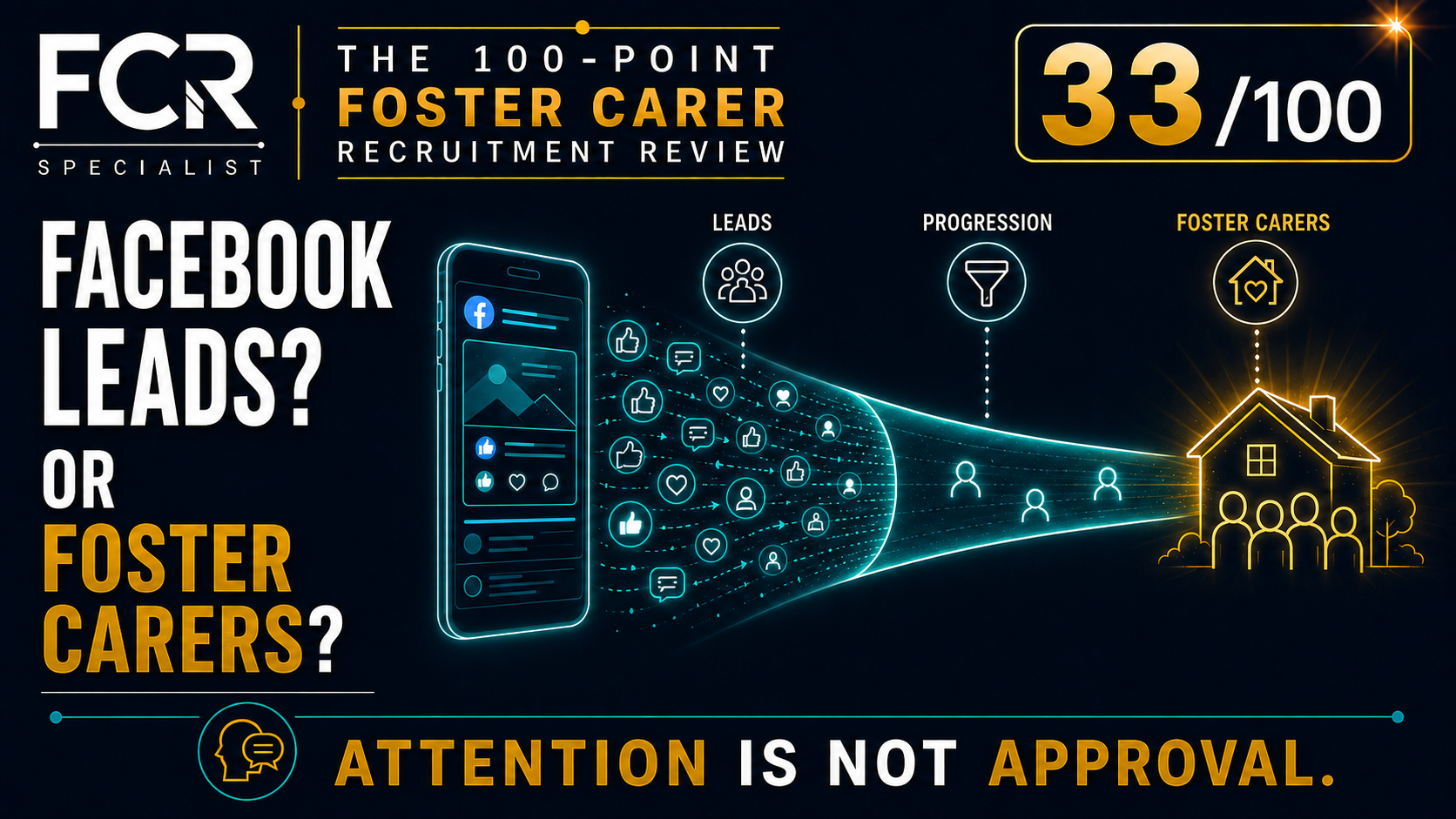
Point 33/100 — Facebook & Instagram Advertising: What Are They Actually Good For?
Point 33/100 — Facebook & Instagram Advertising: What Are They Actually Good For?
Imagine somebody presents this at your next senior management meeting:
“Our Facebook campaign generated 400 leads and reduced our cost per lead by 35%.”
Sounds good.
Perhaps it is.
But I would immediately ask:
What happened to the 400 people?
How many were contactable?
How many lived where you actually needed Foster Carers?
How many understood what fostering involved?
How many progressed?
How many applied?
How many entered assessment?
How many became approved Foster Carers?
And ultimately:
WHAT FOSTER CARER CAPACITY DID THE CAMPAIGN CREATE?
That does not mean Facebook or Instagram advertising doesn't work.
Quite the opposite.
I think Meta can be an extremely useful part of a Foster Carer Recruitment strategy.
But only if we understand what job we are asking it to do.
DON'T ASK WHETHER FACEBOOK ADS WORK
Ask:
WHAT ARE WE ASKING FACEBOOK AND INSTAGRAM TO DO?
This sounds like semantics.
It isn't.
Different recruitment channels perform different jobs.
Google Search, which we will examine in Point 34, is largely built around somebody expressing intent through a search.
Someone types:
fostering agency near me
or:
how do I become a Foster Carer?
They have already indicated an interest.
Meta is different.
Someone may be:
- reading local news;
- looking at family photographs;
- scrolling Facebook;
- watching Instagram Reels;
- checking a community page;
- viewing a friend's post.
Then your fostering message appears.
They weren't necessarily looking for you.
You found them.
That makes Meta particularly powerful for:
DISCOVERY.
Or, in traditional marketing terminology:
INTERRUPTION.
That is neither good nor bad.
It simply tells us what job the channel may be especially well suited to.
META HAS ENORMOUS REACH — BUT REACH IS NOT SUITABILITY
Ofcom's 2025 Online Nation report found that Facebook and Messenger together reached 93% of UK online adults in May 2025, while Instagram reached 78%.
That tells us something important.
Potential Foster Carers are likely to be present somewhere within these very large audiences.
But we must immediately qualify it.
A PLATFORM AUDIENCE IS NOT A FOSTER CARER AUDIENCE.
Millions of people may see Facebook.
That does not mean millions of people:
- have the circumstances to foster;
- live where you need capacity;
- have a spare bedroom;
- are interested;
- are ready;
- are suitable.
The job of recruitment strategy is to narrow the distance between:
available attention
and:
useful Foster Carer capacity.
WHAT IS META ACTUALLY GOOD AT?
For Foster Carer Recruitment, I think Meta has several genuine strengths.
1. Introducing fostering to people who were not actively looking
This is perhaps the biggest.
Someone can begin considering fostering because a message appears at the right moment.
Not because they searched for it.
That matters enormously in a market where many future Foster Carers may not yet think of themselves as Foster Carers.
2. Human stories
Facebook and Instagram suit:
- Foster Carer videos;
- real-life questions;
- testimonials;
- short-form video;
- myth clarification;
- household stories;
- day-to-day experience;
- information events;
- local stories.
This connects directly back to Stage Three.
Instead of:
BECOME A FOSTER CARER TODAY
we might use:
“The first question I asked was whether I could still work full-time.”
Then let a real Foster Carer answer it.
That is recruitment messaging.
Not just branding.
QUESTION → ANSWER → EVIDENCE → EXPERIENCE
Meta can be particularly good at delivering that structure in short visual content.
3. Local awareness
Foster Carer Recruitment is often highly geographical.
An organisation may need Foster Carers:
- within a particular Local Authority;
- within sensible travelling distance of an office;
- around existing Foster Carer clusters;
- close to children's schools and communities;
- within specified regional boundaries.
Location therefore matters.
Current Meta systems increasingly use automated audience tools, with Advantage+ playing a larger role in audience selection. This makes understanding which settings are genuine controls and which are signals or suggestions increasingly important.
For fostering, geography is not a cosmetic campaign setting.
It is operational.
A lead 80 miles away might be cheap.
It may also be largely useless to the particular recruitment requirement.
CHEAP LEAD + WRONG GEOGRAPHY = POOR RECRUITMENT VALUE
That needs to be understood before anyone celebrates the cost-per-lead figure.
4. Testing messages
Meta also gives recruitment teams an environment in which they can test.
For example:
Message A
Could you foster?
versus:
Message B
Can I foster if I work full-time?
versus:
Message C
Our Foster Carers don't all look the same. Neither do their families.
Different messages can be tested against the same recruitment requirement.
This connects directly back to Point 29:
HYPOTHESIS → CONTROLLED CHANGE → MEASUREMENT → LEARNING → DECISION
The important word is controlled.
Changing the audience, imagery, headline, budget and landing page simultaneously may generate a different result.
But you may have little idea which change caused it.
WHAT IS META NOT GOOD AT?
This deserves equal attention.
Meta cannot determine whether somebody will ultimately become a good Foster Carer simply because that person interacts with an advert.
It cannot replace:
- recruitment judgement;
- meaningful conversations;
- assessment;
- safeguarding;
- Form F;
- panel;
- Agency Decision Maker decisions;
- household readiness;
- the prospective Foster Carer's own decision-making.
And it cannot compensate indefinitely for a poor recruitment system.
If your proposition is weak, Meta can expose more people to the weak proposition.
If your landing page is poor, Meta can send more people to the poor landing page.
If enquiries wait three days for a response, Meta can provide you with more people to keep waiting.
Advertising amplifies.
It doesn't automatically repair.
THE CHEAP-LEAD PROBLEM
This is probably the most important section in Point 33.
Digital campaign reporting frequently includes:
- impressions;
- reach;
- clicks;
- click-through rate;
- cost per click;
- leads;
- cost per lead.
All can be perfectly legitimate measures.
But imagine this objective:
Generate the maximum number of lead-form completions for the available budget.
If the form is extremely easy to complete, Meta may find people willing to complete it.
Good.
That is what you asked the system to do.
The problem arises when the organisation silently changes the definition of success from:
lead form completed
to:
potential Foster Carer recruited.
Those are not equivalent.
The government's 2026 Renewing Fostering programme highlights the scale of the wider sector issue: only around 6% of enquiries progressed to application in the year ending March 2025. The government explicitly describes the low conversion rate as concerning.
That 6% is not a Meta conversion figure.
It covers fostering enquiries overall.
But it demonstrates exactly why enquiry volume must not be confused with recruitment outcome.
META CAN OPTIMISE FOR WHAT YOU GIVE IT
This is becoming increasingly important.
Current Meta Blueprint training explicitly teaches organisations how to generate and encourage high-quality leads, including forms, messaging and calls. Meta also now provides training around Advantage+ lead campaigns.
There is an even more interesting development.
Meta's current guidance increasingly encourages advertisers to connect downstream data back into its advertising systems. Its Blueprint materials cover Meta Pixel, Conversions API and deeper tracking of the customer journey; a February 2026 Meta for Business resource specifically discusses feeding CRM outcomes back to improve lead quality.
Put simply:
If the platform only knows:
FORM COMPLETED
that is the signal it has.
If a sophisticated organisation can lawfully feed back better outcome information, it may give the platform more useful signals about what happened later.
For a fostering provider, however, this requires caution.
Do not interpret this as:
upload your Foster Carer applicant database to Meta.
Data protection, necessity, transparency, lawful basis and proportionality all matter.
The ICO's 2026 guidance specifically covers tracking pixels and similar technologies under PECR and UK GDPR, and its direct-marketing guidance warns organisations to understand the data-protection implications of social-media audience tools.
This is an area where your Data Protection Officer or appropriate specialist should be involved.
LEAD FORM OR WEBSITE?
This is another very practical decision.
Meta currently provides lead-generation approaches within its own environment as well as routes that can take people to an external destination. Its current Blueprint lead-generation course explicitly covers form-based lead generation and lead quality.
There are two broad approaches fostering providers should understand.
OPTION ONE — META INSTANT FORM
Someone sees the advert.
Clicks.
Completes a form inside Meta.
Potential strengths
- low friction;
- mobile friendly;
- quick;
- fewer steps;
- useful for an initial expression of interest.
Potential weaknesses
Because the process is easy, the commitment required may also be low.
That can create:
- accidental enquiries;
- curiosity;
- people who do not remember completing the form;
- incomplete understanding;
- difficulty contacting them later.
That does not make instant forms bad.
It means you need to measure what happens next.
OPTION TWO — DEDICATED WEBSITE JOURNEY
Someone sees the advert.
Clicks.
Arrives on a fostering recruitment page.
Reads.
Watches.
Learns.
Then enquires.
Potential strengths
The person has greater opportunity to understand:
- fostering;
- your service;
- expectations;
- financial information;
- support;
- process;
- next steps.
Potential weaknesses
Every additional action introduces friction.
Slow page?
They leave.
Confusing page?
They leave.
Corporate homepage?
They may have no idea where to go next.
DO NOT ASK WHICH ROUTE IS “BEST”
Ask:
WHICH ROUTE PRODUCES BETTER FOSTER CARER RECRUITMENT OUTCOMES FOR US?
Test it.
And don't judge only on cost per lead.
Follow the people.
META AD → CORPORATE HOMEPAGE
This is one of the simplest diagnostic tests I would run.
Click your own advert.
Where do you land?
If the answer is a generic corporate homepage containing:
- adults' services;
- bins;
- parking;
- council tax;
- schools;
- planning;
with fostering buried somewhere underneath:
what exactly did you expect the prospective Foster Carer to do?
The advertising is only the first part of the journey.
YOUR CAMPAIGN OBJECTIVE MATTERS
One thing every manager commissioning Meta advertising should understand is that the campaign is configured around an objective.
In current Meta advertising, the objective and optimisation settings influence what kind of result the system attempts to produce. Current Blueprint material includes training on account setup, delivery, lead generation, placements and measurement.
You do not need to memorise Ads Manager.
You do need to understand the principle.
If the objective is:
AWARENESS
you are primarily asking for visibility.
Don't complain later that it didn't generate 100 applications.
If your approach is primarily:
TRAFFIC
you are asking the system to get people to another destination.
A website visit is not automatically an enquiry.
If the campaign is designed around:
LEADS
then you need to decide what sort of lead route you want and what constitutes useful quality.
The senior-management question is therefore:
WHAT DID WE ACTUALLY TELL META TO OPTIMISE FOR?
That one question can expose an enormous amount.
FACEBOOK, INSTAGRAM AND REELS ARE NOT IDENTICAL EXPERIENCES
Another mistake is assuming:
“We have made a Facebook advert, therefore we have made an Instagram advert.”
The advertising infrastructure may be shared.
The user experience isn't.
Current Meta guidance recommends Advantage+ placements across available environments, but also allows placement-specific creative customisation. Its Reels guidance specifically encourages creative suited to Facebook and Instagram Reels and supports A/B testing of Reels creative.
That means a horizontal corporate graphic may technically appear inside a vertical video environment.
But:
BEING DELIVERED IS NOT THE SAME AS BELONGING.
If someone is consuming short vertical video, perhaps give them:
short vertical video.
A Foster Carer speaking directly to camera.
A recruiter answering one question.
A short myth clarification.
A 20-second household story.
Make creative for the environment in which it will appear.
CREATIVE MAY NOW MATTER MORE, NOT LESS
Advertising platforms increasingly automate parts of:
- audience selection;
- placement;
- bidding;
- optimisation.
That can tempt organisations to believe they need to think less.
I would argue the opposite.
If Meta handles more of the delivery decision, the organisation still has to provide:
- the right recruitment requirement;
- the right geography;
- the right proposition;
- useful creative;
- meaningful outcome signals;
- good follow-up.
Meta's automation cannot invent your recruitment strategy for you.
Remember the Stage Three principle:
MARKETING SHOULD AMPLIFY THE RECRUITMENT STRATEGY.
IT SHOULD NOT HAVE TO INVENT ONE.
WHAT SHOULD THE CREATIVE LOOK LIKE?
There is no single answer.
But I would test whether you are creating recruitment creative or simply corporate creative.
Corporate version
Photograph of smiling family.
Logo.
Could you foster?
Telephone number.
Recruitment version
Real Foster Carer speaking to camera.
“I thought being single would stop me fostering. It didn't.”
Then useful information.
Or:
“Can you foster if you work full-time?”
Then answer it.
Or:
“What does fostering actually pay?”
Then explain it honestly.
Which one addresses the prospective Foster Carer's thought process?
That is the creative question.
GEOGRAPHY — DO NOT WASTE MONEY RECRUITING WHERE YOU DON'T NEED CAPACITY
Stage Two established:
“We need more Foster Carers” is not yet a recruitment brief.
Meta does not change that.
Before setting the geography, establish:
- which areas need carers;
- which areas you can operationally support;
- where children need placements;
- where existing carers are clustered;
- reasonable Social Worker travel;
- proximity to schools and family time where relevant;
- whether a wider geography genuinely helps.
Then configure advertising accordingly.
As Meta's automated targeting develops, providers need to understand the difference between hard geographic boundaries and broader audience suggestions rather than assuming the old detailed-interest-targeting model still operates in exactly the same way. Current Meta systems are increasingly Advantage+-led.
WHAT ABOUT RETARGETING?
Conceptually, there may be value in communicating differently with someone who has already engaged with fostering information.
They may be at a different point in the recruitment journey.
However, retargeting and tracking involve privacy, technical and regulatory considerations.
The ICO's final April 2026 guidance explicitly covers tracking pixels and online advertising and states that online-advertising uses of storage/access technologies require appropriate consent under PECR, alongside UK GDPR obligations where personal data are involved.
So this is not:
“Put a Pixel everywhere and chase everybody.”
It is:
understand the recruitment value, then implement lawful and proportionate tracking properly.
WHAT SHOULD META ADVERTISING COST?
There is no sensible answer such as:
“A fostering lead should cost £17.50.”
Be extremely suspicious of anyone offering you a universal number.
Costs vary according to:
- geography;
- competition;
- audience;
- objective;
- creative;
- campaign history;
- placement;
- available advertising inventory;
- time;
- optimisation;
- website/lead route.
Meta advertising is auction-based rather than a fixed-price catalogue, so conditions can change.
Therefore there are several different costs to consider.
Platform spend
What actually goes to Meta?
Creative cost
Who is making:
- videos;
- imagery;
- copy;
- landing pages?
Management cost
Agency?
Freelancer?
Internal team?
Internal staff cost
Who:
- briefs campaigns;
- approves creative;
- monitors performance;
- contacts enquiries;
- reviews progression?
And ultimately:
Recruitment outcome cost
What did the expenditure actually contribute to?
COST PER LEAD IS INTERESTING
But:
COST PER USEFUL RECRUITMENT OUTCOME IS MORE IMPORTANT.
Imagine two campaigns.
Campaign A
100 leads.
Cheap.
Five progress.
Campaign B
40 leads.
More expensive.
Fifteen progress.
Which was better?
You cannot answer by looking at cost per lead alone.
WHO SHOULD MANAGE META?
Potentially:
- a trained internal recruiter;
- internal marketing;
- corporate communications;
- an external agency;
- a freelancer;
- a specialist;
- a hybrid arrangement.
I don't think there is one correct model.
I do think somebody inside the fostering organisation must retain ownership of the recruitment outcome.
If you outsource Meta advertising, do not outsource your responsibility to understand:
- what is being run;
- why;
- where;
- for whom;
- at what cost;
- what is being tested;
- what happens to the people generated.
BEFORE YOU SPEND £1 ON META…
Ask these ten questions.
1. Who are we actually trying to recruit?
Not:
everyone who could theoretically foster.
2. Where do we need them?
Be specific.
3. What job do we want Meta to do?
Awareness?
Discovery?
Lead generation?
Event attendance?
Re-engagement?
4. Why is Meta the right channel?
Don't use it simply because everybody else does.
5. What question or motivation does the creative address?
What will interrupt the scroll?
6. Where does the person go next?
Instant form?
Landing page?
Information event?
Conversation?
7. What happens immediately after the enquiry?
Who owns it?
8. How will we measure quality?
Not simply lead volume.
9. What happens downstream?
Application?
Assessment?
Approval?
Capacity?
10. What would cause us to change?
Define this before the campaign starts.
LEARN IT YOURSELF
This is one of the things I particularly wanted Stage Four to do.
If you are a:
- fostering CEO;
- Registered Manager;
- Head of Fostering;
- owner of a small IFA;
- Foster Carer Recruitment Manager;
- Social Worker running recruitment;
you do not need to become a professional Meta media buyer.
But you should understand enough to know what you are buying.
Current official resources include:
Meta Blueprint — Generate leads across Meta technologies
This is currently a 25-minute intermediate course covering forms, messaging, calls and high-quality lead generation.
Meta Blueprint — Advantage+ leads campaigns
This covers Meta's increasingly automated lead-campaign model.
Meta Blueprint — Placements and creative
This covers Advantage+ placements and creative strategy.
Meta Blueprint — Pixel and Conversions API
This is a useful introduction if you want to understand how website outcome data can connect to campaign measurement.
Spend a couple of hours understanding the terminology.
Then sit down with your agency or marketing department.
You may find the conversation changes completely.
HERE IS THE TEST
Ask whoever runs your Facebook and Instagram advertising:
What is the campaign objective?
Why did we choose it?
Which geography are we targeting?
Why?
Where are the adverts actually appearing?
What creative performs best?
What are we testing?
Are we using instant forms or a website route?
Why?
What does a lead cost?
Then ask:
WHAT HAPPENED TO THE LEADS?
If the answer becomes vague at that point, you have found the issue.
Because the purpose of Foster Carer Recruitment marketing is not:
to produce cheaper Meta leads.
It is to contribute to:
MORE OF THE RIGHT FOSTER CARER CAPACITY.
POINT 33 CONCLUSION
Facebook and Instagram can be extremely useful Foster Carer Recruitment channels.
They offer:
- scale;
- discovery;
- visual storytelling;
- video;
- local reach;
- lead generation;
- testing;
- repeated visibility.
But they are tools.
And tools need jobs.
The central question is therefore not:
DO FACEBOOK ADS WORK?
It is:
WHAT ARE WE ASKING THEM TO DO?
Then:
what happened afterwards?
Meta is particularly useful for reaching people who may not have started searching for fostering yet.
And that leads us directly to Point 34.
Because what happens when somebody is already searching?
POINT 34/100 — GOOGLE SEARCH: ARE YOU CAPTURING PEOPLE ALREADY LOOKING FOR FOSTERING?
FCR Specialist — Foster Carer Recruitment Diagnostic and Re-Tune
Identify what is working. Find where performance is being lost. Understand why. Make practical changes where required.