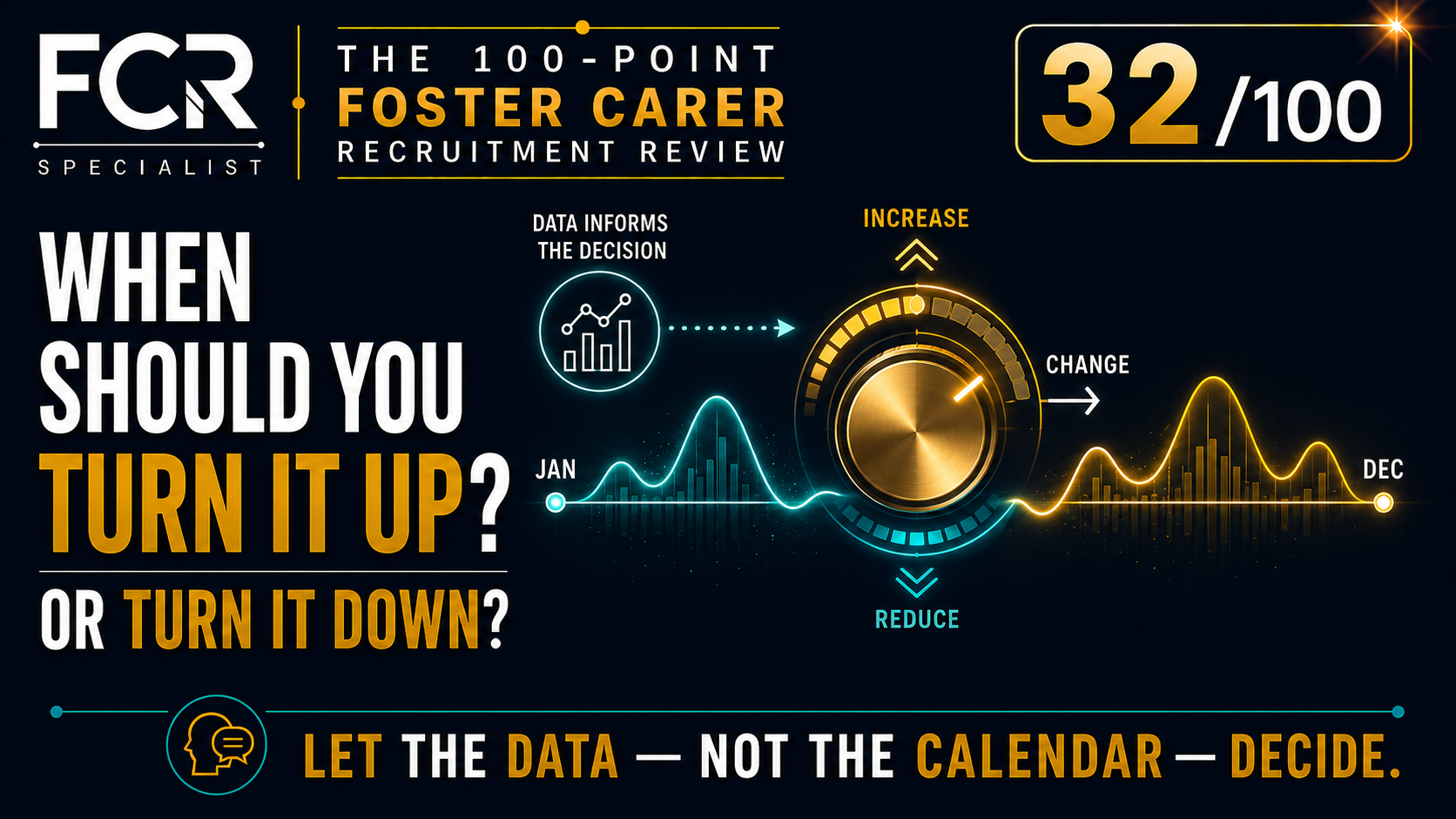
Point 32/100 — When Should You Increase, Reduce or Change Foster Carer Recruitment Activity?
Point 32/100 — When Should You Increase, Reduce or Change Foster Carer Recruitment Activity?
In Point 31 I made the case for always-on Foster Carer Recruitment.
But I also made an important distinction:
ALWAYS ON DOES NOT MEAN ALWAYS SPENDING AT THE SAME LEVEL.
If that is true, the next question becomes unavoidable.
When should we actually increase activity?
When should we reduce it?
When should we change the message?
When should we move budget from one channel to another?
And when should we simply leave a campaign alone long enough to learn something?
This is where Foster Carer Recruitment can become surprisingly vulnerable to received wisdom.
You may hear:
“January is always good for fostering enquiries.”
Or:
“August is dead.”
Or:
“Nobody thinks about fostering at Christmas.”
Or:
“We always spend heavily during Foster Care Fortnight.”
My response to each would be the same:
WHAT DOES YOUR OWN DATA TELL YOU?
Because a seasonal assumption is not yet a recruitment strategy.
Be careful with the word “seasonality”
There probably are periods in which people's behaviour changes.
Christmas changes routines.
School holidays change family life.
Summer changes community activity.
September changes household routines for families with school-age children.
January is associated culturally with reassessment and new beginnings.
National fostering campaigns create periods of additional awareness.
But none of that automatically tells us:
this is when your organisation should spend more money.
There is an important evidence limitation here.
National fostering statistics tell us a great deal about the overall recruitment challenge. For example, Ofsted recorded 8,290 mainstream fostering applications during 2024–25 and 4,430 households joining the sector, while 4,690 households deregistered.
Earlier DfE/Ofsted analysis also showed 125,195 initial mainstream fostering enquiries during 2022–23, with 6% resulting in an application.
But these national publications do not give every individual provider a reliable month-by-month rule saying:
January good. August bad. May excellent. December poor.
So we need to stop pretending they do.
START WITH YOUR OWN FIVE-YEAR — OR BEST AVAILABLE — PICTURE
If I were reviewing a provider, one of the first things I would want is its historic recruitment data.
Ideally several years.
If several years are not available, use what you have.
Plot by month:
- enquiries;
- qualified or suitable enquiries;
- initial visits or equivalent progression;
- applications;
- assessments;
- approvals;
- withdrawals;
- source;
- geography;
- campaign expenditure;
- cost per meaningful outcome.
Then overlay:
- paid campaign dates;
- major changes in budget;
- Foster Care Fortnight;
- information events;
- referral campaigns;
- community activity;
- PR activity;
- significant local events;
- staffing changes;
- website changes;
- major creative changes.
Only then start looking for patterns.
Because otherwise you can make some spectacularly bad deductions.
JANUARY WAS OUR BEST MONTH
Perhaps.
But why?
Imagine these figures: MonthEnquiriesAdvertising spendDecember30£2,000January70£8,000
Someone looking only at enquiries might say:
“January is clearly our strongest month.”
It isn't clear at all.
January produced more enquiries.
But you also spent four times as much.
Now suppose March produced: MonthEnquiriesAdvertising spendMarch50£2,500
Suddenly the picture looks rather different.
And we still haven't established which enquiries progressed.
Perhaps the 70 January enquiries created two applications.
Perhaps the 50 March enquiries created eight.
Perhaps neither produced the type of Foster Carer capacity you needed.
This is why Point 30 mattered.
ACTIVITY → PROGRESSION → APPROVAL → CAPACITY → SUFFICIENCY
Do not abandon that framework just because we have moved into channel planning.
THE CALENDAR DIDN'T NECESSARILY CAUSE THE RESULT
This is a particularly important analytical issue.
If enquiries increase every May, what caused that?
Was it May?
Or was it because every May you:
- increase advertising expenditure;
- publish more Foster Carer stories;
- organise more events;
- receive more local media coverage;
- run information evenings;
- activate existing Foster Carers;
- benefit from national fostering awareness activity?
Those are very different explanations.
Correlation is not causation.
If the organisation concludes:
“May is our strongest recruitment month”
when the real explanation is:
“May is the only month when we properly resource recruitment”
you have learned the wrong lesson.
FOSTER CARE FORTNIGHT — AN OPPORTUNITY, NOT THE RECRUITMENT STRATEGY
Foster Care Fortnight is a genuine national awareness opportunity.
The Fostering Network describes it as the UK's biggest foster-care awareness campaign. In 2026 it ran from 11–24 May, under the theme “This is Fostering”, with resources encouraging fostering services to share stories, work with local media, organise activities and raise awareness locally.
That creates something valuable:
SHARED ATTENTION.
The public may encounter fostering from:
- national organisations;
- Local Authorities;
- IFAs;
- Foster Carers;
- charities;
- media;
- politicians;
- local events;
- social networks.
A provider can sensibly prepare for that.
Content can be ready.
Foster Carer stories can be planned.
PR can be prepared.
Community activity can be coordinated.
Paid activity might be increased if there is a sound case.
But there is a trap.
Foster Care Fortnight cannot become the annual Foster Carer Recruitment strategy.
The children needing fostering placements on 25 May have not disappeared because Foster Care Fortnight finished on 24 May.
Nor have the prospective Foster Carers who first noticed fostering during the fortnight necessarily reached a decision by its conclusion.
A national awareness period should therefore create a peak inside an annual system, not replace the annual system.
WHAT ABOUT JANUARY?
January is probably the most obvious example of assumptions becoming strategy.
It is intuitively attractive.
New Year.
New beginnings.
New career.
New purpose.
New direction.
That can provide useful creative territory.
It may also coincide with people reflecting on their lives.
But that does not establish that January will produce the best Foster Carer Recruitment result for:
- your organisation;
- your geography;
- your audience;
- your proposition;
- your channel mix.
So test it.
If January repeatedly performs well, investigate why.
What happened to:
- cost per enquiry?
- quality?
- applications?
- assessment starts?
- withdrawals?
- approvals?
- time to progression?
- the type of capacity recruited?
Then compare that with other months.
If your own evidence demonstrates a repeatable January opportunity, increase intelligently.
If it doesn't, stop treating folklore as data.
WHAT ABOUT SUMMER?
Again, avoid simple conclusions.
Summer may present challenges.
Families may be away.
Staff may take annual leave.
Routine changes.
Assessment capacity may temporarily reduce.
Response times can deteriorate.
But summer can also offer opportunities.
There may be:
- community festivals;
- county shows;
- sporting events;
- family activities;
- outdoor events;
- local fairs;
- Pride events;
- cultural festivals;
- neighbourhood activities.
The real question is not:
“Is summer good?”
It is:
WHAT CAN WE USE SUMMER FOR?
Perhaps digital spend decreases while community activity increases.
Perhaps your data shows the opposite.
Perhaps certain audiences are easier to reach.
Perhaps your team cannot properly respond during two weeks in August.
That matters.
AND CHRISTMAS?
Christmas requires particularly careful thinking.
There can be a temptation to use highly emotional messages about children needing families.
That raises both recruitment and ethical questions.
A strong fostering recruitment message should not depend on manipulating emotion or oversimplifying children's experiences.
There are also operational issues.
If you run heavy activity immediately before Christmas:
- who is answering?
- who is following up?
- what happens during office closures?
- when can the prospective Foster Carer next speak to somebody?
That does not mean:
switch recruitment off in December.
Point 31 tells us why that would be a mistake.
It may mean:
- change messaging;
- reduce paid intensity;
- maintain organic presence;
- use Foster Carer stories;
- answer common research questions;
- prepare nurture activity;
- make response arrangements completely clear.
Again:
presence remains. Intensity changes.
SCHOOL HOLIDAYS ARE NOT A MARKETING STRATEGY EITHER
School holidays may affect different audiences differently.
A parent with children at home may have less time to investigate fostering.
Another person may have more.
Teachers and school staff may be in a different routine.
Grandparents may be providing childcare.
Families may be travelling.
Community events may increase.
So don't write:
“School holidays are quiet.”
Test:
- website traffic;
- search activity;
- enquiry volume;
- enquiry quality;
- response rates;
- event attendance;
- downstream progression.
The same principle applies throughout the year.
WHEN SHOULD YOU INCREASE ACTIVITY?
There are several sensible signals.
1. When your own historical evidence shows an opportunity
Not simply more enquiries.
A period when meaningful recruitment outcomes improve.
2. When there is increased relevant public attention
Foster Care Fortnight is the obvious national example.
A local news story or regional initiative may create another.
3. When you have a specific sufficiency requirement
If you need Foster Carers in a defined geography or for a particular cohort of children, activity should follow that requirement.
4. When a campaign is demonstrably working
If you are generating suitable prospective Foster Carers at an acceptable cost and they are progressing, lack of budget may constrain a genuine opportunity.
In digital advertising, budget itself can affect how often advertising is served. Google, for example, explicitly advises advertisers to use performance information and planning tools when deciding whether to increase or reduce campaign budgets, rather than treating a budget as static.
5. When operational capacity is ready
This is crucial.
More enquiries are not automatically helpful if:
- nobody can answer them;
- home visits are delayed;
- assessment capacity is full;
- Foster Carer Recruitment staff are overloaded.
Do not manufacture demand that your operation cannot properly manage.
WHEN SHOULD YOU REDUCE ACTIVITY?
Reducing activity is not failure.
It can be intelligent management.
Consider reducing expenditure where:
- downstream quality is deteriorating;
- geography is wrong;
- cost has risen materially without corresponding value;
- the audience is becoming saturated;
- operational capacity cannot absorb additional demand;
- another channel is demonstrably stronger;
- the campaign has achieved its specific purpose;
- messaging requires replacement;
- your sufficiency requirement has changed.
But distinguish:
REDUCE THE CHANNEL
from:
STOP RECRUITING.
They are not the same decision.
WHEN SHOULD YOU CHANGE RATHER THAN REDUCE?
This may be the more important question.
Poor performance does not automatically mean:
stop advertising.
It may mean change:
The audience
Are you reaching the right people?
The geography
Are enquiries coming from places where you actually need capacity?
The message
Does it answer what prospective Foster Carers want to know?
The creative
Has it become invisible through repetition?
The proposition
Are you giving people a reason to choose you?
The destination
Are you sending interested people somewhere useful?
The channel
Are you asking the wrong platform to do the wrong job?
The budget
Is it too small and fragmented to produce useful learning?
The timing
Are you intensifying activity at the wrong moment?
The operational response
Is marketing producing interest that recruitment is then losing?
Do not diagnose every poor result as a media problem.
CAMPAIGN FATIGUE IS DIFFERENT FROM SEASONALITY
This is another distinction worth making.
A campaign may perform well in March and badly in April.
That does not necessarily mean April is a poor recruitment month.
The audience may simply have seen the advert too often.
The creative may be tired.
Competitors may have increased activity.
The landing page may have changed.
The algorithm may be finding a different audience.
The recruiter responding to enquiries may have changed.
Never explain a performance change with the calendar until you have considered the other variables.
COMPETITOR ACTIVITY MATTERS
Fostering providers do not recruit in isolation.
In some areas, prospective Foster Carers may encounter:
- their Local Authority;
- a regional recruitment hub;
- several national IFAs;
- regional IFAs;
- specialist providers;
- multiple paid advertisers.
At certain periods — Foster Care Fortnight being an obvious example — many organisations may increase activity simultaneously.
This creates an interesting possibility.
Public awareness may rise.
But advertising competition may rise too.
Therefore the correct question is not:
“Everyone else is advertising, should we?”
It is:
“What opportunity is present, what does it cost us to reach it, and what outcome are we achieving?”
EXTERNAL EVENTS CAN CHANGE THE PLAN
Annual recruitment plans should be structured.
They should not be rigid.
Something may happen locally or nationally that causes fostering to receive significant attention.
A television programme.
A government announcement.
A major local news story.
A Foster Carer's story receiving substantial attention.
A community initiative.
That may justify increasing relevant activity.
But there should be judgement.
Not every tragic story involving a child should become a recruitment opportunity.
Ethics still matter.
CREATE A BASELINE — AND A FLEX BUDGET
One practical method is to stop treating the annual marketing budget as twelve identical monthly instalments.
Instead think about different functions.
Baseline activity
Money and resource required to maintain continuous recruitment presence.
Planned campaign activity
Known periods where there is a reasonable case for increased activity.
Test budget
Money specifically reserved for learning.
Responsive budget
Some capacity to act when unexpected opportunities or needs arise.
I am deliberately not prescribing percentages.
A £20,000 annual recruitment budget and a £500,000 budget require very different architectures.
An IFA recruiting nationally and a small provider recruiting within 20 miles require different architectures.
The principle matters more than an invented formula.
DO NOT SPEND THE BUDGET BECAUSE THE FINANCIAL YEAR IS ENDING
This deserves mentioning.
A budget is not evidence.
If there is £12,000 left in March, that does not automatically mean £12,000 of advertising should be purchased in March.
Ask:
What could that £12,000 realistically produce?
Could it be used more effectively for:
- creative;
- landing-page improvement;
- referral activity;
- recruiter training;
- community development;
- better tracking;
- content;
- a future campaign?
Budget utilisation is not a Foster Carer Recruitment KPI.
A SIMPLE DECISION MODEL
Before increasing activity, ask four questions:
1. NEED
Do we need more of this particular Foster Carer capacity?
2. EVIDENCE
Do we have evidence that this activity can contribute to it?
3. CAPACITY
Can the recruitment and assessment operation absorb the additional response?
4. LEARNING
Will we be able to measure what happens?
If the answer to all four is yes:
INCREASE INTELLIGENTLY.
If one is uncertain:
TEST.
If the evidence is deteriorating:
CHANGE.
If the activity no longer serves the recruitment requirement:
REDUCE OR STOP THAT ACTIVITY.
But maintain the overall recruitment system.
HERE IS THE TEST
Take your annual recruitment calendar.
Remove the month names.
Remove:
January.
February.
March.
And so on.
Now look only at the evidence.
For every period where activity increases, can you explain:
Why are we increasing it?
Which audience are we trying to reach?
What evidence supports the decision?
What sufficiency requirement does it serve?
What happened here last year?
How much did we spend last year?
What progressed?
What will we change this time?
Can we manage the enquiries if it works?
What result would make us increase further?
What result would make us change?
What result would make us reduce?
If the explanation is:
“Because we always run a campaign then.”
you may have a calendar.
You do not yet have an evidence-led recruitment plan.
POINT 32 CONCLUSION
There is nothing wrong with seasonality.
There is nothing wrong with campaign peaks.
There is nothing wrong with increasing budget during a major awareness period.
The problem begins when assumptions replace analysis.
Your annual Foster Carer Recruitment plan should therefore contain:
A CONTINUOUS BASELINE
plus
PLANNED INTENSITY
plus
RESPONSIVE CAPACITY
plus
EVIDENCE-LED CHANGE.
The question is not:
“Which months are good for fostering?”
It is:
WHICH ACTIVITY WORKS, FOR WHICH AUDIENCE, AT WHICH TIME, IN OUR AREA — AND WHAT HAPPENS AFTERWARDS?
And once we start asking that question, we are ready to examine the channels themselves.
That begins in Point 33/100:
FACEBOOK & INSTAGRAM ADVERTISING: WHAT ARE THEY ACTUALLY GOOD FOR?
FCR Specialist — Foster Carer Recruitment Diagnostic and Re-Tune
Identify what is working. Find where performance is being lost. Understand why. Make practical changes where required.