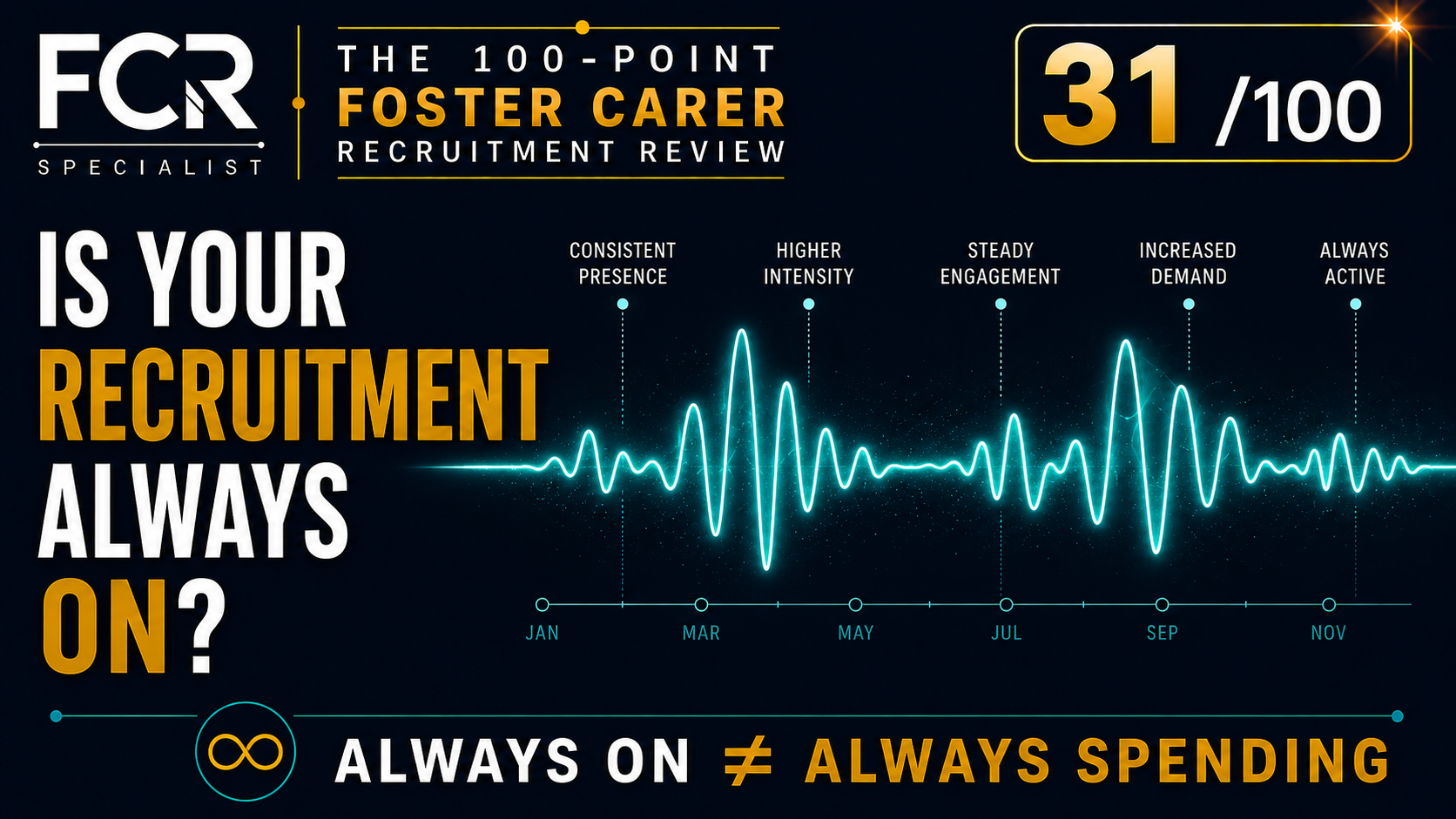
Point 31/100 — Is Your Foster Carer Recruitment Marketing Always On?
There is a pattern I have seen repeatedly in recruitment.
Enquiries start falling.
Concern grows.
Someone asks what marketing is doing.
A new campaign is commissioned.
Money is put behind Facebook, Instagram, Google or another channel.
The numbers improve.
Everyone relaxes.
The campaign ends.
Visibility reduces.
Then, several months later:
enquiries start falling again.
And the cycle starts again.
In ordinary consumer marketing, there may be perfectly legitimate reasons to run short-term campaigns.
But Foster Carer Recruitment is not an ordinary purchase decision.
We are asking somebody to consider changing their home, family life, employment, finances and daily routine in order to care for a child who cannot live with their birth family.
That requires a very different way of thinking about recruitment.
My starting proposition for Point 31 is therefore simple:
FOSTER CARER RECRUITMENT SHOULD GENERALLY BE ALWAYS ON.
But immediately I need to qualify that.
ALWAYS ON DOES NOT MEAN ALWAYS SPENDING AT THE SAME LEVEL.
That distinction matters.
The recruitment requirement does not disappear when the advert stops
The latest Ofsted statistics underline the scale of the continuing challenge.
At March 2025 there were 56,345 approved mainstream Foster Carers in England — 12% fewer than in 2021. During 2024–25, 3,050 newly approved mainstream households were new to fostering, while 4,690 mainstream households deregistered during the year.
The government is consequently extending fostering recruitment and retention hubs towards a more integrated, end-to-end model covering recruitment, assessment, approval and ongoing support.
This isn't a short-term recruitment problem that disappears because a provider has had a good quarter.
It is an ongoing sufficiency challenge.
So why would the recruitment capability repeatedly be switched off?
Fostering doesn't begin with an enquiry
One of the biggest mistakes in recruitment planning is to begin the journey at the point somebody completes an enquiry form.
That is where we see them.
It isn't necessarily where their decision started.
A person may first start thinking about fostering because:
- they know a Foster Carer;
- their children have grown older;
- they have changed jobs;
- they have moved house;
- they have gained a spare bedroom;
- they have encountered fostering professionally;
- they have seen a story about a child in care;
- someone in their community fosters;
- they reach a point in life when they want to do something different.
They might then visit a website.
Say nothing.
Watch a video.
Say nothing.
Talk to their partner.
Wait.
Read another Foster Carer's story.
Wait.
Follow a fostering organisation on Facebook.
Think about their finances.
Talk to their children.
Put the idea away for six months.
Then come back.
Current sector commentary describes fostering decision-making in very similar terms: often a long process of awareness, reflection, conversations and gradual commitment rather than a response to a single advert.
Department for Education behavioural research has also examined the attitudes, motivations and difficulties affecting Foster Carer recruitment, reinforcing the need to understand recruitment as a decision-making journey rather than simply an advertising transaction.
That is why visibility matters before the enquiry.
THE PROBLEM WITH STOP-START RECRUITMENT
Imagine this.
In March your enquiry numbers fall.
You commission a six-week advertising campaign.
New adverts are designed.
Campaigns are built.
Content starts appearing.
People begin seeing you.
Some visit your website.
Some begin researching fostering.
Some are nowhere near ready to enquire.
Six weeks later the campaign finishes.
Your visibility disappears.
But those people haven't necessarily stopped considering fostering.
You stopped talking to them.
That is the strategic weakness.
You have treated the end of your media campaign as though it were the end of the prospective Foster Carer's decision-making journey.
They are not the same thing.
Always-on recruitment is bigger than advertising
This is where terminology becomes important.
I am not arguing that every fostering provider should maintain an expensive paid advertising campaign 365 days a year.
I am arguing for an always-on recruitment system.
That system might contain several different activities operating at different intensities.
Website and recruitment information — always on
Your recruitment pages should remain useful, current and accessible throughout the year.
Someone researching fostering at 10pm on a Sunday doesn't care that your latest paid campaign finished last Thursday.
Organic social — always on
This does not require endless daily posting.
But your channels should demonstrate that your fostering service is alive.
Real people.
Current Foster Carers.
Useful answers.
Events.
Stories.
Local relevance.
Support.
Foster Carer referrals — always on
Why should your existing Foster Carers only be encouraged to talk about fostering during a recruitment campaign?
Word of mouth does not operate according to a media schedule.
Community recruitment — always on
Relationships with schools, employers, businesses, faith groups, voluntary organisations, local groups and communities take time.
They are particularly badly suited to the pattern:
arrive → advertise → disappear.
“Not Now” nurture — always on
Some people who make contact with you will be perfectly sensible prospective Foster Carers but the timing will be wrong.
New job.
House move.
Bereavement.
Pregnancy.
Relationship change.
Children doing exams.
Financial uncertainty.
No spare room yet.
They are not necessarily:
NO.
They may be:
NOT NOW.
Subject to consent and appropriate data handling, a good recruitment operation should have a method of maintaining a useful, respectful relationship with those people rather than simply deleting them from tomorrow's recruitment thinking.
We will look much more closely at this later in the Review.
Paid advertising — variable
This is different.
Facebook, Instagram, Google and other paid channels can be increased, reduced, tested, changed or paused.
That is sensible campaign management.
The mistake is confusing:
reducing advertising spend
with:
switching off recruitment.
A SIMPLE ANNUAL RECRUITMENT ARCHITECTURE
Instead of asking:
“When are we running our Foster Carer Recruitment campaign?”
I would start with:
“What will our Foster Carer Recruitment system look like across the whole year?”
For example: Recruitment activityBaselineCan intensity change?Recruitment websiteContinuousContent refreshedOrganic social presenceContinuousYesFoster Carer storiesContinuous programmeYesReferral activityContinuousYes“Not Now” nurtureContinuousYesCommunity relationshipsContinuousYesInformation eventsPlanned throughout yearYesPaid Meta advertisingVariableAbsolutelyGoogle Search advertisingVariableAbsolutelySpecialist sufficiency campaignsTargeted periodsAbsolutelyRecruitment team capabilityContinuousShould not disappear
This is what I mean by always on.
Not identical activity.
Not identical spending.
Not identical messages.
Continuous recruitment capability with planned variation in intensity.
BUILD THE YEAR BEFORE YOU BUY THE MEDIA
This also changes annual budget discussions.
Instead of:
“We have £50,000 for advertising. How should we spend it?”
start with:
Who do we actually need?
That takes us back to Stage Two.
Where do we need them?
Again, sufficiency and geography.
What will we say?
Stage Three.
Which channels have a genuine job to do?
That takes us into Stage Four.
What needs to remain continuously visible?
Where should we increase activity?
Where might we reduce it?
What can our internal team realistically manage?
What must be outsourced?
What are we going to measure?
Only then do we arrive at:
HOW MUCH SHOULD WE SPEND?
That is a very different conversation.
Always-on should not mean stale
There is another danger here.
An always-on recruitment strategy can become:
the same advert running forever.
That is not what I am recommending either.
Messages fatigue.
Creative ages.
Audience needs change.
Sufficiency requirements change.
A provider that urgently needed carers for sibling groups six months ago may now have a different priority.
Performance changes.
Competitors change.
Local circumstances change.
Always-on means continuous presence.
It does not mean continuous repetition.
THERE IS ALSO AN OPERATIONAL QUESTION
You cannot run an always-on recruitment strategy if recruitment itself is only occasionally resourced.
This is something senior leaders need to consider.
If the organisation successfully creates demand tomorrow:
can somebody actually deal with it?
If the recruiter is expected to manage recruitment, events, assessments, administration, social media, reporting and several other unrelated functions, the marketing plan is already disconnected from operational reality.
Similarly, if every social media post has to compete with dozens of other corporate priorities before a Local Authority communications department can publish it, an annual recruitment plan may look impressive on paper while very little reaches the public.
Always-on recruitment therefore requires more than a marketing calendar.
It requires organisational commitment.
HERE IS THE TEST
Open your organisation as though you were a prospective Foster Carer who had never heard of you.
Imagine that today is an entirely ordinary Tuesday.
Not Foster Care Fortnight.
Not the start of a major campaign.
Not an information-event week.
Ask:
Can I find you?
Does your website look current?
Can I quickly understand why I might foster with you?
Are real Foster Carers visible?
Are my likely questions answered?
Is there recent activity on your social channels?
Can I see activity in my community?
Is there an easy next action?
If I am interested but not ready, is there a reason to stay connected?
And perhaps most importantly:
IF I START THINKING ABOUT FOSTERING TODAY, WILL YOU STILL BE TALKING TO ME WHEN I AM READY?
If the answer is uncertain, you may not have an always-on recruitment strategy.
You may have a collection of campaigns.
Those are not the same thing.
What I would look for in a diagnostic and re-tune
If I walked into an organisation to review this area, I would want to see:
- the annual recruitment requirement;
- sufficiency priorities;
- monthly recruitment activity;
- paid campaign periods;
- organic content;
- referral activity;
- community activity;
- “Not Now” activity;
- planned testing;
- campaign expenditure;
- enquiry and progression data;
- who owns each activity;
- what happens between major campaigns.
The gaps between campaigns can sometimes tell you as much as the campaigns themselves.
POINT 31 CONCLUSION
Foster Carer Recruitment is too important to operate solely in bursts.
The requirement is ongoing.
The prospective audience is continually changing.
People begin considering fostering at different moments and progress at different speeds.
Your recruitment presence therefore needs continuity.
But that does not require uncontrolled continuous spending.
The better model is:
CONTINUOUS PRESENCE + VARIABLE INTENSITY.
Maintain the recruitment infrastructure.
Maintain the conversation.
Maintain the relationships.
Maintain the ability to respond.
Then increase, reduce and redirect paid activity according to evidence.
Which raises the obvious next question:
When should that intensity actually change?
That is Point 32/100: When Should You Increase, Reduce or Change Foster Carer Recruitment Activity?
FCR Specialist — Foster Carer Recruitment Diagnostic and Re-Tune
Identify what is working. Find where performance is being lost. Understand why. Make practical changes where required.