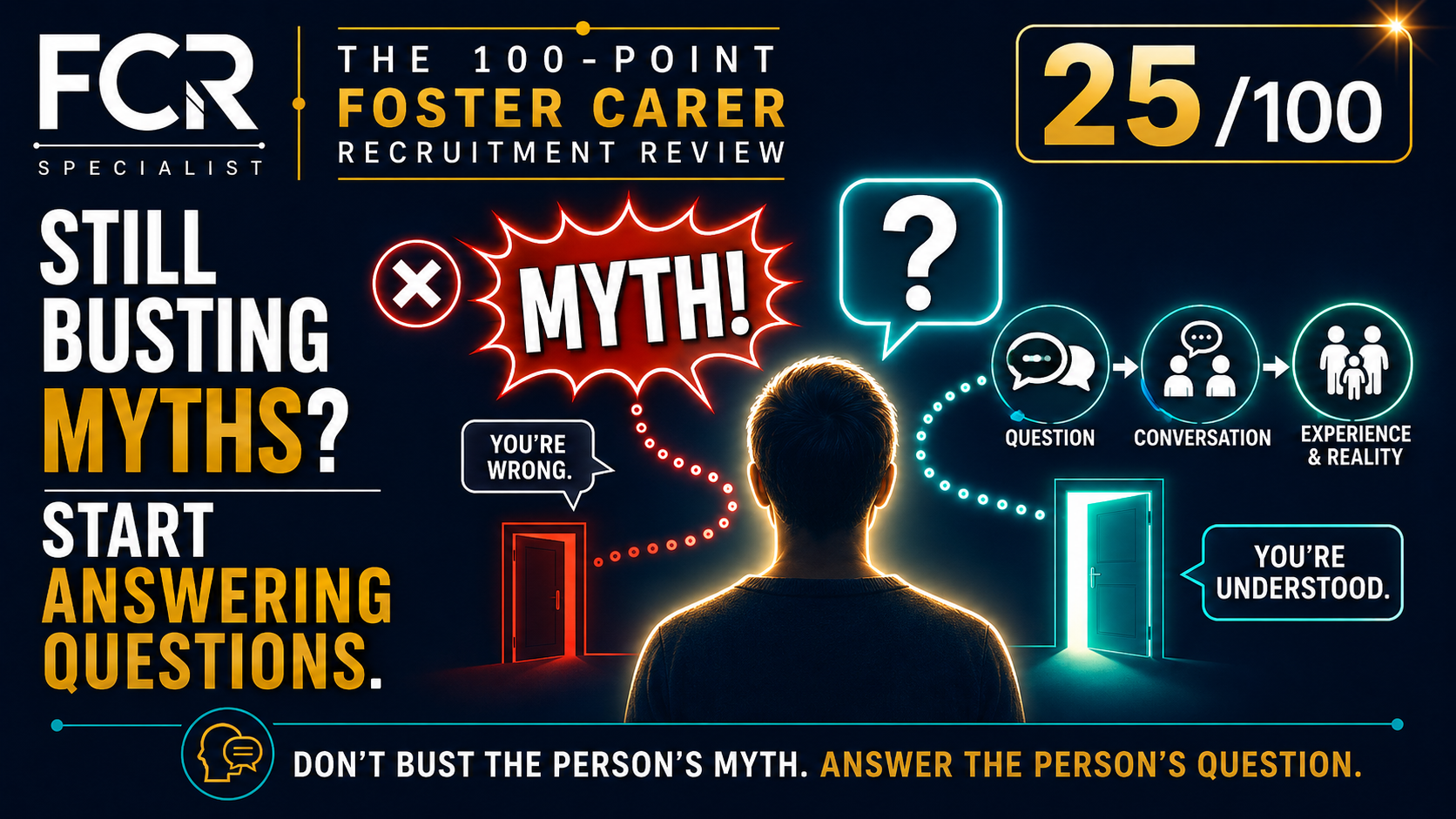
Point 25/100 — Are You Answering People's Questions — or Still Busting Their Myths?
Point 25/100 — Are You Answering People's Questions — or Still Busting Their Myths?
There is a type of Foster Carer Recruitment content almost everyone in the sector will recognise.
MYTH BUSTING.
MYTH: You can't foster if you're single.
MYTH: You have to own your home.
MYTH: You can't foster if you're older.
MYTH: You can't foster if you work.
The precise examples vary, but the format has become deeply established.
And there is a perfectly sensible reason for it.
People can hold inaccurate assumptions about fostering.
If those assumptions prevent suitable people from even enquiring, correcting them matters.
Indeed, Department for Education behavioural research published in 2022 specifically recognised existing myth-busting around factors such as sexuality, faith and ethnicity and suggested that clarification could be broadened to address other assumptions that cause people to rule themselves out.
So this Point is not an argument against correcting inaccurate information.
It is an argument about how we conduct the conversation.
Start with the person's perspective
Imagine somebody tells you:
“I didn't think single people were allowed to foster.”
What exactly have they done?
Have they spread misinformation?
Challenged your professional expertise?
Made an unreasonable assertion?
Probably not.
They have told you something they currently believe.
That belief may have come from:
something somebody told them,
an old newspaper article,
another Foster Carer,
social media,
an outdated understanding,
their own assumptions,
or simply never having had a reason to investigate fostering before.
That is useful recruitment information.
They have effectively said:
“Here is one of the things standing between me and seriously considering fostering.”
And we respond:
MYTH!
I think we should ask whether that is really the best opening move.
The word itself creates a relationship
The problem isn't necessarily the information beneath the heading.
The answer may be entirely correct.
My concern is the conversational frame.
One person says:
“I thought…”
The organisation says:
“Wrong.”
Of course, nobody intends it to sound that aggressive.
But recruitment is about how communication is received, not merely how it was intended.
Professional recruitment teaches you to become interested in why somebody thinks what they think.
If a candidate raises a concern, the objective is not to defeat the concern.
It is to understand it.
That distinction matters enormously in Foster Carer Recruitment.
The DfE research actually gives us a better model
The Department for Education's behavioural-insights research is particularly useful here because it investigated the attitudes and experiences of both successful and unsuccessful applicants as well as existing evidence and stakeholder views.
It found that prospective applicants could approach fostering with a wide range of anxieties, uncertainties and misconceptions.
But the recommendation was not simply:
Correct them.
The research emphasised enabling people to ask questions and explore options, addressing anxieties in a supportive way, and providing reliable information without people feeling that asking the wrong question would lead to judgement.
It specifically recommended a safe space to ask questions and access information, alongside lived experience through testimonials, communities and other opportunities to hear the everyday reality of fostering.
That is a different philosophy.
Not:
MYTH → CORRECTION
but:
QUESTION → CONVERSATION → INFORMATION → EXPERIENCE
Some people are already frightened of asking the wrong question
One finding from the DfE research is particularly important.
Some prospective applicants worried that asking particular questions might lead to them being judged or considered unsuitable. Some saw making the first telephone call not as a casual opportunity to find out more, but as the beginning of the formal application process.
Think about what that means.
We may have somebody who is already monitoring what they say.
They wonder:
Can I ask about money without appearing to foster for the wrong reasons?
Can I say I'm worried about challenging behaviour?
Can I admit I'm nervous about the assessment?
Can I ask whether I could continue working?
Can I admit my partner isn't completely sure yet?
These aren't problems to extinguish.
They are conversations we need them to have.
A recruiter should want the difficult question
If somebody is worried about the financial implications of fostering, I want them to ask.
If somebody is frightened about allegations, I want them to ask.
If somebody is unsure how fostering could affect their own children, I want them to ask.
If somebody has misconceptions about the assessment process, I want them to tell me.
Because once I know what somebody genuinely thinks, I can help them explore it.
The dangerous candidate isn't necessarily the person asking difficult questions.
From a recruitment perspective, the much harder situation is the person who is thinking them but believes it is unsafe to say them aloud.
Turn the myth around
Take a familiar myth-busting headline:
MYTH: You Have to Own Your Home to Foster.
Now write it as a prospective Foster Carer might actually think it:
“Can I Foster if I Rent My Home?”
Immediately the tone changes.
The first version is about correcting somebody.
The second version is about answering somebody.
Try another.
MYTH: You Can't Foster if You're Single.
Becomes:
“Can I Foster if I'm Single?”
Another:
MYTH: You Can't Foster and Work.
Becomes:
“Can I Continue Working if I Foster?”
Notice what happens.
We haven't weakened the factual content.
We haven't avoided answering the question.
We have simply changed the relationship between the organisation and the reader.
And questions allow better answers
There is another advantage.
Myth-busting naturally pushes communication towards simple:
TRUE / FALSE
answers.
Fostering often isn't that simple.
Consider employment.
A prospective Foster Carer asks:
“Can I work and foster?”
A simplistic answer might be:
“Yes — MYTH BUSTED!”
But the genuinely useful recruitment conversation may need to explore:
the person's working pattern,
flexibility,
the fostering service's expectations,
the age and needs of children they might foster,
school transport,
meetings,
training,
contact arrangements,
support available,
and the household's financial circumstances.
So the correct answer may be:
“Yes, many Foster Carers work — but whether your particular circumstances work alongside fostering is something we should explore properly with you.”
That is not as punchy as a myth-busting graphic.
It is far more useful.
Questions expose complexity
The same applies elsewhere.
Instead of:
MYTH BUSTED — AGE ISN'T A BARRIER.
Ask:
“Am I Too Old to Foster?”
Then explain what the service actually considers.
Instead of:
MYTH BUSTED — YOU DON'T NEED TO BE MARRIED.
Ask:
“Do I Need to Be Married or in a Relationship to Foster?”
Then explain the reality.
Instead of:
MYTH BUSTED — FOSTERING ISN'T JUST FOR PEOPLE WITH CHILDREN.
Ask:
“Do I Need Parenting Experience?”
Now you have space for an actual recruitment conversation.
This isn't merely semantics
Some might reasonably say:
“But Rolfe, aren't you just changing a headline?”
Partly.
But language changes organisational thinking.
If a communications calendar contains:
MYTH BUSTING
the task naturally becomes:
Which incorrect belief shall we correct this week?
If the calendar contains:
QUESTIONS PROSPECTIVE FOSTER CARERS ARE ASKING
the task becomes:
What are people actually trying to understand?
That is a much more useful research question.
It encourages the organisation to listen.
Where should the questions come from?
Not from a marketing brainstorming meeting alone.
Go to your evidence.
Ask the recruitment team:
What are people asking you this month?
Ask people who conduct initial visits:
What concerns keep coming up?
Look at website searches.
Look at Google search behaviour.
Look at social media comments.
Ask existing Foster Carers:
What did you worry about before you started?
Ask people who withdrew:
What question did we fail to answer?
Ask people who said “Not Now”:
What still makes you uncertain?
Now content is responding to the market instead of inventing what the market supposedly misunderstands.
Existing Foster Carers can provide the answer
The DfE research found that people who had more direct exposure to everyday fostering tended to develop a more balanced understanding, and it recommended access to real-world fostering experience through testimonials and communities.
That suggests an even stronger alternative to conventional myth-busting.
A prospective Foster Carer asks:
“Will fostering completely change our family life?”
Instead of producing another corporate graphic saying:
MYTH BUSTED!
let a fostering family answer.
Not with:
“No, everything will be fine.”
But perhaps:
“Yes, fostering changed our family life. Some changes were wonderful, some took adjustment, and these are the things we wish we'd known beforehand.”
That answer carries credibility because it does not pretend the concern is ridiculous.
It respects it.
What does the wider evidence say about “debunking”?
There is another reason to be precise with this argument.
We should resist an attractive but simplistic claim that correcting misinformation automatically “backfires”.
Research outside fostering does not support treating backfire as an inevitable consequence of correction. Studies have found that corrections generally can reduce mistaken beliefs, while some evidence suggests that presenting a positive factual affirmation can sometimes create more durable belief change than a format centred on retracting a myth.
That evidence comes from misinformation research, not Foster Carer Recruitment, so we should not overextend it.
But it reinforces an important point:
We don't need to argue that factual correction is psychologically dangerous.
Our case is simpler.
Foster Carer Recruitment is a relationship.
And relationships begin better with curiosity than contradiction.
The persistence of myth-busting does not prove it has failed
There is another argument I want to avoid.
We could say:
“The fostering sector has used myth-busting for decades and still has a recruitment crisis, therefore myth-busting doesn't work.”
That would be too simplistic.
The current shortage of Foster Carers has many causes. The Government continues to regard recruitment as a major national challenge and set out substantial new recruitment and reform measures in 2026.
The continued shortage cannot establish that one communication device caused or failed to solve it.
What it does justify is questioning whether a format that has become habitual is still the best way of communicating.
That's what a proper recruitment diagnostic should do.
Not reject things because they are old.
Ask whether they are still the strongest available approach.
Here is the test
Take every myth-busting post you published in the last twelve months.
For each one:
1. Remove the word “MYTH”.
2. Rewrite the statement as a question somebody might genuinely ask.
3. Answer the question accurately.
4. Explain any nuance rather than forcing a yes/no answer.
5. Add evidence or practical information.
6. Where possible, add Foster Carer lived experience.
7. Give the person a way to ask the next question privately without judgement.
Then compare the two pieces of content.
Which feels more welcoming?
Which starts a conversation?
Which is more likely to help somebody understand whether fostering could genuinely fit their life?
A new framework
I would replace:
MYTH → FACT
with:
QUESTION → ANSWER → EVIDENCE → EXPERIENCE
QUESTION
Use the prospective Foster Carer's own language.
ANSWER
Give a clear answer immediately.
EVIDENCE
Explain what the organisation actually requires or provides.
EXPERIENCE
Show how the issue works in the real life of Foster Carers.
That gives the reader significantly more than a myth-busting graphic.
Don't bust the person's myth
The point isn't to become afraid of telling people they are mistaken.
Sometimes they are.
If somebody believes something incorrect, we should correct it.
But there is a difference between:
correcting information
and
making correction the tone of the relationship.
Prospective Foster Carers do not need to arrive knowing all the answers.
That is why they are prospective Foster Carers.
Our job should be to create an environment where they can say:
“This might sound stupid, but…”
and receive:
“There are no stupid questions here. Let's talk about it.”
Because every genuine question tells us something about what is standing between that person and the next step.
DON'T BUST THE PERSON'S MYTH.
ANSWER THE PERSON'S QUESTION.
NEXT — POINT 26/100
DOES YOUR MARKETING SHOW THE REALITY OF FOSTERING — OR ONLY THE REWARD?
Because once we've encouraged people to ask honest questions, we have a responsibility to give them honest answers.
And that means talking about both the rewards and the realities of fostering.