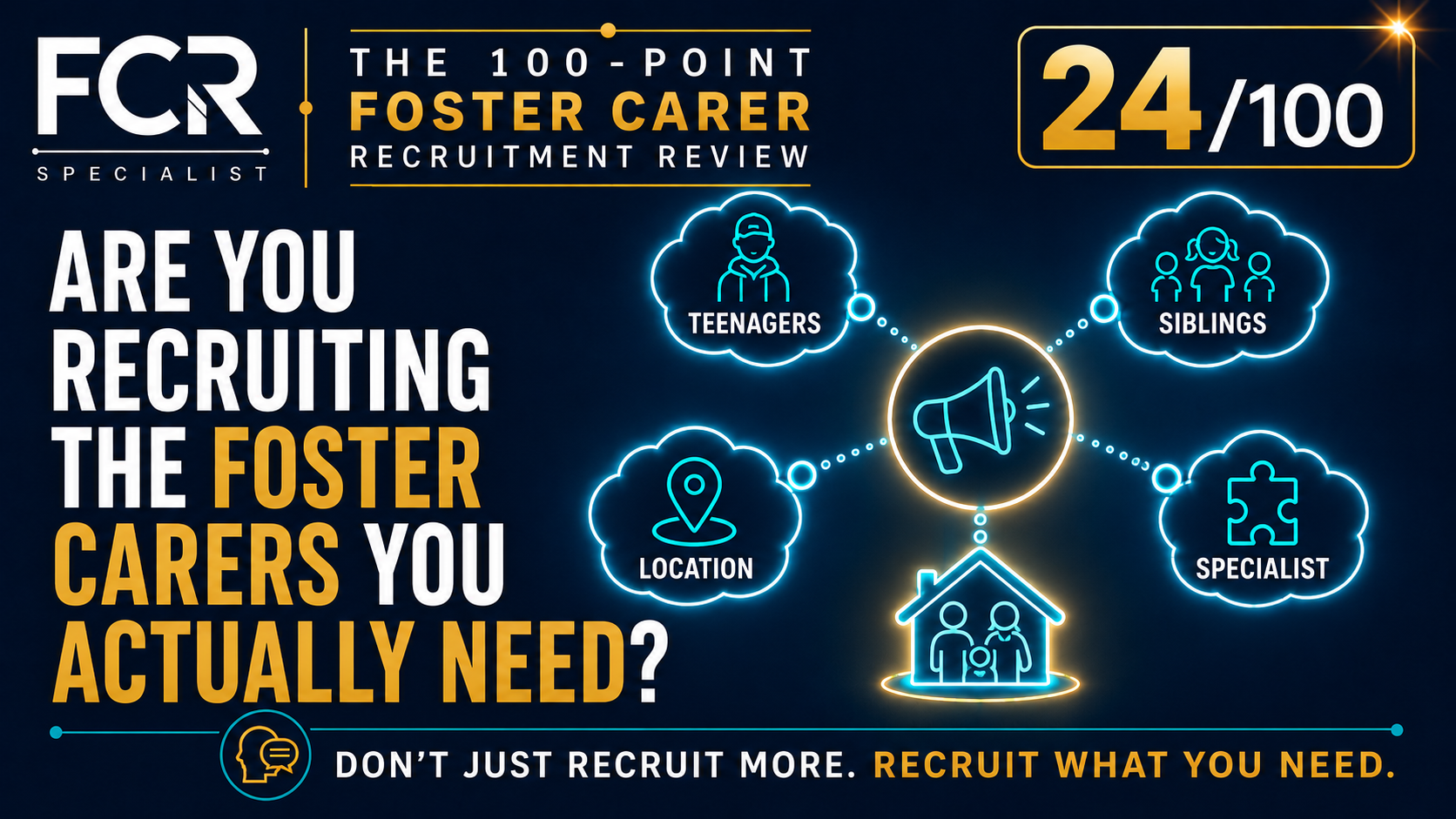
Point 24/100 — Does Your Recruitment Message Match the Foster Carers You Actually Need?
Point 24/100 — Does Your Recruitment Message Match the Foster Carers You Actually Need?
Imagine I walk into your organisation tomorrow morning.
I ask one question:
“Which Foster Carers do you most need to recruit?”
Hopefully, the answer is more precise than:
“More.”
Perhaps you need Foster Carers who can care for teenagers.
Perhaps sibling groups.
Perhaps children with additional or complex needs.
Perhaps short-break Foster Carers.
Perhaps long-term capacity.
Perhaps households in one particular town or postcode because too many children are being placed away from their school, family and community.
Whatever the answer is, I would then ask to see your current recruitment marketing.
And the question becomes:
Can I see your recruitment requirement in your recruitment message?
Because if I cannot, we may have disconnected sufficiency from marketing.
“We need more Foster Carers” is not yet a recruitment brief
It is an objective.
A recruitment brief needs greater precision.
Think about conventional recruitment.
Imagine a business tells its recruitment team:
“We need more staff.”
The obvious response would be:
What staff?
Where?
What skills?
What experience?
What hours?
What capacity?
When?
Why?
Foster Carer Recruitment should be treated with at least the same level of discipline.
Yet the sector can sometimes move very quickly from:
“We need more Foster Carers”
to:
“Let's run a fostering campaign.”
And then to:
“Could You Foster?”
That may be useful as broad awareness.
But it doesn't necessarily tell us whether the campaign is designed around the children for whom the organisation actually needs additional fostering capacity.
Current sufficiency evidence makes this more important
Ofsted's July 2026 research into children's social care sufficiency makes a particularly important distinction.
Sufficiency is not merely the volume of provision.
It depends upon whether placements are suitable, whether they are available in the right locations, and whether the workforce and support around them can meet children's needs. Ofsted found that a lack of Foster Carer availability is associated with more — and younger — children being placed in children's homes.
Its conclusion is highly relevant to Foster Carer Recruitment.
Provision, workforce and support need to align with children's needs at the point when placements are required.
That sounds like a commissioning statement.
It should also be a recruitment statement.
Start with the child — then work backwards
This is where the sequence of this 100-Point Review matters.
Earlier Points asked:
What is your sufficiency requirement?
Where are your Foster Carers?
Where are the gaps?
What does your future audience look like?
Only now are we discussing the message.
Because the message should flow backwards from need.
For example:
NEED
We need more local family placements for older children.
CAPACITY
We need Foster Carers comfortable and appropriately supported to care for teenagers.
POSSIBLE AUDIENCE
Which households might realistically offer that?
PROPOSITION
What support, training, finance and professional structure do we offer them?
MESSAGE
Now we can decide what to say.
That is fundamentally different from starting with:
“It's Foster Care Fortnight next month. What shall we post?”
The picture problem
One of the simplest diagnostics is visual.
Look at the children represented in your Foster Carer Recruitment marketing.
What impression does it create?
If your most significant shortage is carers for teenagers, but most of the imagery depicts young children holding teddy bears, what expectation are you setting?
This does not mean placing pictures of identifiable children in care into recruitment advertising.
Nor does it mean describing teenagers negatively.
It means communicating the reality of the role for which you are recruiting.
Perhaps:
“Could you be the person who helps a teenager believe in what comes next?”
That begins a very different conversation from a generic:
“Could you foster?”
And it allows the prospective Foster Carer to begin imagining the actual role.
Older children matter
The Government's February 2026 Renewing Fostering plan notes that children are now entering care at an older average age and that the composition and needs of the care population have changed. It says the system needs a broad and diverse range of foster families so children can be matched with families able to meet their needs.
Separate DfE placement-location statistics also show that children aged 10 to 15 are among the groups more likely to be placed further from home. That statistic does not prove Foster Carer shortages are the sole cause, but it reinforces why appropriate local capacity matters.
So if older children represent a particular local recruitment need, recruitment messaging should not make them almost invisible.
Siblings provide another obvious example
The Government's 2026 fostering plan explicitly identifies keeping brothers and sisters together as part of the vision for a stronger fostering system. It also sets out plans intended to enable experienced Local Authority Foster Carers to create additional space in their homes to help keep siblings together.
Now consider recruitment.
Suppose your data tells you that sibling capacity is a serious gap.
Would your recruitment campaign communicate:
that siblings need Foster Carers?
why keeping brothers and sisters together can matter?
what space may be required?
what additional support exists?
whether home adaptations or practical assistance are available locally?
what fostering siblings can actually look like?
Or does the campaign still simply ask:
“Have you got a spare room?”
Those are very different recruitment conversations.
Geography should change the message too
Ofsted's recent work repeatedly emphasises location.
Its July 2026 sufficiency research found that limited suitable local provision contributes to children being placed further from home.
DfE's dedicated placement-location analysis also shows substantial differences in how far children travel for care and confirms that some groups are particularly likely to be placed outside their home area.
This means geography is not simply a media-buying issue.
It can become part of the recruitment proposition.
Instead of:
“Could You Foster?”
imagine:
“Could you foster a child from your own community and help them stay close to the people and places they know?”
Now the message connects recruitment to sufficiency.
And for a Local Authority, that can be extremely powerful.
Regional recruitment must not erase local need
This becomes even more important with Regional Foster Carer Recruitment Hubs.
Regional scale can create benefits.
But Ofsted's March 2026 ILACS guidance is unequivocal that each Local Authority remains responsible for ensuring the hub meets its own recruitment needs and the needs of its local children. Inspectors will consider whether recruitment meets the objectives in the Local Authority's sufficiency strategy.
That has a direct marketing implication.
Suppose six Local Authorities participate in one regional campaign.
Their overall message might be:
“Foster with us.”
Fine.
But beneath that regional umbrella, individual areas may need very different things.
Authority A may need sibling capacity.
Authority B may have a particular shortage in one district.
Authority C may need more carers for adolescents.
Authority D may need carers capable of supporting children with particular additional needs.
If all four receive exactly the same regional recruitment messaging, we should ask:
Where did the local sufficiency requirement go?
Regionalisation should increase our ability to target.
Not reduce it.
IFAs face the same strategic question from a different direction
An IFA may not hold the Local Authority's statutory sufficiency duty, but it still needs to understand what Foster Carer capacity is useful within the markets and commissioning environment it serves.
Recruiting 50 additional households does not automatically mean creating 50 useful placement options.
What children can those households care for?
Where are those households?
What age ranges?
What skills?
What availability?
What support will enable them to offer broader capability?
This is why sheer recruitment volume can be misleading.
An enquiry is not capacity
This distinction becomes extremely important.
Imagine Campaign A generates 400 enquiries.
Campaign B generates 120.
Marketing performance immediately favours Campaign A.
But suppose the service desperately needs Foster Carers for teenagers.
Campaign A produces:
400 general enquiries,
mostly from people interested only in caring for very young children.
Campaign B produces:
120 enquiries,
40 of whom are genuinely open to fostering adolescents.
Which is the stronger recruitment campaign?
We cannot know without following them through the process.
But the example demonstrates the principle.
Lead volume and useful capacity are different measurements.
Point 30 will examine this in much greater detail.
For now, Point 24 asks whether we are even trying to generate the right kind of interest.
Be specific without turning children into categories
There is a risk here.
Targeted recruitment can become clumsy.
We should avoid describing children simply as:
“hard to place.”
A child is not a difficult vacancy.
The problem is a shortage of suitable options around them.
Messaging should therefore remain child-centred and respectful.
Instead of:
“We urgently need carers for difficult teenagers.”
perhaps:
“Teenagers in our area need Foster Carers who can offer stability, patience and belief in their future.”
Instead of:
“We need homes for hard-to-place sibling groups.”
perhaps:
“Could your family help brothers and sisters stay together?”
The recruitment requirement can be specific without reducing children to a purchasing category.
Generic awareness still has a place
This Point is not an argument for abandoning broad Foster Carer Recruitment.
There is a legitimate role for:
awareness,
brand building,
community engagement,
general fostering information,
national campaigns,
and broad top-of-funnel activity.
The Government itself plans national and regional communications to raise awareness and help prospective Foster Carers understand what fostering involves.
But awareness and targeted recruitment perform different jobs.
A national campaign might legitimately say:
CONSIDER FOSTERING.
A local recruitment campaign should then be able to say:
THIS IS WHERE WE PARTICULARLY NEED YOU.
That is the distinction.
Here is the test
Take your current sufficiency or capacity requirement.
Identify the three Foster Carer capabilities you most need during the next 12 months.
They might involve:
age range,
siblings,
geography,
specialist capability,
long-term fostering,
short breaks,
particular cultural or community knowledge,
or other genuine local requirements.
Now take every piece of recruitment activity from the previous three months.
Ads.
Social posts.
Videos.
Events.
Website landing pages.
PR.
Google campaigns.
Information evenings.
Community activity.
Then ask:
1. What percentage of our recruitment messaging reflects those three priorities?
2. Would somebody possessing the capacity we need recognise themselves in the campaign?
3. Are we explaining why that particular fostering need exists?
4. Are we explaining the support available to someone offering that capacity?
5. Are our images reinforcing or contradicting the message?
6. Does our targeting reflect the geography where capacity is required?
7. Can we identify which campaigns ultimately produce which kinds of Foster Carer capacity?
If you cannot answer those questions, there may be a gap between:
the children you need homes for
and
the Foster Carers your marketing is attempting to recruit.
Recruitment should be demand-led
This does not mean creating a rigid person specification for Foster Carers.
People's capabilities develop.
Training matters.
Support matters.
Experience matters.
A prospective Foster Carer who initially imagines caring for a young child may, after meeting Foster Carers and understanding the support available, discover that fostering teenagers would suit them extremely well.
So recruitment messaging should not unnecessarily close doors.
But it should open doors people may never otherwise realise exist.
That is the opportunity.
From “Could You Foster?” to “This Is Where You Could Make a Difference”
There is nothing wrong with:
COULD YOU FOSTER?
It is a useful first question.
But perhaps it should be followed quickly by:
What sort of fostering might suit you?
Which children currently need families in your area?
What capacity could your household offer?
What support would help you develop that capacity?
Now recruitment becomes a conversation between:
the needs of children,
the capabilities of households,
and the support of the fostering service.
That is considerably more sophisticated than chasing an enquiry number.
The objective isn't more enquiries
It isn't even simply more approved Foster Carers.
The real recruitment objective is:
MORE OF THE RIGHT FOSTER CARER CAPACITY, IN THE RIGHT PLACES, FOR THE CHILDREN WHO NEED IT.
Ofsted's current ILACS framework essentially applies the same test to Local Authorities: are there enough suitable Foster Carers to meet the needs of local children?
Our recruitment marketing should be asking exactly the same question.
Because if the sufficiency strategy says one thing and the marketing campaign says another, we should not be surprised when recruitment activity fails to solve the capacity problem.
NEXT — POINT 25/100
ARE YOU ANSWERING PEOPLE'S QUESTIONS — OR STILL BUSTING THEIR MYTHS?
Once we know what Foster Carer capacity we are trying to recruit, the next question is how we speak to the people considering it.
And perhaps it is time to reconsider one of fostering's longest-running marketing habits.