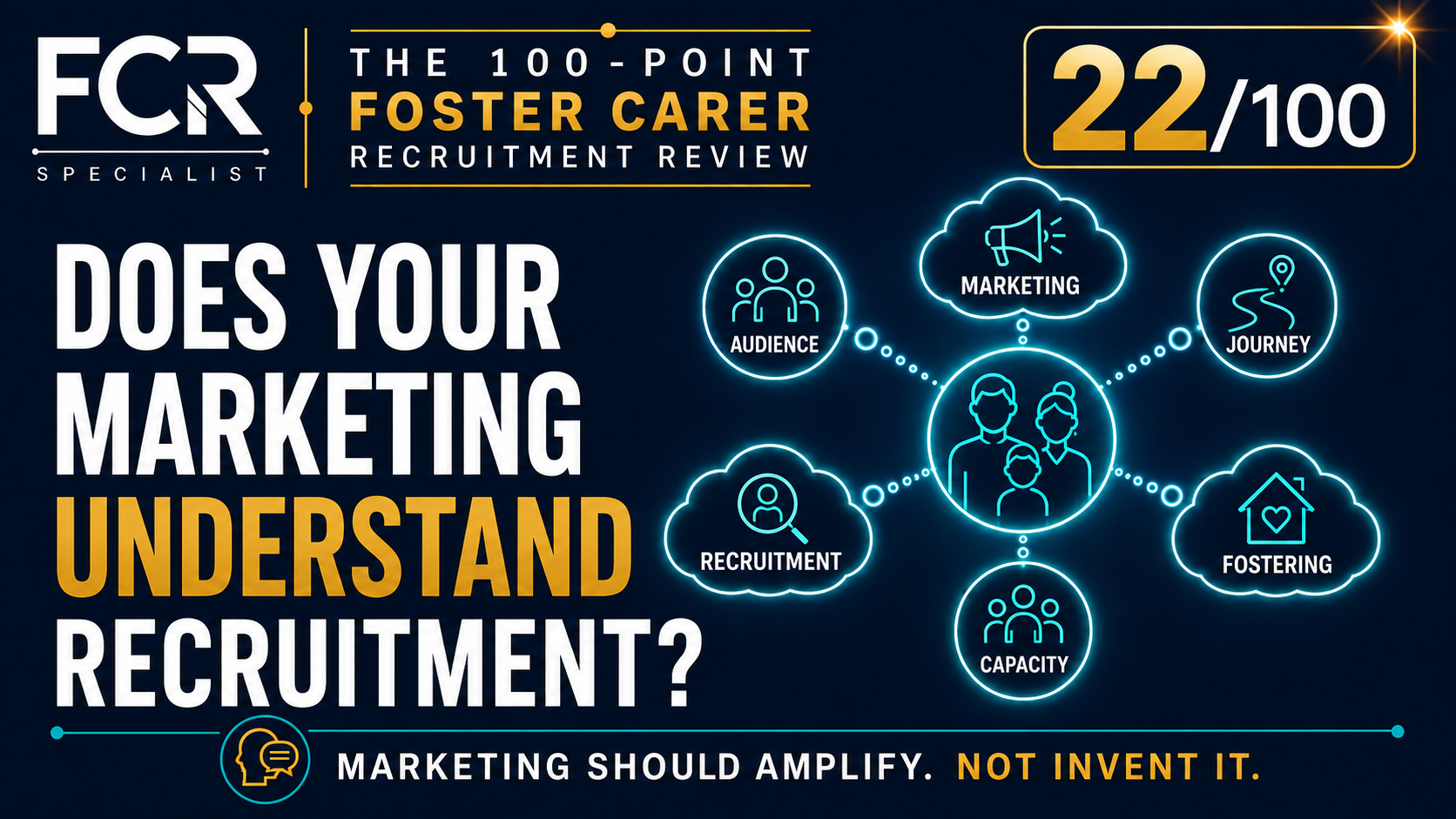
Point 22/100 — Does the Person Responsible for Your Marketing Understand Recruitment?
Point 22/100 — Does the Person Responsible for Your Marketing Understand Recruitment?
That question sounds more provocative than it is intended to be.
So let me start with what I am not saying.
I am not saying marketing professionals don't know their job.
I am not saying social workers should become marketers.
And I am certainly not suggesting professional recruiters can walk into fostering and automatically understand its complexity.
My argument is almost the opposite.
Foster Carer Recruitment requires three different forms of expertise
It requires an understanding of:
Marketing.
Professional recruitment.
Fostering.
There is considerable overlap between them.
But they are not interchangeable.
And when an organisation assumes that expertise in one automatically provides expertise in the other two, important things can start to fall between the gaps.
That is what Point 22 is examining.
Marketing and recruitment marketing are not quite the same thing
A useful starting distinction is this.
Brand marketing asks:
What do we want people to think and feel about our organisation?
Brand recognition.
Trust.
Reputation.
Identity.
Values.
Visibility.
All extremely important.
Recruitment marketing asks:
What does the right prospective candidate need to see, understand, believe and do next?
That introduces a different set of considerations:
Who are we trying to recruit?
Where are they?
What are their motivations?
What are their concerns?
What capacity do we actually need?
What message will be relevant to them?
What information do they need before they enquire?
What action do we want them to take?
And, crucially:
What happens after they do?
That final question takes us from marketing into recruitment.
A campaign can be beautifully designed.
It can achieve excellent reach.
People can like it.
People can share it.
It can strengthen the organisation's reputation.
And it can still produce very few suitable Foster Carers.
That doesn't necessarily mean the marketing failed.
It may mean it succeeded as marketing but was never properly connected to the recruitment requirement.
The DfE research makes an interesting distinction
The Department for Education's 2023 qualitative study into Foster Carer recruitment and conversion rates is particularly useful here.
Its structure itself is revealing.
It examines marketing and advertising separately from the recruitment process and then looks at data and conversion. The study involved ten fostering services — five Local Authorities and five IFAs — so its findings should not be generalised to the whole sector, but they provide useful insight into how differently these responsibilities can be arranged.
The researchers found that responsibility for marketing varied across services. Marketing could be a standalone responsibility, sit within recruitment or service management, operate through centralised and local teams, or involve external agencies.
That variation isn't inherently a problem.
The important question is whether the pieces connect.
Imagine I walked into your organisation
Imagine I spent one day following your Foster Carer Recruitment activity.
I meet the person responsible for social media.
I ask:
Which Foster Carers does the service most urgently need?
Could they answer?
I meet the agency producing your Facebook advertisements.
I ask:
What proportion of enquiries from this campaign normally reach initial visit, application and approval?
Would they know?
I meet the recruitment team.
I ask:
Why was this audience selected?
Could they explain the marketing decision?
I ask the fostering manager:
Which elements of your proposition appear to matter most to prospective Foster Carers?
Do we have evidence?
Then I ask everyone the same question:
What is this campaign actually trying to achieve?
Would I receive the same answer?
If not, the issue may not be the quality of any individual member of staff.
It may be that different functions are working towards different definitions of success.
The Local Authority challenge
Local Authorities can face a particularly difficult organisational structure.
Corporate communications teams may be responsible for communicating enormous numbers of council priorities.
Fostering is one of them.
That same team may also be handling information relating to highways, housing, schools, public health, consultations, libraries, refuse collections, elections, council meetings, events, emergencies and numerous other services.
My concern is not that those teams don't work hard.
The question is whether Foster Carer Recruitment receives enough specialist and sustained recruitment attention within that environment.
The DfE study offers some evidence of the wider structural constraint. Participants reported that Local Authority budgets cover many services rather than fostering alone, and that LA fostering services can have less freedom over marketing because they must operate within the wider Authority's marketing approach and style. Again, this came from a small qualitative sample, so it should be treated as an observed issue rather than a universal condition.
That accords with something I have repeatedly encountered operationally.
A Foster Carer Recruitment team can create a content plan.
Twenty posts are scheduled.
Then something else happens in the Authority.
A corporate priority takes precedence.
Content is delayed.
Something doesn't get published.
Or a post is placed on an existing council platform because that is the available channel, without enough analysis of whether the prospective Foster Carers we want are actually seeing it.
The result can be activity without sufficient visibility.
Here is a very simple Local Authority test
Take your last three months of planned Foster Carer Recruitment content.
Put the original plan alongside what actually happened.
Ask:
What was planned?
What actually went out?
What didn't go out?
Why?
On which channels?
How many people saw it?
Who were those people?
What engagement did it generate?
How many enquiries resulted?
What happened to those enquiries?
That exercise isn't a performance review of the communications department.
It is a diagnostic of whether the organisational system gives Foster Carer Recruitment sufficient priority and control to execute its recruitment plan.
The regional hub model makes this even more important
This is particularly relevant as regional fostering recruitment arrangements develop.
Ofsted's March 2026 ILACS guidance says that recruitment hubs typically include a team focused on regional marketing and recruitment for partner Local Authorities. But the guidance also makes something crucial very clear: the Local Authority must still be able to demonstrate that recruitment arrangements meet the objectives in its own sufficiency strategy and the needs of its local children.
That is a very important principle.
Regionalising marketing does not regionalise away the local recruitment requirement.
The recruitment message still needs to connect to:
the children needing placements,
the geography,
the type of capacity required,
the local Foster Carer population,
and the Local Authority's sufficiency objectives.
That is why a regional marketing function cannot merely become a bigger version of a corporate marketing function.
It needs recruitment intelligence flowing into it.
Otherwise we risk scaling the same disconnect.
The IFA challenge can be almost the reverse
Independent Fostering Agencies often have a different advantage.
Fostering is their core business.
The marketing department isn't trying to promote pothole reporting on Monday, public health on Tuesday and Foster Carer Recruitment on Wednesday.
The organisation can concentrate.
But concentration can introduce a different risk.
The internal echo chamber.
Again, this isn't an accusation.
It is a diagnostic question.
Imagine the process.
Marketing proposes the campaign.
Recruitment reviews it.
The fostering manager comments.
Senior leadership approves it.
Perhaps the board sees it.
Everyone around the table knows fostering.
Everyone works for the same organisation.
Everyone may have heard the same internal explanations for why previous campaigns succeeded or failed.
And slowly, internal assumptions can start validating other internal assumptions.
The question I would ask is:
What evidence from outside the organisation changed your recruitment strategy this year?
Not confirmed it.
Changed it.
Did withdrawn applicants change it?
Did current Foster Carers?
Did people who enquired but never applied?
Did competitor research?
Did demographic data?
Did search behaviour?
Did local community conversations?
Did prospective Foster Carer research?
Did independent external challenge?
If virtually everything informing the strategy originated in internal meetings, the organisation should at least test whether it is seeing the market as prospective Foster Carers see it — or as the organisation sees itself.
This is where recruitment expertise changes the conversation
A marketer may reasonably say:
“This advertisement had excellent engagement.”
The recruiter asks:
“From whom?”
Marketing says:
“Cost per lead fell by 25%.”
Recruitment asks:
“What happened to the leads?”
Marketing says:
“This was our highest-performing creative.”
Recruitment asks:
“Highest performing against what outcome?”
Marketing says:
“We reached 100,000 people.”
Recruitment asks:
“How many were plausible future Foster Carers in the locations where we require capacity?”
Neither person is wrong.
They are simply measuring different things.
And the strongest conversation occurs when they sit together.
The DfE research points in the same direction
The 2023 research found increasing emphasis on digital marketing, but participants also stressed the importance of using multiple approaches rather than relying on a single pathway. It highlighted community outreach, word-of-mouth, current Foster Carers, digital advertising and targeted activity as parts of the recruitment mix.
More importantly for this Point, the report's recommendations included pooling resources through national or regional recruitment arrangements and employing dedicated staff with expertise in digital marketing and advertising. It also recommended better qualitative data about why prospective Foster Carers do not progress.
That combination matters.
Expert marketing.
Plus recruitment data.
Plus candidate feedback.
Not one instead of the others.
A qualified marketer does not automatically become a recruiter
This is perhaps the most sensitive part of the argument, but it matters.
Someone can hold excellent professional marketing qualifications and still never have been trained to:
interview a candidate,
explore motivation,
diagnose a barrier,
manage candidate uncertainty,
qualify suitability,
understand recruitment conversion,
nurture a long-term candidate,
or distinguish between volume of interest and quality of applicant.
Why would they?
Those aren't necessarily their professional disciplines.
Equally, a recruiter can have 25 years of recruitment experience and know almost nothing about fostering.
And a highly experienced social worker may understand fostering better than either of them while having had little training in candidate attraction or recruitment marketing.
So the solution is not to decide which profession should control everything.
It is to combine the expertise.
What should the conversation look like?
Before a Foster Carer campaign goes live, I would want five people — or five functions — represented somehow:
1. Fostering/sufficiency
What Foster Carer capacity do we need?
2. Recruitment
Who are the plausible candidates and how do they make decisions?
3. Marketing
How can we reach them effectively and communicate compellingly?
4. Existing Foster Carers
Does this message resemble the reality of fostering?
5. Data
What did previous activity actually produce?
Now the campaign is no longer starting with:
“What shall we post next month?”
It starts with:
“What recruitment problem are we trying to solve?”
That is a fundamentally different conversation.
Here is the test
Take one campaign currently running.
Remove the artwork.
Remove the logo.
Remove the branding guidelines.
Now answer these questions:
Which Foster Carers are we trying to recruit?
Why those Foster Carers?
Where do they live?
What do we know about them?
What might motivate them?
What might stop them?
Why should they choose us?
What information do they need?
What action do we want them to take?
Who handles that action?
How quickly?
What happens next?
How are we measuring progression?
How will we learn from those who do not progress?
If the answers are clear, marketing has something powerful to amplify.
If they aren't, asking marketing to solve them with another campaign is asking the wrong function to invent the recruitment strategy.
Marketing should amplify the recruitment strategy
That principle closed Point 20.
It becomes even more important here.
Marketing is extraordinarily valuable to Foster Carer Recruitment.
Good marketing can create visibility.
Reach new communities.
Build trust.
Explain complex propositions.
Generate interest.
Challenge outdated assumptions.
Help people imagine themselves fostering.
But the marketing team should not have to decide on its own:
which Foster Carers the organisation needs,
what the actual recruitment proposition is,
where operational leakage occurs,
what the applicant journey should look like,
or whether a lead represents a successful recruitment outcome.
Those questions belong to the wider recruitment system.
The objective is therefore not:
Marketing versus Recruitment.
It is:
Marketing + Recruitment + Fostering.
Three disciplines.
One recruitment requirement.
And one shared outcome:
more of the right Foster Carers, in the right places, for the children who need them.
NEXT — POINT 23/100
CAN YOU EXPLAIN WHY SOMEONE SHOULD FOSTER WITH YOU?
Because once marketing and recruitment are properly connected, the next question becomes unavoidable:
What exactly are we asking marketing to sell?