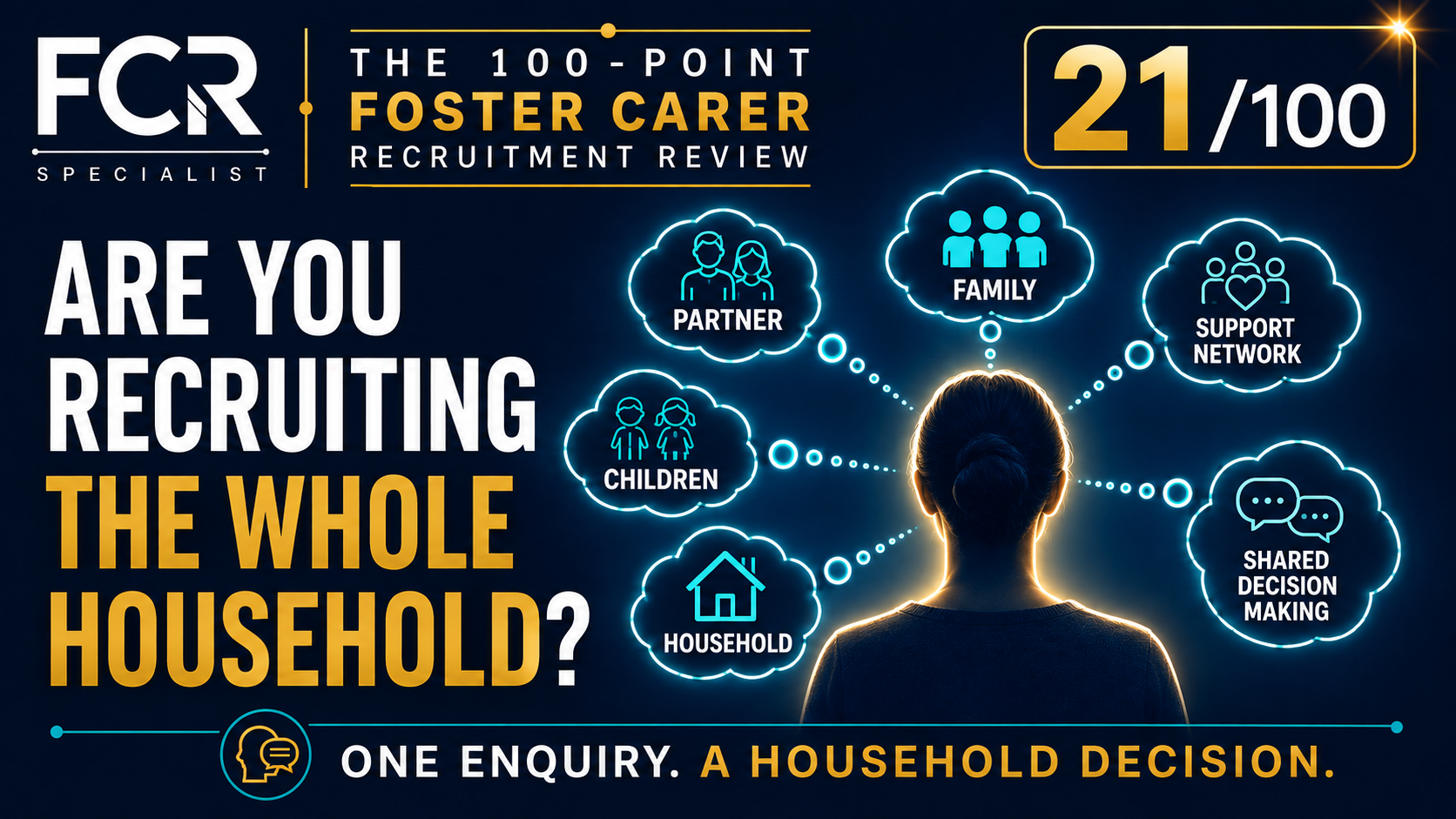
Point 21/100 — Are You Recruiting the Individual — or the Whole Household?
Point 21/100 — Are You Recruiting the Individual — or the Whole Household?
One person usually makes the enquiry.
One person clicks the advert.
One person completes the form.
One person phones the recruitment team.
And because our recruitment systems need a name to attach the enquiry to, that person quickly becomes the prospective Foster Carer.
But is that really what is happening?
Or are we in danger of confusing the person who made the initial contact with the much larger decision that is taking place behind them?
Because fostering doesn't simply enter an individual's life.
It enters a household.
And that distinction matters.
An enquiry may be individual. Fostering rarely is.
Imagine somebody sees your fostering campaign.
Perhaps they have thought about fostering for years.
The children are getting older. Their career is changing. They have a spare bedroom. They have reached a point in life when fostering suddenly feels possible.
They make an enquiry.
From a recruitment perspective, that is a lead.
But around that lead may be an entire network of people processing the implications.
A husband or wife may be thinking:
“I'm not sure I'm ready for this.”
A teenage son or daughter may be wondering:
“What happens to our family?”
An adult child who has left home might be asking:
“Will Mum and Dad still have time for us and the grandchildren?”
A grandparent might wonder about the needs of the children who may arrive.
Friends may either reinforce the decision or fill the household with stories about everything they think can go wrong.
And for working applicants, employment arrangements can become part of the practical equation. GOV.UK confirms that people may work while fostering depending on the circumstances of the child and the requirements of their fostering service, while Foster Carers do not have a statutory right to time off work to care for foster children.
Yet our recruitment process can continue behaving as though we are dealing with one candidate.
The legislation already recognises the household
Interestingly, the assessment framework understands this far more clearly than recruitment sometimes does.
Schedule 3 of the Fostering Services (England) Regulations 2011 requires information about other adult members of the household and about children in the family, whether or not those children live in the household. The assessment framework also requires consideration of whether the prospective Foster Carer's household is suitable for a child.
The statutory guidance is explicitly relevant not only to Foster Carers but to their families.
So by the time somebody reaches formal assessment, the system recognises something fundamental:
The household matters.
My question is whether Foster Carer Recruitment recognises it early enough.
Don't wait until assessment to discover the second decision-maker
Professional recruitment has always taught me something important.
The person sitting in front of you is not necessarily the only person involved in the decision.
Candidates discuss major career decisions with partners.
People discuss house moves with families.
They discuss financial decisions with spouses.
They seek reassurance from people they trust.
Fostering is considerably bigger than most of those decisions.
So consider this scenario.
An enquirer is enthusiastic.
Every telephone conversation goes well.
They attend an information event.
They speak positively about progressing.
The recruitment dashboard therefore looks encouraging.
But at home their partner is saying:
“I'm really not sure about this.”
Who is talking to the partner?
If the answer is:
“That will come out during assessment”
then perhaps we are dealing with it too late.
The purpose should not be to persuade a reluctant partner into fostering.
Quite the opposite.
It should be to give everyone affected the opportunity to understand fostering, ask questions and reach an informed position before considerable time is invested by either the household or the fostering service.
DfE research gives us another clue
The Department for Education's behavioural-insights research into fostering and adoption found that supportive family and friends can be an important social influence on the decision to foster. It also identified particular anxieties among some prospective Foster Carers who already have children, including concerns about managing challenging behaviour and what that might mean within their own family.
The same research emphasised the value of providing a safe environment in which prospective applicants can ask questions and voice concerns without feeling judged. It also highlighted access to existing Foster Carers and everyday fostering experience as ways of helping people develop a more balanced understanding.
That gives us an important recruitment principle:
Don't treat uncertainty within the household as resistance to overcome. Treat it as information that needs exploring.
A partner who asks difficult questions may not be negative.
A teenager who worries about sharing their parents may not be selfish.
An adult child who raises concerns may not be trying to stop the application.
They may simply need information.
And if we create an environment in which people feel they cannot raise those concerns, we haven't removed them.
We have merely made them invisible.
What happens when concerns remain invisible?
The latest Ofsted fostering statistics provide an interesting piece of context.
For applications started during 2024–25 that applicants had withdrawn by 31 March 2025, the most frequently recorded reason was a change in household circumstances, excluding finances, at 36%. A further 20% were recorded as the fostering process not being what the applicant expected.
We need to be careful with those figures.
They do not demonstrate that better household engagement would have prevented those withdrawals.
A change in household circumstances can mean many different things, and some withdrawals are entirely appropriate.
But they do raise a legitimate recruitment question:
How much do we really understand about what is happening inside the household while somebody progresses through our process?
And:
How effectively are we preparing the household for what the fostering journey will involve?
Birth children should not appear halfway through the process
This is particularly important where applicants have children of their own.
The household isn't simply adding another child.
Relationships can change.
Time is redistributed.
Attention is redistributed.
Space is shared.
Parents may sometimes need to respond to the needs of a child who has experienced trauma at precisely the moment their own child also wants them.
There can be enormous positives too.
But good recruitment should not require prospective families to pretend those questions don't exist.
DfE behavioural research specifically identified that prospective Foster Carers with their own children may feel apprehensive about aspects of children's trauma and behaviour.
So why not address that earlier?
Why not offer:
- Foster Carer family stories
- appropriate opportunities for birth children to hear from other fostering families
- partner-focused information
- FAQs specifically about the impact on family life
- conversations about household routines
- realistic discussion about boundaries and privacy
- explanations of support
- opportunities to ask uncomfortable questions without believing that doing so will damage the application
That isn't creating barriers.
It is removing uncertainty.
Recruiting the household does not mean assessing everybody at enquiry
There is an important distinction here.
I am not suggesting that recruitment teams turn the initial enquiry into an assessment.
And I am certainly not suggesting that every relative should have a vote on whether someone can foster.
Recruitment should remain welcoming and proportionate.
But it can recognise that there are other people around the decision.
A simple question can change the conversation:
“Who else is part of this decision for you?”
Another might be:
“What does your partner think about fostering at the moment?”
Or:
“Have you talked to your children about what fostering might mean for your family?”
Not:
“Are they all completely supportive?”
That turns normal uncertainty into a pass/fail question.
Instead:
“What questions do they have?”
That is a recruitment question.
The silent veto
Every experienced recruiter eventually encounters what I call the silent veto.
Everything appears positive.
Then suddenly:
“We've talked about it and decided now isn't the right time.”
Sometimes that genuinely is the correct decision.
But the recruitment diagnostic question is:
Who is “we”?
And when did we first engage them?
If a partner's uncertainty existed from the first week but nobody explored it until month three, that isn't simply an applicant withdrawal.
There may have been a gap in the recruitment journey.
This does not mean pushing harder.
Sometimes the correct recruitment outcome is:
Not now.
Sometimes it is:
Fostering isn't right for us.
Good professional recruitment is not about converting everybody.
It is about helping the right people make a properly informed decision.
The wider support network matters too
There is another group worth considering: the people outside the immediate household.
DfE behavioural research found that supportive family and friends can influence fostering decisions and noted the value of wider peer and community support networks.
That raises some useful questions.
Who will the prospective Foster Carer call after a difficult day?
Who might provide emotional support?
Who understands why plans sometimes change?
Who will continue including the family socially?
Who might help birth children adjust?
Who understands enough about fostering not to unintentionally undermine the household's confidence?
This does not mean turning friends and relatives into Foster Carers.
It means recognising that sustainable fostering does not take place in isolation.
Here is the test
Take ten applicants currently somewhere between enquiry and assessment.
For each one, ask:
1. Who initially enquired?
2. Who else is materially affected by the decision to foster?
3. What does each of those people currently understand about fostering?
4. What concerns have they expressed?
5. Have they had a genuine opportunity to ask questions?
6. Have they heard from people living the reality of fostering?
7. Do we know whether the household is progressing together — or whether one enthusiastic applicant is pulling everyone else behind them?
If you cannot answer those questions, there may be an important part of the candidate journey that is currently invisible.
Applicant or fostering family?
This is the larger issue.
The sector understandably talks about:
applicants.
applications.
assessments.
approvals.
Those terms are necessary.
But recruitment starts before any of them.
And perhaps our language can subtly shape our thinking.
If we think we are recruiting an applicant, our activity naturally centres on the person whose name sits on the CRM.
If we think we are helping a household explore fostering, our behaviour changes.
We ask different questions.
We provide different information.
We involve people differently.
We discover uncertainty earlier.
We introduce lived experience sooner.
And potentially we create households entering assessment with a much clearer understanding of what they are deciding to do.
That should be the objective.
Not simply:
Get the applicant into assessment.
But:
Prepare the household for fostering.
Because ultimately, a Foster Carer does not simply open their diary to fostering.
They open their home.
And everyone already living in that home experiences part of that decision.
NEXT — POINT 22/100
DOES THE PERSON RESPONSIBLE FOR YOUR MARKETING UNDERSTAND RECRUITMENT?
Once we understand who we are really recruiting, the next question is obvious.
Does the person designing the messages intended to reach them understand how recruitment decisions are actually made?