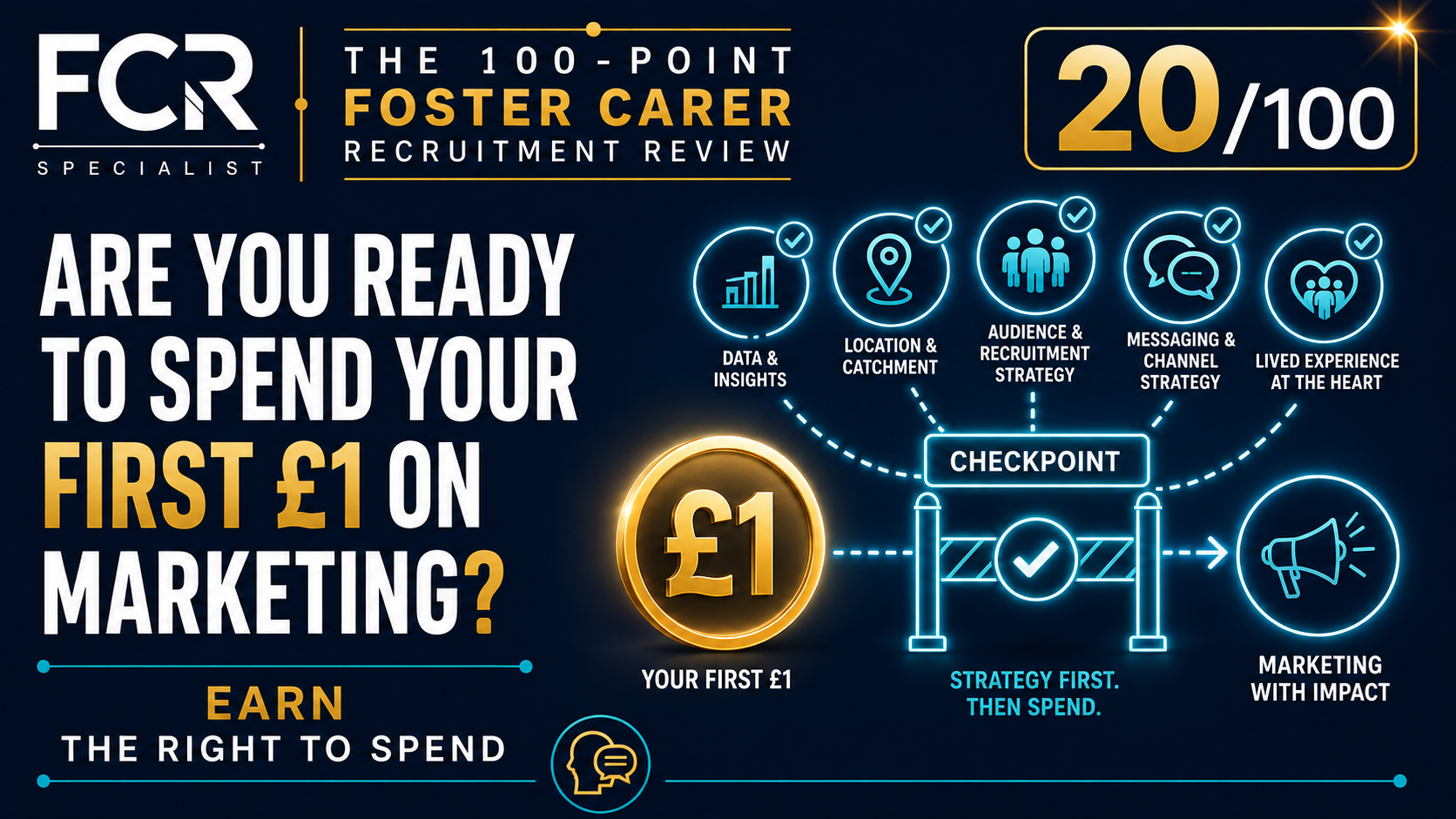
Point 20/100 Are You Ready to Spend Your First £1 on Marketing?
Are You Ready to Spend Your First £1 on Marketing?
Point 20/100 — The 100-Point Foster Carer Recruitment Review
We have reached Point 20.
And I want to draw attention to something quite deliberate.
We still haven't spent any money on marketing.
Not one pound.
No Facebook campaign.
No Google Ads.
No newspaper advert.
No paid lead-generation campaign.
No boosted post.
That may sound strange in a series about Foster Carer Recruitment.
I think it is one of the most important principles in the entire Review.
Because before I spend money attracting more prospective Foster Carers, I want to know what I am trying to attract them into.
MARKETING SHOULD BE AN AMPLIFIER
Marketing is extremely useful.
But marketing cannot decide:
which children need placements;
what Foster Carer capacity you require;
where that capacity should exist;
whether your proposition is competitive;
whether your recruiter can hold a professional conversation;
whether your assessment process loses good applicants;
or whether your existing Foster Carers would recommend you.
Marketing can amplify whatever already exists.
Which creates a slightly uncomfortable possibility:
If the recruitment system is weak, marketing may simply help more people experience the weakness.
That isn't a marketing failure.
It is a system failure that marketing has exposed.
LOOK AT WHAT WE HAVE DONE BEFORE REACHING POINT 20
The sequence of Points 11–19 is deliberate.
We didn't begin:
Who should we advertise to?
We started further back.
We asked what the evidence tells us.
We examined geography.
We examined audience.
We examined motivation.
We examined barriers.
We examined the skills of the person taking the enquiry.
We examined consultative recruitment.
We examined how difficult concerns are handled.
And we examined the role of existing Foster Carers in helping prospects understand what fostering actually feels like.
Only now do I want the marketing budget on the table.
QUESTION 1 — WHAT EXACTLY ARE WE TRYING TO RECRUIT?
Before spending £1, answer:
What Foster Carer capacity do we actually need?
Not:
"More Foster Carers."
That isn't sufficient.
Do we need:
sibling capacity?
adolescent carers?
long-term fostering?
short-term?
respite?
particular geographic capacity?
specialist experience?
greater local placement choice?
For Local Authorities, this should connect directly to sufficiency.
For IFAs, it should connect to the type of referral demand the organisation wants and is properly equipped to support.
Government's 2026 hub specification now explicitly says improved use of data and planning should help create homes where children need them, allowing more children to remain local when that is right for them.
That is where marketing should start.
With the need.
Not the media platform.
QUESTION 2 — WHERE DO WE WANT THEM?
If you tell Facebook:
"Find me people interested in fostering across Yorkshire,"
the platform may do exactly that.
But is Yorkshire your recruitment strategy?
Or simply the available targeting area?
Points 12–14 asked us to think differently.
Where is existing Foster Carer capacity?
Where is placement need?
Where are the gaps?
Where are the communities?
Where are potential clusters?
Which recruitment territories are actually important?
Once that exists, marketing becomes geographically purposeful.
Without it, we may be allowing an advertising algorithm to have more influence over the geography of future fostering capacity than our sufficiency strategy does.
QUESTION 3 — WHO ARE WE TRYING TO TALK TO?
Again:
Not:
"Women aged 45–65 who own their home."
Point 13 deliberately rejected that simplistic model.
Instead:
Which communities exist within the territory?
Where are the housing opportunities?
Which employers?
Which groups?
Which existing Foster Carer networks?
Which underrepresented communities?
Where do people gather physically?
Where do they gather digitally?
What does our existing enquiry data tell us?
Marketing becomes stronger when the audience is understood as:
people living inside communities,
rather than:
targeting parameters inside an advertising account.
QUESTION 4 — DO WE UNDERSTAND WHY THEY MIGHT FOSTER?
Point 15 moved from market intelligence into human intelligence.
Someone doesn't become interested in fostering because an advertising platform has identified them as a conversion opportunity.
They have their own reason.
Children leaving home.
Experience with children.
Personal history.
A change of career.
A sense of purpose.
Knowing another Foster Carer.
Something has made fostering relevant.
If your marketing doesn't connect with genuine human motivation, spending more money may simply increase the number of people who ignore it.
QUESTION 5 — DO WE UNDERSTAND WHAT MIGHT STOP THEM?
Point 16 added the other half.
Money.
Work.
Children.
Home.
Partner.
Assessment.
Confidence.
Allegations.
Timing.
The DfE's own recruitment research found services wanted more qualitative information about why people fail to progress, because numerical funnel data alone often does not explain what is happening underneath the figures.
That is crucial.
Suppose you have a major conversion problem because prospects repeatedly conclude:
"I couldn't make fostering work financially."
Would you rather know that...
or simply increase next month's Facebook budget?
Marketing cannot resolve every barrier.
But understanding barriers can change:
messaging;
information;
proposition;
training;
process;
and sometimes organisational policy.
QUESTION 6 — CAN YOUR TEAM HANDLE THE ENQUIRIES?
This is where Points 15–18 become particularly important.
Imagine tomorrow your marketing campaign suddenly produces:
100 excellent enquiries.
Could your organisation cope?
Who calls them?
How quickly?
At evenings?
At weekends?
Can the recruiter:
ask intelligent questions?
understand motivation?
identify barriers?
handle difficult questions?
discuss money confidently?
talk honestly about fostering?
know when to escalate?
agree the next step?
follow up?
This is why I think we're discovering a bigger issue through this series.
Training somebody in fostering is not necessarily the same as training them in recruitment.
If the enquiry team isn't ready, buying more enquiries may simply increase leakage.
QUESTION 7 — WHAT ARE YOU ACTUALLY OFFERING?
This is the Offer element of my FOSTER System.
A prospective Foster Carer isn't only deciding:
Should I foster?
They may also be deciding:
Who should I foster with?
So what is your proposition?
Support.
Payments.
Training.
Respite.
Peer support.
Therapeutic input.
Out-of-hours response.
Carer community.
Culture.
Locality.
Social-work support.
Communication.
And crucially:
Is the experience the recruiter describes the experience existing Foster Carers actually receive?
Because marketing can make a proposition look good.
It cannot make a poor proposition good.
QUESTION 8 — WOULD YOUR EXISTING FOSTER CARERS SUPPORT THE MESSAGE?
Point 19 gave us a particularly valuable test.
Suppose your campaign says:
"You'll never be alone."
Would your Foster Carers agree?
Suppose it says:
"Outstanding support every step of the way."
Would they say that is an accurate description?
This is why Foster Carers should be involved before the campaign goes live, not simply recruited afterwards to appear in it.
The DfE's 2023 study found participating services regarded word-of-mouth enquiries as particularly strong and believed people who had already spoken with Foster Carers tended to enter recruitment with more realistic expectations.
That is something paid advertising alone cannot manufacture.
QUESTION 9 — CAN YOU TRACK WHAT HAPPENS AFTER THE CLICK?
This may be one of the biggest weaknesses in recruitment marketing.
Marketing reports:
Impressions.
Clicks.
Cost per click.
Leads.
Cost per lead.
Fine.
Then what?
Who progressed?
Who received a home visit?
Who applied?
Who reached assessment?
Who withdrew?
Who was approved?
Which territory?
Which campaign?
Which message?
Why did people leave?
Government's Renewing Fostering programme explicitly identifies weaknesses in applicant tracking and says stronger data should allow services to understand where to focus recruitment activity and what improves conversion from enquiry through to approval.
If you cannot connect spend to recruitment outcomes:
you do not know which marketing is working.
You know which marketing generates leads.
Those are not the same thing.
THIS IS WHERE DIGITAL MARKETING DATA CAN MISLEAD US
The 2023 DfE-commissioned recruitment study found services had increasingly moved towards Google, Facebook and other digital channels.
That is entirely understandable.
Digital marketing offers:
scale;
speed;
targeting;
measurement.
But the same research reported a concern.
Participants said digital marketing could produce larger numbers of enquiries from people who were curious rather than ready to progress, potentially affecting apparent conversion performance. Some also questioned whether the money being spent represented value for money, although they felt online visibility remained necessary.
That is a very important distinction.
More leads does not automatically mean more Foster Carers.
COMPARE THAT WITH WORD-OF-MOUTH
The same study reported almost the opposite pattern for word-of-mouth.
Lower volume.
But participants described the resulting enquiries as among their strongest.
Why?
Because people may already have:
spoken to a Foster Carer;
understood more about the role;
developed more realistic expectations;
and begun creating a support network.
Again, this was qualitative research and should not be treated as proof that word-of-mouth will outperform paid advertising everywhere.
But it demonstrates why measuring only:
lead volume
is too crude.
PERHAPS THE FIRST £1 SHOULD NOT GO WHERE THE LAST £1 WENT
This is another strategic challenge.
Organisations frequently create annual marketing budgets by taking last year's activity and adjusting it.
Facebook:
same.
Google:
same.
Events:
same.
Creative:
same.
Then perhaps:
"Add 10% because enquiries are down."
Point 20 asks whether that logic should be reversed.
Instead:
What do we need?
Where?
What is stopping us?
Which channels fit the problem?
Then allocate the budget.
Budget should follow strategy.
Strategy should not be designed around the budget headings inherited from last year.
THE FIRST £1 MAY GO INTO DIFFERENT THINGS IN DIFFERENT TERRITORIES
Territory A may need:
search;
local landing pages;
Foster Carer content;
paid social.
Territory B may need:
employer relationships;
community engagement;
existing Foster Carer referrals;
events.
Territory C may need:
stronger local SEO;
PR;
partnerships;
organic digital community work.
There is no reason each area should automatically receive the same marketing mix.
The territory tells you what needs doing.
PAID SOCIAL IS A TOOL
Not a strategy.
That statement is worth repeating.
Facebook is a tool.
Google is a tool.
TikTok is a tool.
PR is a tool.
Events are tools.
Email is a tool.
Community engagement is a tool.
Existing Foster Carers are part of the recruitment infrastructure.
The strategic question is:
Which combination helps us build the Foster Carer capacity we actually need?
THE DfE IS NOW MOVING TOWARDS THIS THINKING
The 2026 end-to-end hub programme describes the desired future model as:
regionalised, data-driven and relationship-focused.
Its recruitment requirements include:
better use of data;
ongoing support;
regular check-ins;
Foster Carer involvement;
and local good practice within a regional model.
That is important.
Because it suggests the national direction is not:
Buy more advertisements.
It is considerably broader:
build a better recruitment system.
Marketing sits inside that system.
MY MARKETING READINESS TEST
Before releasing the budget, I would want ten green lights.
1. SUFFICIENCY
We know what capacity we need.
2. GEOGRAPHY
We know where it would be most valuable.
3. AUDIENCE
We know which communities we want to reach.
4. MOTIVATION
We understand why people might consider fostering.
5. BARRIERS
We understand the things preventing progression.
6. PROPOSITION
We know what we can genuinely offer.
7. RECRUITMENT SKILL
The team handling enquiries is properly equipped.
8. PEER INVOLVEMENT
Existing Foster Carers can support the recruitment journey.
9. JOURNEY
The process after enquiry is ready.
10. DATA
We can track the journey through to meaningful recruitment outcomes.
Then:
spend.
DOES EVERYTHING HAVE TO BE PERFECT?
No.
If we waited for perfection, nobody would ever recruit.
The question is whether the obvious foundations exist.
You may still learn things after activity begins.
You should.
Recruitment strategy should change as evidence develops.
The problem is not learning while marketing.
The problem is using marketing as a substitute for thinking.
SOMETIMES YOU NEED TO STOP SPENDING
Here's another uncomfortable thought.
Suppose campaign performance falls dramatically.
The first answer is often:
increase spend;
new creative;
new audience;
new agency.
Perhaps.
But Point 20 suggests another possibility.
Stop.
Look at the system.
Have motivations changed?
Has your proposition fallen behind competitors?
Are calls being answered?
Has assessment slowed?
Is there negative Foster Carer sentiment?
Is geographical targeting wrong?
Has the market been saturated?
Are good prospects withdrawing later?
A recruitment problem cannot always be solved by a marketing response.
FOR SENIOR LEADERS, THIS IS AN ROI QUESTION
Imagine a Director asks:
"Why are we spending £75,000 here?"
The answer should not be:
"Because Facebook performs best."
It should be more like:
"This territory has an identified need for approximately fifteen additional households. Our audience analysis identified these communities. This activity supports existing community engagement, Foster Carer referrals and local search. We expect X enquiries, Y applications and ultimately Z approvals, and we are tracking the entire pathway."
Now marketing expenditure is connected to organisational need.
That's a much stronger conversation.
FOR THE MARKETING TEAM, THIS SHOULD BE LIBERATING
This is not criticism of marketing.
Quite the opposite.
A marketing professional should not have to guess:
who the provider wants;
where it wants them;
what the proposition is;
which children it needs capacity for;
why prospects are dropping out.
Those are organisational questions.
Once answered, the marketer can do what marketers do extremely well:
reach the right people with the right proposition.
The problem comes when marketing is expected to compensate for missing strategy.
FOR THE RECRUITER, MARKETING IS THE BEGINNING — NOT THE RESULT
An enquiry isn't success.
It is an opportunity.
And that opportunity still has to travel through:
conversation;
information;
family discussion;
home visit;
application;
assessment;
approval.
The DfE's 2023 study specifically argued that whole-journey conversion is useful because it helps indicate whether services are attracting the right people and generating higher-quality enquiries.
That is recruitment thinking.
THE £1 QUESTION
So here is the Point 20 test.
Put a pound coin on the table.
Before somebody spends it, ask:
What exactly are we buying?
Attention?
Traffic?
An enquiry?
Or part of a deliberate strategy to create the Foster Carer capacity children need?
Then ask:
Why this audience?
Why this geography?
Why this message?
Why this channel?
Why now?
What happens when they respond?
How will we know whether it worked?
If you can't answer those questions...
keep the pound.
Not forever.
Just until you know what you want it to do.
STAGE TWO — COMPLETE
Points 11–20 have taken us through an important journey.
We have moved from:
market intelligence,
to geography,
to audience,
to motivation,
to barriers,
to recruiter capability,
to professional recruitment conversations,
to peer influence,
and finally:
marketing readiness.
That sequence matters.
Because it reverses something I think the sector has sometimes done for too long.
Instead of:
Campaign first. Work everything else out afterwards.
I would prefer:
Understand first. Recruit professionally. Then amplify.
That is what Point 20 represents.
And it gives us the simplest possible question with which to close this section:
ARE YOU READY TO SPEND YOUR FIRST £1 ON MARKETING?
If the answer is yes, you should now be able to explain exactly why.
100 points.
10 stages.
One end-to-end examination of Foster Carer Recruitment.