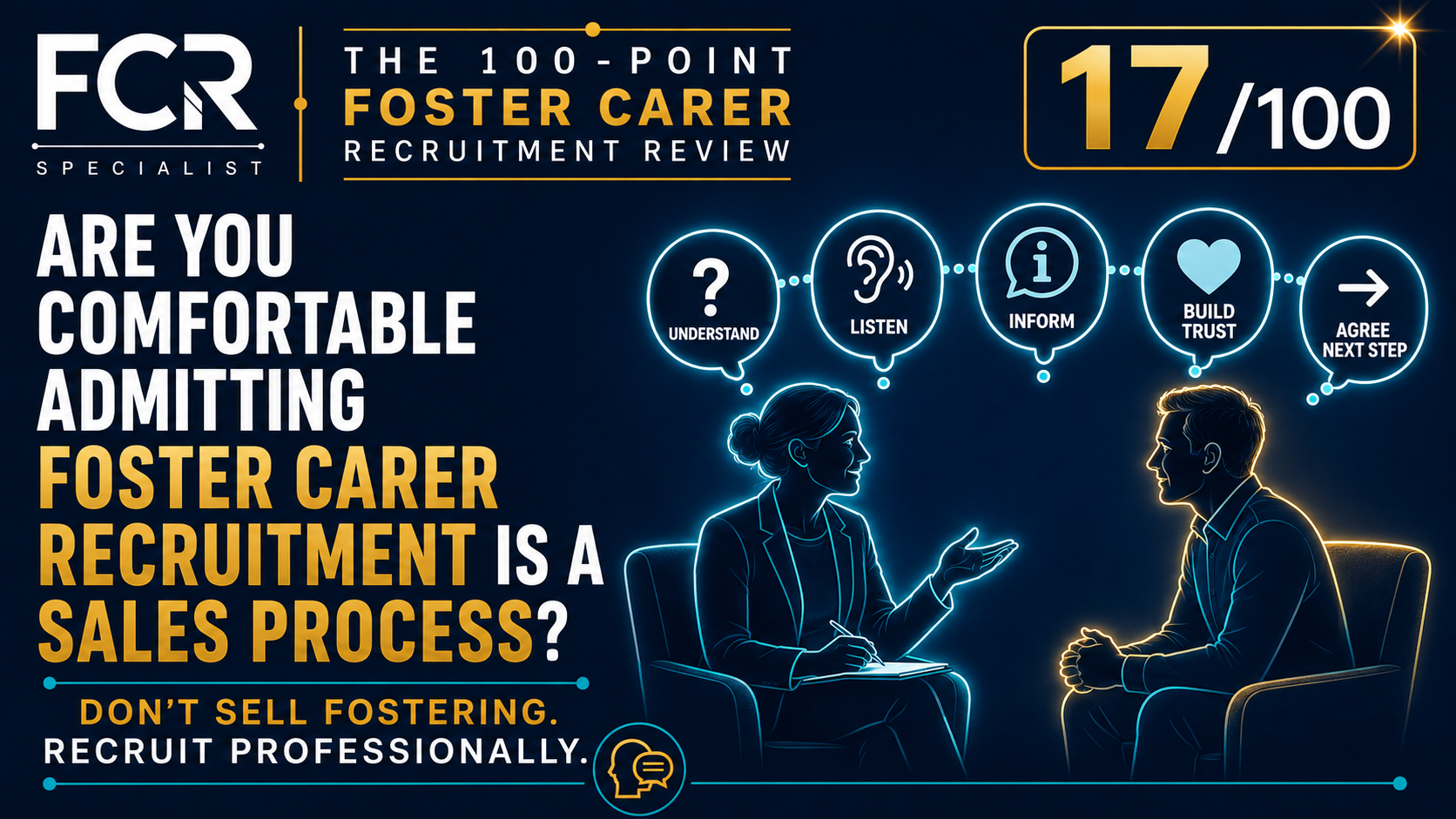
Point 17/100 Are You Comfortable Admitting Foster Carer Recruitment Is a Sales Process?
Are You Comfortable Admitting Foster Carer Recruitment Is a Sales Process?
Point 17/100 — The 100-Point Foster Carer Recruitment Review
There is a word that can make people in children's services visibly uncomfortable.
Sales.
Put the words:
Foster Carer Recruitment
and
sales
in the same sentence and I can almost hear the objections.
"Fostering isn't a product."
"We shouldn't sell fostering."
"We're talking about vulnerable children."
"People shouldn't be persuaded to become Foster Carers."
I agree with all four statements.
And yet I still believe Foster Carer Recruitment contains a sales process.
The important question is what we mean by sales.
Because I am not talking about transactional selling.
I am talking about:
professional consultative selling.
And that distinction matters enormously.
LET'S DEFINE WHAT I DO NOT MEAN FIRST
When I say there are sales skills within Foster Carer Recruitment, I do not mean:
- persuading unsuitable people to foster;
- manipulating emotion;
- pressuring someone into an application;
- hiding difficult aspects of fostering;
- overcoming safeguarding concerns;
- promising someone they will be approved;
- exaggerating payments or support;
- treating children as products;
- reducing assessment standards;
- or trying to "close" every enquiry.
Any of those would completely misunderstand the point.
The safeguarding threshold does not move because recruitment needs more carers.
The assessment standard does not move because your recruitment target is behind.
And an unsuitable prospect who decides not to continue may represent a perfectly good recruitment outcome.
So what do I mean?
WHAT DOES A GOOD CONSULTATIVE RECRUITER ACTUALLY DO?
Think about the conversation we have developed across Points 15 and 16.
A prospective Foster Carer contacts us.
The recruiter:
ASKS QUESTIONS
"Tell me what has made you think about fostering now?"
LISTENS
They allow the person to explain their circumstances rather than racing down a script.
UNDERSTANDS MOTIVATION
Why fostering?
Why now?
IDENTIFIES NEED
What does this person need to know before they can make their next decision?
EXPLORES CONCERNS
Money?
Work?
Children?
Partner?
Assessment?
Confidence?
EXPLAINS THE PROPOSITION
What does fostering involve?
What support exists?
What will the process look like?
What does this provider offer?
PROVIDES EVIDENCE
Examples.
Process.
Experience.
Foster Carer voices.
Accurate information.
BUILDS TRUST
By being honest rather than relentlessly positive.
QUALIFIES
Is there enough here to take another step?
AGREES THE NEXT STEP
Home visit?
Information event?
Another telephone conversation?
Speak to a Foster Carer?
Talk it through with the family?
Not now?
That is a professional recruitment conversation.
It is also recognisably a consultative sales conversation.
THE GOVERNMENT RESEARCH IS INTERESTING HERE
The Department for Education's behavioural research did not describe Foster Carer Recruitment as a sales process.
I want to be clear about that.
But what it found strongly supports a relationship-led approach.
The research was commissioned to understand the drivers and barriers affecting fostering recruitment and to develop interventions capable of generating more quality enquiries and applications, including fewer inappropriate withdrawals.
It tested different ways of communicating with prospective applicants.
Among the findings were the value of:
- helping people explore their options;
- guidance through the decision;
- acknowledging challenges honestly;
- reinforcing available support;
- creating space for questions;
- and increasing people's confidence in their ability to cope.
That is important.
Because none of those things is:
"Here's a leaflet. Call us when you've decided."
They are active recruitment behaviours.
SALES DOES NOT HAVE TO MEAN PERSUASION
This may be where much of the discomfort originates.
People hear sales and think:
persuasion.
I think that definition is too crude.
Good consultative selling starts with diagnosis.
You don't begin:
"How can I convince this person?"
You begin:
"What does this person actually need?"
Sometimes what they need is reassurance.
Sometimes detailed information.
Sometimes challenge.
Sometimes more time.
Sometimes they need somebody to say:
"Based on what you've told me, I don't think progressing now is the right thing."
That can still be excellent recruitment.
FOSTERING HAS A PROPOSITION WHETHER WE LIKE THE LANGUAGE OR NOT
Every fostering provider makes an offer to a prospective Foster Carer.
It may include:
training,
support,
supervision,
respite,
peer networks,
financial arrangements,
out-of-hours support,
therapeutic input,
local teams,
Foster Carer associations,
specialist expertise,
matching philosophy,
relationships,
culture.
That is your:
Foster Carer proposition.
And different providers have different propositions.
A prospective Foster Carer is entitled to understand them.
So the recruiter needs to be able to explain:
Why foster?
and, where the person has choices:
Why foster with us?
That is not unethical.
In fact, pretending the choice does not exist may be less helpful.
PROSPECTIVE FOSTER CARERS MAY BE COMPARING YOU
The fostering system itself recognises that an initial enquiry is not necessarily one individual making one enquiry. Ofsted's analysis has cautioned that people may contact more than one fostering provider, which means raw enquiry totals do not necessarily represent unique individuals.
That has an important practical consequence.
You may believe you are simply:
giving somebody information.
The individual may actually be comparing:
your answer
with
the answer they received from another provider ten minutes earlier.
They are noticing:
who answered quickly;
who listened;
who seemed interested;
who sounded knowledgeable;
who explained things clearly;
who made them feel comfortable;
who put pressure on them;
who followed up;
who didn't.
The first conversation is therefore not neutral.
It is part of your proposition.
YOUR SERVICE IS BEING SOLD WHETHER YOU CALL IT SALES OR NOT
Imagine two fostering providers.
A prospective carer asks both:
"I'm really worried about how fostering might affect my own children."
PROVIDER A
"That's covered during assessment. We'll send you an information pack."
PROVIDER B
"That's a really important question. Tell me a little about your children and what you're worried about."
Then perhaps:
"We have Foster Carers whose children were around the same age when they started. If it would help later, we may be able to arrange an informal conversation with one of them."
Which interaction feels more valuable?
Nobody has been pressured.
Nobody has been sold a fantasy.
No standard has changed.
But Provider B has demonstrated:
listening,
understanding,
experience,
support,
and relevance.
That is proposition selling.
THE RECRUITER SHOULD NOT DELIVER THE SAME PITCH TO EVERYONE
Poor salespeople have a pitch.
Good consultative recruiters have a conversation.
That distinction matters.
If somebody tells me:
"My biggest concern is finances,"
I don't spend ten minutes explaining your therapeutic training programme.
If they say:
"I'm worried about fostering affecting my daughter,"
I don't immediately lead with your allowances.
If they say:
"I've fostered before and I'm thinking of returning,"
I don't give them the same introductory explanation as somebody who saw a fostering advert for the first time yesterday.
The proposition should be:
relevant to the person.
That's why Points 15 and 16 came first.
Before you can explain effectively, you need to understand.
FEATURE DUMPING IS NOT RECRUITMENT
Providers can have a tendency to tell prospective Foster Carers everything.
"We provide this."
"We have that."
"We offer 24-hour support."
"We provide training."
"We have social events."
"We have an app."
"We pay this."
"We offer that."
Twenty minutes later the caller has received enormous amounts of information.
But was any of it answering the question they actually had?
Good recruitment does not mean saying more.
It means making the information relevant.
QUALIFICATION WORKS BOTH WAYS
This is another element of professional recruitment that fostering should embrace.
Traditionally we can think:
Are they suitable for us?
But the prospective Foster Carer is also thinking:
Are you suitable for me?
They are assessing the provider.
Do I trust you?
Will you support me?
Do you understand me?
Will somebody answer the telephone when things are difficult?
Will you prepare me properly?
Will I be treated with respect?
What happens if I disagree?
What happens if an allegation occurs?
Who will support my family?
What sort of children might I care for?
That is a two-way recruitment process.
And it should be.
THE GOVERNMENT'S NEW MODEL IS BECOMING MORE RELATIONAL
This is particularly relevant to the direction of current reform.
The Department for Education's March 2026 end-to-end Fostering Hubs programme moves deliberately beyond a recruitment-only "front door" to cover assessment, approval and support through the Foster Carer journey.
The model includes relational recruitment practices, proactive support and ongoing contact with prospective carers rather than simply generating an enquiry and moving them through a transaction.
Likewise, Renewing Fostering says Government wants a clearer, more predictable applicant journey, reduced friction at critical stages and better understanding of what improves conversion from enquiry to approval.
Again, Government does not call this sales.
I do.
More precisely:
consultative recruitment.
WHY DOES THIS MATTER?
Because England does not appear to have a shortage of people who have ever thought about fostering.
The problem is turning appropriate interest into appropriate applications and ultimately additional Foster Carer capacity.
Ofsted's dedicated recruitment analysis found that in the year ending March 2023 only 6% of recorded initial enquiries resulted in an application, with the proportion staying between 6% and 8% across the previous five years. Ofsted also cautioned that enquiry data has methodological limitations, including multiple enquiries by the same individual.
The latest annual fostering statistics show another challenge further down the process: of applications completed during 2024–25, 61% ended in withdrawal rather than approval. Many withdrawals will be entirely appropriate, but Ofsted also recorded cases where applicants said the process had not been what they expected.
That tells me conversion deserves serious professional attention.
Not aggressive sales tactics.
Better recruitment skill.
THE OBJECTIVE IS NOT TO "CLOSE"
This is another term I would avoid in fostering.
The objective of a first conversation is not:
Close the prospect.
The objective is:
Help the right person become sufficiently informed and confident to take the next appropriate step.
Read that carefully.
The right person.
Not everyone.
Sufficiently informed.
Not blindly enthusiastic.
Confident.
Not pressured.
The next appropriate step.
Not necessarily an application.
That next step might be:
another conversation;
a home visit;
an information session;
speaking to their partner;
speaking to an existing Foster Carer;
reading something specific;
waiting six months;
or deciding fostering is not right for them.
That is professional recruitment.
SMALL NEXT STEPS MATTER
A huge decision can feel intimidating.
"Apply to become a Foster Carer" is enormous.
But:
"Would it be useful if we spoke again once you've talked this through with your partner?"
is manageable.
So is:
"Would you like to meet one of our Foster Carers?"
or:
"Shall we arrange for somebody to visit and talk this through properly?"
A professional recruiter helps somebody move through a decision rather than demanding the entire decision immediately.
TRUST IS PROBABLY YOUR MOST IMPORTANT SALES TOOL
Not persuasion.
Not urgency.
Trust.
The Trust element of my FOSTER System becomes particularly relevant here.
Trust is built when:
you answer accurately;
you say when you don't know;
you don't dismiss difficult questions;
you explain risks as well as benefits;
you follow up when promised;
you do not overpromise;
you allow somebody to say no;
and your behaviour matches what your marketing promised.
This is particularly important because DfE behavioural research found confidence in being able to cope was closely linked to people's belief that appropriate support would be available and accessible.
You cannot simply claim support.
The recruitment experience needs to begin demonstrating it.
THERE ARE SALES TECHNIQUES I WOULD NEVER WANT TO SEE IN FOSTERING
Let's be equally clear.
I would not want to see:
false urgency
"Apply now before it's too late."
emotional manipulation
"Think about all the children who need you."
overcoming serious reservations
"We'll deal with that later."
false reassurance
"Don't worry, fostering isn't that difficult."
hiding negatives
"There's no need to talk about allegations yet."
manufactured scarcity
"We only have a couple of assessment spaces left."
pressure closing
"So can I put you down as applying today?"
No.
That is not the kind of sales discipline I am arguing for.
GOOD SALES CAN INCLUDE SAYING NO
This is perhaps where safeguarding and recruitment align perfectly.
A skilled recruiter identifies fit.
Sometimes there isn't one.
If somebody's motivation is concerning, explore it.
If circumstances aren't right, say so.
If expectations are wildly unrealistic, address them.
If fostering is not appropriate, do not progress them merely because you have a target.
There is no contradiction between:
good recruitment
and
rigorous safeguarding.
Done properly, the former should support the latter.
SO WHY DOES THE WORD STILL MATTER?
Because if we refuse to acknowledge that these recruitment skills exist, we may fail to train them.
We can train people in:
process,
policy,
eligibility,
recording,
safeguarding.
All essential.
But who trains them to:
ask good questions?
listen properly?
understand motivation?
identify need?
present a proposition?
build trust?
respond to concerns?
agree next steps?
follow up?
Those are professional recruitment and consultative-sales competencies.
Changing the label does not remove the need for the skill.
HERE IS THE TEST
Take five people who regularly answer Foster Carer enquiries.
Ask them:
What is the objective of the first telephone call?
Listen carefully to the answers.
Is it:
"To collect the information we need."
"To qualify them."
"To book an initial visit."
"To get them to apply."
Or is it something closer to:
"To understand the person, give them the information relevant to their circumstances, assess whether progression appears appropriate and agree the right next step."
If that's the answer, you already understand consultative recruitment.
You just may not have been comfortable calling part of it sales.
FOSTER — OFFER AND TRUST
This is where two more elements of my FOSTER System begin to become visible.
Offer.
What exactly is the Foster Carer proposition?
And:
Trust.
Why should this person believe that the experience you are describing is the experience they will actually receive?
Neither is created by a glossy brochure.
They are experienced during the conversation.
POINT 17 ISN'T REALLY ABOUT THE WORD SALES
The provocative headline gets us through the door.
But the underlying question is more important:
Have we trained the people responsible for Foster Carer Recruitment to be professional recruiters?
Because if we haven't, we can spend millions finding the right audience...
generate thousands of enquiries...
and then ask people with little recruitment training to somehow convert that opportunity.
That makes very little operational sense.
And once we accept that professional recruitment involves responding intelligently to people's concerns, Point 18 becomes inevitable.
Because the next skill is:
CAN YOUR TEAM HANDLE OBJECTIONS WITHOUT DISMISSING THEM?
That is where we move from understanding the concern to learning how to respond to it.
100 points.
10 stages.
One end-to-end examination of Foster Carer Recruitment.