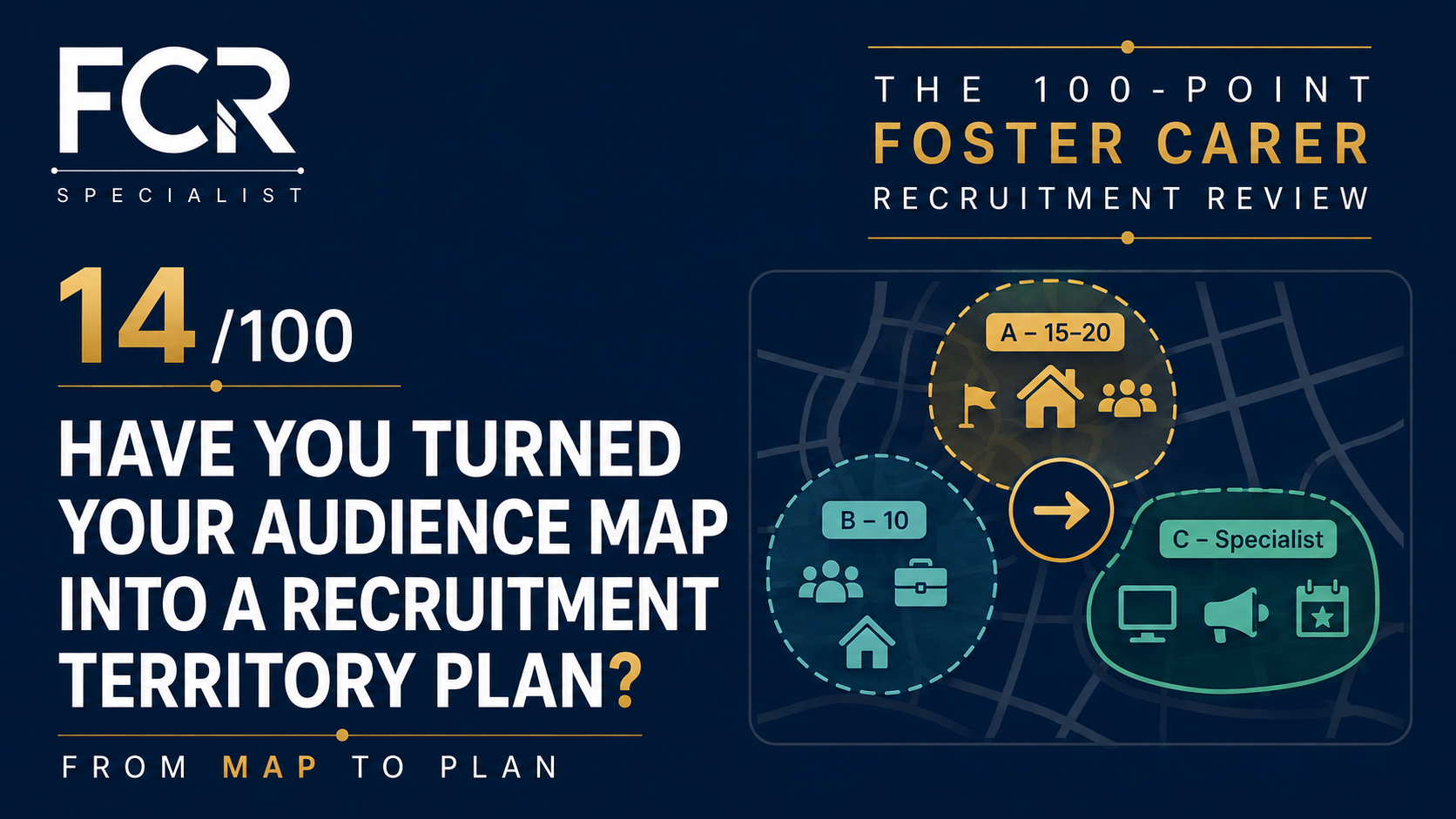
Point 14/100 Have You Turned Your Audience Map Into a Recruitment Territory Plan?
Have You Turned Your Audience Map Into a Recruitment Territory Plan?
Point 14/100 — The 100-Point Foster Carer Recruitment Review
By Point 13, we have accumulated quite a lot of intelligence.
We should have a clearer understanding of:
- which Foster Carer sufficiency gaps we are trying to fill;
- where additional capacity would be strategically useful;
- where existing Foster Carers already live;
- where local clusters might sensibly be developed;
- what housing and population information tells us;
- which communities exist locally;
- and where some of those communities also gather digitally.
So now what?
Because there is a danger at this stage.
You produce an impressive map.
You put some coloured dots on it.
Perhaps somebody presents it to senior management.
Everybody agrees it is interesting.
And then the marketing team goes back to running broadly the same county-wide campaign it was running before.
If that happens, the analysis has achieved remarkably little.
Point 14 is therefore about deployment.
Turn the intelligence into territories.
And then build a recruitment plan for each territory.
A RECRUITMENT AREA IS NOT A RECRUITMENT TERRITORY
There is a distinction worth making.
A fostering provider may say:
"We recruit throughout Lancashire."
Or:
"Our recruitment area covers South London."
Or:
"We recruit within 50 miles of our office."
That tells me where you are prepared to accept enquiries from.
It does not tell me where you are deliberately trying to grow.
A recruitment territory is different.
A territory says:
Area A
We currently have eight Foster Carer households.
We want to develop approximately another ten to fifteen.
Sibling capacity is a particular priority.
We have three existing carers willing to support recruitment.
There are two large employers we want to engage.
There are five community organisations we want relationships with.
We need a properly developed local website presence.
We have identified relevant community groups.
We have two major local events during the next six months.
Paid digital activity will support that work.
And we will measure applications and approvals from the territory — not simply enquiries.
That is no longer a catchment area.
It is a deployment plan.
WHY THIS MATTERS NOW
Current Government policy is moving Foster Carer Recruitment towards larger regional structures.
The Department for Education's 2026 end-to-end fostering model says hubs will take responsibility for regional recruitment and use improved data and planning to create homes where children need them, helping more children remain local when appropriate.
But the same model specifically recognises that some work may still need to happen closer to communities, particularly across large geographical areas. It says staff can be distributed across communities even where accountability sits regionally.
I think there is an important principle here:
Regionalise the infrastructure. Localise the recruitment.
The two ideas do not conflict.
Regional systems can create:
consistency,
data,
shared processes,
technology,
scale,
governance.
But a prospective Foster Carer does not live "in the region".
They live in:
a town,
a neighbourhood,
a village,
a street,
a community.
And communities are where recruitment ultimately has to land.
BUILD THE TERRITORY FROM THE SUFFICIENCY REQUIREMENT
Start with Point 11.
What capacity do we actually need?
Then Point 12.
Where would we ideally like it?
Then Point 13.
What does our intelligence tell us about the opportunity?
Now turn that into something practical.
Suppose the analysis identifies three priority territories.
TERRITORY A
Target: approximately 15–20 additional fostering households.
Priority: general capacity and sibling groups.
TERRITORY B
Target: approximately 10 additional households.
Priority: adolescents and longer-term fostering.
TERRITORY C
Target: smaller specialist growth.
Priority: particular placement requirements identified through referral and commissioning data.
Already this is more useful than:
"We need another 40 Foster Carers."
Because the 40 now have:
a purpose,
a geography,
and eventually a deployment strategy.
EACH TERRITORY NEEDS ITS OWN RECRUITMENT PLAN
I would then create a simple recruitment-territory document.
It does not need to become a 60-page strategy.
Ideally, someone should be able to look at one or two pages and understand exactly what is happening.
For every territory I would want to see at least the following.
1. WHAT ARE WE TRYING TO ACHIEVE?
Be specific.
Not:
Recruit more Foster Carers.
Try:
Develop 10 additional approved households capable of supporting our identified placement requirements within the next 18 months.
Or:
Increase the existing local cluster from eight households to approximately fifteen.
Now we have a defined outcome.
2. WHY THIS TERRITORY?
This is where Point 13 earns its keep.
What evidence led us here?
Perhaps:
- local sufficiency need;
- an existing Foster Carer cluster;
- strong historical enquiry conversion;
- appropriate housing;
- growing population;
- community infrastructure;
- local employers;
- lack of existing provision;
- commissioner demand;
- repeated IFA referrals;
- proximity to children needing placements.
The answer should not simply be:
"Because advertising performs quite well there."
Advertising performance is useful evidence.
It is not the entire strategic case.
3. WHO ALREADY EXISTS IN THE TERRITORY?
Start with your greatest local asset.
Your Foster Carers.
Who is already there?
Which Foster Carers are positive advocates?
Who knows the community?
Who might introduce the recruitment team to:
businesses,
community groups,
schools,
clubs,
employers,
other local people?
Could some become Foster Carer ambassadors?
Could they attend information events?
Could their stories become local content?
Could prospective Foster Carers speak to them?
By Point 19, we will examine that peer relationship in much greater depth.
For now, simply recognise this:
Existing Foster Carers should be part of the territory map.
They are not just recipients of recruitment activity.
They can become part of the recruitment infrastructure.
4. WHICH COMMUNITY RELATIONSHIPS DO WE NEED?
Now look beyond fostering.
Which organisations already have relationships with the people in this territory?
Examples could include:
- community groups;
- voluntary organisations;
- sports clubs;
- local businesses;
- libraries;
- schools;
- colleges;
- community centres;
- faith organisations where appropriate;
- charities;
- professional groups;
- parent networks;
- neighbourhood organisations.
Not every relationship needs to result in:
"Please put our Foster Carer poster on your wall."
That is an extremely limited view of community recruitment.
Perhaps the better question is:
How can this organisation help us start more conversations about fostering?
That could mean:
hosting an event,
sharing a Foster Carer story,
introducing a speaker,
including something in a newsletter,
allowing a conversation with employees,
supporting a local campaign,
or simply becoming familiar enough with fostering to signpost somebody later.
That is relationship building.
5. WHICH EMPLOYERS SHOULD WE ENGAGE?
Employers deserve their own part of the plan.
Why?
Because they provide access to established local networks.
Again, I would not begin with:
"Can you advertise our vacancies?"
Foster Carers are not ordinary vacancies.
Instead:
"Could your organisation help us make sure local people understand the need for Foster Carers in this community?"
That conversation can be very different.
A major employer may have:
hundreds or thousands of employees,
internal communication channels,
community programmes,
CSR activity,
employee networks,
physical premises,
events,
retirement networks,
and links to other local businesses.
The recruitment objective is not necessarily that employees become Foster Carers tomorrow.
It is to make fostering part of the local conversation.
6. WHAT EVENTS MATTER?
Now look at the calendar.
Not simply fostering events.
What does the community already attend?
Shows.
Fairs.
Festivals.
Business events.
Community days.
Pride events.
Sporting events.
Markets.
Employer wellbeing days.
Local conferences.
School or college events.
A provider often asks:
"What fostering event can we organise?"
Sometimes the more useful question is:
Where is the audience already going?
Go there.
But only when it fits the territory strategy.
Attending twenty unrelated events across a huge geography because somebody offered you a stand is not necessarily community recruitment.
It may simply be activity.
Territory planning gives events a reason.
7. BUILD LOCAL WEBSITE CONTENT
This is where territory planning begins connecting with FOUND.
Suppose Area A is now a major recruitment priority.
What happens when somebody in that area searches:
fostering near me
or asks an AI chatbot:
Which fostering providers recruit carers around here?
Does your website contain meaningful information about that locality?
Do you demonstrate that you genuinely operate there?
Are there Foster Carer stories?
Local information?
Office or support arrangements?
Events?
Community activity?
Or is there simply one generic page saying:
"We recruit across the whole region."
That issue becomes increasingly important when we reach the later FOUND, search and AI-visibility Points.
But territory planning should already be telling the digital team which locations matter.
8. ORGANIC SOCIAL MEDIA SHOULD SUPPORT THE TERRITORY
Imagine you are building a recruitment cluster in Town A.
Organic content should help make fostering visible in Town A.
That might include:
a local Foster Carer story;
an employer partnership;
a community event;
an introduction to local support;
a local information evening;
a community organisation;
a Foster Carer speaking about their experience;
news about the growing local network.
The audience begins seeing repeated evidence that:
fostering exists here.
This is much stronger than simply publishing generic national fostering messages several times a week.
9. LOCAL COMMUNITY GROUPS CAN AMPLIFY THE MESSAGE
Point 13 introduced digital geography.
Now deploy against it.
Which online groups genuinely connect people within the territory?
Local Facebook groups are an obvious example, but not the only one.
There may be:
neighbourhood networks,
professional communities,
parent networks,
community newsletters,
special-interest groups,
local pages,
business networks.
Again, do not spam them.
A community administrator who receives the same promotional poster every fortnight may become less helpful, not more.
Bring them something locally relevant.
A local Foster Carer's story.
A genuine question.
An event.
A useful piece of information.
A community partnership.
That feels very different from advertising.
10. THEN ADD PAID SOCIAL
Only now do I want to talk about paid advertising.
Because paid social becomes much more powerful when it supports something already happening.
Imagine the difference between:
Campaign A
Generic Foster Carer advertisement shown across an entire county.
and:
Campaign B
A local Foster Carer story.
Local landing page.
Local event.
Existing carers participating.
Community relationships.
Employer activity.
Local organic content.
Then paid media reinforces that visibility within the same territory.
That is what I mean by channels reinforcing each other geographically.
Paid social is not the strategy.
It is one component of the territory strategy.
11. PAID SEARCH SHOULD ALSO FOLLOW THE PLAN
The same principle applies to search.
If Area A is a recruitment priority, your search activity should reflect it.
What are people locally searching?
Where does your provider appear?
What does the landing experience look like?
Does the result feel locally relevant?
Search activity should connect with:
local pages,
local content,
local Foster Carers,
local support arrangements,
local information.
Otherwise we may pay to attract someone's attention only to send them into a generic digital experience.
12. PR BECOMES MORE USEFUL WHEN IT IS LOCAL
A recruitment territory gives PR a story.
Instead of:
"Fostering provider urgently needs more carers."
which local newspapers have seen many times, you may have:
Local Foster Carers Help Build New Community Network
or:
Town Needs Ten More Fostering Families
or:
Local Employers Join Drive to Find More Foster Carers
The story becomes specific.
People recognise the location.
They recognise participants.
They recognise organisations.
Again:
fostering exists here.
13. REFERRAL ACTIVITY SHOULD ALSO BE GEOGRAPHIC
If you have an existing cluster of Foster Carers, ask:
Who do they know locally?
Could there be a focused referral period linked to the cluster?
Could existing carers invite someone to an informal event?
Could they bring someone for coffee?
Could several Foster Carers collectively support a local recruitment activity?
A referral strategy becomes much stronger when it is integrated with everything else happening in the area.
14. GIVE THE TERRITORY A CALENDAR
This is an important point.
Do not run all channels simultaneously by default.
Create rhythm.
For example:
MONTH 1
Research and relationship building.
Existing Foster Carer engagement.
Community introductions.
Local webpage completed.
MONTH 2
Organic local storytelling.
Employer engagement.
Community partnerships.
Local PR.
MONTH 3
Information activity.
Community events.
Referral campaign.
Paid amplification.
MONTHS 4–6
Continue successful activity.
Nurture prospects.
Repeat visibility.
Analyse conversion.
Adjust.
That is simply an illustration.
Different territories will require different rhythms.
The important thing is that recruitment activity becomes planned over time, rather than a succession of disconnected posts and advertisements.
15. GIVE IT A BUDGET
One of the benefits of territory planning is that budget decisions become more intelligent.
Instead of:
£100,000 annual paid-social budget
you can begin asking:
How much are we investing in Territory A?
What outcome do we want?
How much community activity accompanies that?
How much search?
How much paid social?
How much local content?
What are we learning?
Should investment increase?
Should it move elsewhere?
A marketing budget should follow the strategic requirement.
The strategic requirement should not follow the convenience of the advertising platform.
16. GIVE SOMEBODY OWNERSHIP
This is where otherwise good plans fail.
Who owns Area A?
Not theoretically.
Whose name is against it?
Who is responsible for:
relationships,
activity,
data,
follow-up,
carer involvement,
campaign coordination,
and reporting?
That does not mean one person performs everything.
Marketing may run digital activity.
Recruiters handle prospects.
Operations involve Foster Carers.
Senior managers remove barriers.
But someone needs to see the whole territory.
Otherwise each function completes its individual tasks without anybody managing the combined outcome.
17. MEASURE THE TERRITORY END TO END
Finally, measure it.
Do not stop at:
reach,
clicks,
leads.
Measure:
- enquiries;
- meaningful conversations;
- initial visits;
- applications;
- assessments;
- approvals;
- approval type;
- time to progress;
- withdrawals;
- cost;
- source;
- community partnerships;
- referrals;
- eventual capacity created.
That is where a recruitment territory becomes commercially and operationally accountable.
FOR AN IFA, THE SAME MODEL WORKS — BUT THE STARTING INTELLIGENCE IS DIFFERENT
An IFA might develop its territories using:
Local Authority referral demand,
commissioning conversations,
existing Foster Carer clusters,
operational support geography,
placement gaps,
and market intelligence.
Suppose the IFA repeatedly receives referrals around one part of a region but has very little Foster Carer capacity there.
That may justify a territory strategy.
But the same question from Point 11 remains:
Is this a need the organisation genuinely wants and is equipped to meet?
Do not recruit capacity simply because referrals exist.
Recruit capacity you can support well.
AND FOR LOCAL AUTHORITIES?
The connection should be even clearer.
Government's current sufficiency work emphasises that children can still be placed further from home when suitable provision is unavailable locally and that sufficiency is shaped by location and suitability, not just total numbers.
So Local Authority recruitment territories should connect directly to:
where children come from,
where placement gaps exist,
where existing Foster Carer capacity is declining,
and where additional local capacity could create greater placement choice.
That is recruitment serving sufficiency.
RCCs MAKE TERRITORY PLANNING MORE IMPORTANT, NOT LESS
Regional Care Co-operatives and fostering hubs are designed to create greater coordination and scale. As of July 2026, Government had confirmed seven RCCs covering more than 100 Local Authorities and announced four additional Fostering Hubs, taking the planned national total to 14 by the end of the year.
There is a risk that regionalisation could be interpreted as:
"Recruit broadly across a bigger geography."
I think the better interpretation is:
Use regional intelligence to deploy more precisely locally.
The Department for Education itself describes the emerging model as regionalised, data-driven and relationship-focused.
That sounds much closer to territory planning than blanket advertising.
HERE IS THE TEST
Imagine I walked into your organisation tomorrow and pointed at one town on your recruitment map.
I ask:
"Why are you recruiting here?"
Could you answer?
Then I ask:
"How many Foster Carers do you want here?"
Could you answer?
"What capacity do you want them to provide?"
"Which existing Foster Carers are helping?"
"Which community organisations are involved?"
"Which employers are involved?"
"What local content have you produced?"
"What events are planned?"
"What is your paid-media strategy?"
"What is your budget?"
"What has happened so far?"
"How many applicants and approvals have resulted?"
If all I receive is:
"We're targeting that postcode on Facebook."
you do not yet have a recruitment territory strategy.
You have an advertising audience.
They are not the same thing.
THINK REGIONALLY. DEPLOY LOCALLY.
That is probably the simplest summary of Point 14.
Regionalisation can bring scale.
Market intelligence can identify opportunity.
But recruitment ultimately happens through human beings and communities.
So:
Territory becomes the unit of recruitment planning.
Existing Foster Carers.
Community engagement.
Employers.
Businesses.
Events.
PR.
Organic content.
Website.
Search.
Paid social.
Referrals.
All reinforcing one another in the same place, for the same reason, towards the same recruitment objective.
That is very different from running a generic campaign across a county because an advertising platform makes it easy.
And once you have done that, Stage Two changes direction.
Points 11–14 have dealt primarily with market intelligence.
Point 15 begins the next section:
HUMAN INTELLIGENCE.
Because you can identify exactly the right person, in exactly the right community, at exactly the right time...
and still lose them during the first conversation.
Point 15 asks:
DO YOUR FIRST-CONTACT STAFF UNDERSTAND WHY PEOPLE CONSIDER FOSTERING?
100 points.
10 stages.
One end-to-end examination of Foster Carer Recruitment.