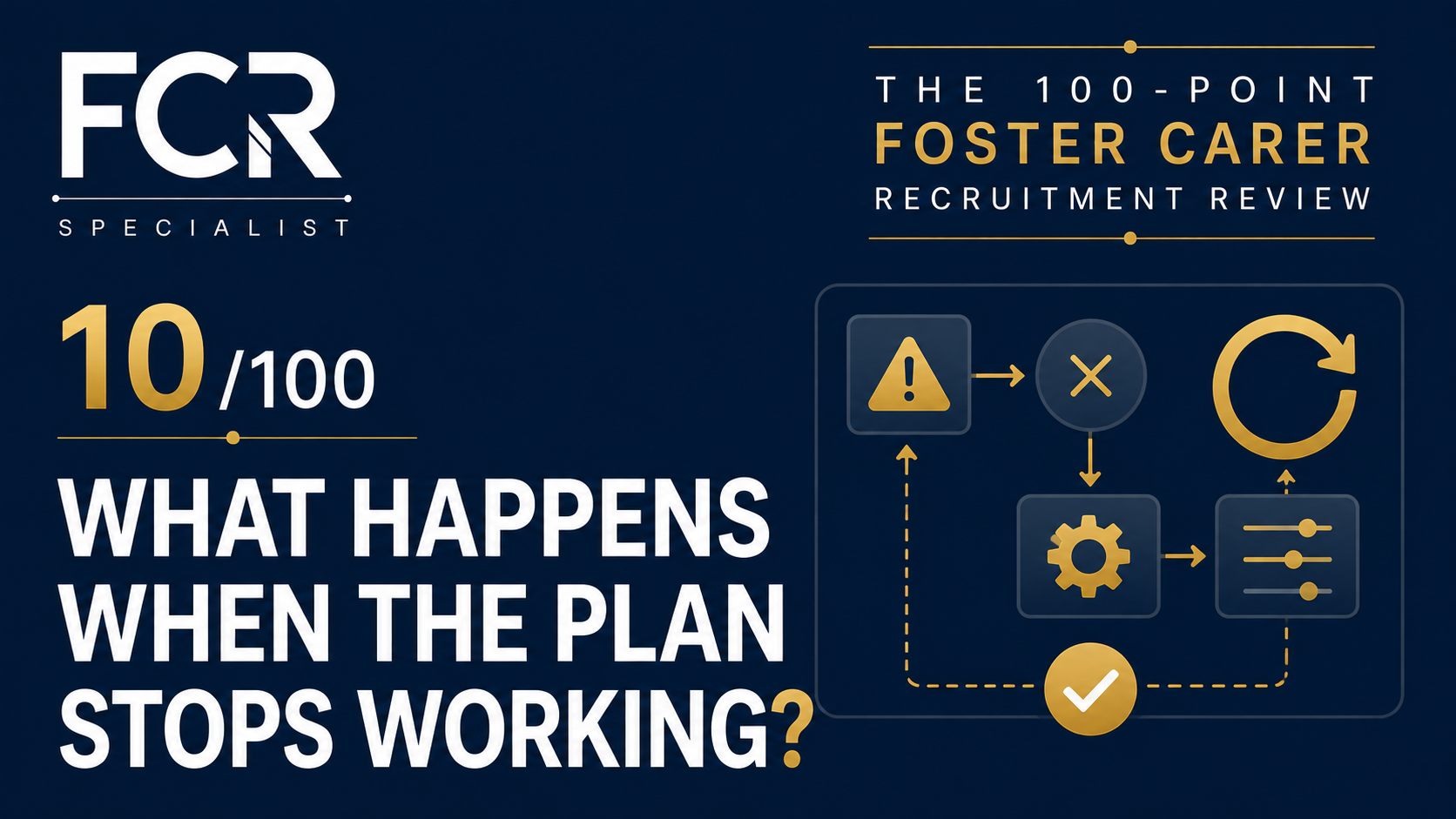
POINT 10/100 — What Happens When the Plan Stops Working?
THE 100-POINT FOSTER CARER RECRUITMENT REVIEW
POINT 10/100 — What Happens When the Plan Stops Working?
Stage One: Strategy & Leadership
By Point 09 of this Review, senior leaders should be able to see what is happening.
The recruitment dashboard tells you:
enquiry volume is falling.
Or perhaps enquiries are rising but suitability is falling.
Initial Home Visit conversion has dropped.
Applications are slowing.
Assessment waiting is increasing.
A particular geographical area is underperforming.
A campaign has stopped producing suitable prospective carers.
The year-end forecast is starting to move away from target.
Excellent.
Not because the problem exists.
But because you have identified it.
Now comes the most important question:
What happens next?
Does somebody investigate?
Does anything change?
Or does exactly the same issue appear in next month's report?
That is the final question in Stage One — Strategy & Leadership of the 100-Point Foster Carer Recruitment Review.
Data without action has limited value
Point 09 asked:
Can Senior Leaders See What Is Really Happening?
Visibility matters.
But visibility is only useful if it changes behaviour.
A red box on a dashboard does not improve Foster Carer Recruitment.
A detailed management report does not improve Foster Carer Recruitment.
A discussion at the monthly meeting does not improve Foster Carer Recruitment.
They may all be necessary steps.
But eventually somebody has to:
do something differently.
This is where reporting becomes management.
The plan will not always work
I think organisations sometimes make a mistake by treating deviation from the recruitment plan as evidence that somebody has failed.
It isn't necessarily.
Recruitment operates in a changing environment.
Audience behaviour changes.
Advertising performance changes.
Competition changes.
People's financial circumstances change.
The needs of children change.
Staff leave.
Operational capacity changes.
A proposition that worked twelve months ago may become less effective.
A campaign may perform differently from forecast.
An event may produce nothing.
Another may produce far more interest than expected.
The problem is not that every assumption made in the plan might fail.
The problem is continuing to behave as though the assumption is still correct once the evidence tells you it isn't.
Current policy increasingly recognises continuous improvement
The Department for Education's 2026 end-to-end fostering programme links transparent pipeline monitoring directly with continuous improvement and accountability.
It also states that programme delivery and impact will be monitored to understand progress and inform future rollout, while hub leads will share learning and best practice.
Later in the programme specification, DfE describes regular performance information as enabling Local Authorities and the department to monitor progress in real time. It also expects ongoing engagement during delivery to help identify and manage delivery challenges early.
That principle is just as relevant inside an individual fostering provider.
Performance information should create a feedback loop.
See.
Understand.
Act.
Learn.
How quickly can you change something?
This is one of my favourite tests of whether something genuinely is a strategic priority.
Imagine recruitment identifies a problem today.
For example:
Prospective foster carers are consistently dropping out between Initial Home Visit and application.
How long before the organisation can make a meaningful change?
A week?
A month?
Three months?
Six months?
Next year's recruitment plan?
The answer tells you a great deal about organisational agility.
Some changes should absolutely take time.
Safeguarding procedures should not be rewritten overnight.
Professional assessment standards should not be weakened because conversion is disappointing.
Major procurement decisions have governance requirements.
But many recruitment interventions do not need months.
A message can change.
A callback process can change.
A web page can change.
Follow-up can change.
An email can change.
An event can be cancelled.
A campaign can be paused.
A recruiter can test a different conversation.
Not every improvement requires organisational transformation.
Decision latency can become a recruitment problem
There is a useful concept here:
Decision latency.
The time between:
knowing something needs attention
and:
somebody being authorised to do something about it.
Imagine recruitment knows a webpage is producing confusion.
Marketing agrees.
The website supplier could change it.
But the amendment requires:
one meeting,
then another meeting,
then budget approval,
then sign-off,
then a communications meeting,
then supplier scheduling.
Four months later the page changes.
During those four months, prospective carers have continued encountering the problem.
The organisation did not lack data.
It lacked the ability to turn information into action quickly enough.
Pre-agree the triggers
One way to improve this is to decide beforehand what should trigger investigation.
For example:
If qualified-enquiry volume falls below an agreed level for two consecutive months:
investigate.
If IHV conversion falls materially below the normal range:
investigate.
If applications wait longer than an agreed period for allocation:
escalate.
If a campaign spends beyond an agreed amount without producing meaningful progression:
review.
If withdrawals with the same reason begin repeating:
investigate.
These do not need to become rigid rules.
They create management discipline.
Without triggers, organisations can tolerate deteriorating performance surprisingly slowly.
Don't jump straight to the solution
There is another danger.
The dashboard shows:
enquiries down.
The immediate conclusion becomes:
“We need more advertising.”
Perhaps.
But Point 03 taught us to look at the funnel.
Point 06 taught us to look at the strategy.
Point 07 taught us to look at resources.
Point 08 taught us to look at the Recruitment–Assessment interface.
The visible symptom may not tell us the cause.
For example:
Applications are falling.
Why?
Because enquiries have fallen?
Or enquiry quality?
Or Initial Home Visit availability?
Or people are attending visits but not applying?
Or response time has deteriorated?
Or the proposition no longer resonates?
Or assessment waiting has become well known locally?
Diagnose before prescribing.
That is one of the most important principles in the whole 100-Point Review.
Ask “what changed?”
This can be a surprisingly productive question.
Suppose performance was stable for six months.
Then conversion falls.
What changed?
New campaign?
Different audience?
Different recruiter?
New regional hub?
New enquiry form?
Website redesign?
Assessment waiting?
Different working hours?
Seasonality?
Staff absence?
Policy change?
Different data definition?
Sometimes the cause is relatively easy to identify once somebody asks the question systematically.
Separate signal from noise
Not every bad week requires intervention.
Recruitment numbers fluctuate.
A small provider may receive relatively few enquiries, meaning one unusual month can distort percentages dramatically.
So leadership needs to distinguish between:
Normal variation
and:
Meaningful change.
This is why trends matter.
One disappointing week may mean very little.
Three months of declining qualified enquiries may mean considerably more.
The decision should match the strength of the evidence.
Create hypotheses, not arguments
Imagine conversion falls.
Marketing says:
“The enquiries are fine. Recruitment isn't converting them.”
Recruitment says:
“The enquiries aren't suitable.”
Assessment says:
“Applicants are not adequately prepared.”
This is where organisations can waste enormous amounts of time defending departments.
There is a better approach.
Turn each claim into a hypothesis.
Hypothesis A
Enquiry quality has deteriorated.
What evidence would confirm or reject that?
Hypothesis B
Response or early-stage conversion has deteriorated.
What evidence would show that?
Hypothesis C
Applicant preparation is insufficient.
What evidence does Assessment have?
Now the organisation is investigating a system.
Not defending a team.
That cultural difference matters.
Test small before changing everything
Not every problem needs a wholesale redesign.
Suppose your follow-up process appears weak.
Test a different approach with 20 enquiries.
Suppose community engagement in one area appears promising.
Test it there before rolling it out everywhere.
Suppose a new message appears to improve click-through.
Now test whether those people actually become suitable enquiries.
Suppose evening calls appear more effective.
Pilot an evening rota.
This is how learning becomes manageable.
Change something specific.
Measure what happens.
Then decide whether to scale it.
Define what success would look like before the test
This prevents another common problem.
A provider introduces an initiative.
Three months later everyone has a different view of whether it worked.
Before testing something, agree:
What are we trying to change?
Which measure should move?
How much movement would be meaningful?
How long will we test it?
What would cause us to stop?
What happens if the result is neutral?
This connects directly back to Point 05:
Does Everyone Agree What Success Looks Like?
The Stop / Start / Continue test
Sometimes improvement does not need to be complicated.
For each major part of the recruitment plan, ask:
STOP
What are we doing that no longer appears to add sufficient value?
START
What does the evidence suggest we should introduce or test?
CONTINUE
What is working well and should be protected?
This is particularly useful because organisations often add new initiatives without removing old ones.
The workload grows.
The strategy becomes cluttered.
Nothing ever stops.
Eventually recruitment becomes a collection of accumulated activity rather than a coherent operating model.
Stop defending sunk cost
This can be difficult.
You have spent:
£20,000 on a campaign.
Months building an event.
Significant time producing creative content.
A senior manager strongly supported the initiative.
Then the data suggests:
It isn't working.
The money already spent is gone.
Continuing to spend purely because stopping would feel uncomfortable does not recover it.
The question should be:
What does the evidence tell us about the next pound, the next hour and the next decision?
That is strategic discipline.
Create a recruitment intervention log
I think this could be extremely useful in many fostering services.
Keep a simple record.
ISSUE
What did we see?
HYPOTHESIS
What do we think may be causing it?
ACTION
What are we changing?
OWNER
Who is responsible?
DATE
When does it start?
MEASURE
What are we watching?
REVIEW DATE
When will we decide whether it worked?
OUTCOME
Continue, adapt or stop?
That becomes organisational memory.
Otherwise the same ideas can be tried repeatedly without anyone remembering what happened last time.
Recruitment needs a review rhythm
An annual recruitment-plan review is not enough.
Neither does every issue require weekly senior-management intervention.
Different layers need different rhythms.
For example:
OPERATIONAL
Weekly or fortnightly:
stuck cases,
response,
pipeline movement,
urgent exceptions.
MANAGEMENT
Monthly:
conversion,
source,
geography,
withdrawal,
capacity,
forecast.
STRATEGIC
Quarterly or at appropriate intervals:
whether the overall recruitment approach, resource allocation and assumptions remain valid.
The exact timetable will differ by provider.
The principle is:
Review frequently enough to influence the outcome.
Not simply explain it afterwards.
Some decisions need senior leadership
Recruitment can change:
a telephone script,
a follow-up rhythm,
an event schedule.
But other problems require authority.
For example:
assessment capacity,
marketing budget,
policy,
working hours,
procurement,
technology,
staffing,
cross-departmental processes.
This takes us back to Point 04.
If the person who sees the problem cannot influence the resource or policy causing it, there must be a clear escalation route.
Otherwise management information identifies a problem that nobody has the authority to solve.
Do not punish people for surfacing bad news
This is a cultural issue.
Imagine a Recruitment Manager discovers:
our expensive campaign is performing badly.
In a healthy organisation, that is useful intelligence.
In an unhealthy one, it can feel safer to explain the performance away.
If staff believe that identifying a problem will be interpreted as admitting failure, problems will surface later.
Leadership needs to create a culture in which:
Early bad news is valuable.
Because a problem discovered while there is still time to intervene is considerably more useful than a beautifully explained missed target at year-end.
Innovation needs permission to fail
Government's current fostering reform programme explicitly talks about encouraging innovation and transformation while monitoring delivery and impact to inform what happens next.
Innovation cannot logically mean:
every experiment must work.
The purpose of testing is to learn.
A new campaign may fail.
A new community approach may underperform.
A different proposition may prove ineffective.
That is acceptable if:
the test was controlled,
the evidence is understood,
the learning is captured,
and the organisation responds.
Failed experiments can improve strategy.
Repeated unexamined failure cannot.
Know when to persevere
Adaptability does not mean abandoning every initiative quickly.
Some recruitment activity requires time.
Community relationships take time.
SEO takes time.
Reputation takes time.
Nurture takes time.
Brand building takes time.
So leadership also needs to ask:
Is this not working — or has it simply not had enough time to work yet?
Again, the answer should come from the original logic of the initiative.
If success was expected in six months, judging it after three weeks makes little sense.
This is why expectations should be agreed before implementation.
Build contingency into the plan
A recruitment plan should not assume that every channel delivers exactly as expected.
For example:
What happens if paid social deteriorates?
What happens if enquiry demand spikes?
What happens if a recruiter leaves?
What happens if Assessment becomes constrained?
What happens if one target geography performs poorly?
What happens if a national campaign suddenly generates significantly more interest?
The answer does not need to be a complex disaster-recovery plan.
But leaders should know where there is flexibility.
The six-stage response loop
I would suggest a simple model:
1. SIGNAL
What changed?
2. DIAGNOSE
What is most likely causing it?
3. DECIDE
What intervention will we make?
4. ACT
Who will do it and by when?
5. REVIEW
Did the intervention change the expected measure?
6. LEARN
Do we embed, modify or stop it?
Then repeat.
That is what continuous improvement actually looks like in practice.
The Stage One leadership test
We have now reached Point 10.
So I would bring the whole first stage together.
A strategically managed Foster Carer Recruitment service should be able to answer:
POINT 01
Is Foster Carer Recruitment genuinely a strategic priority?
POINT 02
Do we know what fostering capacity we actually need?
POINT 03
Have we built the recruitment target backwards?
POINT 04
Who owns the outcome?
POINT 05
Does everyone agree what success looks like?
POINT 06
Do we have a genuine recruitment plan?
POINT 07
Have we resourced it properly?
POINT 08
Are Recruitment and Assessment operating as one journey?
POINT 09
Can leadership see what is happening?
And finally:
POINT 10
When the evidence tells us something isn't working — can we change it?
That is Strategy & Leadership.
Not a document.
A management system.
Ten questions I would ask
- How quickly does underperformance become visible?
- What triggers investigation?
- Who is responsible for diagnosing the cause?
- Can the relevant person actually authorise change?
- How long does it normally take from identifying a problem to implementing an intervention?
- Do you test changes rather than simply launch large solutions?
- Is success defined before a new intervention begins?
- Do you keep a record of what was tried and what happened?
- Can teams surface poor performance without feeling they must defend themselves?
- When the evidence says the plan is wrong, is your organisation prepared to change the plan?
That final question is the Point 10 test.
Where FCR Specialist fits
It is often difficult to diagnose your own operating system while simultaneously running it.
Teams are busy.
Problems cross departmental boundaries.
Historic activity becomes normalised.
Reporting tells you what is happening but not necessarily why.
That is where an external recruitment perspective can add value.
The FCR Specialist Foster Carer Recruitment Diagnostic and Re-tune examines the whole recruitment system:
strategy,
targets,
marketing,
pipeline,
conversion,
assessment,
resources,
data,
candidate experience,
and organisational decision-making.
The purpose is not to arrive with a pre-written answer.
It is to diagnose where performance is being gained or lost and identify practical interventions appropriate to that service.
Because sometimes the right answer is:
do more.
Sometimes:
do less.
Sometimes:
stop something.
Sometimes:
change something.
And occasionally:
leave something alone because it is already working.
Diagnosis should come before prescription.
STAGE ONE COMPLETE
THE 100-POINT FOSTER CARER RECRUITMENT REVIEW
STAGE ONE — STRATEGY & LEADERSHIP
01 — Is Foster Carer Recruitment Really a Strategic Priority?
02 — Do You Know How Many Foster Carers You Actually Need?
03 — Has Your Recruitment Target Been Built Backwards?
04 — Who Actually Owns Foster Carer Recruitment?
05 — Does Everyone Agree What Success Looks Like?
06 — Is Your Recruitment Plan Actually a Plan?
07 — Have You Resourced the Recruitment Ambition Properly?
08 — Are Recruitment and Assessment Working as One System?
09 — Can Senior Leaders See What Is Really Happening?
10 — What Happens When the Plan Stops Working?
Ten questions.
One strategic operating system.
The next ten Points will move us into Stage Two of the Review.