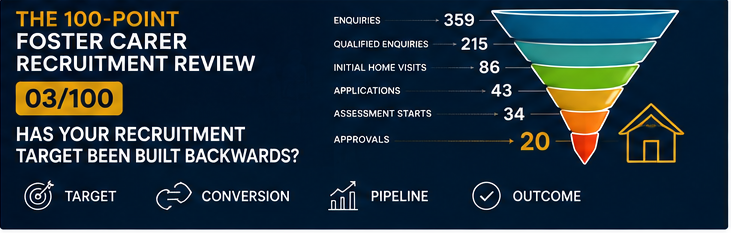
POINT 03/100 — Has Your Recruitment Target Been Built Backwards?
Stage One — Strategy & Leadership
THE 100-POINT FOSTER CARER RECRUITMENT REVIEW
POINT 03/100 — Has Your Recruitment Target Been Built Backwards?
Stage One: Strategy & Leadership
You’ve decided that your fostering service needs another 20 foster carer households.
Thanks for reading! Subscribe for free to receive new posts and support my work.
So the recruitment target is 20.
Simple?
Not quite.
Because the recruitment team cannot go out and find 20 approvals.
They have to find enough people at the beginning of the recruitment journey for 20 suitable households eventually to emerge from the other end.
That is a very different calculation.
And it leads to one of the questions I think every fostering provider should ask:
Has your Foster Carer Recruitment target been built backwards?
Start with the outcome
In Point 02 of this Review I looked at the question:
Do You Know How Many Foster Carers You Actually Need?
That matters because the starting number should be based on the fostering capacity the service needs to create — not simply an arbitrary target for “more carers”.
But once that number has been established, another calculation has to happen.
Suppose the answer is:
We need 20 additional approved fostering households.
Before giving 20 to the recruitment team as their target, leadership needs to work backwards.
How many assessments will have to start to produce 20 approvals?
How many applications will be required to generate those assessments?
How many Initial Home Visits?
How many qualified enquiries?
How many total enquiries?
And how many people will your marketing and community activity need to reach to generate those enquiries?
That is your recruitment funnel.
The target at the bottom determines the requirement at the top
This is ordinary recruitment mathematics.
If every person who enquired became an approved foster carer, the calculation would be very easy.
But they don’t.
Nor should they.
Some people enquire and discover fostering isn’t right for them.
Some are not suitable.
Some decide the timing isn’t right.
Some withdraw.
Some are screened out.
Some circumstances change.
Some enter assessment and do not complete.
That is a normal part of a selection process.
The important issue is not eliminating all attrition.
It is understanding it.
Because once you know your conversion rate at each stage, you can begin to calculate what the top of the recruitment funnel needs to produce.
The national figures demonstrate why this matters
Ofsted recorded 8,290 mainstream fostering applications during 2024/25.
Of the 5,370 applications completed within the reporting period:
- 2,050 resulted in approval
- 3,290 were withdrawn
- 30 were rejected
So 38% of completed applications resulted in approval, while 61% were withdrawn. Of those withdrawn applications, around two thirds were withdrawn by applicants themselves.
These national figures should not be treated as a conversion benchmark for an individual provider. Applications and approvals can also span reporting periods, so simply dividing one annual figure by another can produce misleading conclusions.
But they demonstrate something extremely important:
There is substantial movement between entering the formal application process and reaching approval.
And there are several stages before application where prospective foster carers can also leave.
That means the recruitment requirement at the top of the funnel may be many times larger than the approval target at the bottom.
An illustrative example
Let’s imagine a provider needs:
20 new approved households.
Now suppose its own historic data shows the following conversion rates.
These figures are illustrative only — every provider should use its own data.
Recruitment stageHistoric conversion to next stageEnquiry → qualified enquiry60%Qualified enquiry → Initial Home Visit40%Initial Home Visit → application50%Application → assessment start80%Assessment start → approval60%
Now work backwards.
To achieve 20 approvals, at a 60% assessment-to-approval rate, you need approximately:
34 assessment starts.
To generate 34 assessment starts at an 80% conversion rate:
43 applications.
To generate 43 applications at a 50% conversion rate:
86 Initial Home Visits.
To generate 86 IHVs at a 40% conversion rate:
215 qualified enquiries.
And to generate 215 qualified enquiries at a 60% conversion rate:
Approximately 359 enquiries.
Suddenly:
“Recruit 20 foster carers”
has become:
“Our current recruitment model needs approximately 359 enquiries to produce 20 approvals.”
That is a much more useful management conversation.
And then comes the important question
Can your current operation deliver 359 enquiries?
If historically you generate 180 enquiries a year, giving the team a target of 20 approvals without changing anything else isn’t really a plan.
It is an expectation.
Something in the system will need to change.
There are several possibilities.
You could generate more enquiries.
You could improve the quality of enquiries.
You could improve conversion at one or more stages.
You could reduce unnecessary delay.
You could improve nurture.
You could change the audience being targeted.
You could strengthen the proposition.
You could address avoidable withdrawal.
You could increase operational capacity.
Usually, the answer is likely to involve a combination of several of these.
But now the organisation can make an informed decision.
This is why simply demanding more enquiries can be wrong
Imagine another provider.
It already generates enough enquiries to theoretically achieve its approval target.
But it loses an unusually high proportion between Initial Home Visit and application.
Should its immediate response be:
Spend more money generating more enquiries?
Perhaps not.
You may simply be pouring more people into the top of a funnel that is already leaking badly halfway down.
This is one reason I am cautious when organisations automatically respond to disappointing recruitment by increasing advertising spend.
The marketing may not be the problem.
The number of enquiries may not be the problem.
The conversion point may be somewhere else entirely.
Every stage has a job
A useful end-to-end recruitment funnel might include:
AWARENESS
People who encounter your organisation or fostering proposition.
ENQUIRY
People who actively contact you.
QUALIFIED ENQUIRY
People who remain potentially suitable after initial discussion.
INITIAL HOME VISIT
A meaningful exploration of suitability and mutual expectations.
APPLICATION
The prospective household formally commits to progressing.
ASSESSMENT
The formal assessment journey begins.
PANEL / DECISION
The recommendation and approval process.
APPROVAL
A new fostering household enters the organisation’s available capacity.
Different providers may label these stages differently.
That doesn’t particularly concern me.
What matters is that the stages are defined consistently enough to measure movement between them.
Don’t use sector averages where your own data exists
This is important.
National figures provide context.
They do not provide your recruitment model.
Your conversion rate may be completely different from the provider next door.
It may also differ:
by geography,
by campaign,
by enquiry source,
by audience,
by time of year,
by recruiter,
by placement type,
or by the length of time somebody spends at a particular stage.
So if you are building your recruitment target backwards, use your own historical conversion data wherever possible.
And if you cannot do that because the information isn’t available?
That itself is an important finding.
You are trying to forecast an outcome without knowing how the system currently produces that outcome.
Averages can also hide the problem
Suppose your overall enquiry-to-approval conversion rate is 5%.
That is useful.
But it isn’t enough.
You need to know where people are leaving.
Two providers could both convert 5% of enquiries to approval and have completely different problems.
Provider A may lose most people immediately after enquiry.
Provider B may have excellent early conversion but lose far too many during assessment.
The headline outcome is identical.
The solution is completely different.
That is why I prefer stage-by-stage conversion.
Build time into the calculation
There is another problem with annual targets.
Foster Carer Recruitment has a significant time lag.
Someone who enquires in February is unlikely to become an approved foster carer in February.
They may not be approved within that financial year at all.
Therefore a target such as:
“We need 20 approvals by March”
cannot be considered in isolation from the current pipeline.
How many people are already:
at IHV?
in application?
in assessment?
approaching panel?
How old are those cases?
What is their realistic probability of completing?
And how much of your year’s target must therefore come from people who have not yet enquired?
This is why recruitment forecasting should be a rolling pipeline exercise, not merely an annual target set in April and reviewed the following March.
The Government is moving towards this kind of accountability
The Department for Education’s 2026 Fostering Recruitment and Retention Programme is explicitly extending beyond a recruitment-focused “front door” into assessment, approval and continuing support.
The programme also says Local Authority-level targets will be set towards the national ambition of creating 10,000 additional foster places by April 2029, with participating hubs expected to share regular operational and performance data so progress can be monitored and continuous improvement supported.
That is significant.
A target without an understanding of the operational pathway needed to achieve it has limited management value.
Three tests for your recruitment target
I would apply three simple tests.
TEST ONE — THE CAPACITY TEST
Does the approval target genuinely reflect the fostering capacity identified in Point 02?
If not, stop.
The wrong target accurately calculated is still the wrong target.
TEST TWO — THE CONVERSION TEST
Using your real historic conversion rates, what volume is required at every preceding stage to produce the target?
Does the maths work?
TEST THREE — THE DELIVERY TEST
Does the organisation actually have sufficient marketing reach, recruiter capacity, IHV capacity, assessment capacity and management support to process that volume?
Because generating 500 enquiries is not particularly useful if the operation can only effectively manage 200.
The recruitment team should be able to challenge the target
This is an important leadership issue.
A recruitment manager should be able to say:
“To deliver 25 approvals at our current conversion rates, we need approximately X applications, Y home visits and Z enquiries.”
And leadership should then be able to ask:
“What would have to change to improve that?”
That is a far healthier conversation than:
“Your target is 25. Please go and deliver it.”
One is a recruitment strategy.
The other is a number.
Ten questions I would ask
- What is your required approval target?
- How was it derived?
- What proportion will come from people already in the pipeline?
- What is your historic assessment-to-approval conversion?
- What is your application-to-assessment conversion?
- What is your IHV-to-application conversion?
- What is your qualified-enquiry-to-IHV conversion?
- What is your enquiry-to-qualified-enquiry conversion?
- Using those rates, how many enquiries are required to deliver the target?
- Is your organisation currently capable of generating and processing that volume?
If you cannot answer questions 4–8, then question 9 is largely guesswork.
Where FCR Specialist fits
One of the areas I examine through the Foster Carer Recruitment Diagnostic and Re-tune is the actual recruitment funnel.
Not simply:
How many enquiries did you receive?
But:
Where did they go?
How many progressed?
Where did people leave?
How long did each stage take?
Which sources converted?
Which audiences converted?
And what would your existing conversion performance produce if nothing changed?
That allows us to distinguish between a marketing problem, a conversion problem, a process problem, a capacity problem or a combination of them.
And that is a much better starting point for improvement than simply deciding to spend more.
THE 100-POINT FOSTER CARER RECRUITMENT REVIEW
Stage One — Strategy & Leadership
03/100 — Has Your Recruitment Target Been Built Backwards?
NEXT: 04/100 — Who Actually Owns Foster Carer Recruitment?
Because once the target has been defined and the recruitment funnel understood, another question immediately emerges:
Who in the organisation is actually accountable for making the whole thing work?
COPY 2 — SUBSTACK EXTENDED / ACADEMIC VERSION
Has Your Recruitment Target Been Built Backwards?
Why Foster Carer Recruitment targets should be calculated from outcomes, not aspirations
Point 03 of The 100-Point Foster Carer Recruitment Review
Every recruitment strategy eventually encounters mathematics.
That may sound obvious, but in Foster Carer Recruitment it is surprisingly easy for the mathematics to appear only after the target has already been set.
A senior leadership team decides that the service needs:
15 new households.
20 approvals.
A 10% increase.
Or perhaps a contribution to a larger regional sufficiency ambition.
The number then travels down through the organisation until it arrives with recruitment.
The recruiter is expected to deliver it.
But there is a question that should have been asked much earlier:
What has to happen throughout the recruitment system for that number to become achievable?
That is the subject of Point 03.
Outcome planning versus activity planning
Recruitment plans frequently contain activities.
Social media campaigns.
Recruitment events.
Google advertising.
Facebook advertising.
Community engagement.
Videos.
Open evenings.
Referral campaigns.
Those activities may all have value.
But none of them answers the fundamental planning question:
How much activity must produce how much movement through the recruitment pipeline to create the required number of approved households?
Good recruitment planning works backwards.
We begin with the required outcome.
Then calculate the preceding conditions necessary to produce it.
This is essentially a form of reverse forecasting.
Point 02 established the destination
In Point 02 I argued that:
“We need more foster carers” is not a recruitment target.
Providers should understand the capacity required in terms of volume, replacement, capability, geography and availability.
Only after that requirement has been identified should the recruitment calculation begin.
Suppose that analysis tells us that the organisation requires:
20 additional approved fostering households.
Twenty is the outcome.
It is not the top of the funnel.
To produce those 20 households, the organisation needs a sufficient volume of suitable prospective foster carers moving through every preceding stage.
Recruitment is a probability system
At each stage of a recruitment process, there is a probability that somebody progresses.
No well-designed fostering recruitment process should expect 100% conversion.
Selection is necessary.
Some people will appropriately decide that fostering isn’t right for them.
Some enquiries will be unsuitable.
Some households’ circumstances will change.
Some people will decide to defer.
Some applications will not proceed.
The important distinction is between:
appropriate attrition
and
avoidable attrition.
But both affect recruitment mathematics.
A strategic target therefore needs to account for the reality that only a proportion of people entering one stage will progress to the next.
What national data tells us
Ofsted’s 2024/25 fostering statistics provide a useful illustration.
There were 8,290 mainstream fostering applications recorded during the year.
Of the 5,370 applications completed during the reporting period:
2,050 were approved.
3,290 were withdrawn.
30 were rejected.
This means that 38% of completed applications resulted in approval while 61% were withdrawn. Around 66% of withdrawn applications were withdrawn by applicants rather than by the service.
Care is required when interpreting these figures.
They are annual national data, not a single cohort followed from enquiry to approval. Some applications remain in progress across reporting periods.
Therefore they should not be turned into a simplistic national “conversion rate”.
Their importance here is different.
They demonstrate substantial attrition after formal application has already occurred.
Before application there are further stages where people may disengage.
So an approval target must be supported by considerably more activity upstream.
The reverse-funnel model
Consider an illustrative provider needing 20 approvals.
Suppose its historic data tells it:
- 60% of assessment starts reach approval
- 80% of applications reach assessment
- 50% of Initial Home Visits become applications
- 40% of qualified enquiries reach IHV
- 60% of enquiries become qualified enquiries
These are illustrative percentages, not recommended benchmarks.
Working backwards:
Required stageApproximate number requiredApprovals20Assessment starts34Applications43Initial Home Visits86Qualified enquiries215Total enquiries359
One headline target has suddenly revealed the scale of the operation required to deliver it.
And this is before calculating the audience, website traffic, advertising exposure, community reach and other activity required to generate those 359 enquiries.
This changes the leadership conversation
Suppose the provider historically generates only 180 enquiries per year.
There is now an obvious strategic gap.
At current performance, one or more things must change.
The organisation could:
increase enquiry generation,
improve targeting,
increase the proportion of enquiries that are genuinely suitable,
improve response,
improve early-stage engagement,
increase IHV conversion,
reduce unnecessary withdrawal,
improve assessment throughput,
or increase capacity within the recruitment and assessment functions.
Crucially, leadership can now make choices.
Without the reverse calculation, the conversation often becomes:
“Recruitment needs to work harder.”
The numbers may demonstrate that working harder within the existing system could never have delivered the requested outcome.
A target can be mathematically impossible
This point deserves emphasis.
Imagine a service generated 250 enquiries last year and approved 10 new households.
Nothing significant has changed in:
marketing expenditure,
staffing,
process,
assessment capacity,
geographical reach,
proposition,
or conversion.
Leadership then sets an approval target of 20.
On what basis should the organisation believe output will double?
There may be a perfectly credible answer.
Perhaps a new campaign is launching.
Perhaps conversion has already improved.
Perhaps new recruitment capacity has been funded.
Perhaps community engagement is generating a new pipeline.
Perhaps assessment resources are increasing.
But if nothing in the input or conversion model has changed, doubling the output is not a strategy.
It is an assumption.
More enquiries are not always the answer
Reverse planning can expose another issue.
Suppose the maths indicates that the provider already generates sufficient enquiries to achieve its approval target.
Yet approvals remain low.
The problem may not be lead generation at all.
Perhaps the provider is experiencing substantial leakage:
between enquiry and first meaningful conversation,
between conversation and IHV,
between IHV and application,
or during assessment.
Increasing advertising could make the headline enquiry number look better without materially improving approvals.
It may even create additional operational pressure and worsen candidate experience.
The intervention therefore needs to be made at the constraint, not automatically at the top of the funnel.
Funnel conversion and candidate quality
Conversion cannot be considered independently of quality.
A campaign could dramatically increase enquiries while decreasing the proportion of suitable people within them.
The enquiry number rises.
The conversion rate falls.
Recruitment staff become busier.
Approval output barely changes.
A cheaper enquiry is therefore not necessarily a better recruitment outcome.
The relevant question becomes:
What does it cost and take to produce a suitable approved fostering household?
That is considerably more meaningful than:
What does an enquiry cost?
I will return to channel and marketing effectiveness later in the 100-Point Review.
For Point 03, the principle is simply that volume and conversion must be considered together.
Cohort analysis matters
There is also a methodological problem with annual totals.
If an individual enquires in November and is approved the following June, their enquiry and approval sit in different reporting periods.
If we simply divide approvals this year by enquiries this year, we may produce a conversion figure that does not accurately describe either cohort.
A more mature recruitment operation should therefore be able to follow groups of prospective carers through time.
For example:
Of the people who enquired during Quarter One, what proportion eventually:
qualified?
received an IHV?
applied?
entered assessment?
were approved?
withdrew?
were declined?
deferred?
This provides a clearer understanding of actual recruitment behaviour than isolated monthly totals.
Time should be part of the forecast
A funnel has both volume and velocity.
Two providers may have identical conversion rates but very different outcomes because one progresses people far more slowly.
That matters because annual approval targets have deadlines.
If most prospective foster carers currently take a substantial period to progress from enquiry to approval, then an organisation cannot wait until January to address an annual target due in March.
The current pipeline needs to be considered.
At any point, leaders should have some understanding of:
how many likely approvals are already in assessment,
how many potential future assessments are sitting earlier in the process,
and how much additional pipeline needs to be created to meet forecast demand.
I would describe this as pipeline coverage.
Recruitment capacity can become the bottleneck
There is little value generating a volume the organisation cannot process effectively.
If the reverse calculation tells us that 20 approvals require:
359 enquiries,
86 Initial Home Visits,
43 applications,
and 34 assessment starts,
the organisation must ask whether it has the operational capacity to deliver those activities.
Who will answer those enquiries?
Who will follow them up?
Who will undertake the IHVs?
Who will allocate the assessments?
Who will undertake them?
Is panel capacity available?
Are decision-making arrangements sufficient?
A recruitment target has implications beyond recruitment.
This is one reason Foster Carer Recruitment needs senior organisational ownership.
And it takes us directly towards Point 04.
Government policy is moving towards end-to-end measurement
This is not simply a theoretical model.
The Department for Education’s 2026 expansion of the Fostering Recruitment and Retention Programme explicitly moves beyond a recruitment-only “front door” to include the full assessment and approval journey and ongoing support.
The programme guidance also states that participating areas will have Local Authority-level targets and will provide regular operational and performance information to support real-time monitoring and continuous improvement.
That reflects an important principle:
You cannot manage an end-to-end outcome if you only measure one end of the process.
What good target setting looks like
I would expect a credible Foster Carer Recruitment target to contain at least five things.
1. A defined outcome
What capacity must be produced?
2. A conversion model
What proportion historically progresses through each recruitment stage?
3. A pipeline forecast
What contribution can reasonably be expected from people already progressing?
4. An activity requirement
What additional volume needs to enter each stage?
5. An operational-capacity check
Can recruitment, assessment and the rest of the organisation actually process that volume?
Only when those pieces fit together does an approval target start becoming a credible plan.
What if the organisation doesn’t have the data?
Then don’t invent it.
That is a diagnostic finding.
Start collecting it.
Define the stages.
Agree what counts as an enquiry, qualified enquiry, IHV, application and assessment start.
Track people consistently.
Build a baseline.
The first model may be imperfect.
That is still preferable to setting a target without any understanding of the process required to achieve it.
Ten questions for senior leaders
Before agreeing the next recruitment target, ask:
1. What is the required approval outcome?
2. What contribution is already sitting within the current pipeline?
3. What percentage of assessment starts historically result in approval?
4. What proportion of applicants enter assessment?
5. What proportion of Initial Home Visits become applications?
6. What proportion of qualified enquiries reach IHV?
7. What proportion of initial enquiries become qualified enquiries?
8. What volume is therefore required at each stage?
9. Does the organisation have the capacity to process that volume?
10. If the target requires significantly better performance than last year, what specifically is changing to make that improvement credible?
Question 10 is the one I would be particularly interested in hearing answered.
From Point 03 to Point 04
Once a target has been calculated end to end, something becomes immediately apparent.
No single member of staff controls all of it.
Marketing may generate awareness.
Recruiters may manage enquiries.
Social workers may undertake visits and assessments.
Panels and decision-makers become involved later.
Senior leadership controls resources and policy.
Which leads to Point 04:
Who Actually Owns Foster Carer Recruitment?
Because if several departments influence the outcome, somebody still has to own the result.
Where FCR Specialist fits
When I undertake a Foster Carer Recruitment Diagnostic and Re-tune, I examine the actual recruitment funnel rather than simply looking at headline activity.
That includes:
- stage-by-stage conversion
- pipeline volume
- candidate movement
- withdrawal
- ageing cases
- operational capacity
- recruitment sources
- where performance is being lost
That enables us to distinguish between:
an attraction problem,
a quality problem,
a conversion problem,
a process problem,
an assessment-capacity problem,
or several interacting problems.
Because before increasing expenditure at the top of the funnel, it makes sense to understand what is happening to the people already inside it.
References
Ofsted — Fostering in England: 1 April 2024 to 31 March 2025. National statistics covering applications, approvals, withdrawals, households, carers and fostering places.
Department for Education — Fostering Recruitment and Retention Programme: New Hubs Application Guide, 2026. The current programme extends to recruitment, assessment and approval and requires operational/performance reporting against Local Authority-level targets.