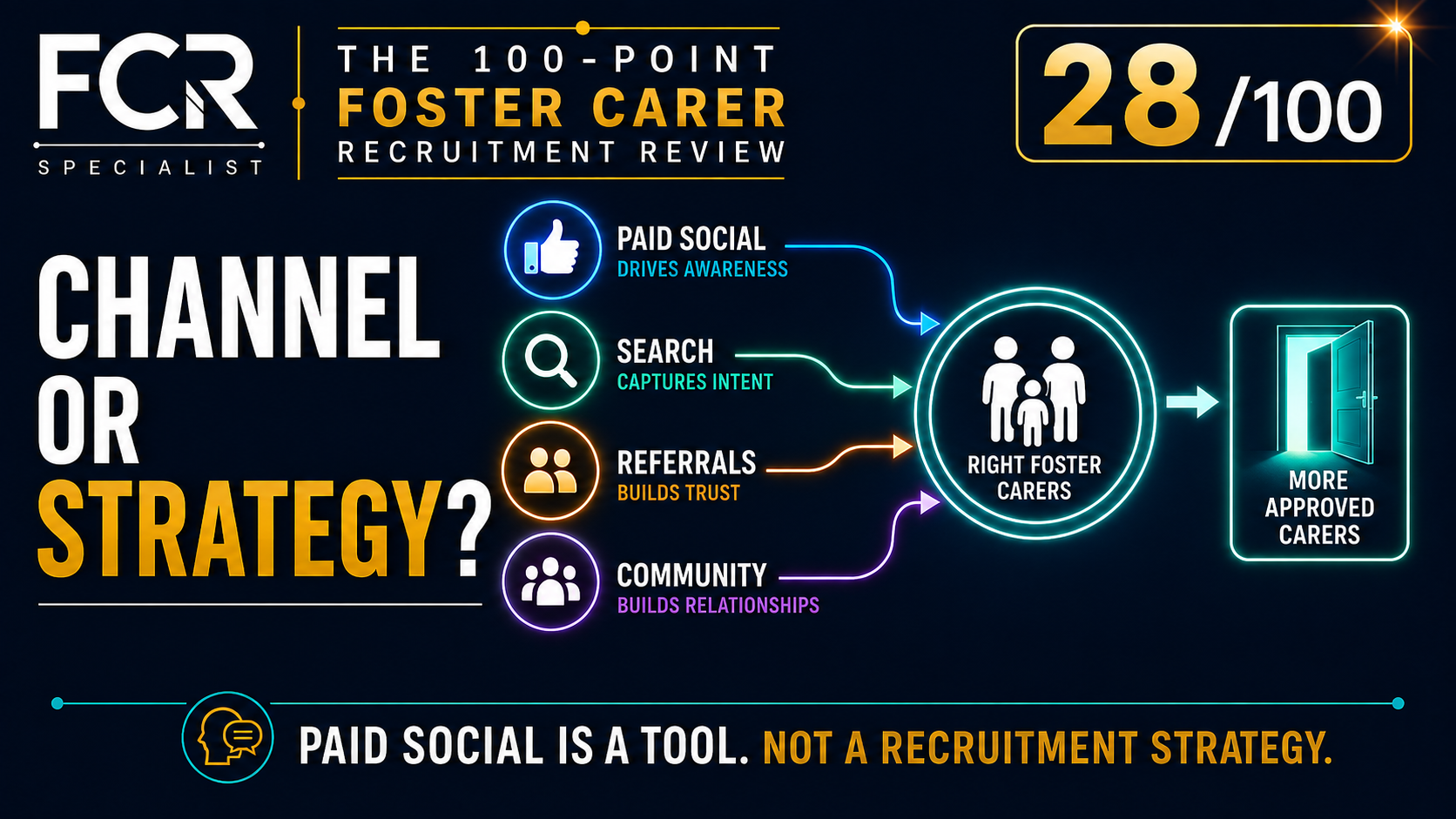
Is Your Channel Strategy Based on Evidence — or Are You Simply Posting Where You Always Have?
Is Your Channel Strategy Based on Evidence — or Are You Simply Posting Where You Always Have?
Point 28 of The 100-Point Foster Carer Recruitment Review
Facebook.
Instagram.
Google.
LinkedIn.
Local newspapers.
Community events.
Schools.
Employers.
Businesses.
Libraries.
Foster Carer referrals.
Email.
PR.
Local groups.
Paid search.
Paid social.
All of them can potentially have a place in Foster Carer Recruitment.
But that is not the important question.
The important question is:
WHY IS EACH ONE IN YOUR PLAN?
If I walked into your organisation tomorrow, pointed to every channel on your Foster Carer Recruitment plan and asked:
“Why are we doing this?”
what would the answer be?
Would it be:
“Because this is where this particular audience can be reached.”
“We know this channel produces strong enquiries.”
“This activity builds awareness in a locality where we need Foster Carers.”
“This channel reaches people earlier in the decision journey.”
“This is where our transfer Foster Carers are coming from.”
“Our Foster Carer referral scheme produces fewer enquiries, but they progress particularly well.”
Or would the answer sometimes be:
“Because we've always done it.”
That is the issue behind Point 28.
A channel is not a strategy
One of the most common phrases in recruitment marketing is:
“We're doing social media.”
That's an activity.
It isn't yet a strategy.
Likewise:
“We're doing Facebook advertising.”
“We're doing Google Ads.”
“We've got an Instagram account.”
“We attend events.”
None tells me:
who the activity is for,
what part of the recruitment journey it serves,
what message it carries,
what outcome is expected,
or how success will be measured.
A channel is simply a means of reaching somebody.
THE CHANNEL NEEDS A JOB.
That job must connect back to the recruitment strategy.
The DfE research gives us an important warning
The Department for Education's Foster Carer Recruitment and Conversion Rates research examined approaches used across its fostering service case studies.
It identified digital, media, physical and in-person activity and reported a clear view among participants that there was no single best marketing approach; using a mixture of channels was considered valuable.
That included:
social media,
Google and paid search,
websites,
physical advertising,
community presence,
events,
word-of-mouth,
refer-a-friend activity,
and transfer incentives.
That should immediately challenge a recruitment plan dominated by one box labelled:
DIGITAL.
Digital is not one thing.
And Foster Carer Recruitment does not happen entirely online.
Different channels perform different recruitment functions
Point 27 gave us:
PERSON → STAGE → QUESTION → MESSAGE → NEXT ACTION
Point 28 adds another element:
PERSON → STAGE → MESSAGE → CHANNEL → ACTION
Once we know who we are trying to communicate with, we can ask:
Where is the appropriate place to reach them?
And that depends partly on what we want the channel to achieve.
PAID SOCIAL — CREATE OR INTERRUPT ATTENTION
Paid social can put fostering in front of somebody who was not actively searching for it.
That is valuable.
Someone may have been vaguely considering fostering for years but never reached the point of actively researching it.
A well-targeted story or question could prompt:
“Maybe this is something I should look at.”
But that person is not necessarily ready to apply.
This is one reason raw lead volume can be deceptive.
Participants in the DfE research reported that digital marketing could generate large numbers of initial, relatively non-committal contacts, and some Facebook-generated contacts were difficult to reconnect with or less likely to progress. The study is qualitative and should not be interpreted as proving Facebook performs badly everywhere; rather, it demonstrates why channel quality needs to be measured beyond lead volume.
So:
FACEBOOK IS NOT THE PROBLEM.
The question is what job we expected Facebook to do.
SEARCH — CAPTURE EXISTING INTENT
Now consider someone typing:
“Fostering near me”
or
“Can I foster if I work full time?”
into Google.
That person is behaving differently.
They are seeking information.
Their intent is active.
The same DfE study reported that participants saw people arriving at fostering websites through Google searches as sometimes spending longer on the site, viewing more pages and being more likely to enquire than social-originating traffic. Again, this was participant-reported evidence rather than a universal benchmark, but it reinforces the importance of distinguishing how people arrived.
This is why Google and paid social should not simply be grouped together as:
“digital enquiries.”
Their recruitment intent may be different.
I will return much more deeply to findability, search and digital visibility later in the 100-Point Review.
For Point 28, the principle is enough:
KNOW WHAT ROLE THE CHANNEL PLAYS.
ORGANIC SOCIAL — FAMILIARITY AND PROOF
Your organic social media may not generate hundreds of direct enquiries.
That does not automatically make it useless.
Someone may encounter a paid advert today.
Visit your website tonight.
Look at your Facebook page tomorrow.
Watch three Foster Carer videos next week.
Then attend an information event a month later.
Which channel generated the enquiry?
The final click?
Or the entire sequence?
This is one reason attribution in recruitment marketing needs care.
Organic content can help demonstrate:
who your Foster Carers are,
what your organisation feels like,
whether your proposition appears credible,
whether your activity is current,
and whether actual Foster Carers seem to be part of the organisation's voice.
It can perform a trust function even where it does not receive the final attribution.
EXISTING FOSTER CARERS — TRUST AND AUTHENTICITY
This may be one of the most underused recruitment channels available.
The DfE study reported that word-of-mouth often generated fewer enquiries but those enquiries were viewed by participants as particularly strong. Prospective Foster Carers coming through an existing Foster Carer were thought to enter the process with better information, more realistic expectations and an existing support connection.
That links beautifully to Points 23 and 26.
Point 23:
CLAIM → PROOF → EXPERIENCE
Point 26:
SHOW THE REWARD. TELL THE TRUTH ABOUT THE JOURNEY.
An existing Foster Carer can do both.
That makes:
Foster Carer referral programmes,
ambassador programmes,
community champions,
Foster Carer-led events,
local introductions,
and personal networks
much more than inexpensive alternatives to advertising.
They are distinct recruitment channels with a different kind of credibility.
COMMUNITY ENGAGEMENT — CREATE LOCAL PRESENCE
Community activity can be misunderstood because organisations sometimes demand immediate enquiries from it.
You attend a Saturday event.
Nobody enquires on Monday.
Therefore:
“The event didn't work.”
Maybe.
But perhaps that wasn't the event's job.
The DfE research found participants describing community events as part of a longer-term awareness strategy, recognising that some people consider fostering over a long period before enquiring.
This matters.
A community strategy can include:
schools,
faith organisations,
community centres,
local businesses,
sports clubs,
employers,
voluntary organisations,
libraries,
parent networks,
local events,
and existing Foster Carers.
The goal is not merely:
give out 500 leaflets.
It may be:
make fostering repeatedly visible and credible within the communities from which Foster Carers need to come.
That is a different objective.
EMPLOYERS AND BUSINESSES — ACCESS TO NETWORKS
Employers can potentially do something paid advertising cannot.
They already have relationships with people.
A local employer might:
share fostering information internally,
host an information session,
support an employee who fosters,
include fostering in community activity,
or introduce the provider to other local organisations.
Again, we should not assume this works simply because it sounds like a good idea.
It should be measured.
But that is precisely the point.
Try it because it has a recruitment hypothesis.
Not because:
“Community engagement is something we ought to do.”
EMAIL — MAINTAIN THE RELATIONSHIP
Point 27 identified the enormous importance of:
NOT NOW.
Somebody may be interested in fostering but unable to progress today.
Paid advertising keeps paying to find them again.
A permission-based nurture programme keeps the relationship.
These are different functions.
Someone who has already said:
“I'm interested but we're moving house in nine months”
doesn't necessarily need another advert asking:
“Have you ever thought about fostering?”
They need relevant contact that recognises where they are.
Channel choice should respond to the recruitment relationship.
PUBLIC RELATIONS — MAKE FOSTERING PART OF THE LOCAL CONVERSATION
PR is another channel that can be wrongly judged against immediate enquiries.
A Foster Carer story in local media may not produce ten applications tomorrow morning.
But it can:
raise awareness,
create credibility,
introduce fostering to new audiences,
support other campaign activity,
and give social media something locally meaningful to amplify.
Again:
What job does the channel have?
Local Authorities have a particular challenge
There is an organisational issue worth examining.
A Local Authority already has:
a corporate Facebook account,
a LinkedIn presence,
perhaps Instagram,
communications staff,
and an established publishing process.
That can create an understandable temptation:
use the channels because they already exist.
But the existence of a channel does not establish its value for Foster Carer Recruitment.
Ask:
How many people actually see fostering content?
Who follows the corporate account?
What else is competing for attention?
How frequently is Foster Carer Recruitment content actually published?
Does the audience resemble the people the recruitment strategy needs to reach?
What happens when someone engages?
And crucially:
WHAT DID THE CHANNEL PRODUCE?
This takes us back to the diagnostic we developed in Point 22:
Compare what was planned with what actually went out.
Then follow the response.
IFAs have a different risk
Independent Fostering Agencies may have more control over their marketing activity.
But that can create another danger:
PAID DIGITAL BECOMES THE STRATEGY.
Budget goes in.
Leads come out.
Cost per lead is monitored.
New creative is commissioned.
Then more budget goes in.
Where are:
the Foster Carer networks?
community relationships?
local employers?
transfer recruitment?
professional referral networks?
“Not Now” nurture?
local partnerships?
PR?
local events?
The answer is not to abandon paid digital.
It is to make sure the recruitment strategy is not entirely dependent on buying attention.
The Government's 2026 hub model reinforces this
This has become especially relevant as Regional Fostering Hubs expand.
The Department for Education's March 2026 end-to-end hub specification describes a model using multi-authority campaigns, shared digital platforms and joint and local outreach events. It also explicitly identifies digital marketing, referral networks and community outreach among the approaches hubs should draw from.
That is important.
Regionalisation does not mean:
everything becomes a regional Facebook campaign.
In fact, the same specification says regional recruitment should be informed by local gaps and should identify local groups who may have the skills and interest to foster.
So there remains a local recruitment requirement inside the regional structure.
And Renewing Fostering itself emphasises stronger data capability so services can target recruitment activity and understand what improves conversion.
This gives us an important principle:
SCALE THE INFRASTRUCTURE.
DON'T LOSE THE LOCAL INTELLIGENCE.
Give every channel a job description
Here is a practical exercise.
Take every recruitment channel you currently fund or use.
Then complete six boxes.
1. AUDIENCE
Who are we trying to reach?
2. PURPOSE
What job is this channel doing?
Awareness?
Discovery?
Research?
Trust?
Enquiry?
Referral?
Nurture?
Transfer?
3. MESSAGE
What should this audience see here?
4. ACTION
What do we want them to do next?
5. MEASUREMENT
How will we know whether this channel worked?
6. RECRUITMENT OUTCOME
What happened to the people it generated?
That gives us:
AUDIENCE → PURPOSE → CHANNEL → ACTION → OUTCOME
Now channel selection becomes part of the recruitment strategy.
HERE IS THE TEST
Imagine I walk into your organisation with a red pen.
I go through the marketing budget line by line.
£10,000 here.
£15,000 there.
Facebook.
Google.
Events.
Print.
Agency fees.
Sponsorship.
Email.
Photography.
Video.
Referral payments.
For every line I ask:
WHY?
Not:
“Why did you spend money?”
But:
What recruitment hypothesis sits behind this spend?
Who were we trying to reach?
Why did we think this channel could reach them?
What happened?
What did we learn?
Would we spend it again?
Would we spend more?
Would we stop?
Could another channel do the job better?
That is channel strategy.
Not:
“Facebook worked last year, so we've put Facebook in the plan again.”
Which brings us naturally to Point 29
Because even when there is a reason for choosing the channel, another question appears.
How do we know whether:
the channel,
the audience,
the message,
the imagery,
the proposition,
or the call to action
actually caused the result we saw?
We need to test.
But changing everything at once doesn't teach us anything.
Which takes us to: