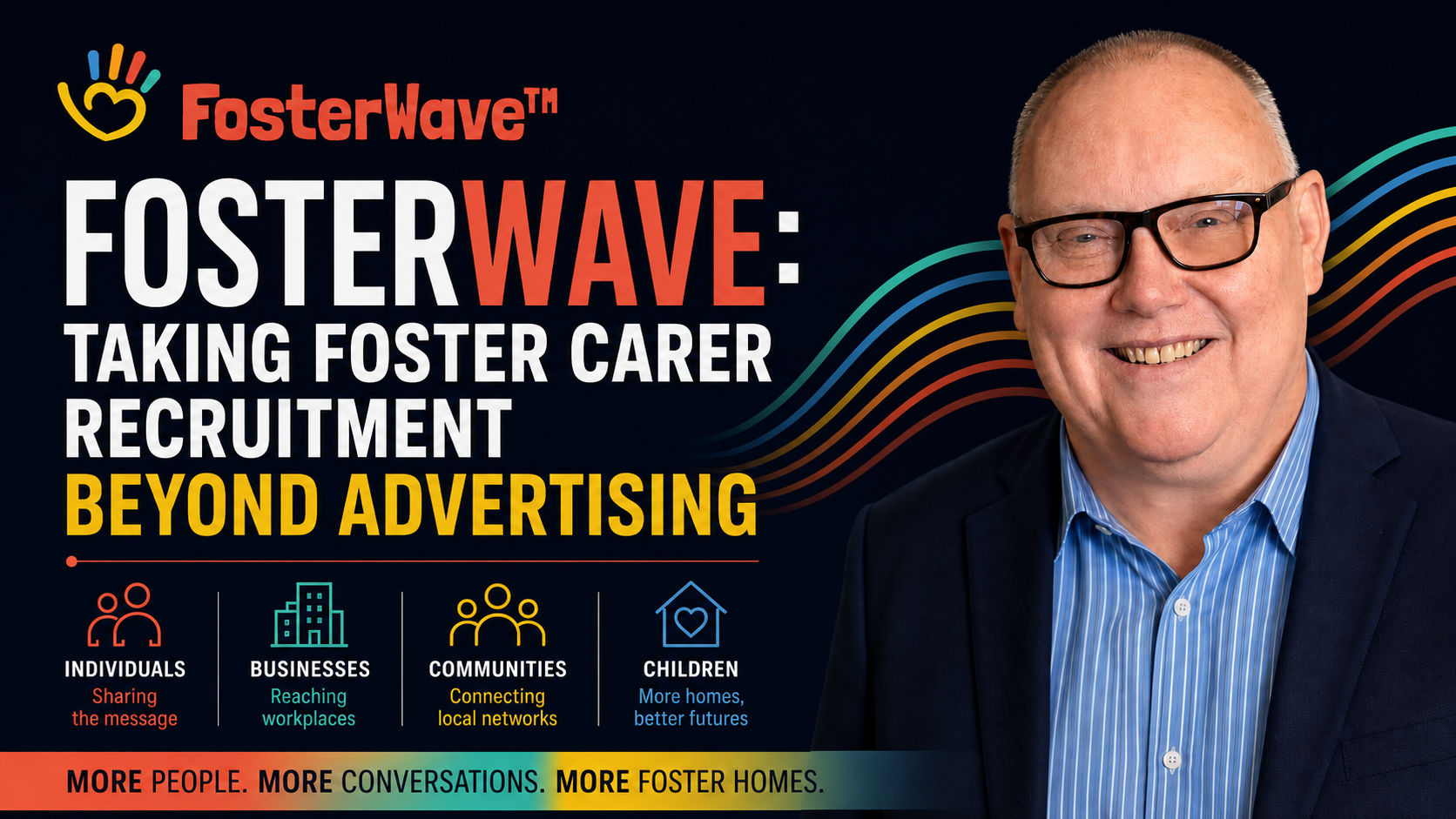
FosterWave: Taking Foster Carer Recruitment Beyond Advertising
How a national community movement could strengthen local authority sufficiency, support independent fostering agency growth and carry existing recruitment campaigns into places conventional marketing rarely reaches
For many years, foster carer recruitment has followed a familiar pattern.
A fostering provider needs more carers. A campaign is commissioned. Advertisements are placed on Facebook, Instagram, Google, buses, billboards or local media. Information events are organised, leaflets are printed and recruitment teams wait for people to respond.
Some campaigns are more effective than others, but the underlying model remains broadly the same:
The fostering provider creates the message, pays to distribute it and waits for somebody to enquire.
There is nothing inherently wrong with that approach.
Fostering providers must be visible. They need strong websites, effective search-engine optimisation, targeted digital advertising, compelling social media content and clear information for people already considering fostering.
But after more than 15 years working specifically in foster carer recruitment—and more than 30 years in recruitment generally—I began to question whether conventional marketing could ever reach enough people on its own.
The problem is not simply that fostering advertisements are ineffective. The deeper challenge is that most campaigns repeatedly operate through the same channels, compete for the attention of similar audiences and depend upon people being sufficiently interested to stop, click and enquire.
Meanwhile, thousands of people may never meaningfully encounter the fostering message.
They may not follow fostering providers online.
They may not search Google for information about becoming a foster carer.
They may scroll past a paid advertisement because fostering does not yet feel personally relevant.
They may assume they would not be eligible.
They may believe foster carers are a completely different type of person from them.
They may be interested but not ready for another two, three or five years.
There is also a much larger group of people who may never become foster carers themselves but would willingly help the message reach their employees, customers, members, friends, relatives and local communities.
That is the gap FosterWave was developed to address.
FosterWave is not intended to replace existing foster carer recruitment marketing.
It is designed to extend its reach.
It takes the message beyond the provider’s own advertising channels and places it into the hands of individuals, businesses and community organisations that already have trusted relationships with the people around them.
The central principle is simple:
Not everybody can foster, but almost everybody can help somebody else consider it.
The scale of the challenge
In February 2026, the Government published Renewing Fostering: Homes for 10,000 More Children.
The plan commits to creating 10,000 additional local authority and third-sector fostering places by 2029, backed by £88 million over two years. It includes England-wide action, enhanced regional collaboration, innovation, stronger support around foster families and reform of the rules governing fostering. (GOV.UK Assets)
The ambition reflects a serious national need.
At March 2025, England had 56,345 approved mainstream foster carers. This was 12 per cent fewer than in 2021. Around one-third were aged 60 or above, meaning that the sector must prepare not only for current shortages but also for the eventual retirement of many experienced carers. (GOV.UK)
There were 42,190 fostering households in England at the same point. During 2024–25, 4,430 mainstream households joined the sector while 4,690 deregistered. The sector was therefore continuing to lose more households than it gained, although the net reduction was smaller than in the previous year. (GOV.UK)
The Government’s analysis also makes an important distinction between interest and successful recruitment. It reports that fostering services received almost 150,000 enquiries during 2024–25 but recorded only 7,365 newly approved foster carers. It identifies delays, slow responses, lengthy assessments and applicant drop-out as significant parts of the problem. (GOV.UK Assets)
These national enquiry figures must be interpreted carefully.
One person may enquire with several providers. Different organisations define and record enquiries differently. Some people will only be seeking preliminary information, while others may already be ready to apply.
Nevertheless, the figures reveal something significant.
England does not begin with a complete absence of public interest.
The challenge is to generate more informed interest, reach people earlier in their decision-making journey and operate a recruitment system capable of sustaining that interest when it appears.
FosterWave primarily addresses the first two requirements.
It expands the number of people and organisations able to begin the conversation.
Why conventional marketing has limitations
Paid digital advertising is an essential component of modern foster carer recruitment.
It allows providers to target people by geography, age, interests and online behaviour. Campaign performance can be monitored, adjusted and measured. Google advertising can place a provider in front of somebody actively searching for information, while social platforms can reach thousands of people quickly.
But paid advertising also has structural limitations.
First, providers are competing with one another.
A local authority, a regional recruitment hub and several independent fostering agencies may all advertise to broadly the same population. Larger organisations can purchase more impressions, appear more frequently and bid more aggressively for relevant search terms.
Second, many digital campaigns depend upon interruption.
The advertisement appears while somebody is reading the news, watching a video or looking at photographs posted by friends. They have not necessarily been considering fostering. The message has only a few seconds to interrupt what they were doing.
Third, digital targeting can identify demographic and behavioural signals, but it cannot reliably determine whether somebody has the emotional readiness, household circumstances, motivation or support network required to foster.
Fourth, many sector campaigns begin to look remarkably similar.
Pictures of smiling families, familiar statements about changing a child’s life, myth-busting content and invitations to attend information events are used repeatedly.
The provider may see a carefully differentiated campaign.
The public may simply see another fostering advertisement.
Finally, paid visibility normally declines when the budget stops.
A campaign may create a temporary increase in reach, but it does not automatically create a lasting network of people willing to continue discussing fostering after the advertising period ends.
None of this means providers should stop advertising.
It means advertising should form part of a broader recruitment ecosystem.
Department for Education research found that fostering services themselves emphasised the need to use multiple approaches across digital, physical and face-to-face channels rather than relying on one route. Community outreach, events, posters and word-of-mouth were still seen as important alongside digital activity. (GOV.UK Assets)
FosterWave provides an additional route.
From an advertising audience to a supporter network
Traditional advertising treats the public primarily as an audience.
People see the message and either respond or do not respond.
FosterWave asks a different question:
What could happen if part of that audience became an active supporter network?
A supporter might be:
- an individual who shares information with friends or family;
- a business communicating with employees, customers or suppliers;
- a charity, faith group, sports club or voluntary organisation;
- a community group sharing information with its members;
- or somebody who previously considered fostering but is not currently ready to proceed.
Supporters are not expected to assess prospective carers, explain every aspect of fostering or persuade somebody to apply.
That remains the responsibility of the fostering provider.
Their role is much simpler.
They help the message travel.
A supporter might share a social media post, display a poster, include a short article in a newsletter, invite a provider to speak at an event or start a conversation with somebody they know.
One individual action may reach only a few people.
But when thousands of small actions are connected, the cumulative reach can become considerable.
That is the reasoning behind the name FosterWave.
A wave develops as individual movements connect and travel further than any one movement could travel alone.
Why trusted communication matters
The source of a message influences how it is received.
An advertisement from an organisation is recognised as marketing.
Information shared by somebody we know enters through an existing relationship.
It may come from:
- a colleague;
- an employer;
- a friend;
- a relative;
- a neighbour;
- a community leader;
- a local business;
- or an existing foster carer.
That does not guarantee that somebody will enquire. But it may make them pause, ask a question or consider fostering in a way that a paid advertisement did not.
The Department for Education’s foster carer conversion research found that word-of-mouth enquiries were often regarded as particularly strong. Although they did not necessarily produce the greatest volume, participants believed that people entering through personal connections were frequently better informed, had more realistic expectations and already possessed some form of support network. (GOV.UK Assets)
The interim evaluation of Foster with North East identified a similar pattern.
Only 27 per cent of enquiries attributed to word-of-mouth became closed contacts, compared with 73.8 per cent of enquiries attributed to social media. Those entering through personal connections were described as more likely to be informed, prepared and ready to progress. (GOV.UK Assets)
This is evidence from one regional programme and should not be treated as a universal national conversion benchmark. Recruitment models, recording practices and local circumstances vary considerably.
It does, however, support an important distinction.
High-volume digital reach and trusted personal communication do not necessarily produce the same type of enquiry.
FosterWave is designed to develop trusted community reach without abandoning digital scale.
Reaching the spaces advertising cannot easily enter
Digital advertising can target a geographical location.
It cannot easily replicate the relationships that exist within that location.
Every community contains communication networks that are partly invisible to conventional marketing:
- workplace intranets;
- internal newsletters;
- staff messaging groups;
- local Facebook communities;
- sports clubs;
- parent networks;
- neighbourhood organisations;
- faith communities;
- professional associations;
- voluntary groups;
- customer databases;
- community noticeboards;
- and informal conversations between friends.
A fostering provider could attempt to contact each of these networks directly.
In practice, recruitment teams rarely have sufficient time or resources to establish and maintain hundreds of separate community relationships.
FosterWave creates a structure through which those networks can identify themselves and participate.
Instead of the provider continually attempting to locate every possible employer, group and local organisation, supporters can register their willingness to help. They can then receive suitable materials and decide how those materials can be shared appropriately within their own networks.
That changes the direction of travel.
The provider is no longer solely pushing information outwards.
The community begins helping to pull the message through its own relationships.
The role of individuals
The individual supporter is the simplest element of FosterWave, but potentially one of its most powerful.
A person does not need a large social media following.
They do not need to be a foster carer.
They do not need specialist knowledge of children’s social care.
They simply need to be willing to help information reach somebody else.
An individual might:
- share a provider’s information event;
- send a carer story privately to somebody who may be interested;
- talk about fostering at work;
- display a FosterWave supporter image;
- introduce a provider to a local organisation;
- or occasionally remind their network that foster carers are still needed.
The supporter is not expected to become a permanent campaigner. The commitment can be small, occasional and entirely voluntary.
That is important because many people care about children in care but do not know how they can contribute.
They may not have a spare bedroom.
Their employment may not be compatible with fostering.
Their family circumstances may make it impossible.
They may not yet feel ready.
Most fostering campaigns have no meaningful role for these people. They are either potential foster carers or they sit outside the campaign.
FosterWave creates a third position:
I cannot foster at present, but I can still help.
The role of businesses
Businesses have access to communities on a scale that many fostering providers cannot reproduce.
Even a relatively small employer may communicate regularly with dozens or hundreds of staff, customers and suppliers. A larger organisation may reach thousands of people across several locations.
Many businesses already support community causes through corporate social responsibility, employee volunteering, local sponsorship or environmental, social and governance programmes.
Supporting foster carer recruitment does not necessarily require fundraising or a major financial commitment.
A FosterWave business could:
- include local fostering information in a staff newsletter;
- share an information event with employees;
- display materials in staff areas;
- host a lunchtime presentation;
- introduce a fostering provider to its workforce;
- share a campaign with customers or social media followers;
- or review whether its employment policies support existing and prospective foster carers.
The business is not being asked to encourage every employee to leave work and foster full-time.
It is providing access to an audience and helping to normalise the conversation.
One message from a respected employer may reach somebody who has never clicked on a fostering advertisement.
It may also reach somebody who considered fostering years earlier but assumed the opportunity had passed.
The value is not limited to the number of employees reached.
It also comes from fostering becoming something that trusted local and national employers are prepared to discuss openly.
The role of community groups
Community groups bring people together around shared interests, values, identities and locations.
They may understand their members in ways that an external advertising platform never could.
A community organisation often knows:
- which communication channels its members use;
- which events they attend;
- what language is appropriate;
- which concerns may prevent engagement;
- and which trusted people should introduce a sensitive subject.
This is particularly valuable when providers want to reach communities that are underrepresented within their existing foster carer population.
Government-commissioned research identified community hubs, faith settings, local events, schools, libraries and other community locations as important parts of a mixed recruitment strategy. It also noted that providers seeking to reach specific communities may need to engage directly with the places and organisations where those groups already gather. (GOV.UK Assets)
FosterWave does not assume that one national message will work equally well for every community.
It supplies the connective infrastructure through which relevant local messages can travel.
The community organisation opens the door.
The provider remains responsible for the professional fostering conversation.
Supporting—not replacing—provider marketing
FosterWave should not be positioned as a competing recruitment brand sitting between providers and prospective foster carers.
Its purpose is to support and amplify providers’ existing recruitment activity.
A provider may already have:
- a well-developed website;
- paid social advertising;
- search advertising;
- strong local branding;
- information events;
- foster carer ambassadors;
- videos and case studies;
- email nurture;
- community engagement;
- and professional recruitment staff.
FosterWave gives those existing assets more routes into the community.
Consider a provider organising an information event.
Conventionally, the event might be promoted through social media, email contacts and paid local advertising.
Through FosterWave, the same event could also be distributed by local employers, individuals, charities and community groups operating within the relevant geographical area.
The event itself has not changed.
Its distribution has been widened.
The same principle can apply to:
- carer stories;
- short videos;
- local recruitment campaigns;
- specialist fostering opportunities;
- open evenings;
- community events;
- articles;
- and explanations of different fostering models.
FosterWave becomes an amplification layer around the provider’s existing work.
It does not assess or approve foster carers.
It does not replace recruitment teams.
It does not determine which provider somebody should join.
It helps participating providers reach people they might not otherwise reach.
Why local authorities can benefit
For a local authority, foster carer recruitment is fundamentally connected to local sufficiency.
The objective is not simply to approve more households.
It is to increase the number and range of suitable homes available for children from that authority, particularly within or close to their own communities.
A stronger local foster carer base can help an authority:
- place more children near their families, schools and support networks;
- reduce reliance on placements far outside the area;
- improve placement options for siblings, teenagers and children with more complex needs;
- create meaningful matching choices rather than relying only on immediate availability;
- increase respite and short-break capacity;
- and reduce pressure on placement budgets.
The Government’s 10,000-place plan explicitly links increased local authority and third-sector capacity with helping children live closer to home and reducing reliance on more expensive provision. (GOV.UK Assets)
Local authorities already possess extensive civic relationships.
They work with:
- schools;
- health organisations;
- local employers;
- councillors;
- charities;
- voluntary groups;
- neighbourhood networks;
- community leaders;
- housing organisations;
- and public-sector partners.
However, those relationships are not always connected systematically to foster carer recruitment.
FosterWave provides a practical structure through which the authority’s wider civic network can participate.
A local employer might distribute an information event to its workforce.
A community group might share a story about a local foster carer.
A charity might introduce the recruitment team to members who have never previously considered fostering.
An individual supporter might open the door to a workplace or neighbourhood the authority has struggled to reach.
The local authority retains its identity, eligibility criteria, recruitment team and assessment process.
FosterWave helps its existing message travel further through the community it serves.
That matters financially as well as socially.
The Competition and Markets Authority estimated that recruiting and registering a successful fostering applicant can cost around £10,000, with other estimates placing the total recruitment and assessment cost between approximately £10,000 and £20,000. (GOV.UK)
For a local authority, the value of improving community reach cannot therefore be assessed only through the cost of generating an enquiry.
The more important question is whether the authority is reaching appropriate people who can eventually create usable local capacity.
Every suitable foster home recruited and retained may create better local placement options and reduce future dependence on less appropriate or more expensive alternatives.
Why independent fostering agencies can benefit
For an independent fostering agency, the challenge is often one of visibility, differentiation, geographical reach and sustainable growth.
An IFA may offer excellent support, specialist expertise and a strong fostering culture but still struggle to become visible against larger competitors or local-authority campaigns.
Several organisations may be advertising to the same population, often using broadly similar messages.
Smaller and specialist agencies can find themselves competing against providers with substantially larger marketing budgets.
FosterWave gives IFAs another route into local communities.
It can help an agency:
- build recognition in carefully selected geographical areas;
- connect with employers and groups close to its offices or foster carer networks;
- extend the reach of information events and carer stories;
- introduce specialist fostering models to relevant audiences;
- maintain visibility between paid campaigns;
- and demonstrate that it is locally connected rather than simply another organisation advertising online.
For an IFA, each suitable foster carer recruited can contribute to organisational sustainability and increase the range of placements the agency can offer to local authorities.
However, the value is not merely commercial.
A larger and more diverse carer base enables the agency to respond more effectively when authorities need homes for siblings, teenagers, children with disabilities or those with more complex needs.
The objective is not the largest possible number of general enquiries.
It is to recruit the right carers in the right places, with the right motivation, skills and support.
FosterWave can help an IFA develop stronger local presence without requiring it to construct an entirely new community network independently in every area where it operates.
It could also support greater cooperation between IFAs and community partners.
A specialist agency may have expertise relevant to a particular community but little direct access to that community. A FosterWave group or business supporter could help create the introduction.
The agency then has the opportunity to explain its offer, demonstrate its expertise and build the relationship professionally.
Shared infrastructure, separate identities
FosterWave does not require local authorities and IFAs to abandon their own identities or campaigns.
Each provider retains control over:
- its recruitment message;
- its geographical priorities;
- its campaign materials;
- its events;
- its enquiry response;
- its assessment process;
- and its relationship with prospective foster carers.
The shared component is the supporter infrastructure.
Individuals, businesses and community groups can join one wider movement supporting fostering, while still being directed towards relevant providers and local opportunities.
This creates a useful balance.
The public can understand one clear national proposition:
More people helping the fostering message reach further.
Providers can then translate that national support into locally and organisationally relevant recruitment activity.
FosterWave does not pretend that competition between local authorities and IFAs will disappear.
Providers will continue to recruit within overlapping geographical markets.
Nor should FosterWave determine which organisation an individual should ultimately choose.
Its purpose is to increase the number and diversity of people who meaningfully encounter the fostering message in the first place.
A larger, better-informed audience can benefit the entire sector.
FosterWave expands the conversation.
The provider must still earn the relationship.
Supporting people who are “not ready yet”
One of FosterWave’s most important practical applications concerns people who have considered fostering but are not currently ready.
Recruitment is often managed as a short-term funnel.
Somebody enquires.
They either progress or they leave.
But the journey towards fostering may take years.
The Department for Education’s conversion study noted that an enquiry does not necessarily progress to application or approval within the same 12-month reporting period. In some cases, an enquiry may lead to an application two to five years later. (GOV.UK Assets)
There are many understandable reasons for this.
A person may need to:
- move house;
- change employment;
- wait for their own children to become older;
- gain the support of a partner;
- resolve a family difficulty;
- improve their financial stability;
- or simply spend longer considering the implications.
A person who is not ready today is not necessarily an unsuccessful enquiry.
Yet the usual response may be:
“Come back when your circumstances change.”
Responsibility for maintaining the relationship is then placed entirely on the prospective carer.
FosterWave provides another option.
With clear permission, the person can remain connected as a supporter.
They can continue learning about fostering.
They can receive occasional, relevant information.
They can help share local campaigns.
They may introduce somebody else who is ready to enquire.
And when their own circumstances change, they remain connected to the fostering community.
This changes “not now” from the end of the relationship into a different form of engagement.
A practical example
Consider a local fostering provider planning a campaign in an area where it needs more carers for teenagers and sibling groups.
Under the conventional model, it may:
- create paid social advertisements;
- purchase Google search traffic;
- publish a webpage;
- distribute leaflets;
- organise an information event;
- ask existing carers to share the campaign.
Through FosterWave, the provider could continue all of those activities but add a community distribution layer.
Relevant registered businesses could receive a short, approved item for staff newsletters.
Community organisations could receive information appropriate for their members.
Individual supporters within the target postcode area could be invited to share the event.
Existing foster carers could connect the campaign to their own support networks.
People who had previously enquired but were not ready could be offered the opportunity to participate as supporters.
The provider’s campaign has not been replaced.
Its potential reach has been extended through relationships that advertising alone could not easily reproduce.
The practical journey would remain clear:
FosterWave raises and distributes awareness.
The provider handles the enquiry.
The provider assesses and supports the prospective carer.
Trust, permission and responsible communication
A community movement cannot be built without trust.
Supporters must understand:
- what information is being collected;
- why it is required;
- how it will be used;
- what communications they may receive;
- and how they can leave.
FosterWave must therefore operate through permission-based participation.
Supporters choose to become involved.
They are not expected to distribute every campaign.
They should not be overwhelmed with messages.
Their details should not be sold.
They must be able to unsubscribe easily.
Providers must retain responsibility for the accuracy of their recruitment information and for all regulated fostering activity.
Supporters are not unofficial assessors.
They should not attempt to determine whether somebody is suitable to foster or advise them on complex eligibility matters.
Their role is to open the conversation.
The provider takes professional responsibility from that point onwards.
Measuring whether it works
FosterWave should not be judged only by the headline number of registered supporters.
A large total may appear impressive but reveal little about practical value.
More meaningful measures would include:
- where supporters are located;
- which communities are represented;
- how many businesses and groups actively participate;
- which provider materials are shared;
- how many people visit provider pages through supporter activity;
- how many introductions or event opportunities are created;
- whether FosterWave-sourced enquirers are better informed;
- whether they progress further;
- whether “not now” enquirers remain engaged;
- and whether community awareness continues between paid campaigns.
Participating providers should eventually be able to record FosterWave as an enquiry source and compare its outcomes with other recruitment routes.
This would allow the sector to examine whether community-supported enquiries display some of the characteristics associated with word-of-mouth: stronger understanding, realistic expectations and greater readiness.
It will take time to develop that evidence.
FosterWave should not claim that every supporter action will create an enquiry or that every enquiry will become an approved foster carer.
Community engagement is rarely linear.
Somebody may see fostering information through their employer, encounter it again through a friend and attend an information event several months later.
Which interaction generated the enquiry?
Possibly all of them.
That is why sustained community visibility matters.
A wave rather than another campaign
A campaign normally has a beginning and an end.
A wave can continue to travel.
That is the larger ambition behind FosterWave.
It is an attempt to create permanent community infrastructure around foster carer recruitment—not to replace professional recruitment, but to help it reach further.
The Government is planning a national communications campaign to increase public understanding of fostering and direct prospective carers towards regional hubs and local authorities. The timing and full details are still to be confirmed. (GOV.UK Assets)
That campaign could create a major moment of national attention.
But an important question remains:
What happens to the attention after the campaign ends?
Does it disappear when advertising expenditure reduces?
Or can it be retained within workplaces, communities and personal networks?
FosterWave offers a mechanism through which national awareness could be converted into sustained local activity.
A national campaign can create the moment.
Fostering providers can provide the professional recruitment pathway.
Individuals, businesses and groups can help carry the message between the two.
Why I developed FosterWave
FosterWave grew from a straightforward observation.
The fostering sector has been asking broadly the same organisations to solve the same recruitment problem using broadly the same methods for many years.
Providers purchase advertising.
Recruitment teams handle enquiries.
Existing foster carers attend events.
The public is asked to foster.
There is enormous commitment and expertise throughout the sector, but the circle of people actively involved in foster carer recruitment remains relatively small.
Outside that circle is a much larger group of people who care about children but have never been given a practical role.
They may say:
“I cannot foster.”
“I do not have a spare room.”
“I work full-time.”
“My circumstances are not right.”
“I am not ready yet.”
FosterWave responds:
You may not be able to foster, but you may know somebody who can.
You may employ them.
You may work with them.
They may belong to your community group.
They may follow your business.
They may trust your judgement.
They may simply need to encounter the idea of fostering in a different place, from a different person and at the right moment in their life.
FosterWave exists to help create more of those moments.
The practical invitation
For individuals, the invitation is:
I may not be able to foster, but I want to help.
For businesses, FosterWave provides an opportunity to use existing communication channels to support children and families in the communities where they operate.
For community groups, it offers a route to connect members with a national issue that has immediate local consequences.
For local authorities, it can extend community reach, support local sufficiency and help recruitment messages enter established civic networks.
For independent fostering agencies, it can strengthen local visibility, support sustainable growth and create access to audiences that conventional advertising may repeatedly miss.
No single supporter will solve the shortage of foster carers.
No single campaign will solve it either.
But thousands of small acts of communication can introduce fostering into thousands of new conversations.
Some may lead nowhere.
Some may support an existing fostering family.
Some may reach a person who will not be ready for several years.
Some may encourage a business to adopt more fostering-friendly employment practices.
And some may eventually help a child find the foster home they need.
That is the practical idea behind FosterWave.
Not another advertising campaign.
Not a replacement for provider marketing.
Not another organisation competing for enquiries.
A growing network of people, businesses and communities helping foster carer recruitment travel further than it has travelled before.
The sector already has fostering providers.
It already has recruitment teams.
It already has marketing expertise.
It already has thousands of committed foster carers.
What it has never had is a permanent national community movement through which people can say:
I may not be able to foster, but I can help the message reach somebody who can.
That is the wave we now need to build.
References
Department for Education, Renewing Fostering: Homes for 10,000 More Children, February 2026. (GOV.UK)
Department for Education and Ipsos, Foster Carer Recruitment and Conversion Rates, July 2023. (GOV.UK)
Department for Education, Evaluation of Foster with North East: Interim Report, September 2025. (GOV.UK)
Ofsted, Fostering in England: 1 April 2024 to 31 March 2025—Main Findings, November 2025. (GOV.UK)
Competition and Markets Authority, Children’s Social Care Market Study: Final Report, March 2022. (GOV.UK)