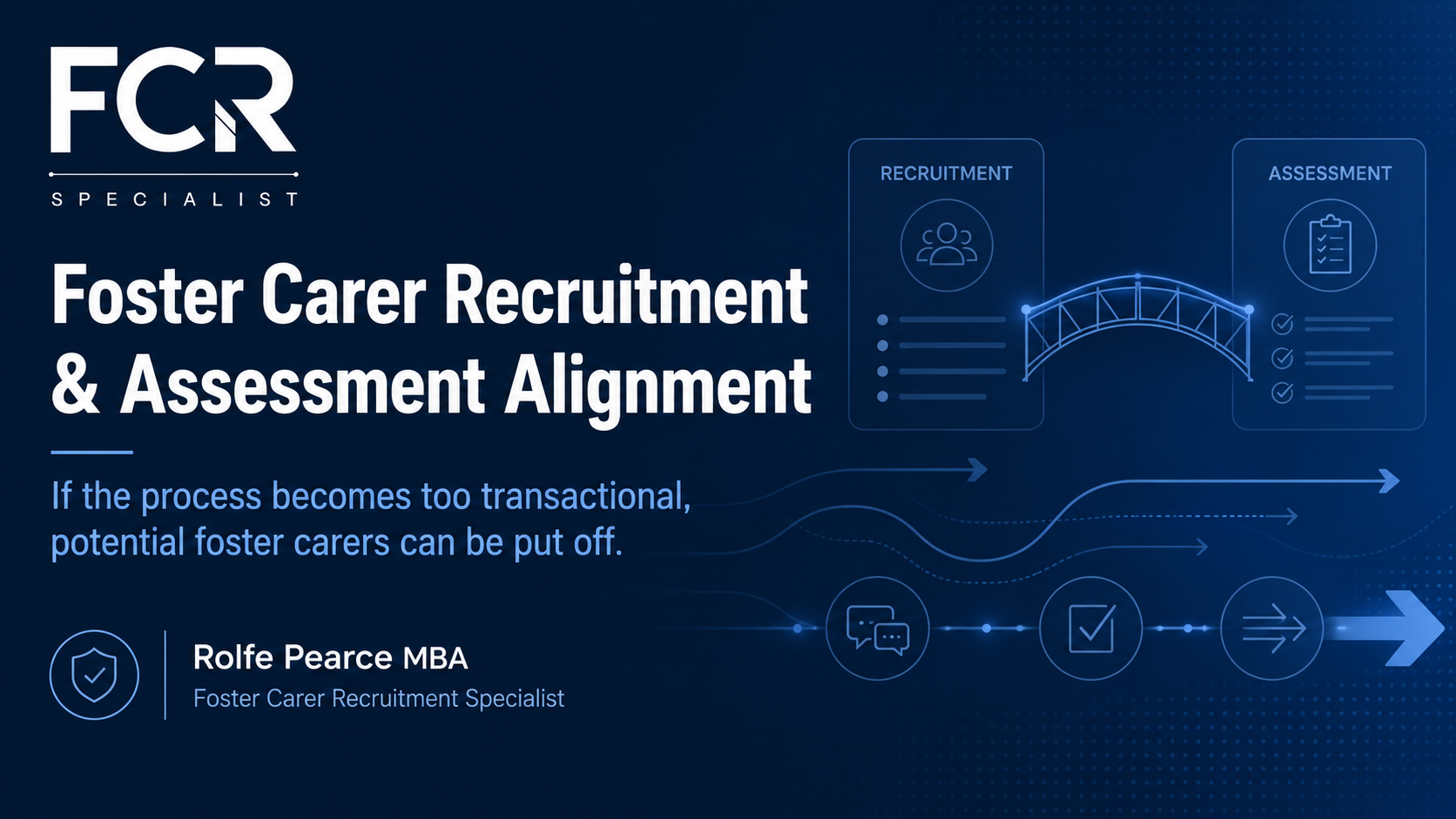
Foster Carer Recruitment and Assessment: Are Both Teams Having the Same Conversation?
A prospective foster carer can have an excellent experience during the early recruitment stages.
They feel welcomed.
Someone listens to why they are considering fostering.
Their questions are answered clearly.
They begin to believe that fostering may be possible for them and their family.
Then the conversation changes.
They move from recruitment into assessment, and suddenly the process can feel very different.
The warm, exploratory discussion becomes more formal and transactional.
The emphasis moves from:
“Tell us about yourself and why you are considering fostering”
to:
“We now need you to provide evidence, complete forms, disclose information and demonstrate your suitability.”
Some of that change is unavoidable.
Foster carer assessment must be thorough. It must explore an applicant’s history, relationships, resilience, support network, experience, health, finances and ability to provide safe and stable care.
The assessment process has an essential safeguarding purpose.
But that does not mean it has to feel cold, disconnected or adversarial.
When recruitment and assessment are not aligned, potentially excellent foster carers can be lost—not because they are unsuitable, but because the service has failed to manage the transition properly.
The applicant experiences one service, not two departments
Within a fostering organisation, recruitment and assessment may be separate functions.
They may have different managers, systems, targets, professional disciplines and ways of working.
The prospective foster carer does not see that internal structure.
They believe they are dealing with one fostering service.
They do not understand why they may have to repeat information they have already provided.
They do not understand why something presented positively by recruitment is treated cautiously during assessment.
They do not understand why the tone of the relationship changes immediately after they submit an application.
From their perspective, the organisation appears inconsistent.
The recruitment team may have spent weeks building trust, only for that trust to be weakened during the first assessment conversation.
What was the applicant told during recruitment?
Before an applicant is handed over to assessment, there should be clarity about the expectations that have already been created.
What timescale was discussed?
How was the assessment process described?
Were any potential complications identified?
Was the applicant told that working full-time would be manageable?
Was their support network explored?
Were financial expectations discussed honestly?
Were issues relating to bedrooms, smoking, pets, health, previous relationships or family history raised?
Did recruitment suggest that a particular type of fostering would be suitable?
If the assessment team then gives a different message, the applicant may feel that the organisation has changed its position.
Even where the assessment team is entirely correct, the inconsistency can damage confidence.
The applicant may begin to wonder:
Were they simply saying what I wanted to hear to get me to apply?
That is a dangerous point in the applicant journey.
Once trust begins to weaken, every further request can feel like another hurdle rather than a necessary part of becoming a foster carer.
Recruitment must not overpromise
Recruitment teams are under pressure to generate applications and move people into assessment.
That pressure can sometimes lead to difficult issues being softened or delayed.
The applicant may be told:
“That should not be a problem.”
“We can look at that later.”
“The assessing social worker will discuss it with you.”
This may help maintain momentum in the short term, but it transfers a difficult conversation into assessment.
The assessment team is then placed in the position of correcting expectations or raising concerns that should have been discussed earlier.
The applicant experiences this as a sudden change in attitude.
Recruitment appears encouraging.
Assessment appears obstructive.
The reality may simply be that neither team has agreed who should have which conversations, at what stage, and in what level of detail.
Recruitment should create confidence, but it must be informed confidence.
Applicants need encouragement alongside realistic information about the commitment, scrutiny and personal reflection involved.
Assessment must not treat the applicant as a completed transaction
There is also a risk that once an application has been received, the recruitment task is considered complete.
The applicant becomes an assessment case.
The focus shifts toward statutory checks, chronologies, references, training, home visits and Form F completion.
The relationship-building work can disappear.
Yet the applicant has not made an irreversible commitment.
They are still deciding whether they want to foster.
They are also deciding whether they want to foster with your organisation.
Every assessment visit, email, form and request contributes to that decision.
The service is assessing the applicant, but the applicant is continuing to assess the service.
They are noticing whether communication is clear.
They are noticing whether appointments are kept.
They are noticing whether different staff provide consistent answers.
They are noticing whether difficult questions are handled respectfully.
They are noticing whether the organisation appears organised.
They are noticing whether they feel valued as future foster carers—or simply processed as another assessment.
Necessary questions can still be asked well
Assessment requires personal and sometimes uncomfortable conversations.
Applicants may be asked about childhood experiences, relationships, bereavement, trauma, health, finances, parenting, previous partners and significant life events.
These questions cannot simply be avoided.
But there is a considerable difference between asking a difficult question sensitively and making the applicant feel interrogated.
Context matters.
Applicants should understand why information is being requested, how it relates to fostering and how it will be used.
A transactional approach can feel like:
Question. Answer. Record. Next question.
A relational approach still gathers the necessary evidence, but it also helps the applicant understand the purpose of the discussion.
It allows space for reflection.
It acknowledges that sharing personal history can be difficult.
It recognises that assessment is being conducted with a person, not on a person.
Professional curiosity and human warmth are not opposites.
A rigorous assessment can still be respectful, clear and supportive.
The handover should be a managed stage of recruitment
The transfer from recruitment to assessment should not be an administrative notification.
It should be a carefully managed part of the applicant journey.
The applicant should know:
who will contact them;
when that contact will happen;
what the first assessment conversation will cover;
what information has already been shared;
what they will need to prepare;
and what the realistic next steps will be.
The assessing social worker should also receive more than a completed application form.
They should understand the person’s motivation, concerns, communication preferences, household circumstances and any expectations created during recruitment.
A good handover protects the relationship that has already been built.
A poor handover makes the applicant feel as though they are starting again with a completely different organisation.
Are recruitment and assessment working toward the same outcome?
Both teams should ultimately want the same thing:
To identify, prepare and approve suitable foster carers who understand the role and are ready to care for children.
But their immediate pressures can be different.
Recruitment may be measured by enquiries, initial visits and applications.
Assessment may be measured by quality, completion times and panel outcomes.
If those measures are not connected, each team can optimise its own part of the process while the overall applicant experience deteriorates.
Recruitment can pass forward people who are not sufficiently prepared.
Assessment can become the stage where expectations are corrected.
Applicants withdraw.
Recruitment is then asked to generate more enquiries to replace them.
The cycle begins again.
The organisation may describe this as natural attrition.
Some withdrawal is inevitable, and assessment should identify people who are not suitable.
But senior leaders should be cautious about assuming that every withdrawal reflects a problem with the applicant.
Some people leave because the process is inconsistent, repetitive, poorly explained or unnecessarily impersonal.
Alignment needs to be assessed—not assumed
When did your recruitment and assessment teams last review the applicant journey together?
Not just the process map.
The actual experience.
Do they agree on the messages applicants should hear?
Do they use the same language to describe timescales and expectations?
Are potential barriers raised at the right stage?
Is the applicant required to repeat the same information?
How is the handover managed?
Who maintains contact if assessment is delayed?
Are withdrawal reasons reviewed jointly?
Does recruitment receive feedback about the quality and preparedness of the applications it passes forward?
Does assessment understand the work already done to build trust with the applicant?
Without these conversations, alignment may exist in policy but not in practice.
This is not about lowering assessment standards
Better alignment does not mean making assessment easier.
It does not mean overlooking concerns to improve conversion rates.
It does not mean recruitment should decide who will ultimately be approved.
It means creating a coherent, honest and professionally managed journey.
The safeguarding purpose of assessment remains non-negotiable.
But unnecessary duplication, inconsistent messages, poor handovers and transactional communication do not improve safeguarding.
They simply make the process harder to navigate.
The strongest applicants are not necessarily the people willing to tolerate the poorest process.
A potentially excellent foster carer may withdraw because they have other choices, limited time or understandable concerns about joining an organisation that already appears disjointed.
The leadership question
Senior fostering leaders should not only ask:
“How many applicants are currently in assessment?”
They should also ask:
“What experience are those applicants having?”
“Are recruitment and assessment giving them a consistent message?”
“Are we maintaining the trust created during recruitment?”
“Are suitable people withdrawing because of how the transition is being handled?”
Recruitment does not end when the application form is submitted.
Assessment is not separate from foster carer recruitment.
It is one of its most important stages.
When the two functions are aligned, applicants experience a professional, honest and supportive journey.
When they are not, the service may spend considerable time and money finding prospective foster carers—only to lose them at the point where the relationship becomes transactional.