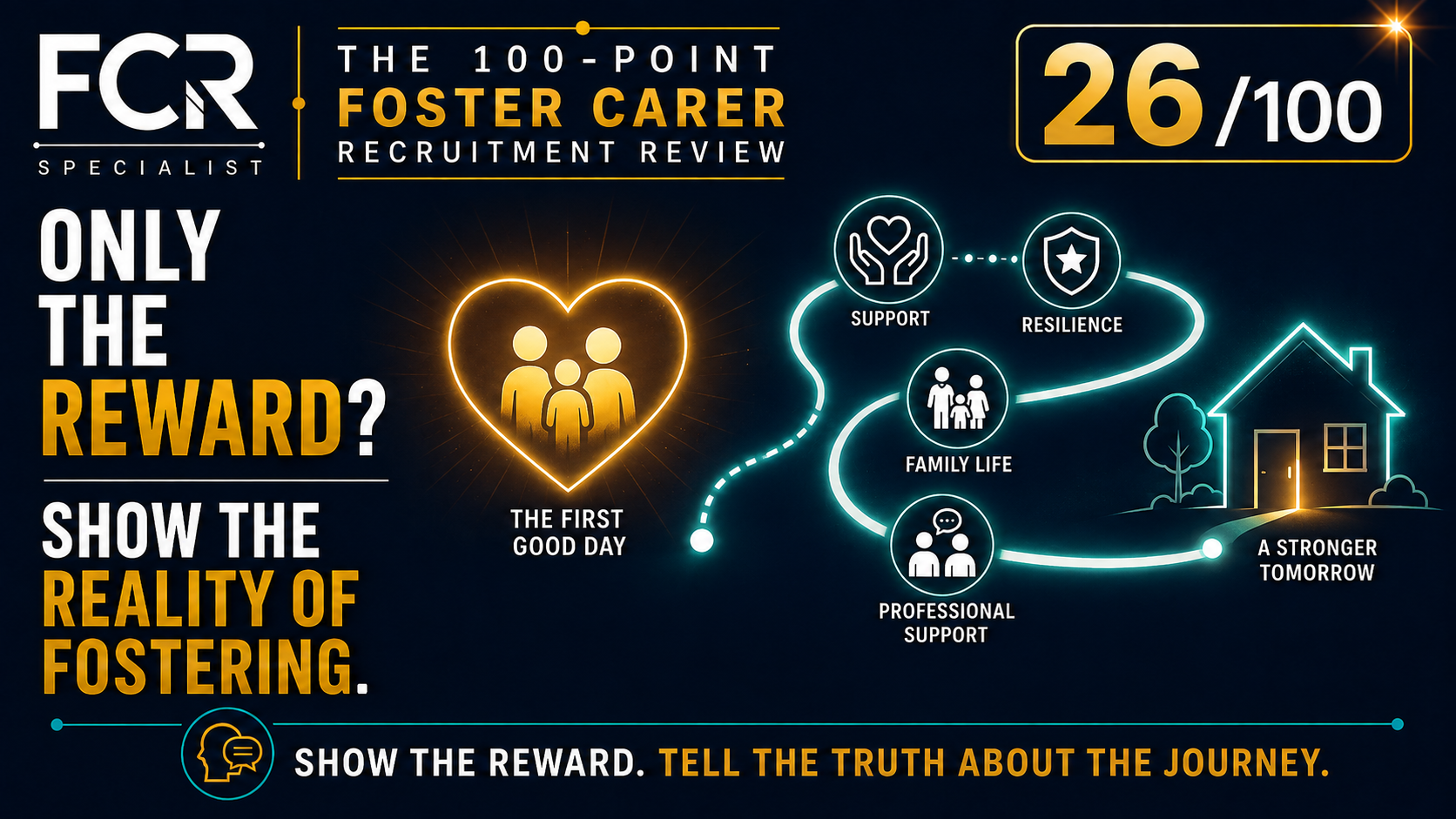
Does Your Marketing Show the Reality of Fostering — or Only the Reward?
Does Your Marketing Show the Reality of Fostering — or Only the Reward?
Point 26 of The 100-Point Foster Carer Recruitment Review
There is an understandable temptation in Foster Carer Recruitment marketing.
Show fostering at its best.
Show the smiles.
Show the achievements.
Show the child whose confidence has grown.
Show the Foster Carer talking about the difference fostering has made to their life.
Use words such as:
rewarding.
life-changing.
make a difference.
transform a child's future.
There is nothing inherently wrong with any of that.
Fostering can be rewarding.
Foster Carers do make an enormous difference.
Children can thrive when they experience stable, skilled and committed family care.
But there is a recruitment question we perhaps do not ask often enough:
Does your marketing describe the first good day — or the whole fostering journey?
Because recruitment is not simply about generating enthusiasm.
It is also about helping someone understand what they are considering.
And those are not quite the same thing.
From Point 25: if we invite honest questions, we need honest answers
In Point 25 I looked at the way Foster Carer Recruitment sometimes treats people's concerns as “myths”.
My argument was not that misconceptions should be allowed to remain uncorrected.
It was that people should feel able to ask genuine questions without feeling that they have said something foolish.
The alternative was:
QUESTION → ANSWER → EVIDENCE → EXPERIENCE
Point 26 takes that one stage further.
Because creating a safe space for questions is only useful if we are prepared to answer those questions properly.
If somebody asks:
“What happens when fostering becomes difficult?”
“Will fostering affect my children?”
“What happens if a child I have cared for leaves?”
“What if I become emotionally attached?”
“What happens if an allegation is made?”
“How much support will I actually receive?”
“What happens at night or at the weekend?”
“What if a placement is not working?”
then the answer cannot always be:
“Don't worry. You'll be fully supported.”
That is a proposition.
It still requires evidence.
We established that in Point 23:
CLAIM → PROOF → EXPERIENCE
The more significant the claim, the more important that becomes.
The DfE research is particularly interesting here
The Department for Education's behavioural-insights research into fostering and adoption did not recommend pretending the challenges do not exist.
Quite the opposite.
One of its recommendations was to acknowledge challenge in a supportive context and to give prospective applicants access to the everyday reality of fostering through things such as testimonials, communities and opportunities to ask questions.
The research also found that people with direct exposure to everyday fostering — either personally or through people close to them — tended to hold a more balanced and positive view than those whose understanding was more distant.
That word is important:
balanced.
Not negative.
Not frightening.
Not sanitised.
Balanced.
The same DfE research concluded that an honest portrayal of challenge, combined with emphasis on accessible support, should form part of recruitment communication.
That is very different from making recruitment gloomy.
It is about making recruitment credible.
There are two ways to get this wrong
At one extreme we can create an almost idyllic version of fostering.
Everything is:
rewarding,
heart-warming,
inspirational,
life-changing.
At the other extreme we could make every recruitment page sound like a risk assessment.
Trauma.
Behaviour.
Allegations.
Loss.
Stress.
Complexity.
That would be equally unhelpful.
Good Foster Carer Recruitment sits somewhere between the two.
INSPIRATION + REALITY + SUPPORT
We want prospective Foster Carers to believe they could make a difference.
We also want them to understand what making that difference can require.
And crucially, we want them to understand what the organisation will do to help them succeed.
Here is the test
Take your website.
Take your Facebook page.
Take your paid adverts.
Take your Foster Carer information pack.
Take your information-event presentation.
Take the last ten Foster Carer stories you published.
Now ask:
How much of the fostering journey do they actually show?
Do they show only:
- successful outcomes?
- smiling Foster Carers?
- celebration events?
- inspirational moments?
- positive quotations?
Or do they also explain, appropriately:
- that children may arrive carrying significant experiences of trauma and disruption?
- that trust can take time?
- that progress is not always linear?
- that fostering affects the household, not simply the individual applicant?
- that some endings are difficult?
- that Foster Carers operate as part of a professional network?
- that Foster Carers need resilience as well as compassion?
- that asking for help is part of good fostering rather than evidence of failure?
- what practical support exists when situations become difficult?
Notice what I am not suggesting.
I am not suggesting that every Facebook advert needs a paragraph about allegations.
I am not suggesting that the first communication with someone considering fostering should present every possible difficulty.
Recruitment has stages.
Information should have stages too.
But by the time someone reaches application and assessment, they should not be discovering fundamental realities of fostering for the first time.
There is an expectation question here
Ofsted's latest published statistics provide an interesting warning sign.
For fostering applications that began during 2024–25 and had been withdrawn by the applicant by year end, one of the cited reasons was that the fostering process was not as the applicant expected, accounting for 20% of those applicant withdrawals. Ofsted does not say recruitment marketing caused those withdrawals, and we should not pretend that it does.
There could be many reasons why expectations did not match reality.
The assessment process itself.
The level of scrutiny.
Timescale.
Household involvement.
Checks and references.
What fostering actually involves.
Individual circumstances.
But from a recruitment perspective, that figure gives us a legitimate question:
At what point are we setting expectations?
And are we setting them deliberately?
If the first part of the journey is designed principally to maximise enquiries, difficult information can slowly migrate towards the end.
That's dangerous.
Not because transparency will necessarily increase enquiries.
It may not.
But the objective isn't simply maximum enquiry volume.
It is progression by people who understand what they are progressing towards.
Honest recruitment may sometimes cause someone to say no
That can feel uncomfortable when recruitment targets are under pressure.
But “no” is not always recruitment failure.
There is an enormous difference between:
“No, because I don't understand fostering.”
and:
“No, because I understand fostering better and I don't believe it is right for my household at this time.”
The second answer may represent a successful piece of recruitment communication.
The prospective Foster Carer has made an informed decision.
They may reconsider later.
They may recommend fostering to somebody else.
They may become a supporter.
Most importantly, they have not progressed several months into a process before discovering something fundamental that could have been discussed earlier.
Your existing Foster Carers are one of your greatest reality checks
This is where organisations have an extraordinary resource available to them:
their Foster Carers.
Not just the Foster Carer who always appears at the recruitment event.
Not simply the polished testimonial:
“Fostering is the best thing we have ever done.”
Ask deeper questions.
What did you wish somebody had told you before you started?
What surprised you?
What was harder than you expected?
What was easier?
When did support really matter?
What did fostering mean for your birth children?
How did your family adapt?
What did your first difficult week feel like?
What helped you continue?
What does a good supervising social worker actually do?
What have you learned about yourself?
And perhaps one of the strongest questions:
Knowing everything you know now, would you still become a Foster Carer?
Imagine the credibility of the answer:
“Yes. Absolutely. But I understand much more now about what it takes.”
That is a powerful recruitment message.
Because it contains both:
REALITY
and
REWARD.
The organisation's proposition has to survive reality
Point 23 asked:
Why should somebody foster with you?
If the answer included:
“excellent support”,
then Point 26 tests whether that support is real when fostering becomes difficult.
If you promote therapeutic support, does it exist when it is needed?
If you promise 24/7 support, who answers at 11pm?
If you describe yourselves as a fostering family, what does that mean when a Foster Carer is struggling?
If you promote respite or short breaks, how accessible are they?
If you say Foster Carers are valued, what does that look like during a disagreement?
This is why Foster Carer Recruitment cannot ultimately be separated from operations.
Marketing makes the promise.
Recruitment explains the promise.
Operations deliver the promise.
Foster Carers then tell the world whether the promise was true.
Some realities should be discussed because they are realities
The Government's 2026 fostering reform programme itself recognises the importance of stronger support around foster families.
The same reform programme has been examining the handling of allegations. Government consultation material published in 2026 acknowledges both the need for robust safeguarding and the potentially significant effect an allegation investigation can have on Foster Carers and their households.
Again, that does not mean allegations belong in every recruitment advert.
It means mature Foster Carer Recruitment does not behave as though difficult subjects somehow disappear if marketing avoids mentioning them.
They need to be introduced:
at the right time,
in the right way,
with the right explanation,
and alongside the organisational response and support.
Recruitment is not about closing the sale
There is a commercial discipline from mainstream recruitment that applies particularly strongly here.
The objective is not:
Get the candidate to say yes.
The objective is:
Help the right candidate make a well-informed decision and continue when there is genuine alignment.
Foster Carer Recruitment is even more significant because the decision affects:
the applicant,
their partner,
their children,
their wider family,
the fostering service,
and ultimately a child who may come to live in their home.
A glossy campaign may generate an enquiry.
Trust helps someone continue.
So what should realistic recruitment look like?
Not frightening.
Not sanitised.
Not a succession of smiling stock photographs either.
Show Foster Carers talking naturally.
Show different stages of the journey.
Talk about learning.
Talk about difficult moments that were navigated successfully.
Talk about support without pretending support removes all difficulty.
Talk about uncertainty.
Talk about resilience.
Talk about the household.
Talk about relationships.
Talk about the professionalism required.
Talk about joy.
Talk about pride.
Talk about those moments when a child achieves something that once seemed impossible.
But make the positive story believable precisely because you are willing to acknowledge the journey behind it.
HERE IS THE TEST
Put all your Foster Carer Recruitment content on the table.
Then ask:
Does this help someone imagine becoming a Foster Carer?
Good.
Now ask the harder question:
Does this help someone understand becoming a Foster Carer?
If the answer to the first question is yes but the second is no, the recruitment message is incomplete.
The objective should not be to make fostering look easy.
Nor should it be to make fostering look impossibly difficult.
The objective is to make fostering understandable.
Because:
HONEST RECRUITMENT BUILDS CREDIBLE EXPECTATIONS.
CREDIBLE EXPECTATIONS HELP BUILD TRUST.
And once we start thinking about what information prospective Foster Carers actually need, another problem emerges.
Because they don't all need the same information.
That takes us to: